
Refining risk within RUNX1::RUNX1T1-positive AML: Unmasking a hidden high-risk subgroup
-

-
REFERENCES
[1] Xun Y., Shen Y., Yang H., et al. (2026). Unmasking hidden high risk in RUNX1::RUNX1T1 pediatric AML: Development of a novel prognostic model. The Innovation 7:101344. DOI:10.1016/j.xinn.2026.101344 [2] Tarlock K., Alonzo T.A., Wang Y.C., et al. (2019). Functional properties of KIT mutations are associated with differential clinical outcomes and response to targeted therapeutics in CBF acute myeloid leukemia. Clin. Cancer Res. 25:5038−5048. DOI:10.1158/1078-0432.CCR-18-1897 [3] Döhner H., Wei A.H., Appelbaum F.R., et al. (2022). Diagnosis and management of AML in adults: 2022 recommendations from an international expert panel on behalf of the ELN. Blood 140:1345−1377. DOI:10.1182/blood.2022016867 [4] Liu Y., Liu W., Lai A., et al. (2024). Multi-omics analysis identifies a high-risk subgroup that predicts poor prognosis in t(8;21) acute myeloid leukemia. Blood Cancer J. 14:162. DOI:10.1038/s41408-024-01144-1 [5] Schuurhuis G.J., Heuser M., Freeman S., et al. (2018). Minimal/measurable residual disease in AML: A consensus document from the European LeukemiaNet MRD Working Party. Blood 131:1275−1291. DOI:10.1182/blood-2017-09-801498 -
ABOUT THIS ARTICLE
Cite this article:
Tang B., Zhang Y. and Li C. (2026). Refining risk within RUNX1::RUNX1T1-positive AML: Unmasking a hidden high-risk subgroup. The Innovation Oncology 1:100017. https://doi.org/10.59717/j.xinn-oncol.2026.100017
Welcome!
To request copyright permission to republish or share portions of our works, please visit Copyright Clearance Center's (CCC) Marketplace website at marketplace.copyright.com.
Export File
Citation
Tang B., Zhang Y. and Li C. (2026). Refining risk within RUNX1::RUNX1T1-positive AML: Unmasking a hidden high-risk subgroup. The Innovation Oncology 1:100017. https://doi.org/10.59717/j.xinn-oncol.2026.100017

Format
Content
 DownLoad:
-
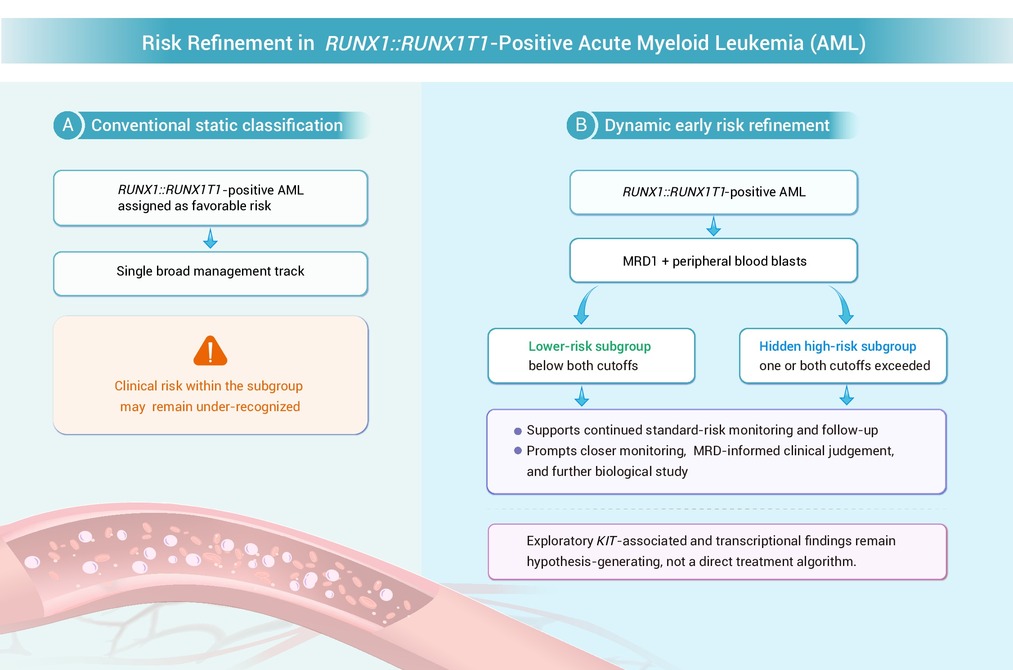
Figure 1.
Risk refinement in RUNX1::RUNX1T1-positive AML
