
From evolutionary selection to the possibility of design: Engineering CAR-T cell states beyond nature
-

-
REFERENCES
[1] Lynn R.C., Weber E.W., Sotillo E., et al. (2019). c-Jun overexpression in CAR T cells induces exhaustion resistance. Nature 576:293−300. DOI:10.1038/s41586-019-1805-z [2] Spigel D.R., Hamilton E., Bashir B., et al. (2023). 754 Phase 1 trial of LYL797, a ROR1-targeted CAR T-cell therapy enhanced with genetic and epigenetic reprogramming, in advanced triple-negative breast cancer (TNBC) and non-small cell lung cancer (NSCLC). J. Immunother. Cancer 11(Suppl 1):A1–A1731. DOI:10.1136/jitc-2023-SITC2023.0754 [3] Takacsi-Nagy O., Kasinathan S., Hartman A., et al. (2026). Synthetic transcription factors designed by domain recombination enhance CAR T cell antitumor function. Cell 189:6024-6043.e10. DOI:10.1016/j.cell.2026.07.054 [4] Chen Z., Zhu Z., Hu T., et al. (2026). Regulation of T cell exhaustion and stemness: Molecular mechanisms and implications for cancer immunotherapy. Cell. Mol. Immunol. 23:1−14. DOI:10.1038/s41423-025-01378-4 -
ABOUT THIS ARTICLE
Cite this article:
Leng X. and Hu T. (2026). From evolutionary selection to the possibility of design: Engineering CAR-T cell states beyond nature. The Innovation Oncology 1:100033. https://doi.org/10.59717/j.xinn-oncol.2026.100033
Welcome!
To request copyright permission to republish or share portions of our works, please visit Copyright Clearance Center's (CCC) Marketplace website at marketplace.copyright.com.
Export File
Citation
Leng X. and Hu T. (2026). From evolutionary selection to the possibility of design: Engineering CAR-T cell states beyond nature. The Innovation Oncology 1:100033. https://doi.org/10.59717/j.xinn-oncol.2026.100033

Format
Content
 DownLoad:
-
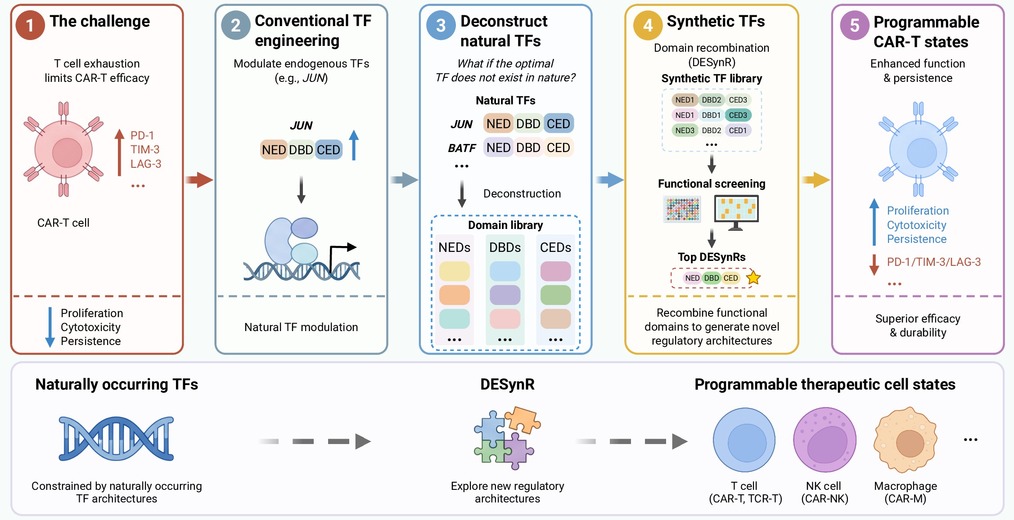
Figure 1.
From natural transcription factor engineering to programmable therapeutic cell states
