
From stromal barrier to immune anchor: A translational view of FAP×CD3 engagement with OMTX305
-

-
REFERENCES
[1] Thiel J., Schlegel J.A., Liang C., et al. (2026). The FAP × CD3 bispecific antibody OMTX305 induces T cell-mediated antitumor effects in patient-derived ex vivo models of solid tumors. Sci. Adv. 12:eaee2124. DOI:10.1126/sciadv.aee2124 [2] Klein C., Brinkmann U., Reichert J.M., et al. (2024). The present and future of bispecific antibodies for cancer therapy. Nat. Rev. Drug Discov. 23:301−319. DOI:10.1038/s41573-024-00896-6 [3] Grout J.A., Sirven P., Leader A.M., et al. (2022). Spatial positioning and matrix programs of cancer-associated fibroblasts promote T-cell exclusion in human lung tumors. Cancer Discov. 12:2606−2625. DOI:10.1158/2159-8290.CD-21-1714 [4] Feng Z., Liu S., Wu Y., et al. (2026). 68Gallium-labelled FAP-inhibitors outperforms 18F-fluorodeoxyglucose PET/CT for recurrent ovarian cancer in the poly adenosine diphosphate-ribose polymerase inhibitor era. Chin. Med. J. Published online March 11:2026. DOI:10.1097/CM9.0000000000003976 [5] Melero I., Tanos T., Bustamante M., et al. (2023). A first-in-human study of the fibroblast activation protein-targeted, 4-1BB agonist RO7122290 in patients with advanced solid tumors. Sci. Transl. Med. 15:eabp9229. DOI:10.1126/scitranslmed.abp9229 -
ABOUT THIS ARTICLE
Cite this article:
Wu Y., Liu S., Feng Z., et al. (2026). From stromal barrier to immune anchor: A translational view of FAP×CD3 engagement with OMTX305. The Innovation Oncology 1:100035. https://doi.org/10.59717/j.xinn-oncol.2026.100035
Welcome!
To request copyright permission to republish or share portions of our works, please visit Copyright Clearance Center's (CCC) Marketplace website at marketplace.copyright.com.
Export File
Citation
Wu Y., Liu S., Feng Z., et al. (2026). From stromal barrier to immune anchor: A translational view of FAP×CD3 engagement with OMTX305. The Innovation Oncology 1:100035. https://doi.org/10.59717/j.xinn-oncol.2026.100035

Format
Content
 DownLoad:
-
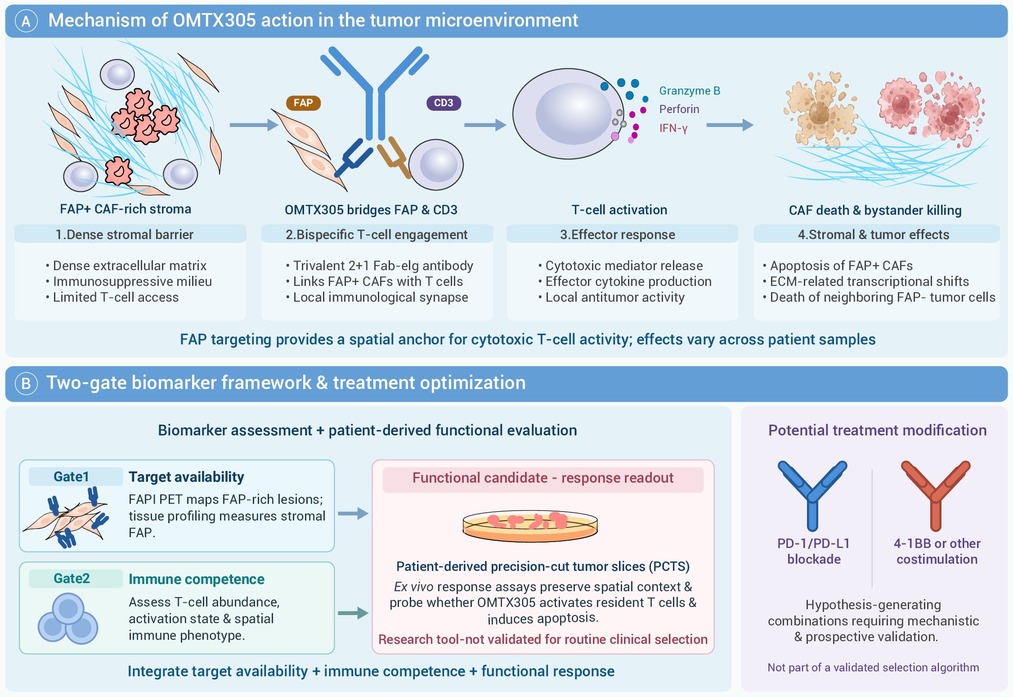
Figure 1.
OMTX305 mechanism and a proposed biomarker-guided framework for FAP×CD3 therapy
