
When tRNA mischarging becomes a metabolic brake on translation
-

-
REFERENCES
[1] Zong Z., Xie F., Wang S., et al. (2024). Alanyl-tRNA synthetase, AARS1, is a lactate sensor and lactyltransferase that lactylates p53 and contributes to tumorigenesis. Cell 187:2375−2392.e33. DOI:10.1016/j.cell.2024.04.002 [2] Wang X., Lin C., Zhang Y., et al. (2026). Excess intracellular lactate represses mRNA translation and tumor progression through lactate-tRNA charging. Mol. Cell 86:3529−3544.e9. DOI:10.1016/j.molcel.2026.07.026 [3] Ju J., Zhang H., Lin M., et al. (2024). The alanyl-tRNA synthetase AARS1 moonlights as a lactyltransferase to promote YAP signaling in gastric cancer. J. Clin. Invest. 134:e174587. DOI:10.1172/jci174587 [4] Pataskar A., Champagne J., Nagel R., et al. (2022). Tryptophan depletion results in tryptophan-to-phenylalanine substitutants. Nature 603:721−727. DOI:10.1038/s41586-022-04499-2 [5] Zhang W., Lahry K., Cipurko D., et al. (2025). Two microbiome metabolites compete for tRNA modification to impact mammalian cell proliferation and translation quality control. Nat. Cell Biol. 27:1812−1826. DOI:10.1038/s41556-025-01750-6 -
ABOUT THIS ARTICLE
Cite this article:
Zhang C., Yu X., Singh S., et al. (2026). When tRNA mischarging becomes a metabolic brake on translation. The Innovation Oncology 1:100039. https://doi.org/10.59717/j.xinn-oncol.2026.100039
Welcome!
To request copyright permission to republish or share portions of our works, please visit Copyright Clearance Center's (CCC) Marketplace website at marketplace.copyright.com.
Export File
Citation
Zhang C., Yu X., Singh S., et al. (2026). When tRNA mischarging becomes a metabolic brake on translation. The Innovation Oncology 1:100039. https://doi.org/10.59717/j.xinn-oncol.2026.100039

Format
Content
 DownLoad:
-
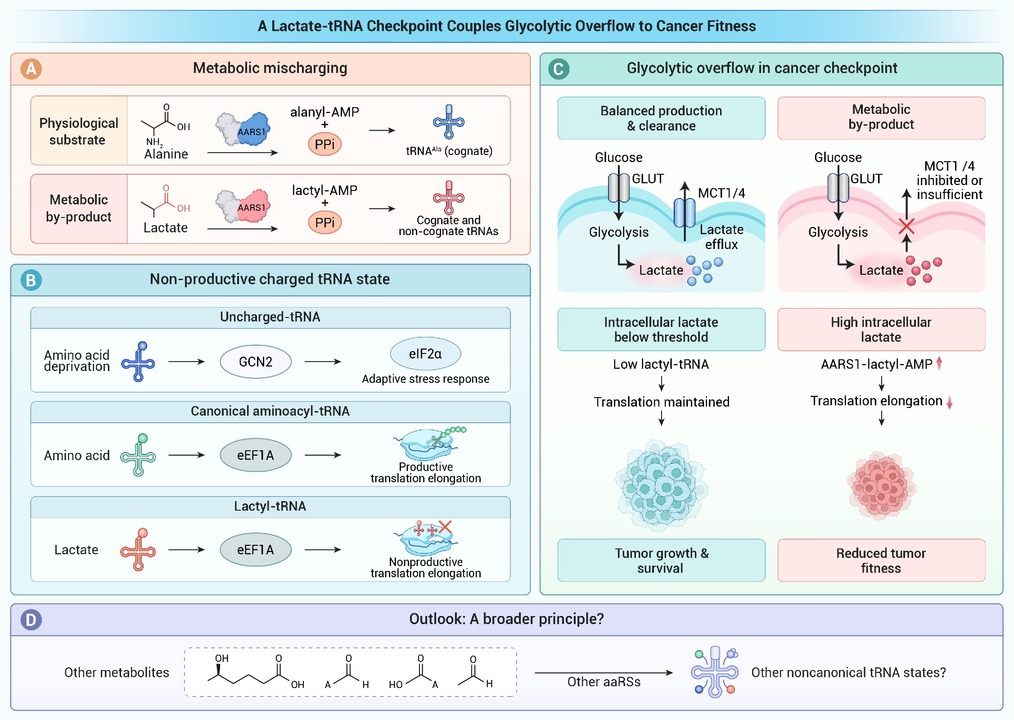
Figure 1.
Lactate-dependent tRNA mischarging links glycolytic overflow to translational control
