
The NLRP3 inflammasome in Parkinson disease: Breaking a self-reinforcing neuroimmune circuit
-

-
REFERENCES
[1] Liu, K., He, Z., Zhang, L. et al. (2026). The NLRP3–α-Synuclein Circuit: A Core Driver and Therapeutic Target in Parkinson's Disease. J. Inflamm. Res. 19:1−17. DOI:10.2147/JIR.S597280 [2] Luque, M., Matic, M., Heras-Garvin, A. et al. (2026). Clinically advanced NLRP3 inhibitor modulates microglial transcriptome and alleviates α-synuclein-induced progression of parkinsonism. J. Neuroinflammation 23:76. DOI:10.1186/s12974-026-03716-3 [3] Huang, P., Zhang, Z., Zhang, P. et al. (2024). TREM2 Deficiency Aggravates NLRP3 Inflammasome Activation and Pyroptosis in MPTP-Induced Parkinson’s Disease Mice and LPS-Induced BV2 Cells. Mol. Neurobiol. 61:2590−2605. DOI:10.1007/s12035-023-03713-0 [4] Miao, Q., Wang, T., Wang, H. et al. (2025). Loss of DJ-1 alleviates microglia-mediated neuroinflammation in Parkinson’s disease via autophagy-lysosomal degradation of NLRP3. Front. Immunol. 16. DOI:10.3389/fimmu.2025.1656729. [5] Abdelaziz, A. M., Rasheed, N. O. A., Zaki, H. F. et al. (2025). Canagliflozin attenuates neurodegeneration and ameliorates dyskinesia through targeting the NLRP3/Nurr1/GSK-3β/SIRT3 pathway and autophagy modulation in rotenone-lesioned rats. Int. Immunopharmacol. 146:113839. DOI:10.1016/j.intimp.2024.113839 -
ABOUT THIS ARTICLE
Cite this article:
An C., Zhong M., Fang Z., et al. (2026). The NLRP3 inflammasome in Parkinson disease: Breaking a self-reinforcing neuroimmune circuit. The Innovation Neurology 1:100012. https://doi.org/10.59717/j.xinn-tine.2026.100012
Welcome!
To request copyright permission to republish or share portions of our works, please visit Copyright Clearance Center's (CCC) Marketplace website at marketplace.copyright.com.
Export File
Citation
An C., Zhong M., Fang Z., et al. (2026). The NLRP3 inflammasome in Parkinson disease: Breaking a self-reinforcing neuroimmune circuit. The Innovation Neurology 1:100012. https://doi.org/10.59717/j.xinn-tine.2026.100012

Format
Content
 DownLoad:
-
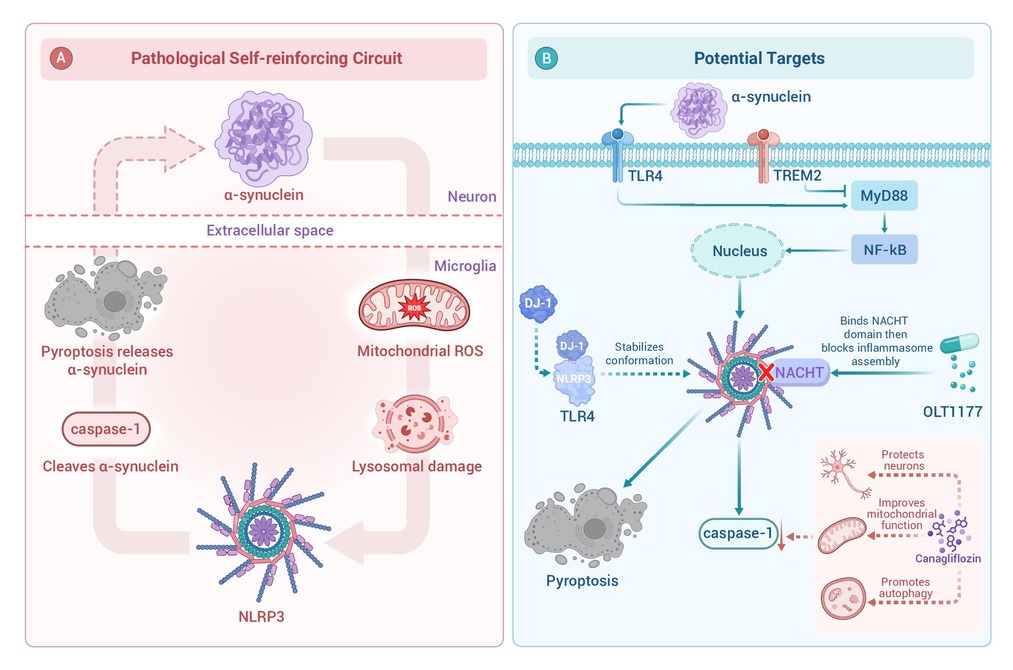
Figure 1.
The NLRP3–α-synuclein self-reinforcing circuit in PD and its therapeutic modulation
