
-

-
REFERENCES
[1] Afzal S., Ali L., Batool A., et al. (2023). Hantavirus: an overview and advancements in therapeutic approaches for infection. Front. Microbiol. 14:1233433. DOI:10.3389/fmicb.2023.1233433 [2] Wang B., Pei J., Zhang H., et al. (2022). Dihydropyridine-derived calcium channel blocker as a promising anti-hantavirus entry inhibitor. Front. Pharmacol. 13:940178. DOI:10.3389/fphar.2022.940178 [3] Mayor J., Engler O. and Rothenberger S. (2021). Antiviral efficacy of ribavirin and favipiravir against Hantaan virus. Microorganisms 9:1306. DOI:10.3390/microorganisms9061306 [4] Chung D. H., Kumarapperuma S. C., Sun Y., et al. (2008). Synthesis of 1-β-D-ribofuranosyl-3-ethynyl-[1,2,4]triazole and its in vitro and in vivo efficacy against Hantavirus. Antiviral Res. 79:19−27. DOI:10.1016/j.antiviral.2008.02.003 [5] Ye C., Wang D., Liu H., et al. (2019). An improved enzyme-linked focus formation assay revealed baloxavir acid as a potential antiviral therapeutic against Hantavirus infection. Front. Pharmacol. 10:1203. DOI:10.3389/fphar.2019.01203 [6] Xing Y., Zhao Y., Luo L., et al. (2026). Direct targeting of the nucleocapsid protein by morin inhibits Hantaan virus infection. Biochem. Biophys. Res. Commun. 795:153081. DOI:10.1016/j.bbrc.2025.153081 [7] Gorbunova E. E., Gavrilovskaya I. N., Pepini T., et al. (2011). VEGFR2 and Src kinase inhibitors suppress Andes virus-induced endothelial cell permeability. J. Virol. 85:2296−2303. DOI:10.1128/JVI.02319-10 [8] Bird B. H., Shrivastava-Ranjan P., Dodd K. A., et al. (2016). Effect of vandetanib on Andes virus survival in the hamster model of Hantavirus pulmonary syndrome. Antiviral Res. 132:66−69. DOI:10.1016/j.antiviral.2016.05.014 [9] Dang Y., Wang Y., Wei J., et al. (2024). 25-Hydroxycholesterol inhibits Hantavirus infection by reprogramming cholesterol metabolism. Free Radic. Biol. Med. 224:232−245. DOI:10.1016/j.freeradbiomed.2024.08.029 [10] Garrido J. L., Prescott J., Calvo M., et al. (2018). Two recombinant human monoclonal antibodies that protect against lethal Andes hantavirus infection in vivo. Sci. Transl. Med. 10:eaat6420. DOI:10.1126/scitranslmed.aat6420 -
ABOUT THIS ARTICLE
Cite this article:
Du S., Hu X., Li J., et al. (2026). Strategies for developing anti-Hantavirus drugs. The Innovation Drug Discovery 1:100035. https://doi.org/10.59717/j.xinn-drugdisc.2026.100035
Welcome!
To request copyright permission to republish or share portions of our works, please visit Copyright Clearance Center's (CCC) Marketplace website at marketplace.copyright.com.
Export File
Citation
Du S., Hu X., Li J., et al. (2026). Strategies for developing anti-Hantavirus drugs. The Innovation Drug Discovery 1:100035. https://doi.org/10.59717/j.xinn-drugdisc.2026.100035

Format
Content
 DownLoad:
-
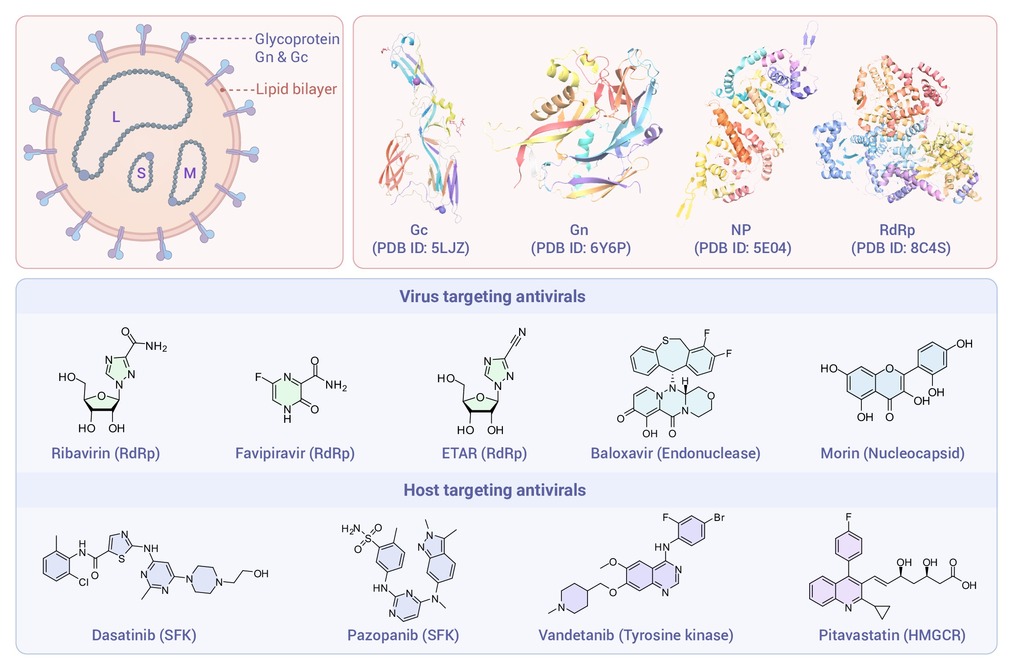
Figure 1.
Hantavirus structure and crystal structure of a potential drug target, along with corresponding therapeutic agents.
