
Equivalence of Inverter Air Conditioners as Virtual Synchronous Generators for Enhancing Power System Inertia and Frequency Stability
-
GRAPHICAL ABSTRACT
 DownLoad:
Full size image
DownLoad:
Full size image
-
PUBLIC SUMMARY
-
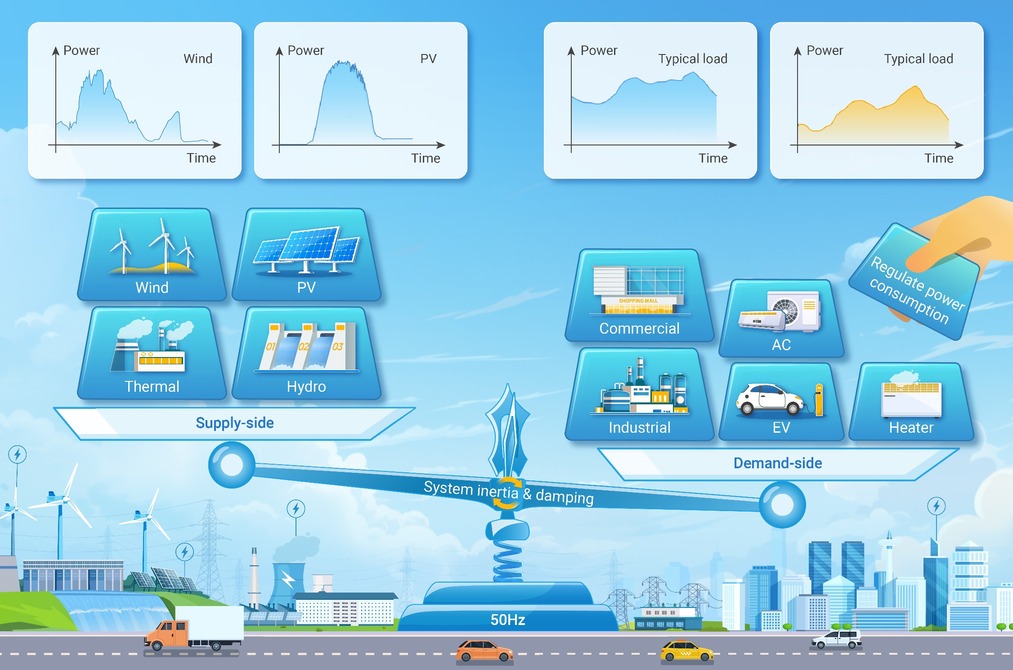
Proposes controlling inverter air conditioners (IACs) as virtual synchronous generators (VSGs) to enhance power system frequency stability.
A control scheme that ensures IACs provide inertia and damping while maintaining comfortable temperature limits.
A dynamic evaluation method and flexible parameter configuration for IAC-VSG controllers, validated by numerical studies.
-
-
ABSTRACT
The increasing penetration of renewable energies is decreasing modern power systems’ inertia and damping rapidly, which threatens the safe and stable operation of the power system. Considering inverter air conditioners (IACs) account for more than 30% of the total power consumption and have huge regulation potential, this paper proposes to control IACs as virtual synchronous generators (VSGs), named IAC-VSG resources, to provide additional inertia and damping for frequency stability enhancement.A simple but widely adaptable control scheme for general IACs supporting frequency response is developed by modifying the active power reference. The modified IACs can not only provide inertia and damping as VSGs do, but also remain user-friendly by maintaining comfortable temperature limits in the control model. To quantify the dynamic performance of the power system after integrating IAC-VSGs, a dynamic evaluation method is proposed via the closed-loop transfer function in the complex frequency domain, including the resonant frequency, peak value, and 2-norm.On this basis, a parameter configuration method for IAC-VSG controllers is designed to flexibly adjust the equivalent inertia and damping ratios according to different power system requirements. Finally, numerical studies verify the effectiveness of the proposed methods. -

-
REFERENCES
[1] Zhou, Q., Li, Z., Wu, Q., & Shahidehpour, M. (2019). Two-stage load shedding for secondary control in hierarchical operation of islanded microgrids. IEEE Trans. Smart Grid, 10(3):3103−3111. DOI:10.1109/TSG.2018.2879741 [2] Shi, Q., Li, F., Kuruganti, T., Olama, M. M., Dong, J., Wang, X., & Winstead, C. (2021). Resilience-oriented DG siting and sizing considering stochastic scenario reduction. IEEE Trans. Power Syst., 36(4):3715−3727. DOI:10.1109/TPWRS.2021.3070229 [3] Jiang, T., Sun, T., Liu, G., Li, X., Zhang, R., & Li, F. (2022). Resilience evaluation and enhancement for island city integrated energy systems. IEEE Trans. Smart Grid, Early Access. DOI: 10.1109/TSG.2022.3150804. [4] Zhou, Q., Shahidehpour, M., Li, Z., & Xu, X. (2019). Two-layer control scheme for maintaining the frequency and the optimal economic operation of hybrid AC/DC microgrids. IEEE Trans. Power Syst., 34(1):64−75. DOI:10.1109/TPWRS.2018.2886871 [5] Mir, A. S., & Senroy, N. (2020). Self-tuning neural predictive control scheme for ultrabattery to emulate a virtual synchronous machine in autonomous power systems. IEEE Trans. Neural Netw. Learn. Syst., 31(1):136−147. DOI:10.1109/TNNLS.2019.2900369 [6] Chen, T., Zhang, B., Pourbabak, H., Kavousi-Fard, A., & Su, W. (2018). Optimal routing and charging of an electric vehicle fleet for high-efficiency dynamic transit systems. IEEE Trans. Smart Grid, 9(4):3563−3572. DOI:10.1109/TSG.2017.2708499 [7] Zhang, X., Pipattanasomporn, M., Chen, T., & Rahman, S. (2020). An IoT-based thermal model learning framework for smart buildings. IEEE Internet Things J., 7(1):518−527. DOI:10.1109/JIOT.2019.2921389 [8] Siano, P., & Sarno, D. (2016). Assessing the benefits of residential demand response in a real-time distribution energy market. Appl. Energy, 161:533−551. DOI:10.1016/j.apenergy.2015.08.019 [9] Shao, C., Ding, Y., Siano, P., & Lin, Z. (2019). A framework for incorporating demand response of smart buildings into the integrated heat and electricity energy system. IEEE Trans. Ind. Electron., 66(2):1465−1475. DOI:10.1109/TIE.2018.2834674 [10] Chen, G., Zhang, H., Hui, H., & Song, Y. (2021). Fast Wasserstein-distance-based distributionally robust chance-constrained power dispatch for multi-zone HVAC systems. IEEE Trans. Smart Grid, 12(5):4016−4028. DOI:10.1109/TSG.2021.3062303 [11] Lu, N. (2012). An evaluation of the HVAC load potential for providing load balancing service. IEEE Trans. Smart Grid, 3(3):1263−1270. DOI:10.1109/TSG.2012.2193230 [12] Chen, T., Cui, Q., Gao, C., Hu, Q., Lai, K., Yang, J., Lyu, R., Zhang, H., & Zhang, J. (2021). Optimal demand response strategy of commercial building-based virtual power plant using reinforcement learning. IET Gener. Transm. Distrib., April 2021. [13] Song, M., Gao, C., Yan, H., & Yang, J. (2018). Thermal battery modeling of inverter air conditioning for demand response. IEEE Trans. Smart Grid, 9(6):5522−5534. DOI:10.1109/TSG.2018.2797791 [14] Hong, J., Hui, H., Zhang, H., Dai, N., & Song, Y. (2022). Distributed control of large-scale inverter air conditioners for providing operating reserve based on consensus with nonlinear protocol. IEEE Internet Things J., Early Access, February 2022. [15] Hui, H., Ding, Y., & Zheng, M. (2018). Equivalent modeling of inverter air conditioners for providing frequency regulation service. IEEE Trans. Ind. Electron., 66(2):1413−1423. DOI:10.1109/TIE.2018.2822333 [16] Song, M., Sun, W., Shahidehpour, M., Yan, M., & Gao, C. (2021). Multi-time scale coordinated control and scheduling of inverter-based TCLs with variable wind generation. IEEE Trans. Sustain. Energy, 12(1):46−57. DOI:10.1109/TSTE.2020.2996974 [17] Zhang, X., Biagioni, D., Cai, M., Graf, P., & Rahman, S. (2021). An edge-cloud integrated solution for buildings demand response using reinforcement learning. IEEE Trans. Smart Grid, 12(1):420−431. DOI:10.1109/TSG.2021.3033140 [18] Kim, Y. (2018). Optimal price based demand response of HVAC systems in multizone office buildings considering thermal preferences of individual occupants. IEEE Trans. Ind. Informat., 14(11):5060−5073. DOI:10.1109/TII.2020.3033045 [19] Shi, Q., Chen, C., Mammoli, A., & Li, F. (2020). Estimating the profile of incentive-based demand response (IBDR) by integrating technical models and social-behavioral factors. IEEE Trans. Smart Grid, 11(1):171−183. DOI:10.1109/TSG.2020.2971345 [20] Jiang, T., Wu, C., Zhang, R., Li, X., Chen, H., & Li, G. (2022). Flexibility clearing in joint energy and flexibility markets considering TSO-DSO coordination. IEEE Trans. Smart Grid, Early Access, February 2022. [21] Hui, H., Ding, Y., Chen, T., Rahman, S., & Song, Y. (2021). Dynamic and stability analysis of the power system with the control loop of inverter air conditioners. IEEE Trans. Ind. Electron., 68(3):2725−2736. DOI:10.1109/TIE.2020.2972082 [22] Zhong, Q. (2016). Virtual synchronous machines: A unified interface for grid integration. IEEE Power Electron. Mag., 3(4):18−27. DOI:10.1109/MPEL.2016.2608285 [23] Othman, M. H., Mokhlis, H., Mubin, M., Talpur, S., Ab Aziz, N. F., Dradi, M., & Mohamad, H. (2020). Progress in control and coordination of energy storage system-based VSG: A review. IET Renew. Power Gener., 14(2):177−187. DOI:10.1049/rpg2.12067 [24] Bevrani, H., Ise, T., & Miura, Y. (2014). Virtual synchronous generators: A survey and new perspectives. Int. J. Electr. Power Energy Syst., 54:244−254. DOI:10.1016/j.ijepes.2013.07.016 [25] Zhang, J., & Xu, H. (2017). Online identification of power system equivalent inertia constant. IEEE Trans. Ind. Electron., 64(10):8098−8107. DOI:10.1109/TIE.2017.2754060 [26] Chen, M., Zhou, D., & Blaabjerg, F. (2020). Modelling, implementation, and assessment of virtual synchronous generator in power systems. J. Mod. Power Syst. Clean Energy, 8(3):399−411. DOI:10.1007/s40565-019-00443-3 [27] Zhang, W., & Yan, X. (2020). Equivalence analysis of virtual synchronous machines and frequency-droops for inertia emulation in power systems with converter-interfaced renewables. J. Electr. Eng. Technol., 15(3):1167−1175. DOI:10.5370/JEET.2020.15.3.1167 [28] Wang, Y., Chen, Q., Hong, T., & Kang, C. (2019). Review of smart meter data analytics: Applications, methodologies, and challenges. IEEE Trans. Smart Grid, 10(3):3125−3148. DOI:10.1109/TSG.2018.2856510 [29] Wang, J., Huang, S., Wu, D., & Lu, N. (2021). Operating a commercial building HVAC load as a virtual battery through airflow control. IEEE Trans. Sustain. Energy, 12(1):158−168. DOI:10.1109/TSTE.2020.2997773 [30] Skogestad, S., & Postlethwaite, I. (2007). Multivariable feedback control: Analysis and design. New York, NY, USA: Wiley. [31] R., V., P., R., & M.P., S. (2018). A modified active power control scheme for enhanced operation of PMSG-based WGs. IEEE Trans. Sustain. Energy, 9(2):630−638. DOI:10.1109/TSTE.2017.2784526 [32] Mir, A. S., & Senroy, N. (2019). Intelligently controlled flywheel storage for enhanced dynamic performance. IEEE Trans. Sustain. Energy, 10(4):2163−2173. DOI:10.1109/TSTE.2019.2903039 -
ABOUT THIS ARTICLE
Cite this article:
and Song Y. (2025). Equivalence of Inverter Air Conditioners as Virtual Synchronous Generators for Enhancing Power System Inertia and Frequency Stability. Energy Use 1:100009. https://doi.org/10.59717/ipj.energy-use.2025.100009
Welcome!
To request copyright permission to republish or share portions of our works, please visit Copyright Clearance Center's (CCC) Marketplace website at marketplace.copyright.com.

Article Metrics
Relative Articles
Cited by
Export File
Citation
and Song Y. (2025). Equivalence of Inverter Air Conditioners as Virtual Synchronous Generators for Enhancing Power System Inertia and Frequency Stability. Energy Use 1:100009. https://doi.org/10.59717/ipj.energy-use.2025.100009

Format
Content



-
Figure 1.
The power system model with traditional generating units, renewable energies, and IAC-VSGs.
-
Figure 2.
Bode plots of the power system. (A) Scenarios of different inertia ratios. (B) Scenarios of different damping ratios.
-
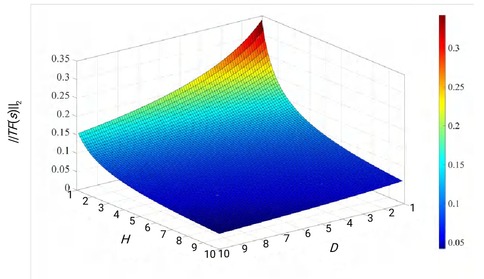
Figure 3.
The 2-norm of the system’s closed-loop transfer function with different damping and inertia ratios.
-
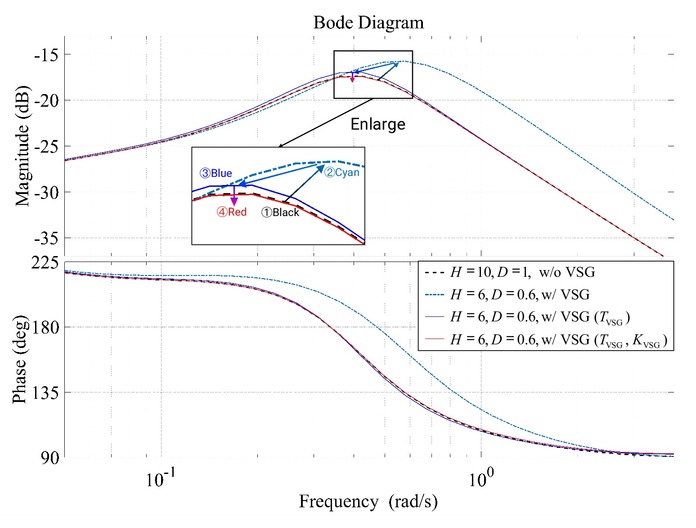
Figure 4.
Bode plots of the power system with IAC-VSGs. (A) Scenarios of different
$ {{T}}_{{\mathrm{VSG}}} $ $ {{K}}_{{\mathrm{VSG}}} $ -
Figure 5.
System frequency deviations under load disturbances
-
Figure 6.
Bode plots of the power system with different inertia ratios.
-
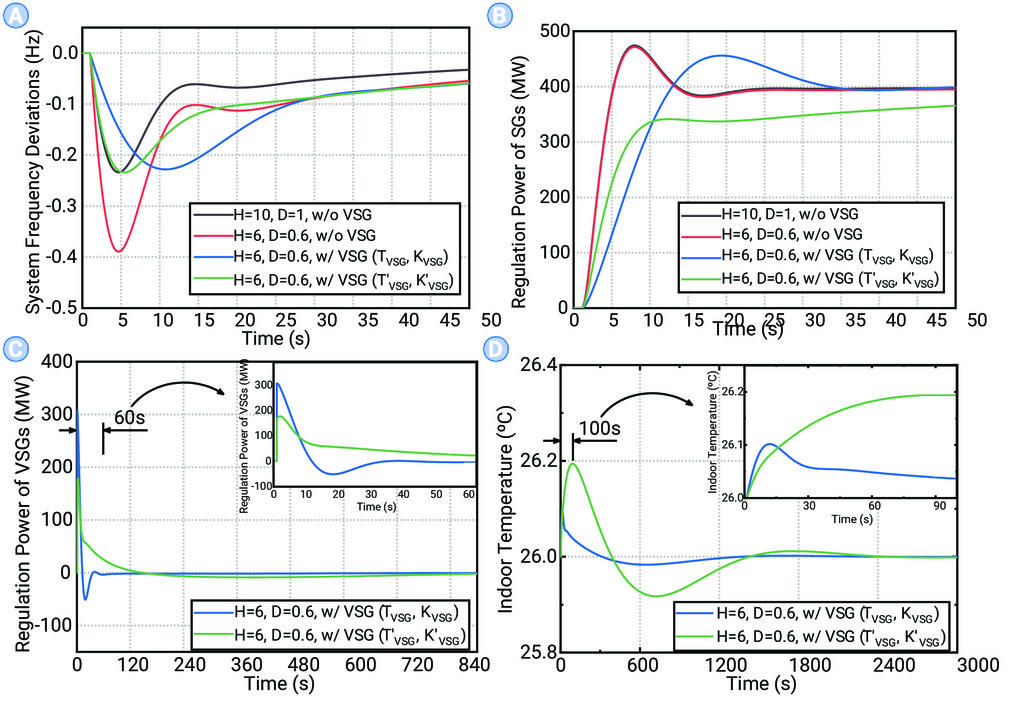
Figure 7.
Regulation process of the power system under load disturbances.