
Next-Generation Large-Scale AI Model for Renewable Power Forecasting Launched by Shenzhen Energy and Huawei
-

-
REFERENCES
[1] Huawei. (2025). Huawei Developer Conference 2025. DOI:developer.huawei.com/home/hdc/hdc2025.html [2] Wang J., Chen L., Tan Z., et al. (2023). Inherent spatiotemporal uncertainty of renewable power in China. Nat. Commun. 14:5379. DOI:10.1038/s41467-023-40670-7 [3] Bi K., Xie L., Zhang H., et al. (2023). Accurate medium-range global weather forecasting with 3D neural networks. Nature 619:533−8. DOI:10.1038/s41586-023-06185-3 [4] Li Y., Ding Y., He S., et al. (2024). Artificial intelligence-based methods for renewable power system operation. Nat. Rev. Electr. Eng. 1:163−179. DOI:10.1038/s44287-024-00018-9 [5] Zhang Y., Shen J., Li J., et al. (2024). A new lightweight framework based on knowledge distillation for reducing the complexity of multi-modal solar irradiance prediction model. J. Clean. Prod. 475:143663. DOI:10.1016/j.jclepro.2024.143663 -
ABOUT THIS ARTICLE
Cite this article:
Zhang Y., Shen J., Li J., et al. (2025). Next-Generation Large-Scale AI Model for Renewable Power Forecasting Launched by Shenzhen Energy and Huawei. Energy Use 1:100013. https://doi.org/10.59717/ipj.energy-use.2025.100013
Welcome!
To request copyright permission to republish or share portions of our works, please visit Copyright Clearance Center's (CCC) Marketplace website at marketplace.copyright.com.
Export File
Citation
Zhang Y., Shen J., Li J., et al. (2025). Next-Generation Large-Scale AI Model for Renewable Power Forecasting Launched by Shenzhen Energy and Huawei. Energy Use 1:100013. https://doi.org/10.59717/ipj.energy-use.2025.100013

Format
Content
 DownLoad:
-
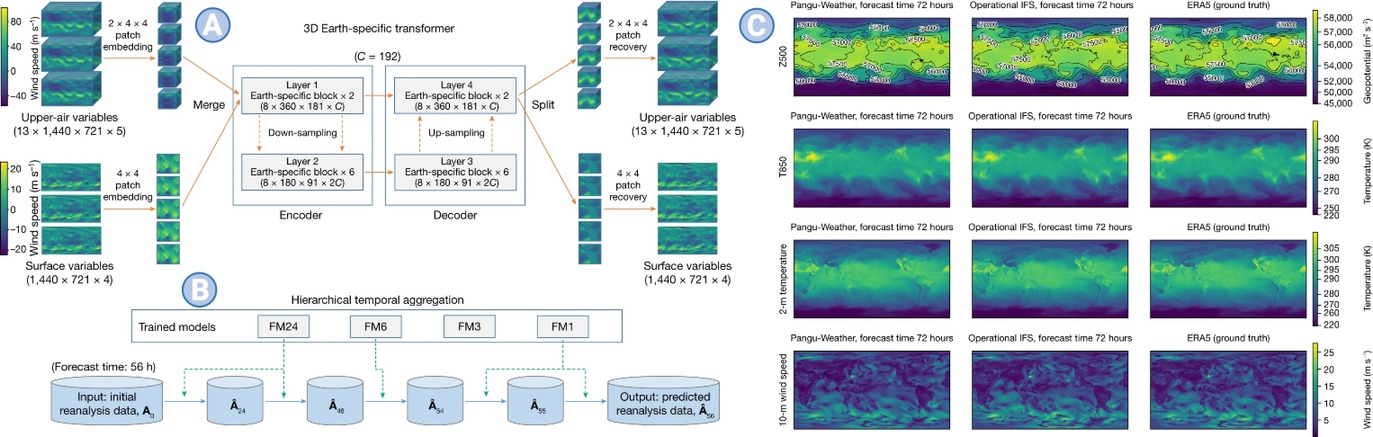
Figure 1.
The Pangu-weather model in renewable power forecasting3