
Can Shifting from Temporary Mitigation to Permanent Removal Accelerate the Urgency of Negative Carbon Goals?
-

-
REFERENCES
[1] 1 Ampah J.D., Jin C., Liu H., et al. (2025). Scaling carbon removal without delaying emission reductions. Nat. Rev. Clean Tech. 1:599-601. DOI:10.1038/s44359-025-00081-x [2] Nature. (2016). Negative carbon emissions needed. Nature 535:11-11, DOI:10.1038/535011e [3] Deng Z., Zhu B., Davis S., et al. (2025). Global carbon emissions and decarbonization in 2024. Nat. Rev. Earth Environ. 6:231−233. DOI:10.1038/s43017-025-00658-x [4] Weng Z., Van Zwieten L., Singh B., et al. (2017). Biochar built soil carbon over a decade by stabilizing rhizodeposits. Nat. Clim. Change 7:371−376. DOI:10.1038/nclimate3276 [5] Migliavacca M., Grassi G., Bastos A., et al. (2025). Securing the forest carbon sink for the European Union’s climate ambition. Nature 643:1203−1213. DOI:10.1038/s41586-025-08967-3 -
ABOUT THIS ARTICLE
Cite this article:
Yang J., Jin C., Ampah J. D., et al. (2025). Can Shifting from Temporary Mitigation to Permanent Removal Accelerate the Urgency of Negative Carbon Goals? Energy Use 1:100025. https://doi.org/10.59717/ipj.energy-use.2025.100025
Welcome!
To request copyright permission to republish or share portions of our works, please visit Copyright Clearance Center's (CCC) Marketplace website at marketplace.copyright.com.
Export File
Citation
Yang J., Jin C., Ampah J. D., et al. (2025). Can Shifting from Temporary Mitigation to Permanent Removal Accelerate the Urgency of Negative Carbon Goals? Energy Use 1:100025. https://doi.org/10.59717/ipj.energy-use.2025.100025

Format
Content
 DownLoad:
-
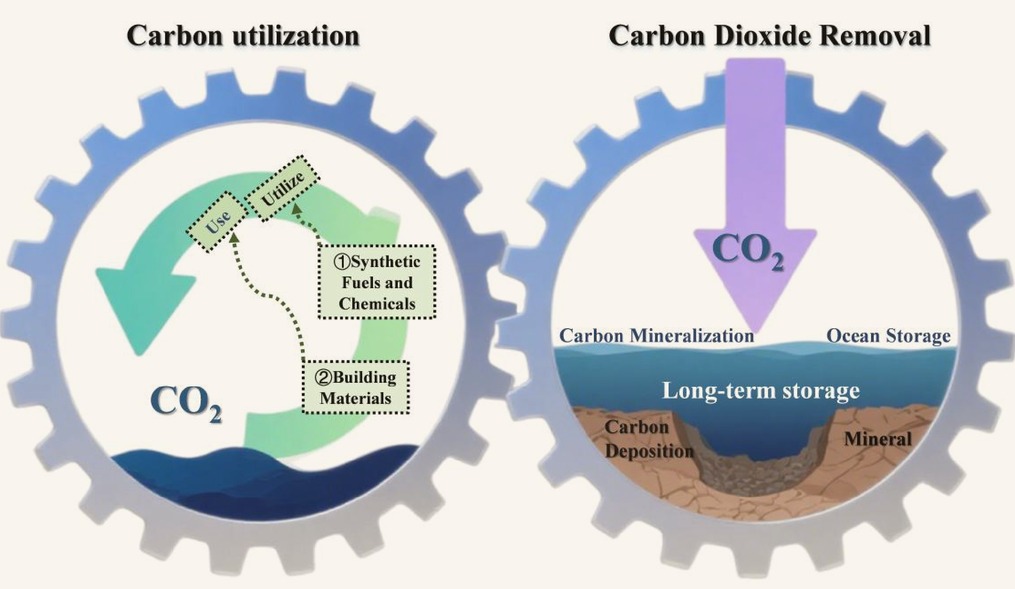
Figure 1.
Synergistic carbon utilization and removal achieve net negative carbon targets through carbon capture and conversion technologies and permanent sequestration pathways.