
Thermodynamics-Grounded AI-Collaboration Trend in Systematically Exploring Models and Interpretably Predicting Thermophysical Properties for Working Fluids
-

-
REFERENCES
[1] Jirasek F. and Hasse H. (2023). Combining Machine Learning with Physical Knowledge in Thermodynamic Modeling of Fluid Mixtures. Annu. Rev. Chem. Biomol. Eng. 14:31−51. DOI:10.1146/annurev-chembioeng-092220-025342 [2] Xu Y., Shao Z., Liu X., et al. (2026). AI for science: Progress, challenges, and perspectives. The Innovation 101530 (in press). DOI: 10.1016/j.xinn.2026.101530 [3] Liu Y., Hong W., and Cao B. (2019). Machine learning for predicting thermodynamic properties of pure fluids and their mixtures. Energy 188:116091. DOI:10.1016/j.energy.2019.116091 [4] He Y., Feng Y., Qiu L., et al. (2024). Data-driven approach augmented by attention mechanism in critical and boiling thermophysical properties prediction of fluorine/chlorine-based refrigerants. Energy 306:132490. DOI:10.1016/j.energy.2024.132490 [5] Chaparro G. and Müller E.A. (2024). Development of a Helmholtz free energy equation of state for fluid and solid phases via artificial neural networks. Commun. Phys. 7:406. DOI:10.1038/s42005-024-01892-3 [6] Wang X., Li Y., Yan Y., et al. (2020). Prediction on the viscosity and thermal conductivity of HFC/HFO refrigerants with artificial neural network models. Int. J. Refrig. 119:316−325. DOI:10.1016/j.ijrefrig.2020.07.006 [7] Alkhatib I.I.I., Albà C.G., Darwish A.S., et al. (2022). Searching for Sustainable Refrigerants by Bridging Molecular Modeling with Machine Learning. Ind. Eng. Chem. Res. 61:7414−7429. DOI:10.1021/acs.iecr.2c00719 [8] Peng X., Qing K., Tan Y., et al. (2026). A physically interpretable machine-learning method in efficiently and explicitly exploring predictive thermodynamic models for mixture working fluids. Energy 342:139577. DOI:10.1016/j.energy.2025.139577 [9] McLinden M.O., Brown J.S., Brignoli R., et al. (2017). Limited options for low-global-warming-potential refrigerants. Nat. Commun. 8:14476. DOI:10.1038/ncomms14476 [10] Yan Y., Yang F., Zhang H., et al. (2023). Study on performance evaluation framework and design/ selection guidelines of working fluids for subcritical organic Rankine cycle from molecular structure perspective. Energy 282:128582. DOI:10.1016/j.energy.2023.128582 -
ABOUT THIS ARTICLE
Cite this article:
Peng X., Jin Y., Li J., et al. (2026). Thermodynamics-Grounded AI-Collaboration Trend in Systematically Exploring Models and Interpretably Predicting Thermophysical Properties for Working Fluids. Energy Use 2:100073. https://doi.org/10.59717/ipj.energy-use.2026.100073
Welcome!
To request copyright permission to republish or share portions of our works, please visit Copyright Clearance Center's (CCC) Marketplace website at marketplace.copyright.com.
Export File
Citation
Peng X., Jin Y., Li J., et al. (2026). Thermodynamics-Grounded AI-Collaboration Trend in Systematically Exploring Models and Interpretably Predicting Thermophysical Properties for Working Fluids. Energy Use 2:100073. https://doi.org/10.59717/ipj.energy-use.2026.100073

Format
Content
 DownLoad:
-
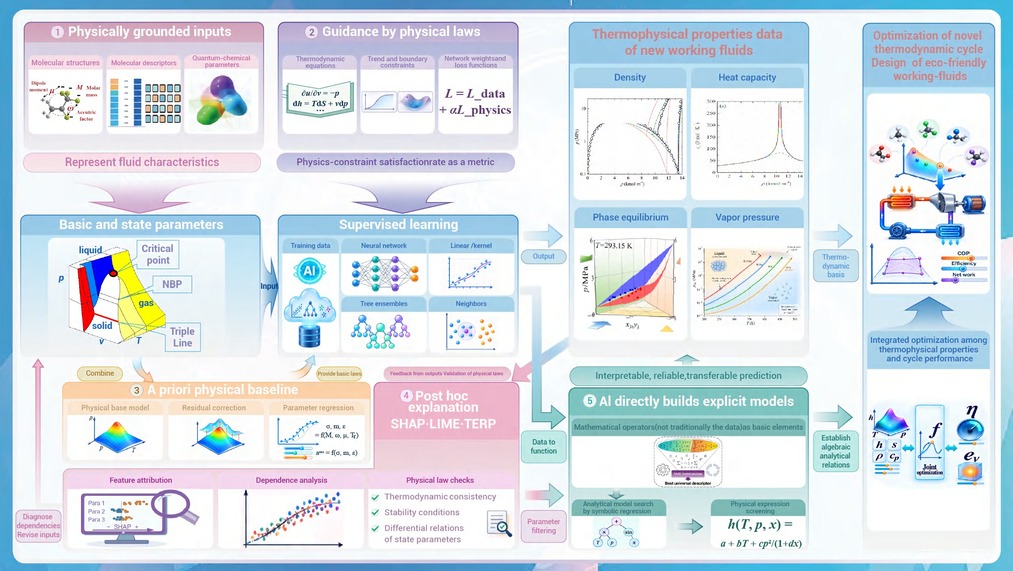
Figure 1.
Physically interpretable machine learning methods in thermophysical property modeling of working fluids in energy utilization systems