
Nanoconfined ion transport: Common foundations driving innovative theories and transformative applications
-

-
REFERENCES
[1] Li Z.W., Misra R.P., Li Y.H., et al. (2023). Breakdown of the Nernst-Einstein relation in carbon nanotube porins. Nat. Nanotechnol. 18:177−183. DOI:10.1038/s41565-022-01276-0 [2] Kingsbury R.S., Baird M.A., Zhang J.W., et al. (2024). Kinetic barrier networks reveal rate limitations in ion-selective membranes. Matter 7:2161−2183. DOI:10.1016/j.matt.2024.03.021 [3] Chen L., Shi G.S., Shen J., et al. (2017). Ion sieving in graphene oxide membranes via cationic control of interlayer spacing. Nature 550:415−418. DOI:10.1038/nature24044 [4] Liu Q., Wang Q., Qu Z.G., et al. (2023). Interfacial binding rope theory of ion transport in sub-nanochannels and its application for osmotic energy conversion. Nano Energy 113:108545. DOI:10.1016/j.nanoen.2023.108545 [5] Chen W.S., Gu J.J., Liu Q.L., et al. (2022). Two-dimensional quantum-sheet films with sub-1.2 nm channels for ultrahigh-rate electrochemical capacitance. Nat. Nanotechnol. 17:153–158. DOI:10.1038/s41565-021-01020-0. -
ABOUT THIS ARTICLE
Cite this article:
Wang Q. and Qu Z. (2025). Nanoconfined ion transport: Common foundations driving innovative theories and transformative applications. The Innovation Energy 2:100075. https://doi.org/10.59717/j.xinn-energy.2024.100075
Welcome!
To request copyright permission to republish or share portions of our works, please visit Copyright Clearance Center's (CCC) Marketplace website at marketplace.copyright.com.
Export File
Citation
Wang Q. and Qu Z. (2025). Nanoconfined ion transport: Common foundations driving innovative theories and transformative applications. The Innovation Energy 2:100075. https://doi.org/10.59717/j.xinn-energy.2024.100075

Format
Content
 DownLoad:
-
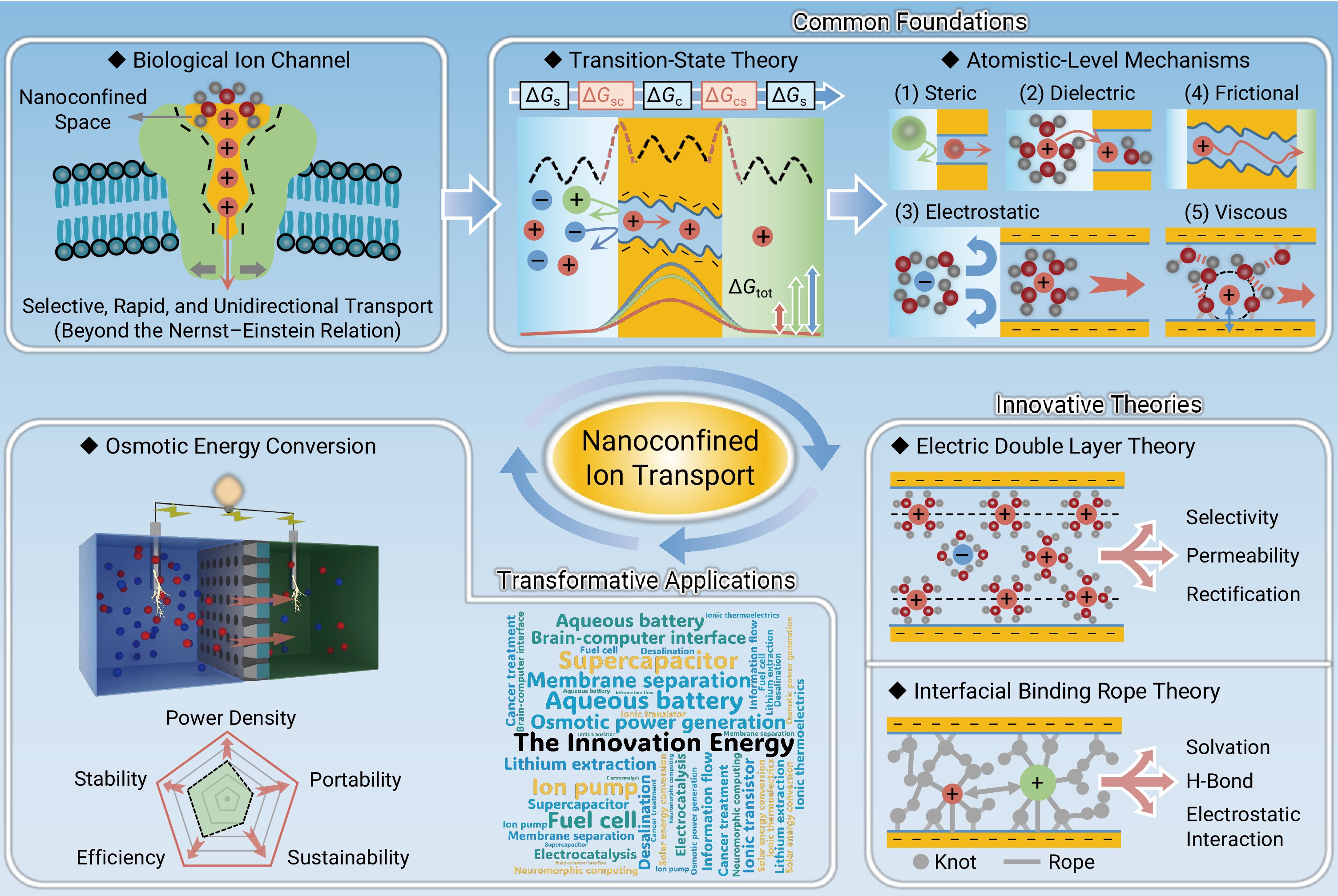
Figure 1.
Common foundations, innovative theories, and transformative applications of nanoconfined ion transport.
