
Day-Night energy harvesting: Photovoltaics-driven moisture evaporation and absorption for simultaneous 24-hour power and dehumidification
-
GRAPHICAL ABSTRACT
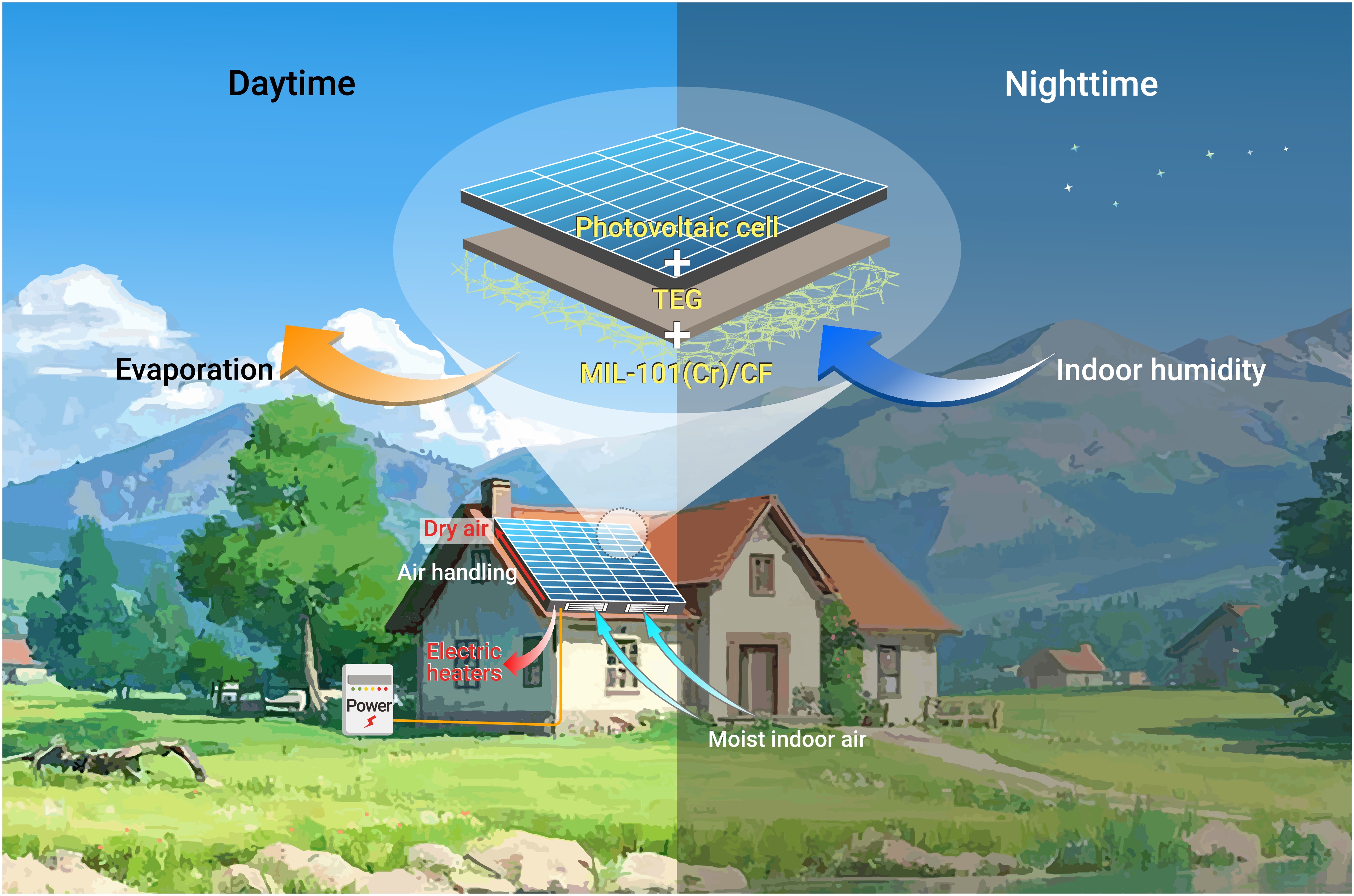
 DownLoad:
Full size image
DownLoad:
Full size image
-
PUBLIC SUMMARY
-
Hybrid system enhances PV efficiency by 23% and thermoelectric efficiency by 353%.
Reduces relative humidity from 79.12% to 63.34% in 4 hours.
Generates 1.08×10⁴ to 1.69×10⁴ kW annually, saving up to 498 kW in air-conditioning energy.
-
-
ABSTRACT
Building sector is a significant contributor to global carbon emission, primarily driven by electricity consumption and air-conditioning demands. A sustainable pathway toward building decarbonization involves harnessing solar energy to simultaneously generate electricity and address indoor humidity control. In this work, we present an innovative hybrid system that integrates photovoltaic cells, thermoelectric generators, and metal-organic frameworks to enable all-day power generation and efficient air dehumidification. This system leverages the synergy between moisture-induced adsorption/desorption heat from MOFs and the harvesting of solar heat and radiative cooling from PV cells. Notably, the synergistic effects significantly enhanced the PV efficiency of the photovoltaic cell by 23% due to the intensified heat exchange during moisture desorption, and increased the average thermoelectric efficiency by 353%. Additionally, it effectively reduced the air relative humidity from an average of 79.12% to 63.34% within 4 hours. We further demonstrate the application of this hybrid system on building roofs, achieving maximum power densities of 88 W·m-2 during the day and 2.12 W·m-2 at night in Nanjing, respectively. Across various cities in China, the system shows the annual power generated ranges from 1.08×10⁴ to 1.69×10⁴ kW, along with air-conditioning energy savings between 29 and 498 kW. This novel approach provides a low-energy and sustainable solution for continuous power generation and air dehumidification, supporting the decarbonization of buildings.
-

-
REFERENCES
[1] Ballif C., Perret-Aebi L. E., Lufkin S., et al. (2018). Integrated thinking for photovoltaics in buildings. Nat. Energy. 3:438−442. DOI:10.1038/s41560-018-0176-2 [2] González-Torres M., Pérez-Lombard L., Coronel J. F., et al. (2022). A review on buildings energy information: Trends, end-uses, fuels and drivers. Energy. Rep. 8:626−637. DOI:10.1016/j.egyr.2021.11.280 [3] Heer P., Derungs C., Huber B., et al. (2024). Comprehensive energy demand and usage data for building automation. Sci. Data. 11. DOI:10.1038/s41597-024-03292-2 [4] Jani D. B., Mishra M. and Sahoo P. K. (2016). Solid desiccant air conditioning - A state of the art review. Renew. Sust. Energ. Rev. 60:1451−1469. DOI:10.1016/j.rser.2016.03.031 [5] Li X. Y., Zhao Q. Q. and Qu D. Q. (2015). Investigation on the dynamic characteristics of a direct contact thermal energy storage charging process for use in conventional air-conditioning systems. Appl. Therm. Eng. 91:172−180. DOI:10.1016/j.applthermaleng.2015.08.005 [6] Harriman L. G., Plager D. and Kosar D. (1997). Dehumidification and cooling loads from ventilation air. Ashrae. J. 39:37. DOI:10.1080/01998595.1999.10530479 [7] Castellano J., Sanz V., Cañas E., et al. (2022). Assessment of humidity self-regulation functionality for ceramic tiles. J. Eur. Ceram. Soc. 42:716−723. DOI:10.1016/j.jeurceramsoc.2021.10.025 [8] Castellano J., Sanz V., Cañas E., et al. Assessment of humidity self-regulation functionality for ceramic tiles. J. Eur. Ceram. Soc. Li M., Nicolas V., Khelifa M., et al. (2019). Modelling the hygrothermal behaviour of cement-bonded wood composite panels as permanent formwork. Ind. Crop. Prod. 142. DOI:10.1016/j.indcrop.2019.111784 [9] Castellano J., Sanz V., Cañas E., et al. Assessment of humidity self-regulation functionality for ceramic tiles. J. Eur. Ceram. Soc. Qin M. G., Hou P. M., Wu Z. M., et al. (2020). Precise humidity control materials for autonomous regulation of indoor moisture. Build. Environ. 169. DOI:10.1016/j.buildenv.2019.106581 [10] Ybyraiymkul D., Chen Q., Burhan M., et al. (2023). Innovative solid desiccant dehumidification using distributed microwaves. Sci. Rep. Uk. 13. DOI:10.1038/s41598-023-34542-9 [11] Ge L. R., Feng Y. H., Wu J. R., et al. (2024). Performance evaluation of MIL-101(Cr) based desiccant-coated heat exchangers for efficient dehumidification. Energy 289. DOI:10.1016/j.energy.2023.130049 [12] Cao B. Y., Tu Y. D. and Wang R. Z. (2019). A Moisture-Penetrating Humidity Pump Directly Powered by One-Sun Illumination. Iscience 15:502. DOI:10.1016/j.isci.2019.05.013 [13] Yan J., Yu Y., Ma C., et al. (2015). Adsorption isotherms and kinetics of water vapor on novel adsorbents MIL-101(Cr)@GO with super-high capacity. Appl. Therm. Eng. 84:118−125. DOI:10.1016/j.applthermaleng.2015.03.040 [14] Hashjin M. A., Zarshad S., Emrooz H. B. M., et al. (2023). Enhanced atmospheric water harvesting efficiency through green-synthesized MOF-801: a comparative study with solvothermal synthesis. Sci. Rep. Uk. 13. DOI:10.1038/s41598-023-44367-1 [15] He Y., Fu T., Wang L. J., et al. (2023). Self-assembly of MOF-801 into robust hierarchically porous monoliths for scale-up atmospheric water harvesting. Chem. Eng. J. 472. DOI:10.1016/j.cej.2023.144786 [16] Cui S. Q., Qin M. H., Marandi A., et al. (2018). Metal-Organic Frameworks as advanced moisture sorbents for energy-efficient high temperature cooling. Sci. Rep. Uk. 8. DOI:10.1038/s41598-018-33704-4 [17] Nayak P. K., Mahesh S., Snaith H. J., et al. (2019). Photovoltaic solar cell technologies: analysing the state of the art. Nat. Rev. Mater. 4:269−285. DOI:10.1038/s41578-019-0097-0 [18] Hayat M. B., Ali D., Monyake K. C., et al. (2019). Solar energy-A look into power generation, challenges, and a solar-powered future. Int. J. Energ Res. 43:1049−1067. DOI:10.1002/er.4252 [19] Huang J. C., Chen X., Yang H. X., et al. (2018). Numerical investigation of a novel vacuum photovoltaic curtain wall and integrated optimization of photovoltaic envelope systems. Appl. Energy 229:1048−1060. DOI:10.1016/j.apenergy.2018.08.095 [20] Tang Y. Y., Ji J., Zhang C. Y., et al. (2024). An advanced exhausting airflow photovoltaic curtain wall system coupled with an air source heat pump for outdoor air treatment: Energy-saving performance assessment. Energy Convers. Manag. 299. DOI:10.1016/j.enconman.2023.117872 [21] Tan Y. T., Peng J. Q., Luo Z. Y., et al. (2023). Multi-function partitioned design method for photovoltaic curtain wall integrated with vacuum glazing towards zero-energy buildings. Renew. Energ. 218. DOI:10.1016/j.renene.2023.119257 [22] Meng Y., Tan Y. T., Li X., et al. (2022). Building-integrated photovoltaic smart window with energy generation and conservation. Appl. Energy 324. DOI:10.1016/j.apenergy.2022.119676 [23] Bing J. M., McKenzie D. R., Stals T., et al. (2023). Perspective Total equivalent energy efficiency metric for building-integrated photovoltaic windows. Joule 7:2668−2683. DOI:10.1016/j.joule.2023.11.010 [24] Liu H. X., He W., Liu X. H., et al. (2023). Building integrated concentrating photovoltaic window coupling luminescent solar concentrator and thermotropic material. Energy 284. DOI:10.1016/j.energy.2023.129237 [25] Joshi S., Mittal S., Holloway P., et al. (2021). High resolution global spatiotemporal assessment of rooftop solar photovoltaics potential for renewable electricity generation. Nat. Commun. 12. DOI:10.1038/s41467-021-25720-2 [26] Chen T. Y., Zhang N., Ye Z. B., et al. (2024). Carbon reduction benefits of photovoltaic-green roofs and their climate change mitigation potential: A case study of Xiamen city. Sustain. Cities Soc. 114. DOI:10.1016/j.scs.2024.105760 [27] Ma Q. L., Zhang Y., Wu G., et al. (2022). Photovoltaic/spectrum performance analysis of a multifunctional solid spectral splitting covering for passive solar greenhouse roof. Energy Convers. Manag. 251. DOI:10.1016/j.enconman.2021.114955 [28] Zhang Z. X., Chen M., Zhong T., et al. (2023). Carbon mitigation potential afforded by rooftop photovoltaic in China. Nat. Commun. 14. DOI:10.1038/s41467-023-38079-3 [29] Libra M., Petrik T., Poulek V., et al. (2021). Changes in the Efficiency of Photovoltaic Energy Conversion in Temperature Range With Extreme Limits. Ieee J Photovolt 11:1479−1484. DOI:10.1109/Jphotov.2021.3108484 [30] Huang G., Xu J. Y. and Markides C. N. (2023). High-efficiency bio-inspired hybrid multi-generation photovoltaic leaf. Nat. Commun. 14. DOI:10.1038/s41467-023-38984-7 [31] Liu J. W., Zhou Y. F., Zhou Z. H., et al. (2024). Passive Photovoltaic Cooling: Advances Toward Low-Temperature Operation. Adv. Energy Mater. 14. DOI:10.1002/aenm.202302662 [32] Bamisile O., Acen C., Cai D. S., et al. (2025). The environmental factors affecting solar photovoltaic output. Renew. Sust. Energy Rev. 208. DOI:10.1016/j.rser.2024.115073 [33] Khan M. A. I., Khan M. I., Kazim A. H., et al. (2021). An Experimental and Comparative Performance Evaluation of a Hybrid Photovoltaic-Thermoelectric System. Front. Energy Res. 9. DOI:10.3389/fenrg.2021.722514 [34] Yang B., Wu S. C., Huang J. X., et al. (2023). Salp swarm optimization algorithm based MPPT design for PV-TEG hybrid system under partial shading conditions. Energy Convers. Manag. 292. DOI:10.1016/j.enconman.2023.117410 [35] Xu L., Luo K., Ji J., et al. (2020). Study of a hybrid BIPV/T solar wall system. Energy 193:116578. DOI:https://doi.org/10.1016/j.energy.2019.116578 [36] Yu B. D., Li N. S., Yan C. C., et al. (2022). The comprehensive performance analysis on a novel high-performance air-purification-sterilization type PV-Trombe wall. Renew. Energ. 182:1201−1218. DOI:10.1016/j.renene.2021.11.029 [37] Yang M., Zhong H. M., Li T., et al. (2023). Phase Change Material Enhanced Radiative Cooler for Temperature-Adaptive Thermal Regulation. Acs. Nano. 17:1693−1700. DOI:10.1021/acsnano.2c11916 [38] Ding T. P., Zhu L. L., Wang X. Q., et al. (2018). Hybrid Photothermal Pyroelectric and Thermogalvanic Generator for Multisituation Low Grade Heat Harvesting. Adv. Energy Mater. 8. DOI:10.1002/aenm.201802397 [39] Tao Y. L., Li Q. Q., Wu Q. N., et al. (2021). Embedding metal foam into metal-organic framework monoliths for triggering a highly efficient release of adsorbed atmospheric water by localized eddy current heating. Mater. Horiz. 8:1439−1445. DOI:10.1039/d1mh00306b [40] Hanikel N., Prévot M. S., Fathieh F., et al. (2019). Rapid Cycling and Exceptional Yield in a Metal-Organic Framework Water Harvester. Acs. Central Sci. 5:1699−1706. DOI:10.1021/acscentsci.9b00745 [41] Tao Y. L., Wu Q. N., Huang C., et al. (2022). Sandwich-Structured Carbon Paper/Metal-Organic Framework Monoliths for Flexible Solar-Powered Atmospheric Water Harvesting On Demand. Acs. Appl. Mater. Inter. 14:10966−10975. DOI:10.1021/acsami.1c23644 [42] Jiménez-Laines G., Flores E., García-Peña N. G., et al. (2023). Double step heating synthesis of MIL-101(Cr) composites for water harvesting applications. Micropor Mesopor. Mat. 362. DOI:10.1016/j.micromeso.2023.112782 [43] Permyakova A., Wang S. J., Courbon E., et al. (2017). Design of salt-metal organic framework composites for seasonal heat storage applications. J. Mater. Chem. A 5:12889−12898. DOI:10.1039/c7ta03069j [44] Fan S. H. and Raman A. (2018). Metamaterials for radiative sky cooling. Nat. Sci. Rev. 5:132−133. DOI:10.1093/nsr/nwy012 [45] Raman A. P., Li W. and Fan S. H. (2019). Generating Light from Darkness. Joule 3:2679−2686. DOI:10.1016/j.joule.2019.08.009 [46] Hossain M. M. and Gu M. (2016). Radiative Cooling: Principles, Progress, and Potentials. Adv Sci 3. DOI:10.1002/advs.201500360 -
ABOUT THIS ARTICLE
Cite this article:
Che L., Li N., Wei W., et al. (2025). Day-Night energy harvesting: Photovoltaics-driven moisture evaporation and absorption for simultaneous 24-hour power and dehumidification. The Innovation Energy 2:100078. https://doi.org/10.59717/j.xinn-energy.2025.100078
Welcome!
To request copyright permission to republish or share portions of our works, please visit Copyright Clearance Center's (CCC) Marketplace website at marketplace.copyright.com.
Article Metrics
Relative Articles
Cited by
Export File
Citation
Che L., Li N., Wei W., et al. (2025). Day-Night energy harvesting: Photovoltaics-driven moisture evaporation and absorption for simultaneous 24-hour power and dehumidification. The Innovation Energy 2:100078. https://doi.org/10.59717/j.xinn-energy.2025.100078

Format
Content


-
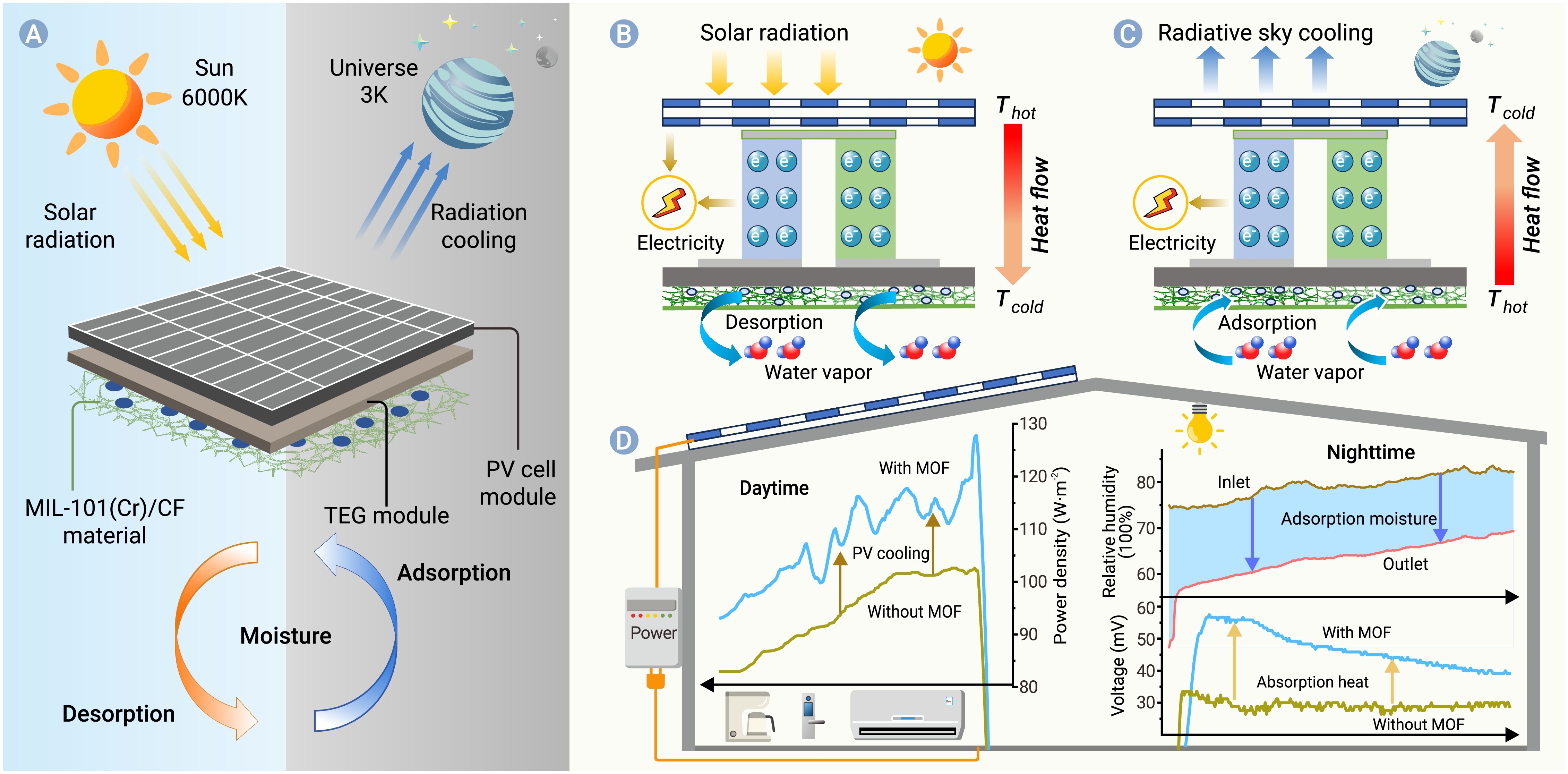
Figure 1.
All-day power generation and dehumidification principle
-
Figure 2.
Synthesis and characterization of MIL-101(Cr)/CF composite for water sorption
-
Figure 3.
Proof-of-concept for PV-TEG-MOF hybrid experiments
-
Figure 4.
Outdoor demonstration of the hybrid PV-TEG-MOF device for all-day power generation and humidity control
-
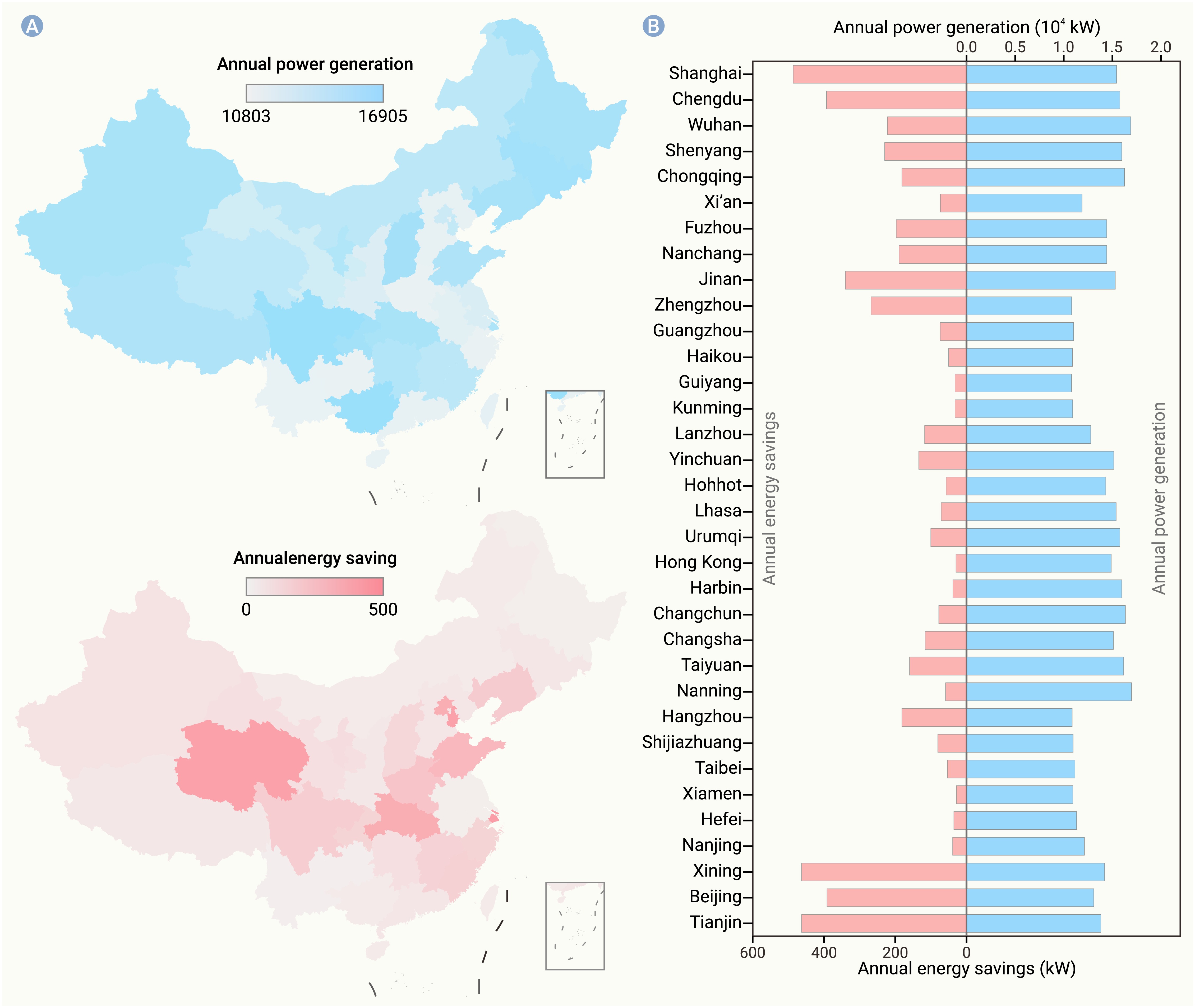
Figure 5.
Dehumidification and power generation of multi-functional roof modeling analysis
