
Intelligent deepwater energy development: Flow assurance monitoring and smart decision-making system
-
GRAPHICAL ABSTRACT

 DownLoad:
Full size image
DownLoad:
Full size image
-
PUBLIC SUMMARY
-
A physics-informed deep-learning model for hydrate blockage prediction is developed.
Two-stage evolution of the fluid differential pressure during hydrate blockage formation is revealed.
Hydrate blockage prediction is defined as an unsupervised anomaly detection problem.
The Transformer-LSTM-VAE (TLV) model is developed based on the Variational Auto-Encoder framework.
The TLV model achieves superior performance in evaluations (F1-score=0.969).
-
-
ABSTRACT
Deepwater hydrocarbon resources (oil, gas, and hydrate) constitute an important part of the world's existing and emerging energy landscape. The high hydrostatic pressure, low temperature, and complex geological structures of deepwater environments present significant challenges for energy development. The development of flow assurance monitoring and intelligent decision-making systems to quantify the risk of hydrate blockage is a prerequisite for safe and efficient development. In this work, the hydrate growth and blockage under varying liquid loading, pump speed, pipe inclination, subcooling, and oil-water ratio were investigated using a high-pressure visual flow loop. A database containing 27 sets of tests with about 510,000 pieces of data was created. The evolution of differential pressure in oil-gas-water-hydrate multiphase flow was found to have two stages. Stage I, differential pressure remains stable or rises slightly with increasing hydrate concentration. Stage II, differential pressure changes abruptly after the hydrate reaches the critical concentration. Therefore, the prediction of hydrate blockage was defined as an unsupervised anomaly detection problem. The Transformer-LSTM-VAE (TLV) blockage prediction model was developed based on the Variational Auto-Encoder framework. The Transformer and LSTM models were utilized as encoder and decoder, respectively. Two uneven weight adjustment methods were proposed to achieve earlier warnings of blockage. In systematic comparisons with three classic and two state-of-the-art machine learning models, the TLV model consistently performed the best with an F1-score of 0.969. The TLV model demonstrated the potential of deep learning methods in deepwater energy development. -

-
REFERENCES
[1] Khan N., Kumar A., Johns M.L., et al. (2023). Experimental investigation to elucidate the hydrate Anti-Agglomerating characteristics of 2-Butoxyethanol. Chem. Eng. J. 471:144288. DOI:10.1016/j.cej.2023.144288 [2] McCollum D.L., Zhou W., Bertram C., et al. (2018). Energy investment needs for fulfilling the Paris Agreement and achieving the Sustainable Development Goals. Nat. Energy 3:589−599. DOI:10.1038/s41560-018-0179-z [3] Hunt J.D., Nascimento A., Nascimento N., et al. (2022). Possible pathways for oil and gas companies in a sustainable future: From the perspective of a hydrogen economy. Renew. Sustain. Energy Rev. 160:112291. DOI:10.1016/j.rser.2022.112291 [4] Wen Z., Wang J., Wang Z., et al. (2023). Analysis of the world deepwater oil and gas exploration situation. Petro. Explor. Develop. 50:1060−1076. DOI:10.1016/S1876-3804(23)60449-5 [5] Yu Y., Zhang X., Liu J., et al. (2021). Natural gas hydrate resources and hydrate technologies: a review and analysis of the associated energy and global warming challenges. Energy Environ. Sci. 14:5611−5668. DOI:10.1039/d1ee02093e [6] Sloan E.D. (2003). Fundamental principles and applications of natural gas hydrates. Nature 426:353−359. DOI:10.1038/nature02135 [7] Tan Z., Yang L., Zhang D., et al. (2020). Development mechanism of internal local corrosion of X80 pipeline steel. J. Mater. Sci. Tech. 49:186−201. DOI:10.1016/j.jmst.2019.10.023 [8] Al-Shboul T., Sagala F. and Nassar N.N. (2023). Role of surfactants, polymers, nanoparticles, and its combination in inhibition of wax deposition and precipitation: A review. Adv. Coll. Inter. Sci. 315:102904. DOI:10.1016/j.cis.2023.102904 [9] Yin X., Yan Y., Zhang X., et al. (2023). Designing Robust Superhydrophobic Materials for Inhibiting Nucleation of Clathrate Hydrates by Imitating Glass Sponges. ACS Cent. Sci. 9:318−327. DOI:10.1021/acscentsci.2c01406 [10] Boufadel M.C., Özgökmen T., Socolofsky S.A., et al. (2023). Oil Transport Following the Deepwater Horizon Blowout. Ann. Rev. Marine Sci. 15:67−93. DOI:10.1146/annurev-marine-040821-104411 [11] Mirza M.A., Ghoroori M. and Chen, Z. (2022). Intelligent Petroleum Engineering. Engineering 18:27−32. DOI:10.1016/j.eng.2022.06.009 [12] Cremades A., Hoyas S., Deshpande R., et al. (2024). Identifying regions of importance in wall-bounded turbulence through explainable deep learning. Nat. Commun. 15:3864. DOI:10.1038/s41467-024-47954-6 [13] Kontolati K., Goswami S., Em Karniadakis G., et al. (2024). Learning nonlinear operators in latent spaces for real-time predictions of complex dynamics in physical systems. Nat. Commun. 15:5101. DOI:10.1038/s41467-024-49411-w [14] Wang Q., Chen D., Li M., et al. (2023). A novel method for petroleum and natural gas resource potential evaluation and prediction by support vector machines (SVM). Appl. Energy 351:121836. DOI:10.1016/j.apenergy.2023.121836 [15] Li G., Song X., Tian S., et al. (2022). Intelligent Drilling and Completion: A Review. Engineering 18:33−48. DOI:10.1016/j.eng.2022.07.014 [16] Wang J., Meng Y., Han B., et al. (2023). Hydrate blockage in subsea oil/gas flowlines: Prediction, prevention, and remediation. Chem. Eng. J. 461:142020. DOI:10.1016/j.cej.2023.142020 [17] Aman Z.M. and Koh C.A. (2016). Interfacial phenomena in gas hydrate systems. Chem. Soc. Rev. 45:1678−1690. DOI:10.1039/C5CS00791G [18] Meng Y., Han B., Wang J., et al. (2024). Hydrate Blockage in Subsea Oil/Gas Pipelines: Characterization, Detection, and Engineering Solutions. Engineering. 90:1051−1058. DOI:10.1016/j.eng.2024.10.020 [19] Lang C., Chen Z., Hassanpouryouzband A., et al. (2024). Spontaneous Lifting and Self-Cleaning of Gas Hydrate Crystals. ACS Nano 18:33671−33680. DOI:10.1021/acsnano.4c12943 [20] Lim V.W.S., Metaxas P.J., Johns M.L., et al. (2022). The impact of mono-ethylene glycol and kinetic inhibitors on methane hydrate formation. Chem. Eng. J. 427:131531. DOI:10.1016/j.cej.2021.131531 [21] Koh C.A. (2002). Towards a fundamental understanding of natural gas hydrates. Chem. Soc. Rev. 31:157−167. DOI:10.1039/b008672J [22] Zhang J., Sun Q., Wang Z., et al. (2021). Prediction of hydrate formation and plugging in the trial production pipes of offshore natural gas hydrates. J. Clean. Product. 316:128262. DOI:10.1016/j.jclepro.2021.128262 [23] Zhang J., Wang Z., Liu S., et al. (2019). Prediction of hydrate deposition in pipelines to improve gas transportation efficiency and safety. Appl. Energy 253:113521. DOI:10.1016/j.apenergy.2019.113521 [24] Zeng X., Feng J., Ke W., et al. (2023). Film formation kinetics of Methane-propane hydrate on gas bubble in MEG and luvicap EG solutions. Appl. Energy 330:120301. DOI:10.1016/j.apenergy.2022.120301 [25] Wang X.H., Xu X.J., Cai J., et al. (2023). Experimental study on the intrinsic dissociation rate of methane hydrate. Chem. Eng. Sci. 282:119278. DOI:10.1016/j.ces.2023.119278 [26] Hassanpouryouzband A., Joonaki E., Farahani M.V., et al. (2020). Gas hydrates in sustainable chemistry. Chem. Soc. Rev. 49:5225−5309. DOI:10.1039/c8cs00989a [27] Wang J., Zhang Q., Jin R., et al. (2023). Identification and prediction of hydrate–slug flow to improve safety and efficiency of deepwater hydrocarbon transportation. J. Clean. Product. 430:139632. DOI:10.1016/j.jclepro.2023.139632 [28] Majid A.A.A., Lee W., Srivastava V., et al. (2017). Experimental Investigation of Gas-Hydrate Formation and Particle Transportability in Fully and Partially Dispersed Multiphase-Flow Systems Using a High-Pressure Flow Loop. SPE J. 23:937−951. DOI:10.2118/187952-PA [29] Zhang X., Sa J.-H. and Sum A.K. (2020). Hydrate management in Deadlegs: Effect of water vapor content on hydrate deposition. Fuel 273:117714. DOI:10.1016/j.fuel.2020.117714 [30] Yin Z., Khurana M., Tan H.K., et al. (2018). A review of gas hydrate growth kinetic models. Chem. Eng. J. 342:9−29. DOI:10.1016/j.cej.2018.01.120 [31] Karpenko M., Stosiak M., Šukevičius Š., et al. (2023). Hydrodynamic Processes in Angular Fitting Connections of a Transport Machine’s Hydraulic Drive. Machines 11:355. DOI:10.3390/machines11030355 [32] Pickarts M.A., Ravichandran S., Ismail N.A., et al. (2022). Perspective on the oil-dominated gas hydrate plugging conceptual picture as applied to transient Shut-In/Restart. Fuel 324:124606. DOI:10.1016/j.fuel.2022.124606 [33] Lee N., Kim H., Jung J., et al. (2022). Time series prediction of hydrate dynamics on flow assurance using PCA and Recurrent neural networks with iterative transfer learning. Chem. Eng. Sci. 263:118111. DOI:10.1016/j.ces.2022.118111 [34] Wang J., Wang Q., Meng Y., et al. (2022). Flow characteristic and blockage mechanism with hydrate formation in multiphase transmission pipelines: In-situ observation and machine learning predictions. Fuel 330:125669. DOI:10.1016/j.fuel.2022.125669 [35] Song, Z., Yang, X., Xu, Z., and King, I. (2023). Graph-Based Semi-Supervised Learning: A Comprehensive Review. IEEE Trans. Neu. Net. Learn. Sys. 34:8174−8194. DOI:10.1109/TNNLS.2022.3155478 [36] Qi G. and Luo J. (2022). Small Data Challenges in Big Data Era: A Survey of Recent Progress on Unsupervised and Semi-Supervised Methods. IEEE Tran. Pat. Analy. Machine Intel. 44:2168−2187. DOI:10.1109/TPAMI.2020.3031898 [37] Ma R., Xiao S., Chang Y., et al. (2023). An interfacial gas-enrichment strategy for mitigating hydrate adhesion and blockage. Chem. Eng. J. 453:139918. DOI:10.1016/j.cej.2022.139918 [38] Hestness J., Narang S., Ardalani N., et al. (2017). Deep learning scaling is predictable, empirically. pre-prints arXiv :1712.00409. DOI:10.48550/arXiv.1712.00409. [39] Liu Z., Ma S., Wu Z., et al. (2024). Investigation of flow and viscosity characteristics of hydrate slurries within a visual-loop system. Energy 289:129929. DOI:10.1016/j.energy.2023.129929 [40] Nguyen H.D., Tran K.P., Thomassey S., et al. (2021). Forecasting and Anomaly Detection approaches using LSTM and LSTM Autoencoder techniques with the applications in supply chain management. Int. J. Inf. Manag. 57:102282. DOI:10.1016/j.ijinfomgt.2020.102282 [41] Elsayed M.S., Le-Khac N.-A., Dev S., et al. (2020). Network Anomaly Detection Using LSTM Based Autoencoder. Proceedings of the 16th ACM Symposium on QoS and Security for Wireless and Mobile Networks. Association for Computing Machinery. [42] Xu J., Wu H., Wang J., et al. (2021). Anomaly transformer: Time series anomaly detection with association discrepancy. pre-prints arXiv :2110.02642. DOI:10.48550/arXiv.2110.02642. [43] Yang Y., Zhang C., Zhou T., et al. (2023). DCdetector: Dual Attention Contrastive Representation Learning for Time Series Anomaly Detection. Proceedings of the 29th ACM SIGKDD Conference on Knowledge Discovery and Data Mining. Association for Computing Machinery. -
ABOUT THIS ARTICLE
Cite this article:
Wang J., Yang B., Jin K., et al. (2025). Intelligent deepwater energy development: Flow assurance monitoring and smart decision-making system. The Innovation Energy 2:100081. https://doi.org/10.59717/j.xinn-energy.2025.100081
Welcome!
To request copyright permission to republish or share portions of our works, please visit Copyright Clearance Center's (CCC) Marketplace website at marketplace.copyright.com.

Article Metrics
Relative Articles
Cited by
Export File
Citation
Wang J., Yang B., Jin K., et al. (2025). Intelligent deepwater energy development: Flow assurance monitoring and smart decision-making system. The Innovation Energy 2:100081. https://doi.org/10.59717/j.xinn-energy.2025.100081

Format
Content


-
Figure 1.
Challenges in deepwater hydrocarbon energy development and informatization development approaches
-
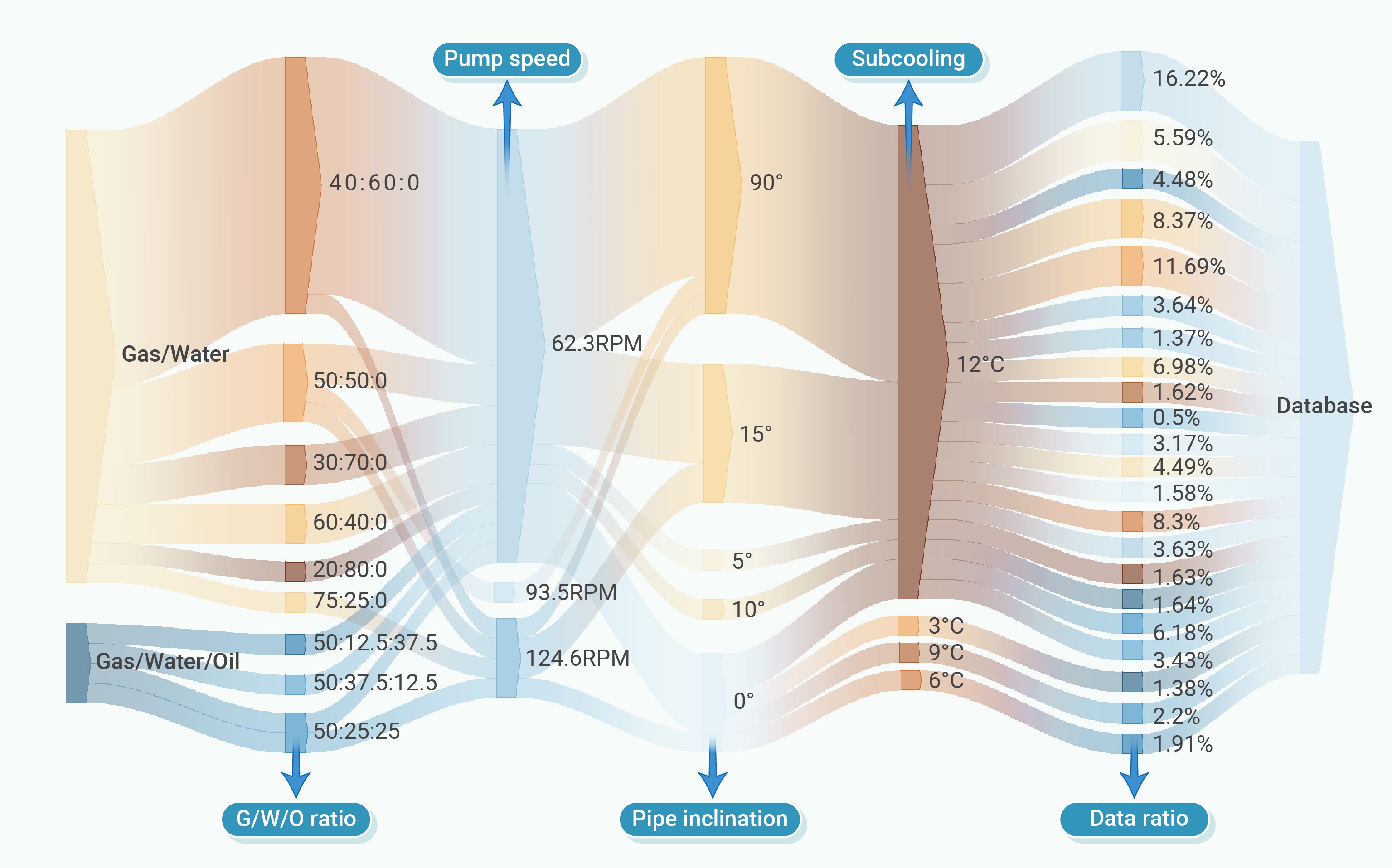
Figure 2.
Sankey diagrams of data structure.
-
Figure 3.
Schematic of TLV model architecture
-
Figure 4.
Three-dimensional scatter plots of the evolution of volume flow rate (Qm) and pressure drop (ΔP) with water conversion fraction (WCF).
-
Figure 5.
Three-dimensional scatter plots of the evolution of Qm and ΔP with WCF.
-
Figure 6.
Evolution curves of ΔP with WCF in five systems
-
Figure 7.
Performance metrics for the TLV model and five baseline models in the test
-
Figure 8.
Visualization of the effectiveness of UWA methods
