
High-resolution data unveils overestimation of China's electricity carbon footprint in international LCA databases
-

-
REFERENCES
[1] Liu Z., Ciais P., Deng Z., et al. (2020). Carbon Monitor, a near-real-time daily dataset of global CO2 emission from fossil fuel and cement production. Sci. Data 7:392. DOI:10.1038/s41597-020-00708-7 [2] World Trade Organization. (2024). Global Trade Outlook and Statistics. https://www.wto-ilibrary.org/content/books/9789287076335. [3] Zhang Q., Qiao K., Hu C., et al. (2024). Study on life-cycle carbon emission factors of electricity in China. Int. J. Low-Carbon Tech. 19:2287−2298. DOI:10.1093/ijlct/ctae181 [4] Li A., Wang Z., Sun X., et al. (2025). Accounting Factors and Spatio-Temporal Differences of the Carbon Footprint Factor in China’s Power System. Energies 18:2663. DOI:10.3390/en18102663 [5] Wang M., Yao M., Wang S., et al. (2021). Study of the emissions and spatial distributions of various power-generation technologies in China. J. Environ. Manag. 278:111401. DOI:10.1016/j.jenvman.2020.111401 [6] Li, J., Tian, Y., Zhang, Y., et al. (2021). Spatializing environmental footprint by integrating geographic information system into life cycle assessment: A review and practice recommendations. J. Clean. Product. 323:129113. DOI:10.1016/j.jclepro.2021.129113 [7] China Electricity Council. (2022). Compilation of Statistical Data on China's Electric Power Industry. Beijing: China Electric Power Press. https://www.shujuku.org/power-industry-statistics.html. [8] Liu, M., Zhu, G., Tian, Y. (2024). The historical evolution and research trends of life cycle assessment. Green Carbon 2:425−437. DOI:10.1016/j.greenca.2024.08.003 -
ABOUT THIS ARTICLE
Cite this article:
Zhu G., Tian Y., Xiong J., et al. (2026). High-resolution data unveils overestimation of China's electricity carbon footprint in international LCA databases. The Innovation Energy 3:100132. https://doi.org/10.59717/j.xinn-energy.2026.100132
Welcome!
To request copyright permission to republish or share portions of our works, please visit Copyright Clearance Center's (CCC) Marketplace website at marketplace.copyright.com.
Export File
Citation
Zhu G., Tian Y., Xiong J., et al. (2026). High-resolution data unveils overestimation of China's electricity carbon footprint in international LCA databases. The Innovation Energy 3:100132. https://doi.org/10.59717/j.xinn-energy.2026.100132

Format
Content
 DownLoad:
-
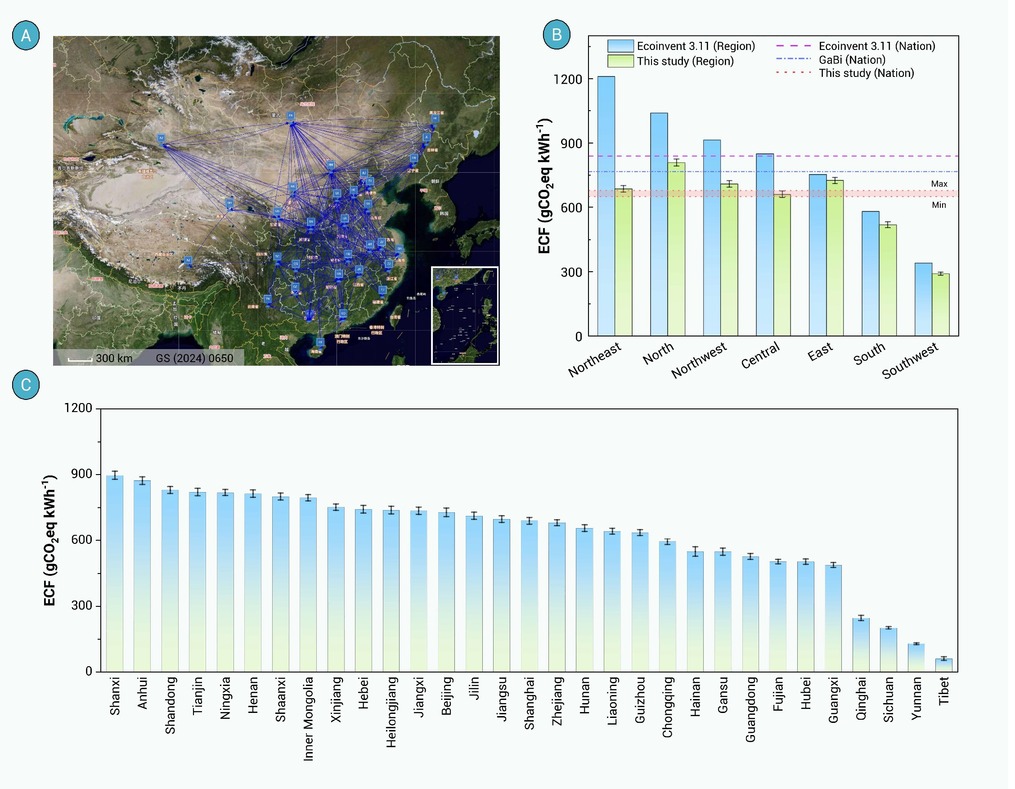
Figure 1.
Framework of China’s ECF accounting model (A), national and regional ECFs (B), and provincial ECFs (C).
