
Thermoelectric-based battery thermal management with cooling and energy recovery
-
GRAPHICAL ABSTRACT
 DownLoad:
Full size image
DownLoad:
Full size image
-
PUBLIC SUMMARY
-
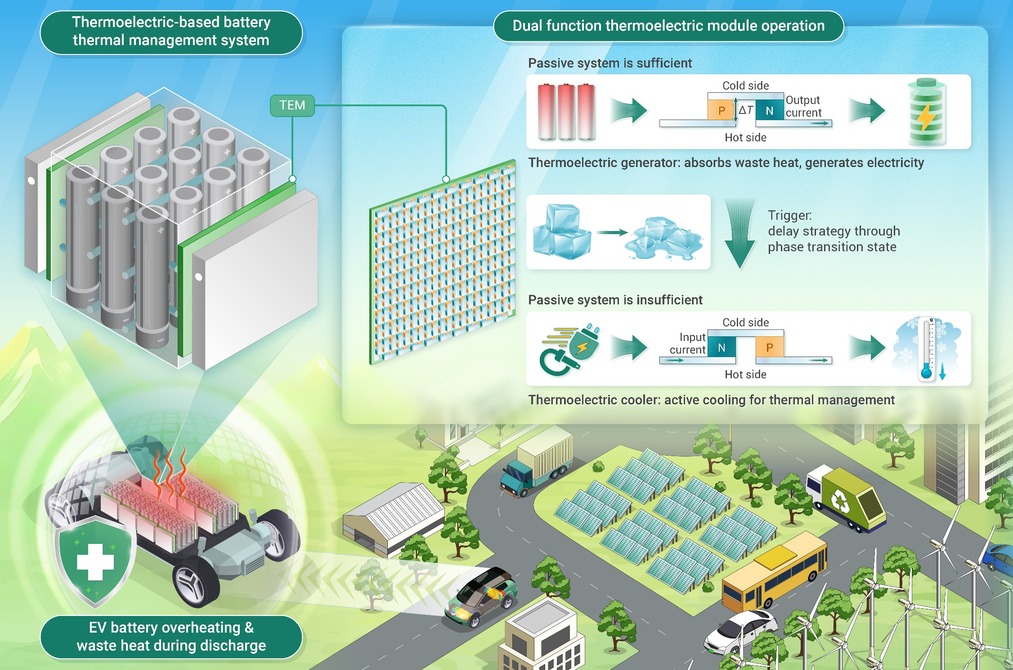
Hybrid BTMS (TEM+PCM+LC) enables dual TEM functions: waste-heat power generation and active cooling.
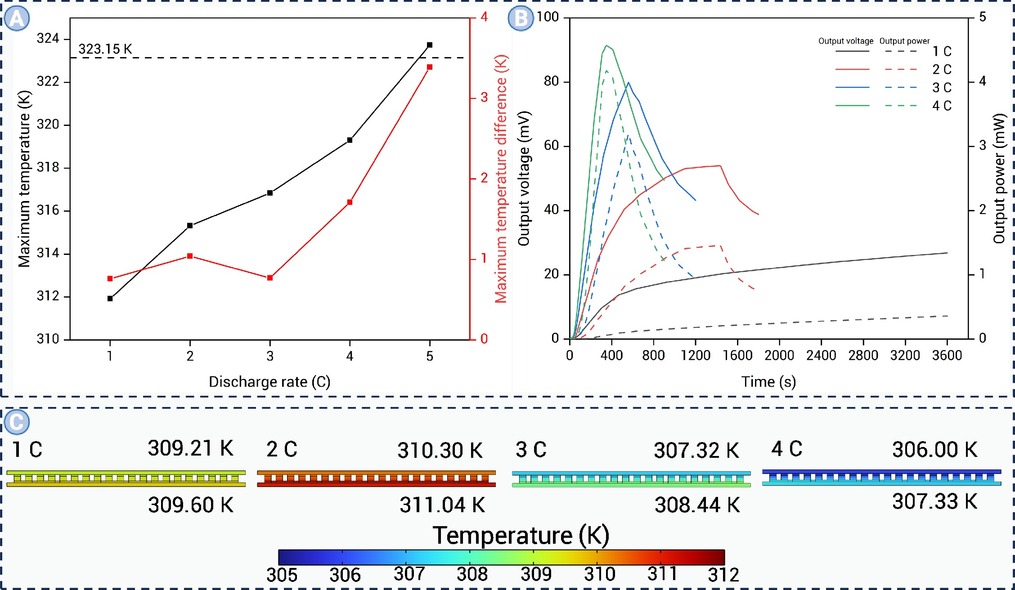
Passive cooling keeps Tmax <323.15 K and ΔT <5 K under 1C–4C while TEG output rises with discharge rate.
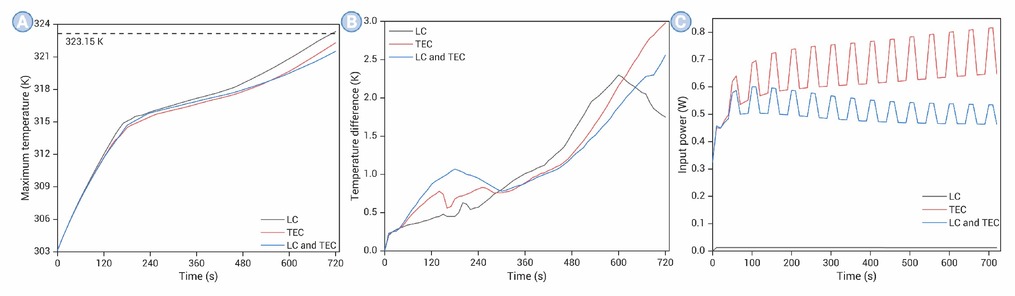
At 5C, TEC+LC cut Tmax from 323.74 K to 321.51 K and reduce energy use by lowering hot-side temperature.
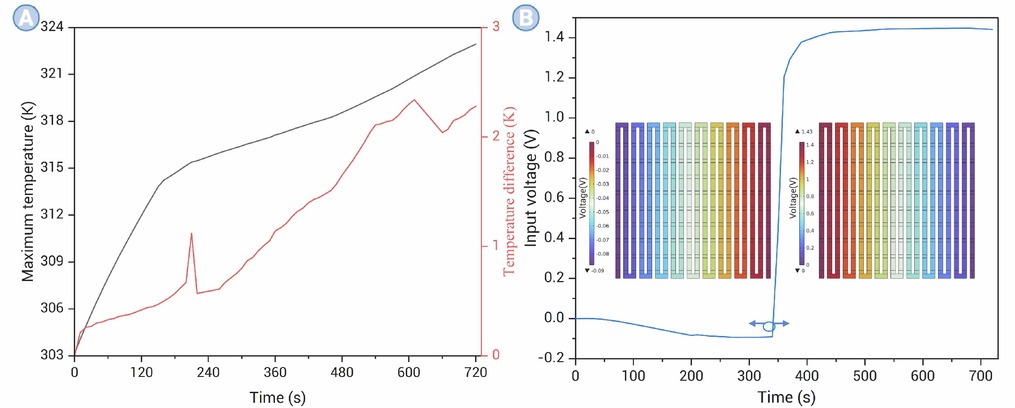
Delayed (340 s) active cooling extends TEG operation by 340 s and reduces active cooling time by 47.2%.
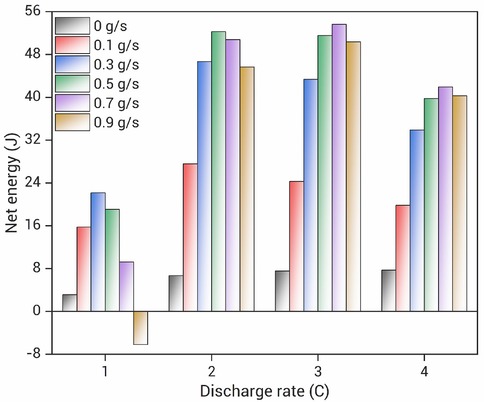
Optimal LC flow maximizes net energy recovery, achieving up to 53.60 J at 3C discharge.
-
-
ABSTRACT
This work proposes the hybrid battery thermal management system (BTMS) integrating thermoelectric modules (TEM), phase change materials (PCM), and liquid cooling (LC) to achieve dual functionalities of TEM: power generation and cooling. A multi-physics numerical model is established to analyze the system’s performance under varying discharge rates, along with proposing a phase transition temperature-triggered operational strategy. Results demonstrate that under 1 C to 4 C discharge conditions, the passive cooling system maintains the Tmax of batteries below 323.15 K with a ΔT under 5 K, while TEM acts as the thermoelectric generator (TEG) to recover waste heat, exhibiting significant increases in output voltage and power with rising discharge rates. At 5C discharge, thermoelectric cooling (TEC) and LC reduce the Tmax of batteries from 323.74 K to 321.51 K, while LC lowers the TEC hot-side temperature, thereby decreasing system energy consumption. The proposed 340 s delayed activation strategy for active cooling extends TEG power generation time by 340 s and reduces active cooling operation time by 47.2%. In 1C, 2C, 3C, and 4C discharge rates, the peak net energies of 22.15 J, 52.24 J, 53.60 J, and 41.93 J occur at liquid cooling mass flow rates of 0.3 g/s, 0.5 g/s, 0.7 g/s, and 0.7 g/s, respectively. This work provides an innovative solution for the BTMS that balances thermal control efficiency and energy recovery. -

-
REFERENCES
[1] Murugan M., Saravanan A., Elumalai P.V., et al. (2022). Thermal management system of lithium-ion battery packs for electric vehicles: An insight based on bibliometric study. J. Energy Storage 52:104723. DOI:10.1016/j.est.2022.104723 [2] Zhou W., Li M., Zhang Q., et al. (2024). Potential and challenges of capacitive power transfer systems for wireless EV charging: A review of key technologies. Green Energy Intell. Transp. 3:100174. DOI:10.1016/j.geits.2024.100174 [3] International Energy Agency. (2024). EV battery supply chain sustainability. IEA. https://www.iea.org/reports/ev-battery-supply-chain-sustainability. [4] Khoshvaght-Aliabadi M., Ghodrati P., Kang Y.T. (2025). Developing a novel battery thermal management system utilizing supercritical CO2 as the cooling medium. Appl. Energy 381:125207. DOI:10.1016/j.apenergy.2024.125207 [5] Liu X., Wu P.Y., Su C.Q., et al. (2025). Research on precise temperature control performance of battery thermal management system integrating piezoelectric pump and thermoelectric cooler. Energy 317:134623. DOI:10.1016/j.energy.2024.134623 [6] Li H., Chen L., Zuo H., et al. (2024). Performance enhancement of a battery thermal management system using novel liquid cold plates with micro-channel featuring pin fins. Energy 301:131731. DOI:10.1016/j.energy.2024.131731 [7] Luo D., Jiang L., Wu Z., et al. (2025). Realizing cyclic utilization of phase change materials in thermoelectric-based battery thermal management system under real discharge–charge conditions. J. Energy Storage 114:115682. DOI:10.1016/j.est.2025.115682 [8] Li X. and Wang R. (2025). Towards integrated thermal management systems in battery electric vehicles: A review. eTransportation 24:100396. DOI:10.1016/j.etran.2025.100396 [9] Pilali E., Soltani M., Hatefi M., et al. (2025). Passive thermal management systems with phase change material-based methods for lithium-ion batteries: A state-of-the-art review. J. Power Sources 632:236345. DOI:10.1016/j.jpowsour.2025.236345 [10] Shahmohammadi M., Seddighi S., Taklifi A. (2024). Active and hybrid battery thermal management system using microchannels and phase change materials for efficient energy storage. J. Power Sources 621:235317. DOI:10.1016/j.jpowsour.2024.235317 [11] Murali G., Sravya G.S.N., Jaya J., et al. (2021). A review on hybrid thermal management of battery packs and cooling performance by enhanced PCM. Renew. Sustain. Energy Rev. 150:111513. DOI:10.1016/j.rser.2021.111513 [12] Li Y., Zhang R., Zhou B., et al. (2025). One-pot strategy for multifunctional recyclable thermally conductive phase change composites toward efficient thermal management. Chem. Eng. J. 521:166972. DOI:10.1016/j.cej.2025.166972 [13] Ping P., Dai X., Kong D., et al. (2023). Experimental study on nano-encapsulated inorganic phase change material for lithium-ion battery thermal management and thermal runaway suppression. Chem. Eng. J. 463:142401. DOI:10.1016/j.cej.2023.142401 [14] Masthan Vali P.S.N., Murali G., Chinnasamy S. (2023). Comparison study on cooling management of composite phase change material battery pack. Thermal Sci. 27:218−228. DOI:10.2298/TSCI220422218V [15] Abd H.M., Khalifa A.H.N., Hamad A.J. (2024). Experimental comparison of Li-ion battery thermal management systems using a hybrid flat heat pipe coupled with phase change materials. J. Energy Storage 84:110963. DOI:10.1016/j.est.2024.110963 [16] Kumar R. and Panigrahi P.K. (2024). A hybrid battery thermal management system using ionic wind and phase change material. Appl. Energy 359:122676. DOI:10.1016/j.apenergy.2024.122676 [17] Liu Z., Zhang X., Qi N. (2025). Performance analysis and multi-objective optimization of a hybrid thermal management system based on PCM and liquid cooling. J. Energy Storage 135:118264. DOI:10.1016/j.est.2025.118264 [18] Luo D., Wu Z., Chen H., et al. (2025). Thermal performance of an active battery thermal management system combining annular thermoelectric coolers and phase change materials. Renew. Energy 249:123278. DOI:10.1016/j.renene.2024.123278 [19] Luo D., Wu Z., Jiang L., et al. (2024). Rapid cooling and latent heat recovery in thermoelectric-based battery thermal management systems at high temperatures. Appl. Energy 370:123642. DOI:10.1016/j.apenergy.2024.123642 [20] Luo D., Chen H., Chen W.H., et al. (2025). Interdependent optimization strategies for material, module, and system designs in thermoelectric devices. Device 3:100752. DOI:10.1016/j.device.2025.100752 [21] Jiang L., Zhang H., Li J., Xia P. (2019). Thermal performance of cylindrical battery modules impregnated with PCM composites based on thermoelectric cooling. Energy 188:116048. DOI:10.1016/j.energy.2019.116048 [22] Wei J., Zhou Y., Wang Y., et al. (2023). Large-sized thermoelectric modules composed of cement-based composite blocks for pavement energy harvesting. Energy 265:126398. DOI:10.1016/j.energy.2023.126398 [23] Li Y., Chen Z., Feng Y., et al. (2023). A novel petal-type battery thermal management system with dual phase change materials. Int. J. Heat Mass Transfer 207:123989. DOI:10.1016/j.ijheatmasstransfer.2023.123989 [24] Chen H., Tang Y.F., Zhou Y.X., et al. (2023). Steady and transient sensitivity investigations on a passive battery thermal management system coupled with PCM and heat pipes. J. Energy Storage 73:109054. DOI:10.1016/j.est.2023.109054 [25] Hu Q., Luo D., Guo J., et al. (2022). Broad temperature plateau for high thermoelectric properties of n-type Bi2Te2.7Se0.3 via defect engineering. ACS Appl. Mater. Interfaces 15:1296–1304. DOI:10.1021/acsami.2c18645. [26] Mama M., Solai E., Capurso T., et al. (2025). Comprehensive review of multi-scale lithium-ion battery modeling: From electrochemical dynamics to thermal management. Energy Convers. Manage. 325:119223. DOI:10.1016/j.enconman.2025.119223 [27] Dwivedi A., Kumar R., Goel V., et al. (2025). Comprehensive review on heat pipe-assisted hybrid battery thermal management strategies. J. Energy Storage 112:115475. DOI:10.1016/j.est.2025.115475 [28] Wu C., Qiu C., Yuan X., et al. (2024). Numerical study and optimization of battery thermal management systems based on fin–PCM under variable gravity. Appl. Therm. Eng. 244:122777. DOI:10.1016/j.applthermaleng.2024.122777 [29] Luo D., Wu H., Cao J., et al. (2024). Numerical investigation of battery thermal management system integrated with vapor chamber and thermoelectric refrigeration. J. Clean. Prod. 434:140089. DOI:10.1016/j.jclepro.2024.140089 [30] Liu X., Zhang C.F., Zhou J.G., et al. (2022). Thermal performance of battery thermal management system using fins to enhance thermoelectric cooler and PCM coupling. Appl. Energy 322:119503. DOI:10.1016/j.apenergy.2022.119503 [31] Hu S., Wang S., Ma C., et al. (2022). A hybrid cooling method with low energy consumption for lithium-ion batteries under extreme conditions. Energy Convers. Manage. 266:115831. DOI:10.1016/j.enconman.2022.115831 [32] Luo D., Jiang L., Chen H., et al. (2025). Enhanced energy efficiency of hybrid battery thermal management systems via delay control of thermoelectric coolers. Renew. Energy 253:123607. DOI:10.1016/j.renene.2025.123607 [33] Du Y., Chen Y., Liu J., et al. (2024). Boosting thermoelectric generator performance with tandem radiative, evaporative, and phase change cooling. Nano Energy 128:109909. DOI:10.1016/j.nanoen.2024.109909 -
ABOUT THIS ARTICLE
Cite this article:
Luo D., Jiang L., Chen H., et al. (2026). Thermoelectric-based battery thermal management with cooling and energy recovery. The Innovation Energy 3:100134. https://doi.org/10.59717/j.xinn-energy.2026.100134
Welcome!
To request copyright permission to republish or share portions of our works, please visit Copyright Clearance Center's (CCC) Marketplace website at marketplace.copyright.com.
Export File
Citation
Luo D., Jiang L., Chen H., et al. (2026). Thermoelectric-based battery thermal management with cooling and energy recovery. The Innovation Energy 3:100134. https://doi.org/10.59717/j.xinn-energy.2026.100134

Format
Content
-
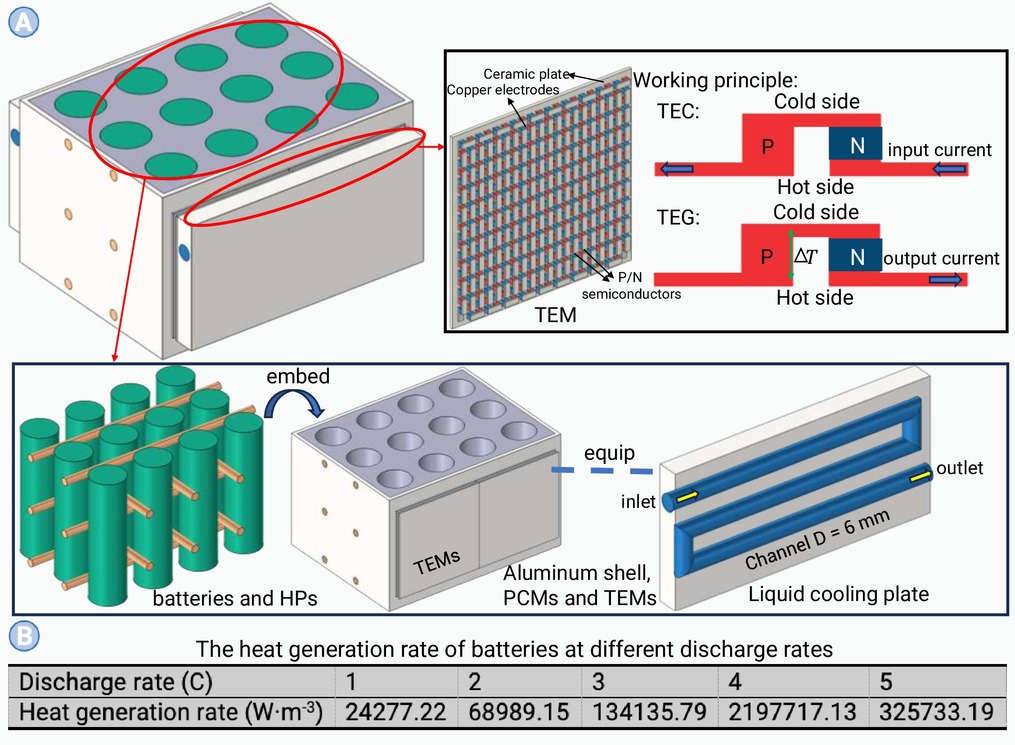
Figure 1.
(A) Physical structure of the hybrid BTMS. (B) The heat generation rate of batteries at different discharge rates.
-
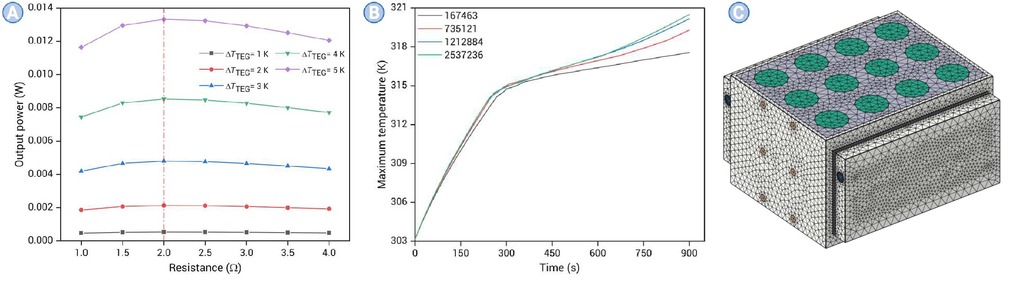
Figure 2.
(A) Dependence of TEG internal resistance and output power on varying thermal gradients. (B) Impact of grid number on the battery’s Tmax. (C) Model nodes.
-
Figure 3.
(A) Thermal performance of the system; (B) Performance of the TEG; (C) Temperature distribution characteristics at the cold/hot sides of the TEG.
-
Figure 4.
Performance of the system with different active cooling configurations: (A) Tmax of the battery; (B)
$ \Delta T $ -
Figure 5.
System performance after implementing the operational strategy: (A) Thermal performance of the system; (B) Input voltage of the TEG and its temperature distribution characteristics.
-
Figure 6.
Net energy of the system under varying mass flow rates.
