
Modeling position specific carbon isotopologue fractionation of thermogenic propane and precursors
-
GRAPHICAL ABSTRACT
 DownLoad:
Full size image
DownLoad:
Full size image
-
PUBLIC SUMMARY
-
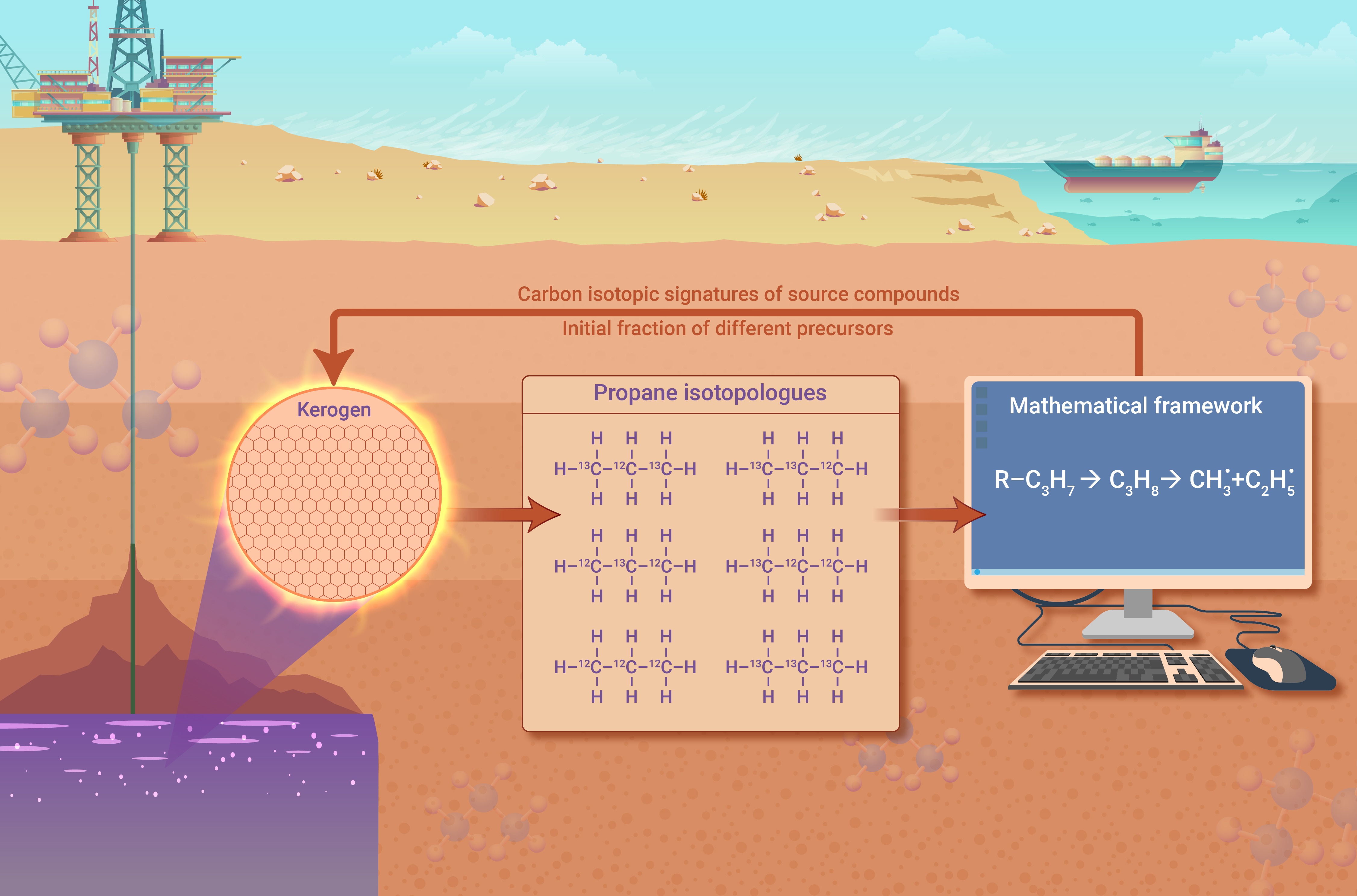
A mathematical framework to describe carbon isotopic evolution of thermogenic propane and its precursors.
Initial fraction and isotopic signatures of different propane precursors are quantified by our model.
Source compounds distribution could impact position specific carbon isotopic signals of thermogenic propane.
-
-
ABSTRACT
Position specific isotope analysis (PSIA) of thermogenic propane allows to track carbon isotopic compositions at different molecular positions, and thus providing new evidence to investigate propane’s origin, fate, and mechanisms of formation. However, the link between observed δ13C PSIA signals of propane and carbon isotopologue signatures of precursors in source organics still remains unclear, and understanding the underlying mechanisms requires a more sophisticated model. Here we developed a mathematical framework to simulate position specific carbon isotopologues of propane and its precursors based on mechanistic understanding of thermogenic propane’s bond-cleavage pathways. Besides, our model also allows integrating multiple signals including temperature, and isotopic characteristics of source compounds. Our model is validated by precisely reproducing propane’s experimental PSIA data obtained during cracking of different kerogens, and also correctly quantified the initial carbon isotopic signatures and the initial fraction of the different precursors in the source materials. Our model allows to include more complex reaction mechanisms to elucidate unknown reaction pathways, and could also guide and optimize future experimental studies to test different hypothesis. -

-
REFERENCES
[1] Stolper, D.A., Lawson, M., Davis, C.L., et al. (2014). Formation temperatures of thermogenic and biogenic methane. Science 344(6191): 1500−1503. DOI: 10.1126/science.1254509. [2] Schoell, M. (1988). Multiple origins of methane in the Earth. Chemical Geology 71(1): 1−10. DOI: 10.1016/0009-2541(88)90101-5. [3] Dai, J., Zou, C., Liao, S., et al. (2014). Geochemistry of the extremely high thermal maturity Longmaxi shale gas, southern Sichuan Basin. Organic Geochemistry 74: 3−12. DOI: 10.1016/j.orggeochem.2014.01.018. [4] Queneau, Y., and Han, B. (2022). Biomass: Renewable carbon resource for chemical and energy industry. The Innovation 3(1): 100184. DOI: 10.1016/j.xinn.2021.100184. [5] Zhang, X. (2023). Uncover the black box of black shales. The Innovation Geoscience 1 (1): 100005. DOI: 10.59717/j.xinn-geo.2023.100005. [6] Gilbert, A., Sherwood Lollar, B., Musat, F., et al. (2019). Intramolecular isotopic evidence for bacterial oxidation of propane in subsurface natural gas reservoirs. Proceedings of the National Academy of Sciences 116(14): 6653−6658. DOI: 10.1073/pnas.1817784116. [7] Gilbert, A. (2021). The Organic Isotopologue Frontier. Annual Review of Earth and Planetary Sciences 49(1): 435−464. DOI: 10.1146/annurev-earth-071420-053134. [8] Gao, L., He, P., Jin, Y., et al. (2016). Determination of position-specific carbon isotope ratios in propane from hydrocarbon gas mixtures. Chemical Geology 435: 1−9. DOI: 10.1016/j.chemgeo.2016.04.019. [9] Li, Y., Zhang, L., Xiong, Y., et al. (2018). Determination of position-specific carbon isotope ratios of propane from natural gas. Organic Geochemistry 119: 11−21. DOI: 10.1016/j.orggeochem.2018.02.007. [10] Piasecki, A., Sessions, A., Lawson, M., et al. (2016). Analysis of the site-specific carbon isotope composition of propane by gas source isotope ratio mass spectrometer. Geochimica et Cosmochimica Acta 188: 58−72. DOI: 10.1016/j.gca.2016.04.048. [11] Zhang, L., Li, Y., Jiang, W., and Xiong, Y. (2022). Position-specific carbon isotopic composition of thermogenic propane: Insights from pyrolysis experiments. Organic Geochemistry 166 : 104379. DOI: 10.1016/j.orggeochem.2022.104379. [12] Piasecki, A., Sessions, A., Lawson, M., et al. (2018). Position-specific 13C distributions within propane from experiments and natural gas samples. Geochimica et Cosmochimica Acta 220: 110−124. DOI: 10.1016/j.gca.2017.09.042. [13] Piasecki, A., Sessions, A., Peterson, B., and Eiler, J. (2016). Prediction of equilibrium distributions of isotopologues for methane, ethane and propane using density functional theory. Geochimica et Cosmochimica Acta 190: 1−12. DOI: 10.1016/j.gca.2016.06.003. [14] Gilbert, A., Yamada, K., Suda, K., et al. (2016). Measurement of position-specific 13C isotopic composition of propane at the nanomole level. Geochimica et Cosmochimica Acta 177: 205−216. DOI: 10.1016/j.gca.2016.01.017. [15] Chung, H.M., Gormly, J.R., and Squires, R.M. (1988). Origin of gaseous hydrocarbons in subsurface environments: Theoretical considerations of carbon isotope distribution. Chemical Geology 71(1): 97−104. DOI: 10.1016/0009-2541(88)90108-8. [16] Tang, Y., Perry, J.K., Jenden, P.D., and Schoell, M. (2000). Mathematical modeling of stable carbon isotope ratios in natural gases††We dedicate this paper to Bill Sackett on the occasion of his 70th birthday. Geochimica et Cosmochimica Acta 64(15): 2673−2687. DOI: 10.1016/S0016-7037(00)00377-X. [17] Rooney, M.A., Claypool, G.E., and Moses Chung, H. (1995). Modeling thermogenic gas generation using carbon isotope ratios of natural gas hydrocarbons. Chemical Geology 126(3): 219−232. DOI: 10.1016/0009-2541(95)00119-0. [18] Xie, H., Dong, G., Formolo, M., et al. (2021). The evolution of intra- and inter-molecular isotope equilibria in natural gases with thermal maturation. Geochimica et Cosmochimica Acta 307: 22−41. DOI: 10.1016/j.gca.2021.05.012. [19] Jin, B., and Rolle, M. (2016). Position-specific isotope modeling of organic micropollutants transformation through different reaction pathways. Environmental Pollution 210: 94−103. DOI: 10.1016/j.envpol.2015.11.014. [20] Jin, B., and Rolle, M. (2014). Mechanistic approach to multi-element isotope modeling of organic contaminant degradation. Chemosphere 95: 131−139. DOI: 10.1016/j.chemosphere.2013.08.050. [21] Maggi, F., and Riley, W.J. (2010). Mathematical treatment of isotopologue and isotopomer speciation and fractionation in biochemical kinetics. Geochimica et Cosmochimica Acta 74(6): 1823−1835. DOI: 10.1016/j.gca.2009.12.021. [22] Xie, H., Formolo, M., and Eiler, J. (2022). Predicting isotopologue abundances in the products of organic catagenesis with a kinetic Monte-Carlo model. Geochimica et Cosmochimica Acta 327: 200−228. DOI: 10.1016/j.gca.2022.03.028. [23] Jin, B., Laskov, C., Rolle, M., and Haderlein, S.B. (2011). Chlorine Isotope Analysis of Organic Contaminants Using GC–qMS: Method Optimization and Comparison of Different Evaluation Schemes. Environmental Science & Technology 45(12): 5279−5286. DOI: 10.1021/es200749d. [24] Jin, B., Haderlein, S.B., and Rolle, M. (2013). Integrated Carbon and Chlorine Isotope Modeling: Applications to Chlorinated Aliphatic Hydrocarbons Dechlorination. Environmental Science & Technology 47: 1443−1451. DOI: 10.1021/es304053h. -
ABOUT THIS ARTICLE
Cite this article:
Jin B. and Peng P. (2024). Modeling position specific carbon isotopologue fractionation of thermogenic propane and precursors. The Innovation Geoscience 2(1): 100054. https://doi.org/10.59717/j.xinn-geo.2024.100054
Welcome!
To request copyright permission to republish or share portions of our works, please visit Copyright Clearance Center's (CCC) Marketplace website at marketplace.copyright.com.

Article Metrics
Relative Articles
Cited by
Export File
Citation
Jin B. and Peng P. (2024). Modeling position specific carbon isotopologue fractionation of thermogenic propane and precursors. The Innovation Geoscience 2(1): 100054. https://doi.org/10.59717/j.xinn-geo.2024.100054

Format
Content

-
Figure 1.
Reaction network and bond-cleavage pathways of thermogenic propane and its precursors’ isotopologues
-
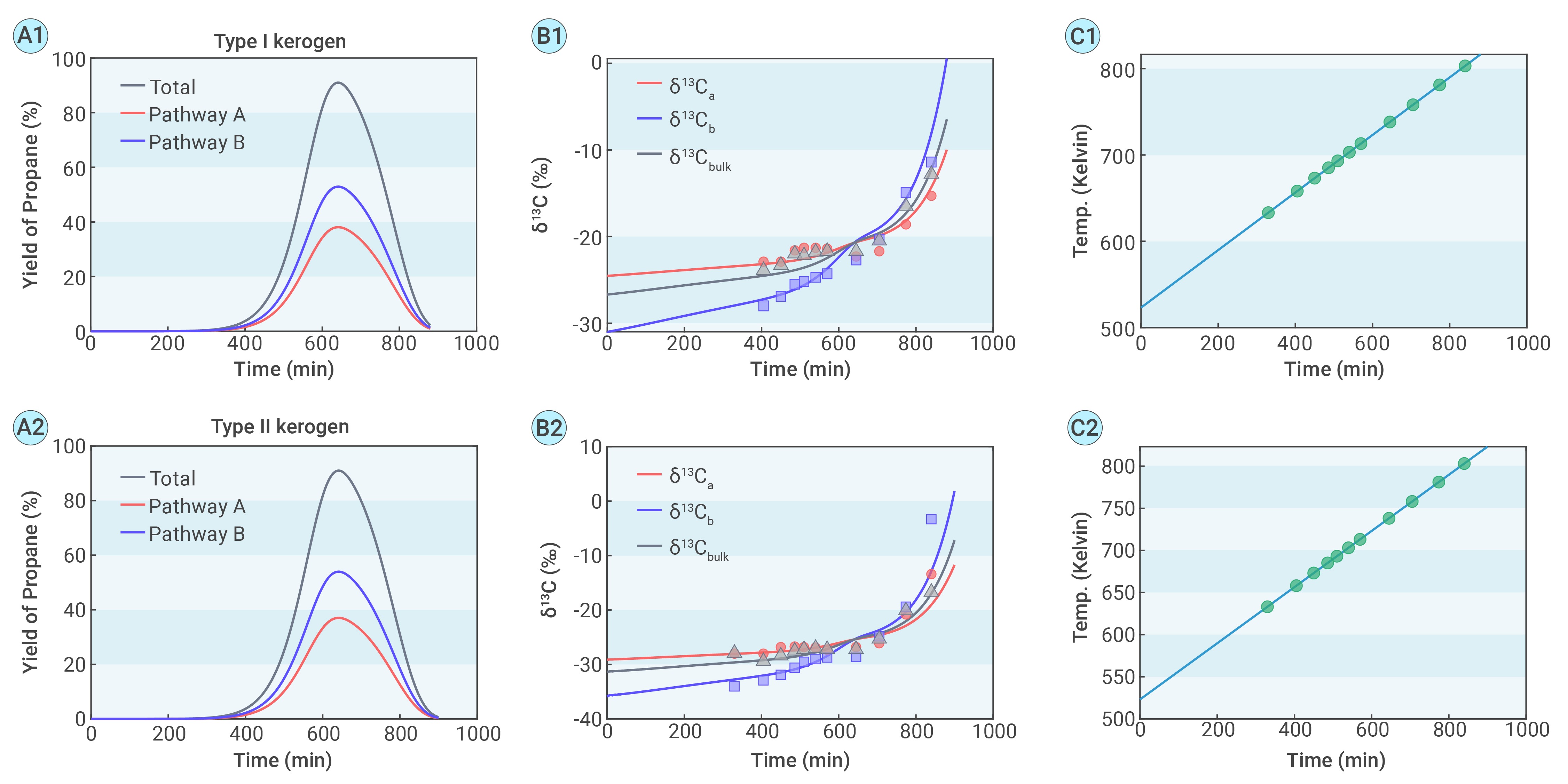
Figure 2.
Temporal trends of propane production and associated compound specific and position specific carbon isotope fractionation during thermolysis of Type I and II kerogens
-
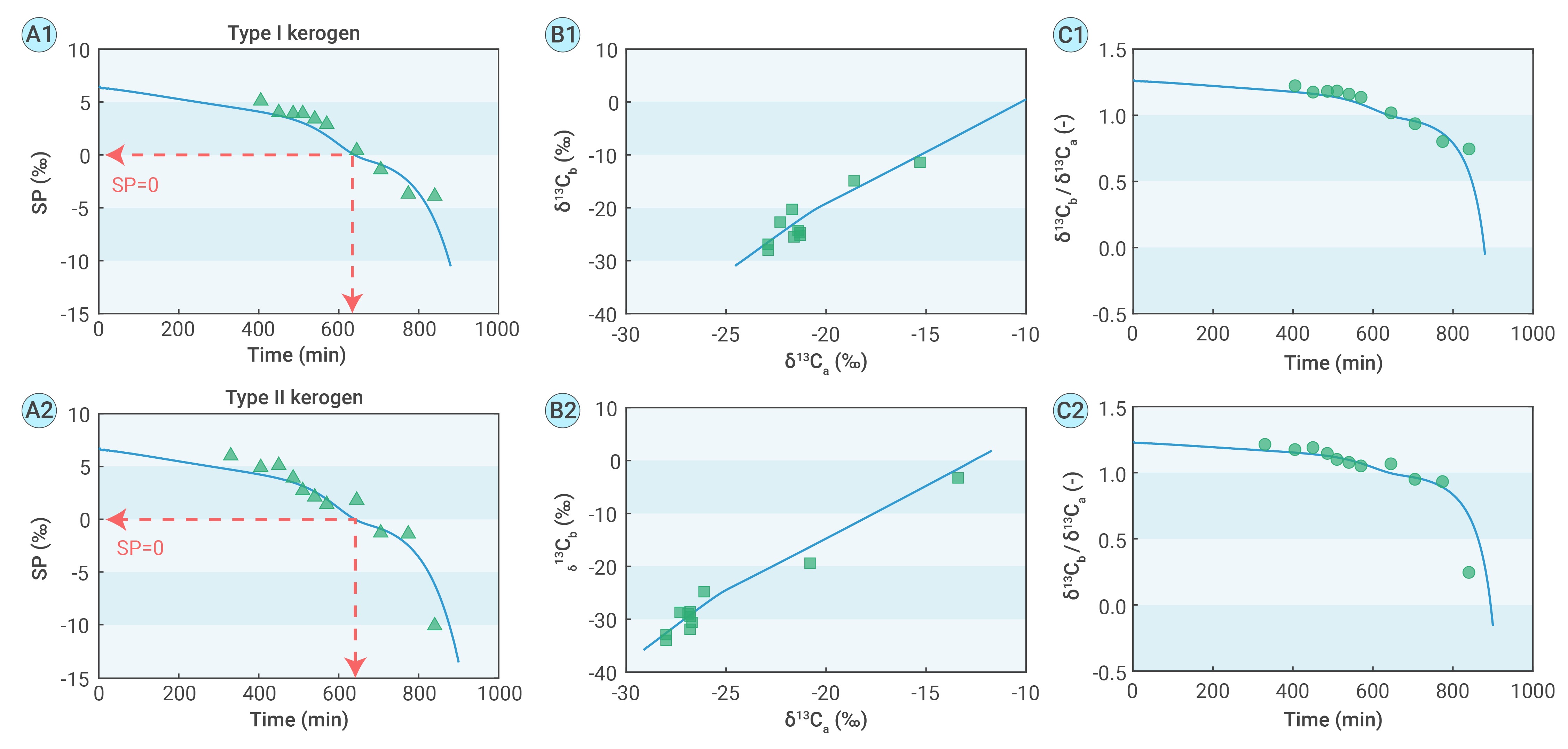
Figure 3.
Temporal trend of site preference (SP) values, and δ13Ca and δ13Cb correlations of propane released during cracking of Type I and II kerogens
-
Figure 4.
Simulated δ13Ca and δ13Cb correlations of propane released during cracking of Type I kerogen containing different fraction of precursor A and precursor B
