
Positive asymmetric responses indicate larger carbon sink with increase in precipitation variability in global terrestrial ecosystems
-
GRAPHICAL ABSTRACT
 DownLoad:
Full size image
DownLoad:
Full size image
-
PUBLIC SUMMARY
-
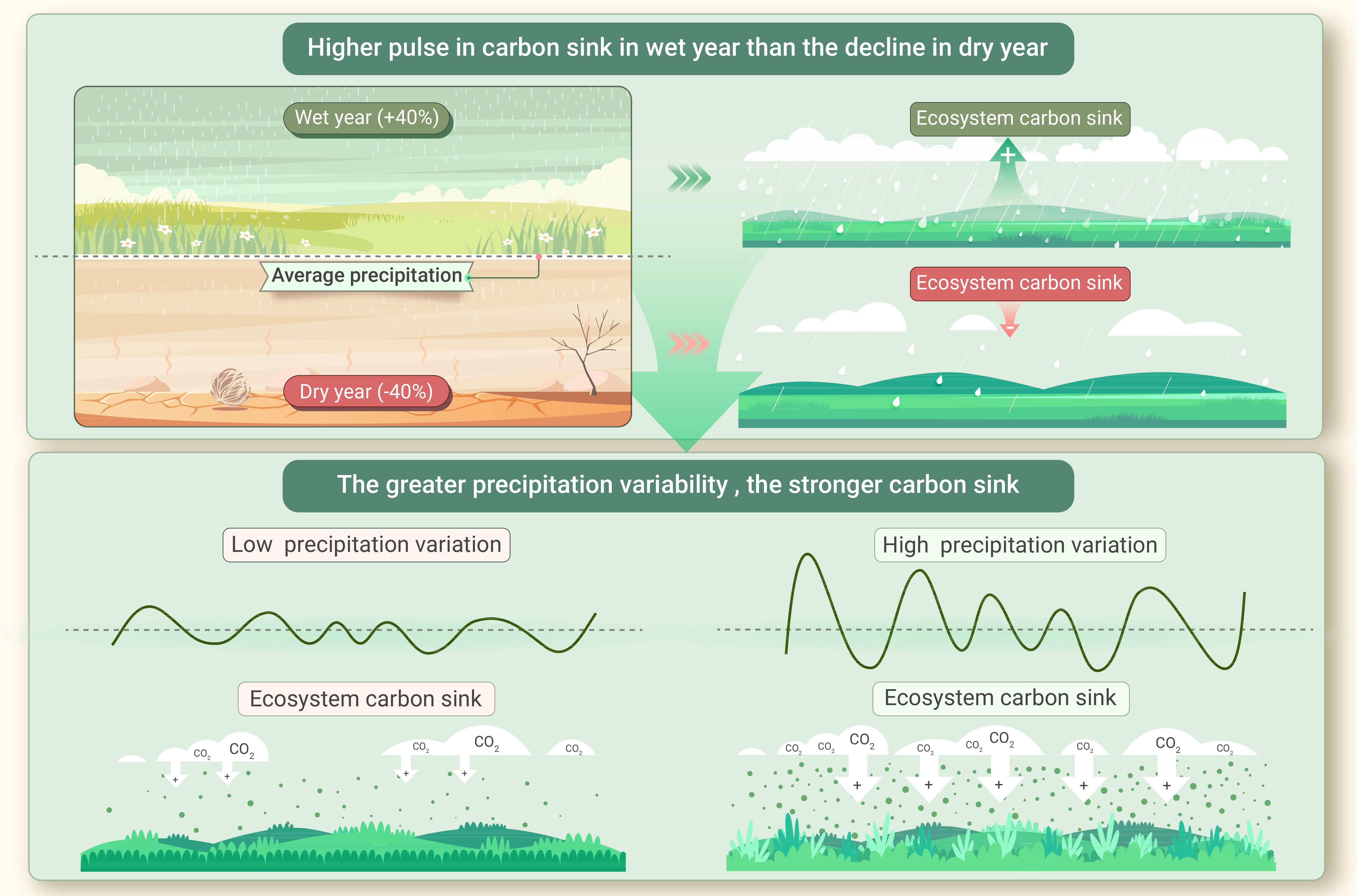
Increased carbon sink in wet years exceeds the reduction in dry years.
Greater precipitation variability enhances carbon sink strength.
Models display poor performance in ecosystem respiration responses.
Improvements in simulating the soil water content responses could promote model performance.
-
-
ABSTRACT
Climate changes have caused high inter-annual variability in precipitation. However, how the terrestrial ecosystem responds to precipitation variability remains unclear. Using global remote sensing data and a meta-analysis by synthesizing 800 pairwise observations of experimental manipulations worldwide, we quantified the responses of the terrestrial ecosystem net carbon productivity (NEP) to precipitation variability. The results indicate that NEP displays a positive asymmetry in response to precipitation change, e.g., the magnitude of the increase in NEP (33.4%) under water-addition treatments is larger than that of the decline in NEP (-24.62%) under water-reduction treatments. The positive asymmetry of NEP in arid regions (< 500 mm) is larger than that in humid regions (> 500 mm). The former is mainly due to the positive asymmetry in vegetation productivity, while the latter results from the respiration process, i.e., the decrease in soil respiration in water-reduction treatments is stronger than in water-addition treatments. Furthermore, land models reproduce a positive NEP asymmetry in response to precipitation change, but display poor performance in ecosystem respiration (ER) responses owing to uncertainties in simulating soil water content (SWC). The positive asymmetry of NEP in this study implies that the increase in precipitation variability (except extreme anomalies) is conducive to high carbon sink in the global terrestrial ecosystem. Meanwhile, the performance of the models when simulating SWC in response to precipitation in humid regions needs to be further improved to better predict the carbon sink in the terrestrial ecosystem. -

-
REFERENCES
[1] Sloat, L.L., Gerber, J.S., Samberg, L.H., et al. (2018). Increasing importance of precipitation variability on global livestock grazing lands. Nature Climate Change 8 (3):214-218. DOI: 10.1038/s41558-018-0081-5. [2] Smith, M.D. (2011). An ecological perspective on extreme climatic events: a synthetic definition and framework to guide future research. Journal of Ecology 99(3): 656−663. DOI: 10.1111/j.1365-2745.2011.01798.x. [3] Zhang, W., Furtado, K., Wu, P., et al. (2021). Increasing precipitation variability on daily-to-multiyear time scales in a warmer world. Science advances 7(31): eabf8021. DOI: 10.1126/sciadv.abf8021. [4] Poulter, B., Frank, D., Ciais, P., et al. (2014). Contribution of semi-arid ecosystems to interannual variability of the global carbon cycle. Nature 509(7502): 600−603. DOI: 10.1038/nature13376. [5] Hu, Z., Liang, M., Knapp, A., et al. (2022). Are regional precipitation–productivity relationships robust to decadal-scale dry period. Journal of Plant Ecology 15(4): 711−720. DOI: 10.1093/jpe/rtac008. [6] Piao, S., Sitch, S., Ciais, P., et al. (2013). Evaluation of terrestrial carbon cycle models for their response to climate variability and to CO2 trends. Global change biology 19(7): 2117−2132. DOI: 10.1111/gcb.12187. [7] Song, J., Wan, S., Piao, S., et al. (2019). A meta-analysis of 1,119 manipulative experiments on terrestrial carbon-cycling responses to global change. Nature ecology & evolution 3(9): 1309−1320. DOI: 10.1038/s41559-019-0958-3. [8] Ahlström, A., Raupach, M.R., Schurgers, G., et al. (2015). The dominant role of semi-arid ecosystems in the trend and variability of the land CO2 sink. Science 348(6237): 895−899. DOI: 10.1126/science.aaa1668. [9] Rudgers, J.A., Chung, Y.A., Maurer, G.E., et al. (2018). Climate sensitivity functions and net primary production: a framework for incorporating climate mean and variability. Ecology 99(3): 576−582. DOI: 10.1002/ecy.2136. [10] Shang, R., Chen, J.M., Xu, M., et al. (2023). China’s current forest age structure will lead to weakened carbon sinks in the near future. The Innovation 4 (6):100515. DOI: 10.1016/j.xinn.2023.100515. [11] Hou, E., Litvak, M.E., Rudgers, J.A., et al. (2021). Divergent responses of primary production to increasing precipitation variability in global drylands. Global change biology 27(20): 5225−5237. DOI: 10.1111/gcb.15801. [12] Gherardi, L.A., and Sala, O.E. (2015). Enhanced interannual precipitation variability increases plant functional diversity that in turn ameliorates negative impact on productivity. Ecology Letters 18(12): 1293−1300. DOI: 10.1111/ele.12523. [13] Gherardi, L.A., and Sala, O.E. (2015). Enhanced precipitation variability decreases grass-and increases shrub-productivity. Proceedings of the National Academy of Sciences 112(41): 12735−12740. DOI: 10.1073/pnas.1506433112. [14] Knapp, A.K., Avolio, M.L., Beier, C., et al. (2017). Pushing precipitation to the extremes in distributed experiments: recommendations for simulating wet and dry years. Global change biology 23(5): 1774−1782. DOI: 10.1111/gcb.13504. [15] Ru, J., Wan, S., Hui, D., et al. (2022). Increased interannual precipitation variability enhances the carbon sink in a semi‐arid grassland. Functional Ecology 36(4): 987−997. DOI: 110.1111/1365-2435.14011. [16] Jiang, H., Deng, Q., Zhou, G., et al. (2013). Responses of soil respiration and its temperature/moisture sensitivity to precipitation in three subtropical forests in southern China. Biogeosciences 10(6): 3963−3982. DOI: 110.5194/bg-10-3963-2013. [17] Miao, Y., Han, H., Du, Y., et al. (2017). Nonlinear responses of soil respiration to precipitation changes in a semiarid temperate steppe. Scientific Reports 7(1): 1−8. DOI: 10.1038/srep45782. [18] Hedges, L.V., and Olkin, I. (2014). Statistical methods for meta-analysis (Academic press). [19] Liu, L., Wang, X., Lajeunesse, M.J., et al. (2016). A cross‐biome synthesis of soil respiration and its determinants under simulated precipitation changes. Global change biology 22(4): 1394−1405. DOI: 10.1111/gcb.13156. [20] Koricheva, J., Gurevitch, J., and Mengersen, K. (2013). Handbook of meta-analysis in ecology and evolution (Princeton University Press). [21] Wang, B., Chen, Y., Li, Y., et al. (2021). Differential effects of altered precipitation regimes on soil carbon cycles in arid versus humid terrestrial ecosystems. Global Change Biology 27(24): 6348−6362. DOI: 10.1111/gcb.15875. [22] Sitch, S., Friedlingstein, P., Gruber, N., et al. (2015). Recent trends and drivers of regional sources and sinks of carbon dioxide. Biogeosciences 12(3): 653−679. DOI: 10.5194/bg-12-653-2015. [23] Tian, H., Chen, G., Lu, C., et al. (2015). North American terrestrial CO2 uptake largely offset by CH4 and N2O emissions: toward a full accounting of the greenhouse gas budget. Climatic Change 129(3): 413−426. DOI: 10.1007/s10584-014-1072-9. [24] Jain, A.K., Meiyappan, P., Song, Y., et al. (2013). CO2 emissions from land‐use change affected more by nitrogen cycle, than by the choice of land‐cover data. Global change biology 19(9): 2893−2906. DOI: 10.1111/gcb.12207. [25] Poulter, B., Frank, D., Hodson, E., et al. (2011). Impacts of land cover and climate data selection on understanding terrestrial carbon dynamics and the CO 2 airborne fraction. Biogeosciences 8(8): 2027−2036. DOI: 110.5194/bg-8-2027-2011. [26] Krinner, G., Viovy, N., de Noblet‐Ducoudré, N., et al. (2005). A dynamic global vegetation model for studies of the coupled atmosphere‐biosphere system. Global Biogeochemical Cycles 19 (1). DOI: 10.1029/2003gb002199. [27] Zeng, N., Mariotti, A., and Wetzel, P. (2005). Terrestrial mechanisms of interannual CO2 variability. Global biogeochemical cycles 19 (1). DOI: 10.1029/2004gb002273. [28] Kato, E., Kinoshita, T., Ito, A., et al. (2013). Evaluation of spatially explicit emission scenario of land-use change and biomass burning using a process-based biogeochemical model. Journal of Land Use Science 8(1): 104−122. DOI: 10.1080/1747423x.2011.628705. [29] Haverd, V., Smith, B., Nieradzik, L., et al. (2017). A new version of the CABLE land surface model, incorporating land-use change, woody vegetation demography and a novel optimisation-based approach to plant coordination of photosynthesis. arXiv preprint arXiv:1711.05351. DOI: 10.48550/arXiv.1711.05351. [30] Smith, B., Wårlind, D., Arneth, A., et al. (2014). Implications of incorporating N cycling and N limitations on primary production in an individual-based dynamic vegetation model. Biogeosciences 11(7): 2027−2054. DOI: 10.5194/bg-11-2027-2014. [31] Zhang, Y., Joiner, J., Alemohammad, S.H., et al. (2018). A global spatially contiguous solar-induced fluorescence (CSIF) dataset using neural networks. Biogeosciences 15(19): 5779−5800. DOI: 10.5194/bg-15-5779-2018. [32] Ciais, P., Reichstein, M., Viovy, N., et al. (2005). Europe-wide reduction in primary productivity caused by the heat and drought in 2003. Nature 437(7058): 529−533. DOI: 10.1038/nature03972. [33] Reichstein, M., Bahn, M., Ciais, P., et al. (2013). Climate extremes and the carbon cycle. Nature 500(7462): 287−295. DOI: 10.1038/nature12350. [34] Li, L., Kang, X., Biederman, J.A., et al. (2021). Nonlinear carbon cycling responses to precipitation variability in a semiarid grassland. Science of the Total Environment 781: 147062. DOI: 10.1016/j.scitotenv.2021.147062. [35] Graham, S.L., Millard, P., Hunt, J.E., et al. (2012). Roots affect the response of heterotrophic soil respiration to temperature in tussock grass microcosms. Annals of Botany 110(2): 253−258. DOI: 10.1093/aob/mcs073. [36] King, J.S., Hanson, P.J., Bernhardt, E., et al. (2004). A multiyear synthesis of soil respiration responses to elevated atmospheric CO2 from four forest FACE experiments. Global Change Biology 10(6): 1027−1042. DOI: 10.1111/j.1529-8817.2003.00789.x. [37] Gherardi, L.A., and Sala, O.E. (2019). Effect of interannual precipitation variability on dryland productivity: A global synthesis. Global Change Biology 25(1): 269−276. DOI: 10.1111/gcb.14480. [38] Guo, Q., Hu, Z., Li, S., et al. (2015). Contrasting responses of gross primary productivity to precipitation events in a water-limited and a temperature-limited grassland ecosystem. Agricultural and Forest Meteorology 214: 169−177. DOI: 10.1016/j.agrformet.2015.08.251. [39] Hao, Y., Zhou, C., Liu, W., et al. (2017). Aboveground net primary productivity and carbon balance remain stable under extreme precipitation events in a semiarid steppe ecosystem. Agricultural and Forest Meteorology 240: 1−9. DOI: 10.1016/j.agrformet.2017.03.006. [40] Jung, M., Reichstein, M., Schwalm, C.R., et al. (2017). Compensatory water effects link yearly global land CO2 sink changes to temperature. Nature 541(7638): 516−520. DOI: 10.1038/nature20780. [41] Knapp, A.K., Fay, P.A., Blair, J.M., et al. (2002). Rainfall variability, carbon cycling, and plant species diversity in a mesic grassland. Science 298(5601): 2202−2205. DOI: 10.1126/science.1076347. [42] Parton, W., Morgan, J., Smith, D., et al. (2012). Impact of precipitation dynamics on net ecosystem productivity. Global Change Biology 18(3): 915−927. DOI: 10.1111/j.1365-2486.2011.02611.x. [43] Shibata, H., Hasegawa, Y., Watanabe, T., et al. (2013). Impact of snowpack decrease on net nitrogen mineralization and nitrification in forest soil of northern Japan. Biogeochemistry 116(1): 69−82. DOI: 10.1007/s10533-013-9882-9. [44] Craine, J.M., Ocheltree, T.W., Nippert, J.B., et al. (2013). Global diversity of drought tolerance and grassland climate-change resilience. Nature Climate Change 3(1): 63−67. DOI: 10.1038/nclimate1634. [45] Ponce-Campos, G.E., Moran, M.S., Huete, A., et al. (2013). Ecosystem resilience despite large-scale altered hydroclimatic conditions. Nature 494(7437): 349−352. DOI: 10.1038/nature11836. [46] Du, Y., Han, H., Wang, Y., et al. (2018). Plant functional groups regulate soil respiration responses to nitrogen addition and mowing over a decade. Functional Ecology 32(4): 1117−1127. DOI: 10.1111/1365-2435.13045. [47] Zhang, F., Quan, Q., Ma, F., et al. (2019). Differential responses of ecosystem carbon flux components to experimental precipitation gradient in an alpine meadow. Functional Ecology 33(5): 889−900. DOI: 10.1111/1365-2435.13300. [48] Li, L., Zheng, Z., Biederman, J.A., et al. (2019). Ecological responses to heavy rainfall depend on seasonal timing and multi‐year recurrence. New Phytologist 223(2): 647−660. DOI: 10.1111/nph.15832. [49] Doughty, C.E., Metcalfe, D., Girardin, C., et al. (2015). Drought impact on forest carbon dynamics and fluxes in Amazonia. Nature 519(7541): 78−82. DOI: 10.1038/nature14213. [50] Xu, L., Samanta, A., Costa, M.H., et al. (2011). Widespread decline in greenness of Amazonian vegetation due to the 2010 drought. Geophysical Research Letters 38 (7). DOI: 10.1029/2011gl046824. [51] Du, Y., Wang, Y.P., Su, F., et al. (2020). The response of soil respiration to precipitation change is asymmetric and differs between grasslands and forests. Global Change Biology 26(10): 6015−6024. DOI: 10.1111/gcb.15270. [52] Wang, P., Huang, K., and Hu, S. (2020). Distinct fine‐root responses to precipitation changes in herbaceous and woody plants: a meta‐analysis. New Phytologist 225(4): 1491−1499. DOI: 10.1111/nph.16266. [53] Unger, S., Máguas, C., Pereira, J.S., et al. (2010). The influence of precipitation pulses on soil respiration–Assessing the “Birch effect” by stable carbon isotopes. Soil Biology and Biochemistry 42(10): 1800−1810. DOI: 10.1016/j.soilbio.2010.06.019. [54] Deng, Q., Hui, D., Zhang, D., et al. (2012). Effects of precipitation increase on soil respiration: a three-year field experiment in subtropical forests in China. PLoS One 7(7): e41493. DOI: 10.1371/journal.pone.0041493. [55] He, L., Ivanov, V.Y., Bohrer, G., et al. (2013). Temporal dynamics of soil moisture in a northern temperate mixed successional forest after a prescribed intermediate disturbance. Agricultural and Forest Meteorology 180: 22−33. DOI: 10.1016/j.agrformet.2013.04.014. [56] Cheng, K., Hu, Z., Li, S., et al. (2021). Improvement of predicting ecosystem productivity by modifying carbon–water–nitrogen coupling processes in a temperate grassland. Journal of Plant Ecology 14(1): 10−21. DOI: 10.1093/jpe/rtaa072. [57] Knapp, A.K., and Smith, M.D. (2001). Variation among biomes in temporal dynamics of aboveground primary production. Science 291(5503): 481−484. DOI: 10.1126/science.291.5503.481. -
ABOUT THIS ARTICLE
Cite this article:
Dai L., Yang Y., Wang X., et al., (2024). Positive asymmetric responses indicate larger carbon sink with increase in precipitation variability in global terrestrial ecosystems. The Innovation Geoscience 2(1): 100060. https://doi.org/10.59717/j.xinn-geo.2024.100060
Welcome!
To request copyright permission to republish or share portions of our works, please visit Copyright Clearance Center's (CCC) Marketplace website at marketplace.copyright.com.

Article Metrics
Relative Articles
Cited by
Export File
Citation
Dai L., Yang Y., Wang X., et al., (2024). Positive asymmetric responses indicate larger carbon sink with increase in precipitation variability in global terrestrial ecosystems. The Innovation Geoscience 2(1): 100060. https://doi.org/10.59717/j.xinn-geo.2024.100060

Format
Content



-
Figure 1.
Schematic illustration of the response forms of NEP to precipitation variability
-
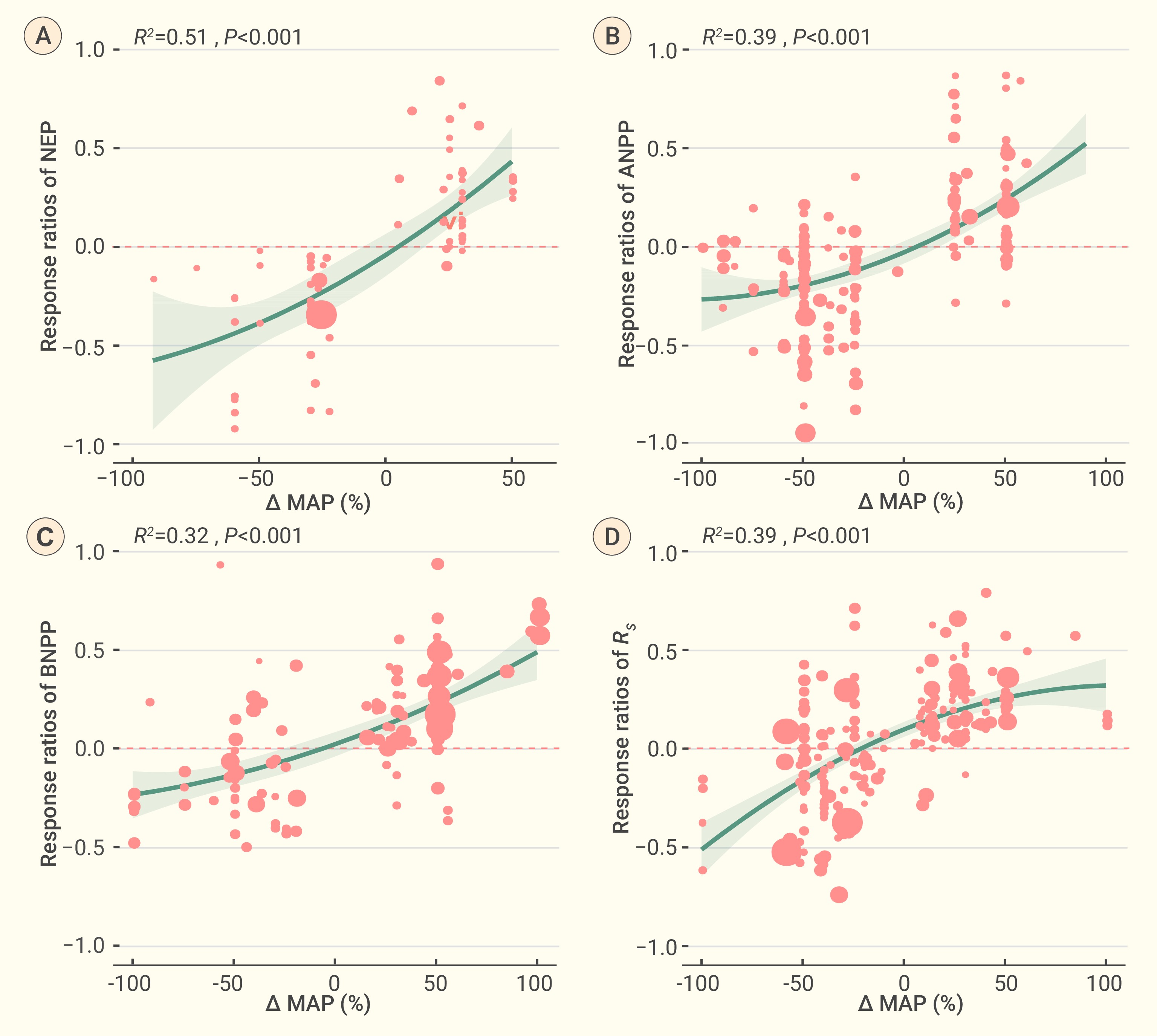
Figure 2.
Relationships between precipitation changes and the response ratios of NEP (A), ANPP (B), BNPP (C), and Rs at all sites (D)
-
Figure 3.
Changes in NEP, ANPP, BNPP, and Rs under the normalized precipitation change (40%)
-
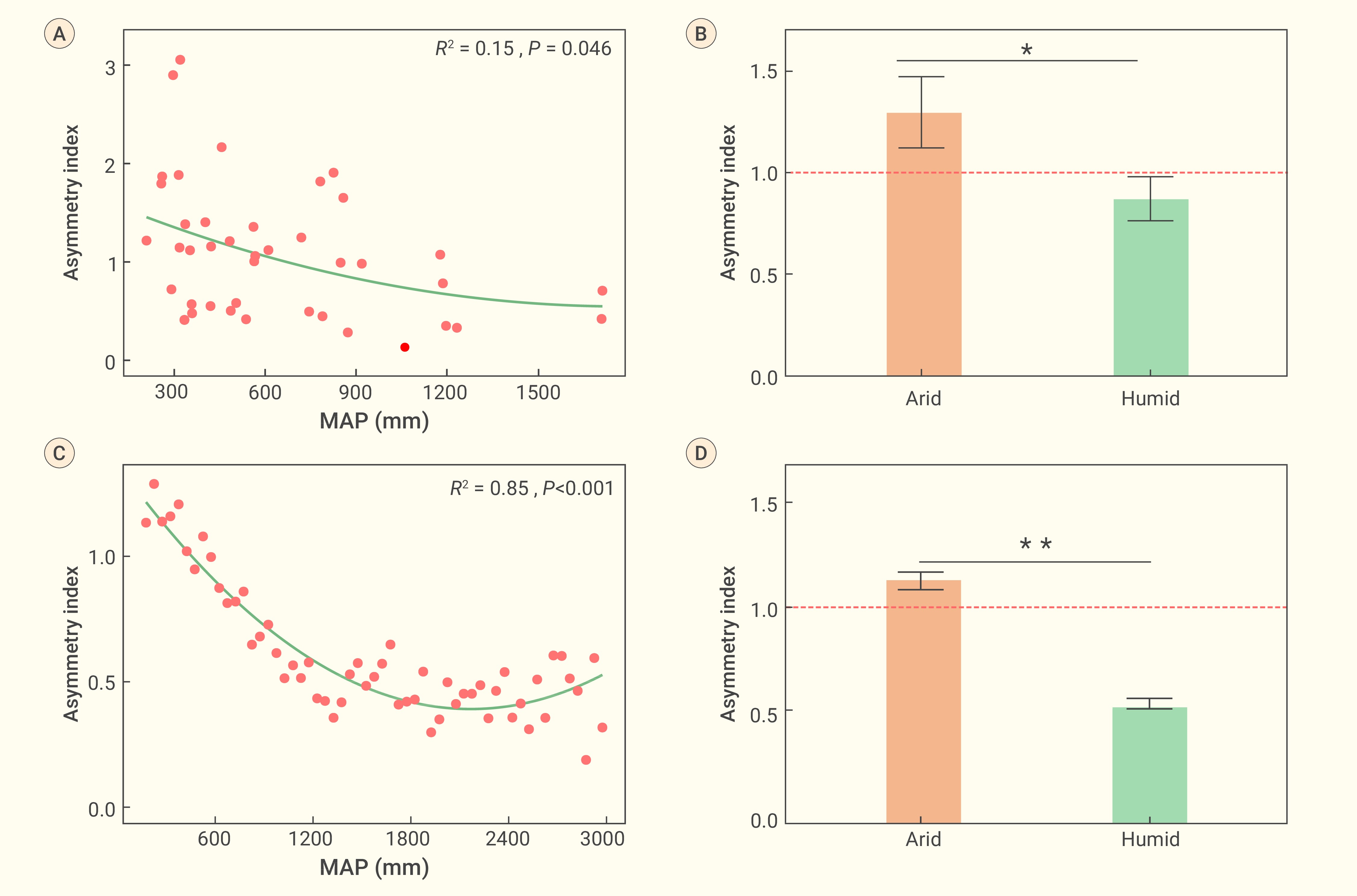
Figure 4.
Spatial variations of the asymmetry index (AS) of solar-induced chlorophyll fluorescence (SIF) along precipitation gradient
-
Figure 5.
Mechanism of asymmetric responses of carbon budget to changes in precipitation in arid regions (A) and humid regions (B)
-
Figure 6.
Comparison of responses of carbon fluxes to precipitation change between model simulations under the S3 scenario (changing climate, CO2, and N deposition) and observations along precipitation gradient
