
Historical land use and land cover change reduced the temperature of cold extremes more than that of hot extremes
-
GRAPHICAL ABSTRACT
 DownLoad:
Full size image
DownLoad:
Full size image
-
PUBLIC SUMMARY
-
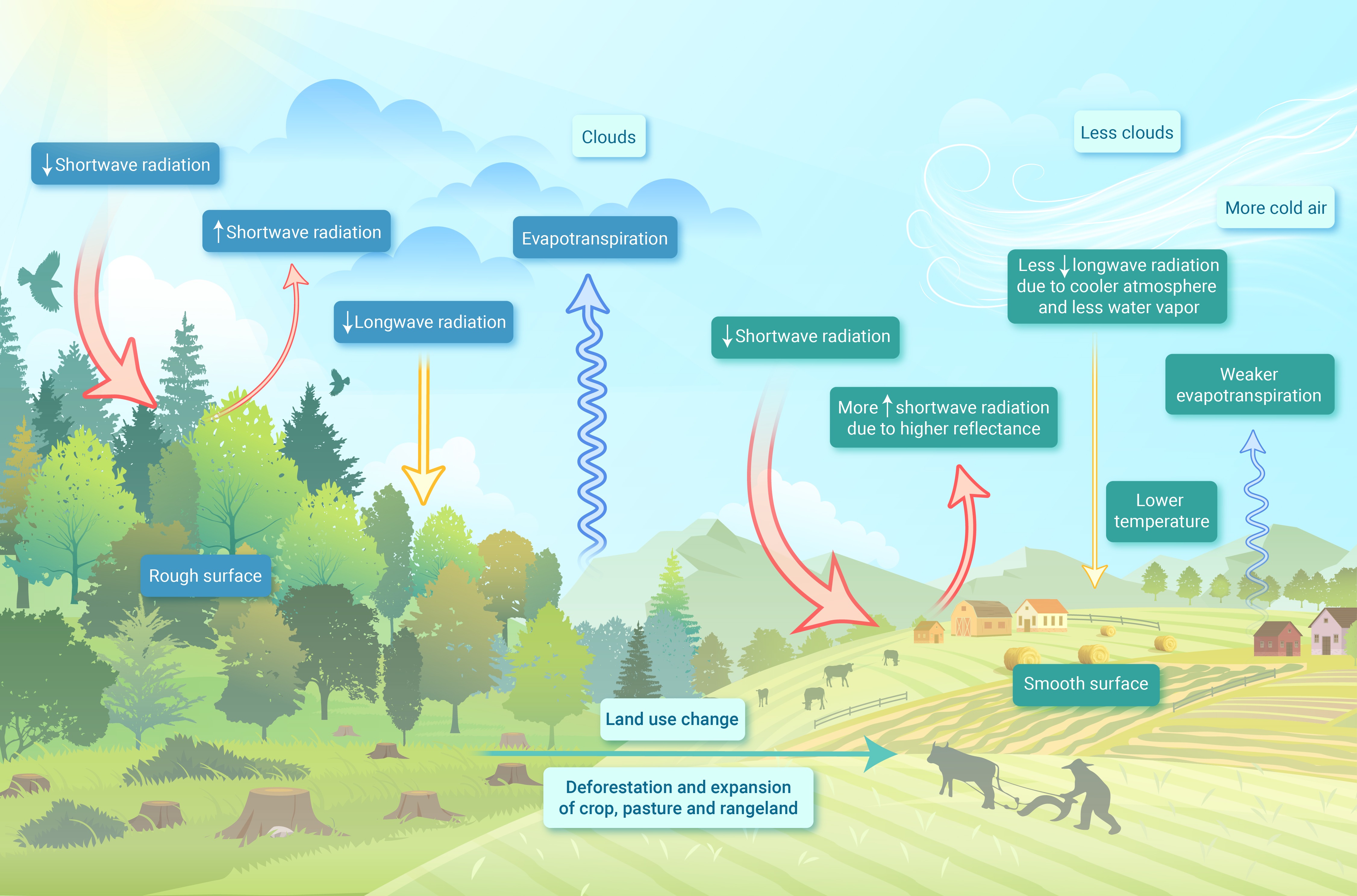
We quantified the impact of historical land use and land cover change (LULCC) on extreme temperature.
LULCC has enhanced cold extremes and alleviated hot extremes over the mid-latitudes of northern hemisphere.
The strongest changes are observed in the central and eastern North America and Europe.
These changes are largely the results of climate feedback due to LULCC.
-
-
ABSTRACT
The impact of historical land use and land cover change (LULCC) on the mean climate has been extensively studied, but its impact on temperature extremes is not well understood. This study investigates the biophysical effect of LULCC on temperature extremes using two sets of model simulations – one with land use fixed at 1850 level and the other with historical LULCC from 1850 to 2014. We find that the historical LULCC has two asymmetric effects: (i) it decreases the temperature of coldest day (–0.56 ± 0.23 K; mean ± std. error) more than that of the hottest day (–0.21 ± 0.07 K) at the mid-latitudes of northern hemisphere; and (ii) it has a stronger impact in the mid-latitudes of northern hemisphere relative to the tropical region. These changes result largely from an indirect effect of LULCC via changes in clouds, circulations, and the downward longwave radiation. We stress that the indirect effects from climate feedback of LULCC should be considered when implementing reforestation policy. -

-
REFERENCES
[1] Donat, M.G., Alexander, L.V., Yang, H., et al. (2013). Global land-based datasets for monitoring climatic extremes. Bull. Am. Meteorol. Soc. 94: 997−1006. DOI: 10.1175/BAMS-D-12-00109.1. [2] Hartmann, D., Klein Tank, A., Rusticucci, M., et al. (2013). Observations: Atmosphere and surface. Stoker, T. F., Qin, D., Plattner, G.-K. et al., (eds). Climate change 2013: The physical science basis. Contribution of working group I to the fifth assessment report of the intergovernmental panel on climate change (Cambridge University Press), pp. 159-254. [3] Hurtt, G.C., Chini, L., Sahajpal, R., et al. (2020). Harmonization of global land use change and management for the period 850–2100 (LUH2) for CMIP6. Geosci. Model Dev. 13 : 5425−5464. DOI: 10.5194/gmd-13-5425-2020. [4] Li, Y., Zhao, M., Motesharrei, S., et al. (2015). Local cooling and warming effects of forests based on satellite observations. Nat. Commun. 6: 6603. DOI: 10.1038/ncomms7603. [5] Perugini, L., Caporaso, L., Marconi, S., et al. (2017). Biophysical effects on temperature and precipitation due to land cover change. Environ. Res. Lett. 12: 053002. DOI: 10.1088/1748-9326/aa6b3f. [6] Tang, T., Lee, X., Zhang, K., et al. (2023). Biophysical impact of land-use and land-cover change on subgrid temperature in CMIP6 models. J. Hydrometeorol. 24: 373−388. DOI: 10.1175/JHM-D-22-0073.1. [7] Lee, X., Goulden, M.L., Hollinger, D.Y., et al. (2011). Observed increase in local cooling effect of deforestation at higher latitudes. Nature 479: 384−387. DOI: 10.1038/nature10588. [8] Davin, E.L. and de Noblet-Ducoudré, N. (2010). Climatic impact of global-scale deforestation: Radiative versus nonradiative processes. J. Clim. 23: 97−112. DOI: 10.1175/2009JCLI3102.1. [9] Chen, L. and Dirmeyer, P.A. (2016). Adapting observationally based metrics of biogeophysical feedbacks from land cover/land use change to climate modeling. Environ. Res. Lett. 11: 034002. DOI: 10.1088/1748-9326/11/3/034002. [10] Davin, E.L., Rechid, D., Breil, M., et al. (2020). Biogeophysical impacts of forestation in Europe: first results from the LUCAS (Land Use and Climate Across Scales) regional climate model intercomparison. Earth Syst. Dynam. 11: 183−200. DOI: 10.5194/esd-11-183-2020. [11] Boysen, L.R., Brovkin, V., Pongratz, J., et al. (2020). Global climate response to idealized deforestation in CMIP6 models. Biogeosciences 17: 5615−5638. DOI: 10.5194/bg-17-5615-2020. [12] Findell, K.L., Knutson, T.R., and Milly, P.C.D. (2006). Weak simulated extratropical responses to complete tropical deforestation. J. Clim. 19: 2835−2850. DOI: 10.1175/JCLI3737.1. [13] Avissar, R. and Werth, D. (2005). Global hydroclimatological teleconnections resulting from tropical deforestation. J. Hydrometeorol. 6: 134−145. DOI: 10.1175/JHM406.1. [14] Bala, G., Caldeira, K., Wickett, M., et al. (2007). Combined climate and carbon-cycle effects of large-scale deforestation. Proc. Natl. Acad. Sci. USA 104: 6550−6555. DOI: 10.1073/pnas.0608998104. [15] Zhang, H., Henderson-Sellers, A., and McGuffie, K. (2001). The compounding effects of tropical deforestation and greenhouse warming on climate. Clim. Change 49: 309−338. DOI: 10.1023/A:1010662425950. [16] Lawrence, D. and Vandecar, K. (2015). Effects of tropical deforestation on climate and agriculture. Nat. Clim. Change 5: 27−36. DOI: 10.1038/nclimate2430. [17] Lejeune, Q., Davin, E.L., Gudmundsson, L., et al. (2018). Historical deforestation locally increased the intensity of hot days in northern mid-latitudes. Nat. Clim. Change 8: 386−390. DOI: 10.1038/s41558-018-0131-z. [18] Chen, L. and Dirmeyer, P.A. (2019). The relative importance among anthropogenic forcings of land use/land cover change in affecting temperature extremes. Clim. Dynam. 52: 2269−2285. DOI: 10.1007/s00382-018-4250-z. [19] Christidis, N., Stott, P.A., Hegerl, G.C., et al. (2013). The role of land use change in the recent warming of daily extreme temperatures. Geophys. Res. Lett. 40: 589−594. DOI: 10.1002/grl.50159. [20] Findell, K.L., Berg, A., Gentine, P., et al. (2017). The impact of anthropogenic land use and land cover change on regional climate extremes. Nat. Commun. 8: 989. DOI: 10.1038/s41467-017-01038-w. [21] Betts, R.A. (2001). Biogeophysical impacts of land use on present-day climate: Near-surface temperature change and radiative forcing. Atmos. Sci. Lett. 2: 39−51. DOI: 10.1006/asle.2001.0023. [22] Davin, E.L., de Noblet-Ducoudré, N., and Friedlingstein, P. (2007). Impact of land cover change on surface climate: Relevance of the radiative forcing concept. Geophys. Res. Lett. 34: L13702. DOI: 10.1029/2007GL029678. [23] Flato, G., Marotzke, J., Abiodun, B., et al. (2013). Evaluation of climate models. T.F. Stoker, D. Qin, G.-K. Plattner, et al., eds. Climate change 2013: The physical science basis. Contribution of working group I to the fifth assessment report of the intergovernmental panel on climate change (Cambridge University Press), pp. 741-866. [24] Yun, W.T., Stefanova, L., and Krishnamurti, T.N. (2003). Improvement of the multimodel superensemble technique for seasonal forecasts. J. Clim. 16: 3834−3840. DOI: 2.0.CO;2">10.1175/1520-0442(2003)016<3834:IOTMST>2.0.CO;2. [25] Sillmann, J., Kharin, V.V., Zhang, X., et al. (2013). Climate extremes indices in the CMIP5 multimodel ensemble: Part 1. J. Geophys. Res. Atmos. 118: 1716−1733. DOI: 10.1002/jgrd.50203. [26] Lawrence, D.M., Hurtt, G.C., Arneth, A., et al. (2016). The land use model intercomparison project (LUMIP) contribution to CMIP6: Rationale and experimental design. Geosci. Model Dev. 9: 2973−2998. DOI: 10.5194/gmd-9-2973-2016. [27] Klein Goldewijk, K., Beusen, A., Doelman, J., et al. (2017). Anthropogenic land use estimates for the Holocene – HYDE 3.2. Earth Syst. Sci. Data 9 : 927-953. DOI: 10.5194/essd-9-927-2017. [28] Thiery, W., Visser, A.J., Fischer, E.M., et al. (2020). Warming of hot extremes alleviated by expanding irrigation. Nat. Commun. 11: 290. DOI: 10.1038/s41467-019-14075-4. [29] Ramanathan, V., Cess, R.D., Harrison, E.F., et al. (1989). Cloud-radiative forcing and climate: Results from the Earth radiation budget experiment. Science 243: 57−63. DOI: 10.1126/science.243.4887.57. [30] Clark, J.P., Clothiaux, E.E., Feldstein, S.B., et al. (2021). Drivers of global clear sky surface downwelling longwave irradiance trends from 1984 to 2017. Geophys. Res. Lett. 48: e2021GL093961. DOI: 10.1029/2021GL093961. [31] Chen, S., Wu, R., Chen, W., et al. (2020). Coherent interannual variations of springtime surface temperature and temperature extremes between Central-Northern Europe and Northeast Asia. J. Geophys. Res. Atmos. 125: e2019JD032226. DOI: 10.1029/2019JD032226. [32] Chen, S., Wu, R., Song, L., et al. (2018). Combined influence of the arctic oscillation and the scandinavia pattern on spring surface air temperature variations over Eurasia. J. Geophys. Res. Atmos. 123: 9410−9429. DOI: 10.1029/2018JD028685. [33] Horton, D.E., Johnson, N.C., Singh, D., et al. (2015). Contribution of changes in atmospheric circulation patterns to extreme temperature trends. Nature 522: 465−469. DOI: 10.1038/nature14550. [34] Zhu, Y., Wang, D., Smith, P., et al. (2022). What can the Glasgow Declaration on Forests bring to global emission reduction. The Innovation 3: 100307. DOI: 10.1016/j.xinn.2022.100307. [35] Liang, S., Liang, L., Wang, D., et al. (2024). Dryland forestation: Uncovering the carbon sequestration potential. The Innovation Geoscience 2: 100058. DOI: 10.59717/j.xinn-geo.2024.100058. [36] Cook, B.I., Puma, M.J., and Krakauer, N.Y. (2011). Irrigation induced surface cooling in the context of modern and increased greenhouse gas forcing. Clim. Dynam. 37: 1587−1600. DOI: 10.1007/s00382-010-0932-x. [37] Alkama, R. and Cescatti, A. (2016). Biophysical climate impacts of recent changes in global forest cover. Science 351: 600. DOI: 10.1126/science.aac8083. [38] Monier, E., Gao, X., Scott, J.R., et al. (2015). A framework for modeling uncertainty in regional climate change. Clim. Change 131: 51−66. DOI: 10.1007/s10584-014-1112-5. [39] Tebaldi, C. and Knutti, R. (2007). The use of the multi-model ensemble in probabilistic climate projections. Philos. Tr. Soc. A 365: 2053−2075. DOI: 10.1098/rsta.2007.2076. -
ABOUT THIS ARTICLE
Cite this article:
Tang T., Lee X., and Zhang K. (2024). Historical land use and land cover change reduced the temperature of cold extremes more than that of hot extremes. The Innovation Geoscience 2(3): 100079. https://doi.org/10.59717/j.xinn-geo.2024.100079
Welcome!
To request copyright permission to republish or share portions of our works, please visit Copyright Clearance Center's (CCC) Marketplace website at marketplace.copyright.com.
Article Metrics
Relative Articles
Cited by
Export File
Citation
Tang T., Lee X., and Zhang K. (2024). Historical land use and land cover change reduced the temperature of cold extremes more than that of hot extremes. The Innovation Geoscience 2(3): 100079. https://doi.org/10.59717/j.xinn-geo.2024.100079

Format
Content


-
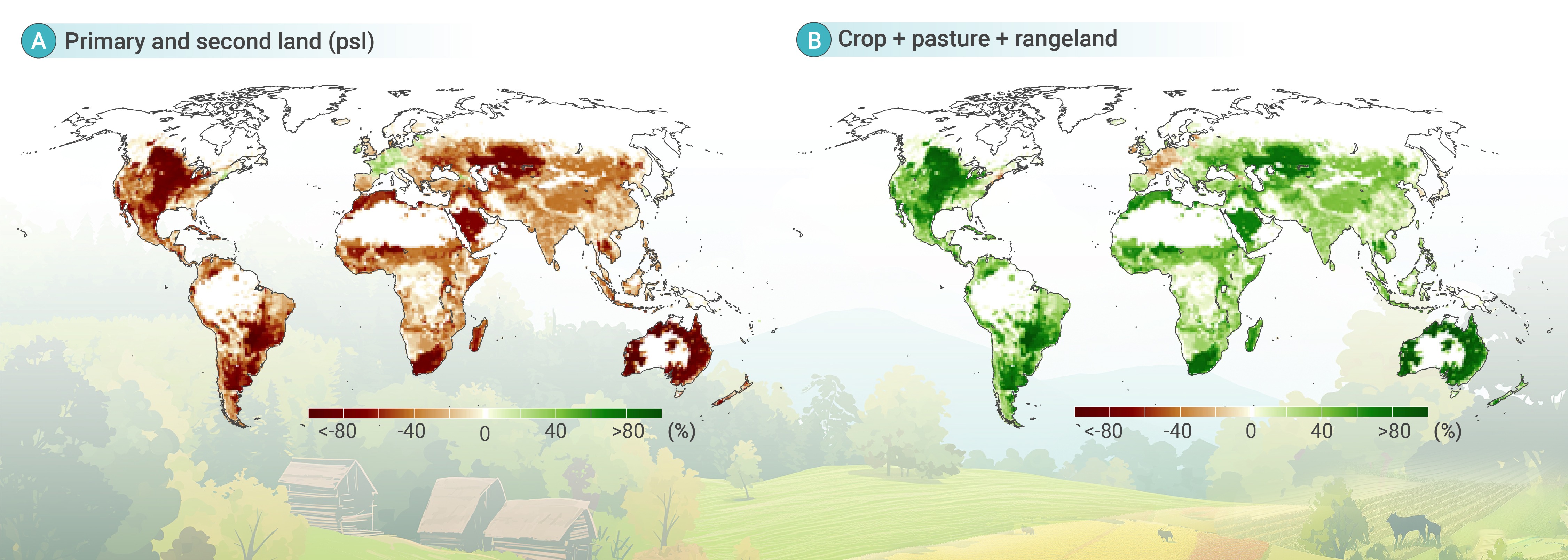
Figure 1.
Spatial pattern of fractional changes of land type in each gridcell in 1995-2014 relative to 1850
-
Figure 2.
Spatial pattern of MMM changes of extreme temperature indices
-
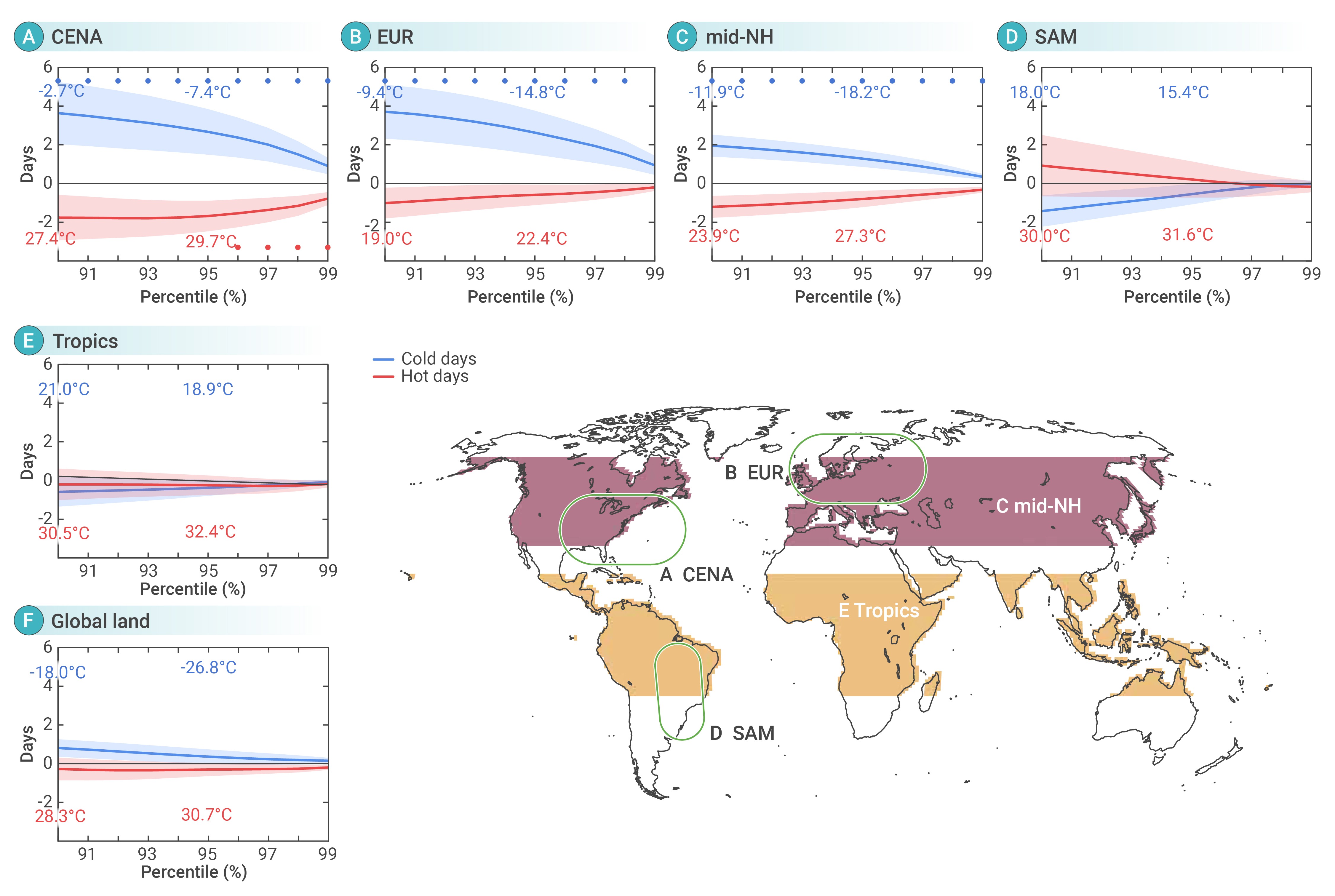
Figure 3.
Changes in the number of extreme cold (blue) and hot days (red) as functions of percentile for the selected regions
-
Figure 4.
Direct (left column) and indirect (middle column) effects of LULCC on the four temperature indices
-
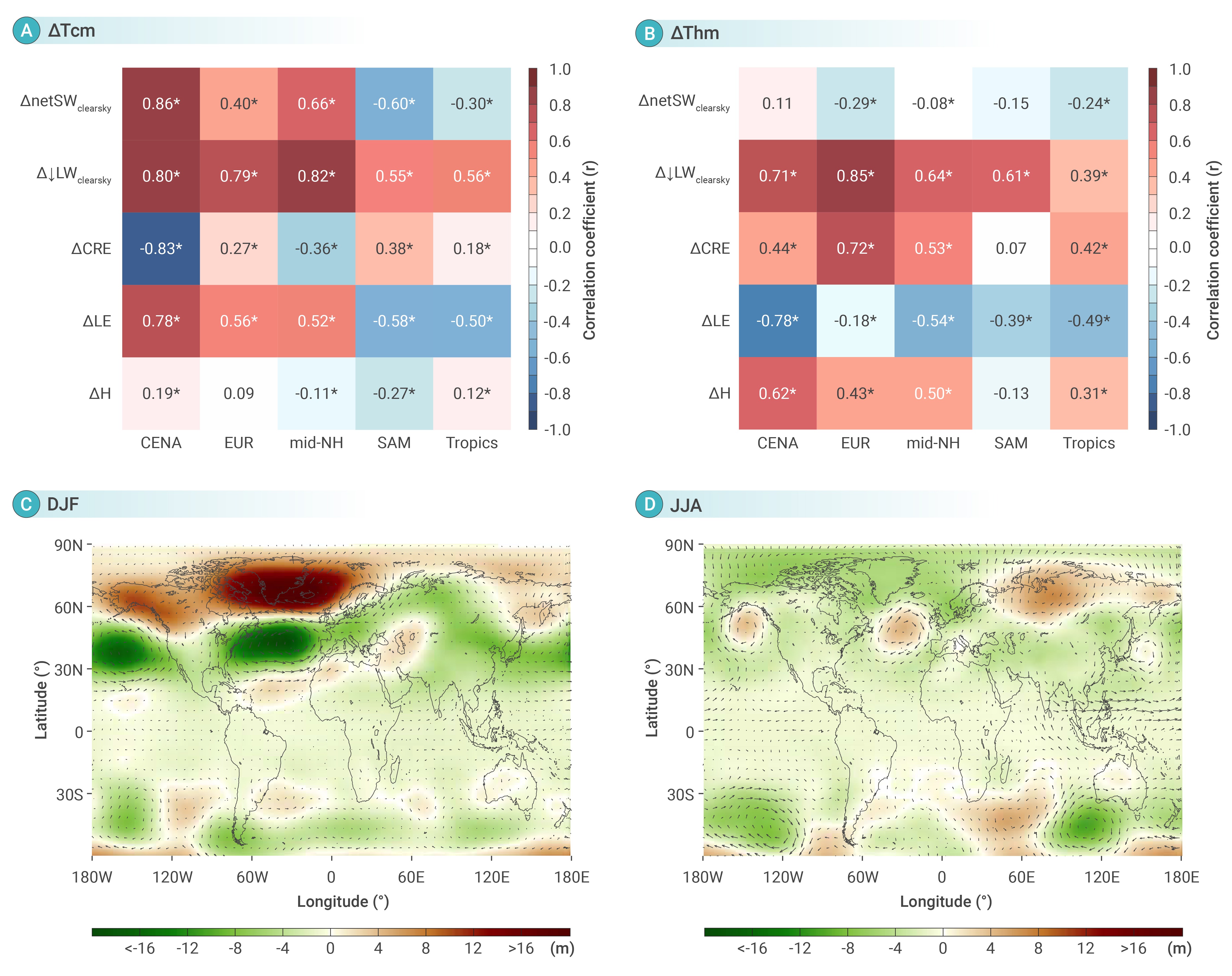
Figure 5.
Changes of surface energy budget and circulations
