
Chicken or egg? Recipes for creating Earth’s continental crust
-

-
REFERENCES
[1] Chowdhury, P., Mulder, J.A., Cawood, P.A. et al. (2021). Magmatic thickening of crust in non–plate tectonic settings initiated the subaerial rise of Earth’s first continents 3.3 to 3.2 billion years ago. Proc. Natl. Acad. Sci. USA 118 : e2105746118. DOI:10.1073/pnas.2105746118. [2] Nebel, O., Capitanio, F.A., Moyen, J.F., et al. (2018). When crust comes of age: on the chemical evolution of Archaean, felsic continental crust by crustal drip tectonics. Phil. Trans. R. Soc. A 376: 20180103. DOI: 10.1098/rsta.2018.0103. [3] Reimink, J.R. and Smye, A.J. (2024). Subaerial weathering drove stabilization of continents. Nature 629 : 609-615. DOI:10.1038/s41586-024-07307-1. [4] Tamblyn, R., Hermann, J., Hasterok, D., et al. (2023). Hydrated komatiites as a source of water for TTG formation in the Archean. Earth Planet. Sci. Lett. 603 : 117982. DOI:10.1016/j.jpgl.2022.117982. [5] Arndt, N. (2023). How did the continental crust form: No basalt, no water, no granite. Precambrian Res. 397 : 107196. DOI:10.1016/j.precamres.2023.107196. -
ABOUT THIS ARTICLE
Cite this article:
Roberts N. (2024). Chicken or egg? Recipes for creating Earth’s continental crust. The Innovation Geoscience 2(3): 100091. https://doi.org/10.59717/j.xinn-geo.2024.100091
Welcome!
To request copyright permission to republish or share portions of our works, please visit Copyright Clearance Center's (CCC) Marketplace website at marketplace.copyright.com.
Export File
Citation
Roberts N. (2024). Chicken or egg? Recipes for creating Earth’s continental crust. The Innovation Geoscience 2(3): 100091. https://doi.org/10.59717/j.xinn-geo.2024.100091

Format
Content
 DownLoad:
-
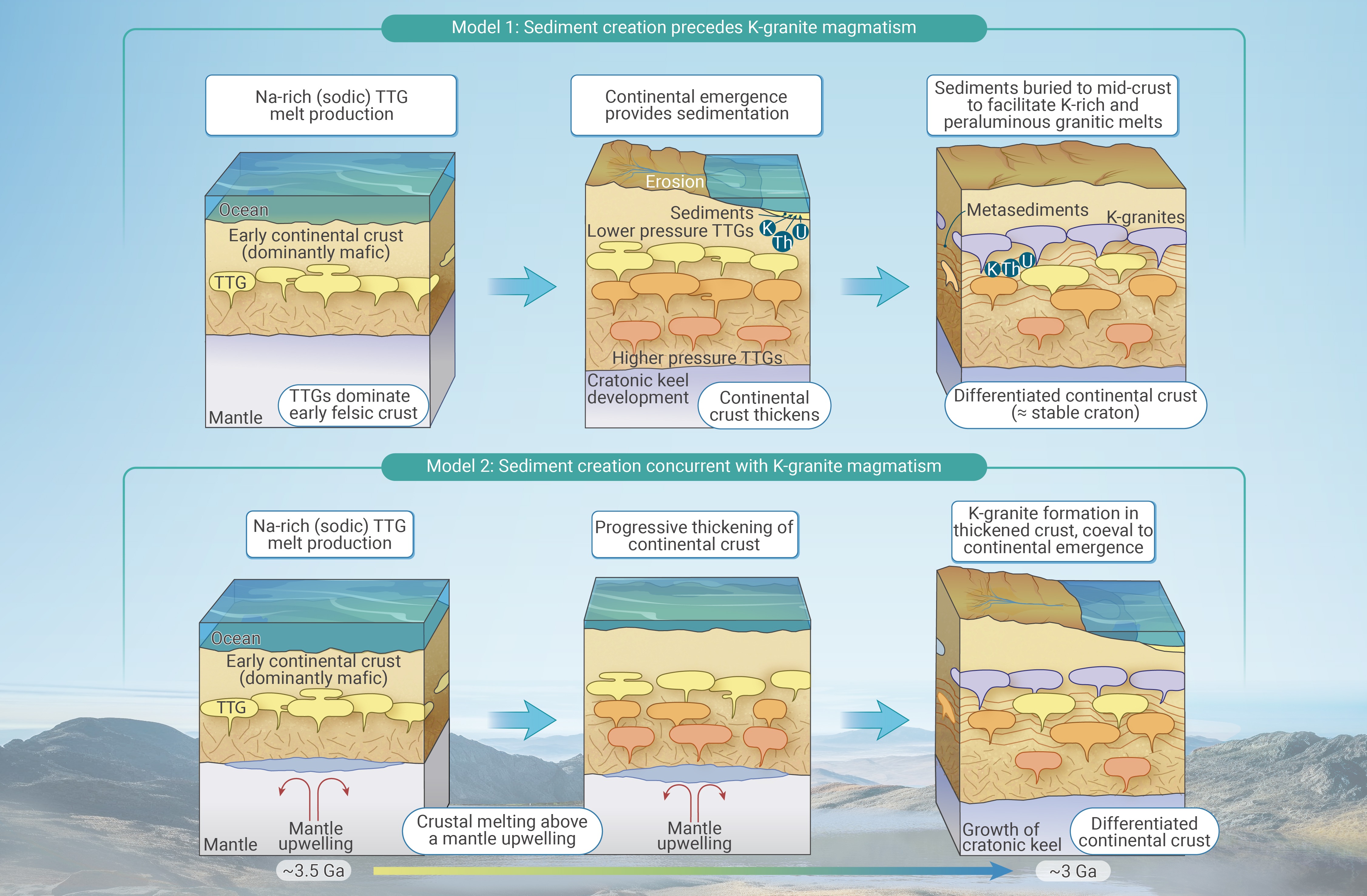
Figure 1.
Two contrasting models for creating stable and emergent continental crust
