
Digital twin of earth: A novel information framework for managing a sustainable earth
-
ABSTRACT
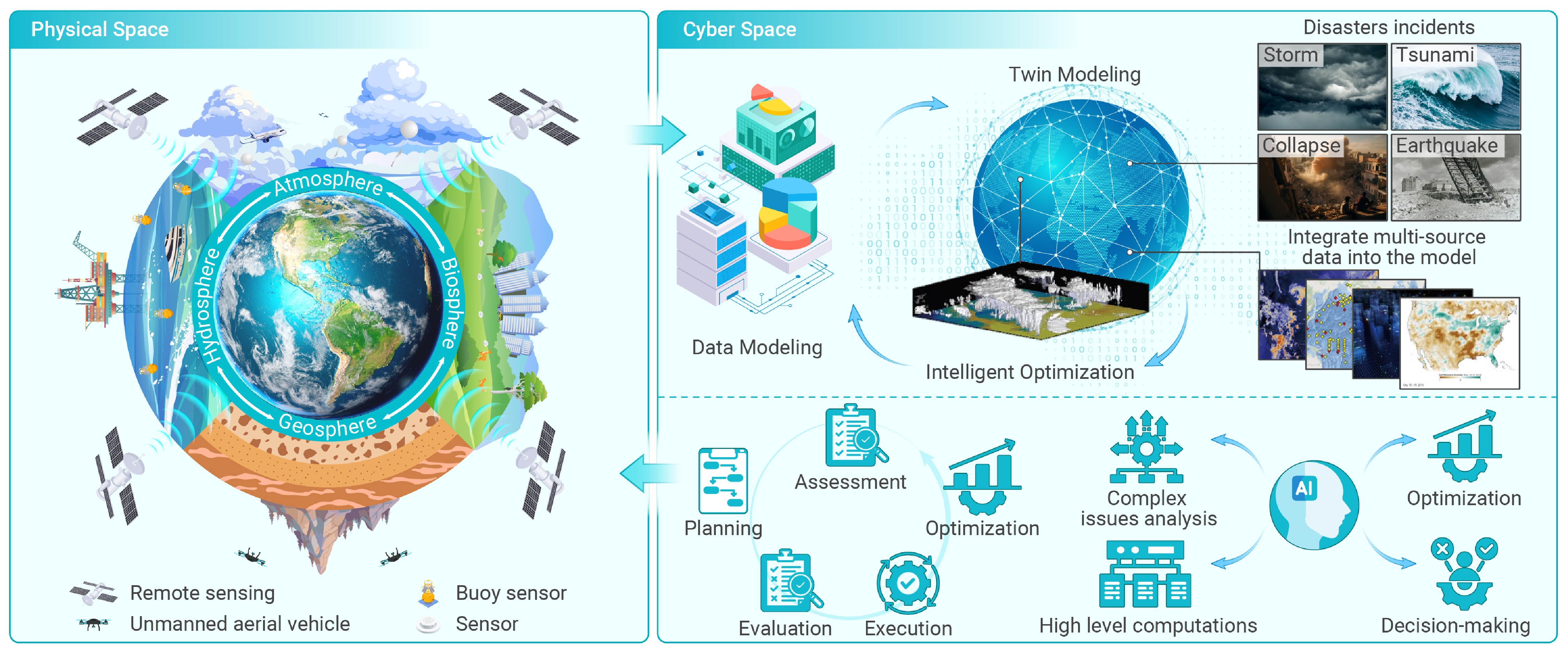
As the progress of human society rapidly enters a new stage, sustainable development has become an essential target. It is necessary to have an effective approach to managing the resources and ecosystems of Earth, with the target of promoting sustainable development while meeting the needs and requirements of both present and future generations. Digital twin technology provides a fresh perspective on sustainable management with a better understanding of the interconnectedness of Earth's systems and accurate simulation and prediction of future changes. By integrating various types of data and models, including climate models, geophysical models, and social media data, a digital twin of Earth can simulate and analyze various aspects of the planet. The digital twin of Earth leverages real-time multi-source data integration through advanced IoT and wireless sensor networks, feeding into a data lake architecture that supports the seamless integration and processing of heterogeneous data. The integrated data then informs dynamic models, combining numerical simulation models with intelligent algorithms for enhanced prediction and analysis. This approach emphasizes the integration of environmental, social, and economic considerations into decision-making that balances economic growth, social well-being, and environmental protection to achieve sustainable development. This paper introduces the definition and information framework of the new concept of a digital twin of Earth to promote the current research on Earth management based on digital transformation techniques. -

-
REFERENCES
[1] Hai, C. (2020). Future Earth and sustainable developments. The Innovation 1: 100055. DOI: 10.1016/j.xinn.2020.100055. [2] Peng G., Huadong G., Bin C., et al. (2023). iEarth: An interdisciplinary framework in the era of big data and AI for sustainable development. Natl. Sci. Rev. 10: nwad178. DOI: 10.1093/nsr/nwad178. [3] Guo, H., Nativi, S., Liang, D., et al. (2020). Big earth data science: An information framework for a sustainable planet. Int. J. Digit. Earth 13: 743−767. DOI: 10.1080/17538947.2020.1743785. [4] Grieves, M. and John V. (2017). Digital twin: Mitigating unpredictable, undesirable emergent behavior. Franz-Josef, K., Shannon, F., Anabela, A. (ed). Transdisciplinary perspectives on complex systems: New findings and approaches. (Springer), pp: 85–113. DOI: 10.1007/978-3-319-38756-7_4. [5] Caldarelli, G., Arcaute, E., Barthelemy, M., et al. (2023). The role of complexity for digital twins of cities. Nat. Comput. Sci. 3: 374−381. DOI: 10.1038/s43588-023-00431-4. [6] Bauer, P., Stevens, B., and Hazeleger, W. A. (2021). A Digital twin of Earth for the green transition. Nat. Clim. Change 11: 80−83. DOI: 10.1038/s41558-021-00986-y. [7] Frolov, S., Rousseaux, C. S., Auligne, T., et al. (2023). Road map for the next decade of earth system reanalysis in the United States. Bull. Am. Meteorol. Soc. 104: E706−E714. DOI: 10.1175/BAMS-D-23-0011.1. [8] Capone, D. G., Popa, R., Flood, B., et al. (2006). Follow the nitrogen. Science 312: 708−709. DOI: 10.1126/science.1111863. [9] Yang, W., Wang, F., Ma, L., et al. (2023). An international journal of Earth science. The Innovation Geoscience 1: 100001. DOI: 10.59717/j.xinn-geo.2023.100001. [10] Popescu, D. C. and Dumitrache, I. (2021). Relational modeling framework for complex systems. U.P.B. Sci. Bull., Series C 83 : 16-28. https://www.scientificbulletin.upb.ro/rev_docs_arhiva/rez3a6_719008.pdf. -
ABOUT THIS ARTICLE
Cite this article:
Wang Y., Wang L., Han W., et al., (2024). Digital twin of earth: A novel information framework for managing a sustainable earth. The Innovation Geoscience 2(4): 100092. https://doi.org/10.59717/j.xinn-geo.2024.100092
Welcome!
To request copyright permission to republish or share portions of our works, please visit Copyright Clearance Center's (CCC) Marketplace website at marketplace.copyright.com.
Export File
Citation
Wang Y., Wang L., Han W., et al., (2024). Digital twin of earth: A novel information framework for managing a sustainable earth. The Innovation Geoscience 2(4): 100092. https://doi.org/10.59717/j.xinn-geo.2024.100092

Format
Content
 DownLoad:
-
Figure 1.
An Information Framework of DTE to support sustainable Earth management.
