
A novel framework for leveraging geological environment big data to assess sustainable development goals
-
ABSTRACT
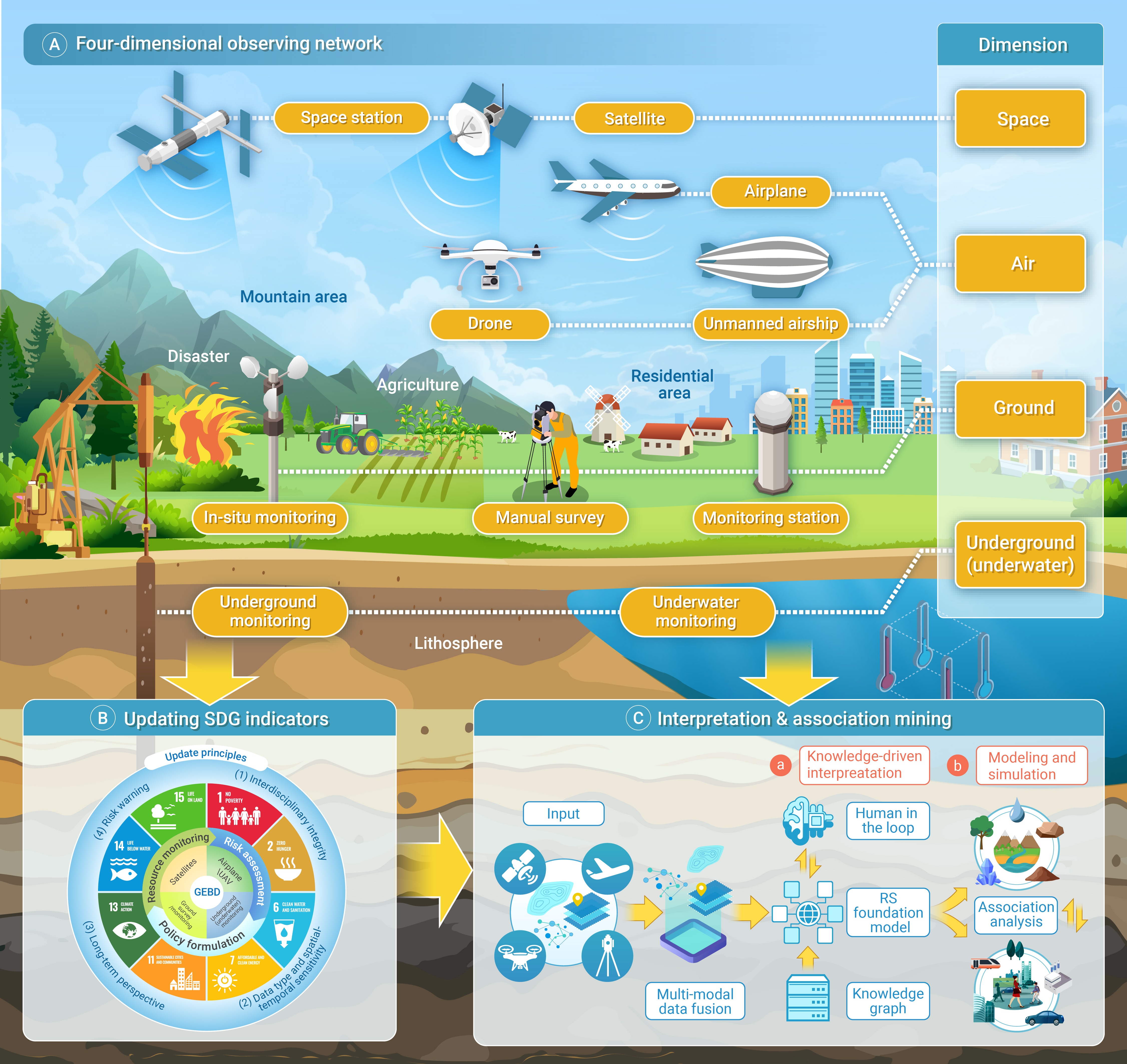
Geological environmental big data (GEBD) offers a significant opportunity for the comprehensive monitoring of the Earth’s shallow structures, dynamic processes, and their interactions among surface spheres, promisingly contributing to the precise assessment of sustainable development goals (SDGs). To systematically harness the potential of GEBD in SDG assessment, an innovative framework has been developed to address current challenges through a four-dimensional observation network, a strategy of integrating GEBD into SDG indicators, and a knowledge-driven association-mining method. This framework potentially provides a series of positive and profound impacts, ranging from technology development and environmental conservation to enhanced public awareness. -

-
REFERENCES
[1] Han W., et al. (2023). A survey of machine learning and deep learning in remote sensing of geological environment: Challenges, advances, and opportunities, ISPRS J. Photogramm. Remote Sens. 202:87-113. DOI:10.1016/j.isprsjprs.2023.05.032 [2] United Nations. (2022). The sustainable development goals: Report 2022. https://unstats.un.org/sdgs/report/2022/The-Sustainable-Development-Goals-Report-2022.pdf [3] United Nations. (2015). Transforming our world: The 2030 Agenda for sustainable. https://documents.un.org/doc/undoc/gen/n15/291/89/pdf/n1529189.pdf [4] Gill J C., (2017). Geology and the sustainable development goals, Episodes 4:70-76. DOI:10.18814/epiiugs/2017/v40i1/017010 [5] Luo L., et al., (2023). Space technology: A powerful tool for safeguarding world heritage, The Innovation 4:100420. DOI:10.1016/j.xinn.2023.100420 [6] LeCun Y., et al., (2015). Deep learning, Nature 521:436-444. DOI:10.1038/nature14539 [7] Guo H., et al., (2022). Measuring and evaluating SDG indicators with Big Earth Data, Science Bulletin 67:1792-1801. DOI:10.1016/j.scib.2022.07.015 [8] Gao J., et al., (2022). Urban land patterns can moderate population exposures to climate extremes over the 21st century, Nature Communications 14:6536. DOI:10.1038/s41467-023-42084-x [9] Zhao T., et al., (2024). Artificial intelligence for geoscience: Progress, challenges and perspectives, The Innovation 5:100691. DOI:10.1016/i.xinn.2024.100691 [10] Mosqueira-Rey E., et al., (2023). Human-in-the-loop machine learning: A state of the art, Artificial Intelligence Review 56:3005-3054. DOI:10.1007/s10462-022-10246-W -
ABOUT THIS ARTICLE
Cite this article:
Han W., Wang L., Wang Y., et al. (2025). A novel framework for leveraging geological environment big data to assess sustainable development goals. The Innovation Geoscience 3:100122. https://doi.org/10.59717/j.xinn-geo.2024.100122
Welcome!
To request copyright permission to republish or share portions of our works, please visit Copyright Clearance Center's (CCC) Marketplace website at marketplace.copyright.com.
Export File
Citation
Han W., Wang L., Wang Y., et al. (2025). A novel framework for leveraging geological environment big data to assess sustainable development goals. The Innovation Geoscience 3:100122. https://doi.org/10.59717/j.xinn-geo.2024.100122

Format
Content
 DownLoad:
-
Figure 1.
The overall structure of the proposed framework.
