
Mercury evidences link intensive volcanism to the Late Ordovician mass extinction and changes in the atmosphere-land-ocean system
-
GRAPHICAL ABSTRACT

 DownLoad:
Full size image
DownLoad:
Full size image
-
PUBLIC SUMMARY
-
Organic matter and sulfides are both important hosts of Hg during the Late Ordovician Mass Extinction.
Hg isotopes across the Ordovician-Silurian transition indicate multiple Hg sources linked to volcanism.
Intensive volcanism induced significant changes in the atmosphere-land-ocean system.
-
-
ABSTRACT
The Late Ordovician mass extinction (LOME, ca. 445 Ma), which occurred over two extinction intervals (LOMEI-1 and LOMEI-2), was the first “Big Five” biotic crises of the Phanerozoic. The ultimate trigger of this extinction remains debated, with glacially induced global cooling and volcanism-driven warming events separately suggested as the underlying cause. Here, we report anomalously high mercury (Hg) levels in two Ordovician-Silurian successions from a shelf-to-slope transect in South China, indicating abnormally high Hg loading to the ocean. Analyses of Hg isotopes through the successions reveal near-zero Δ199Hg from the late Katian to the earliest Hirnantian (LOMEI-1), suggesting that Hg was mainly derived from large-scale volcanism. Positive shifts in Δ199Hg are observed during the Hirnantian stage, coincident with global glaciation, suggesting enhanced Hg sequestration to sediments driven by subsidence of cold and dense surface seawater. Negative shifts in Δ199Hg values across the LOMEI-2 within the Hirnantian likely suggest enhanced terrestrial Hg and sulfate fluxes to the ocean due to volcanism-induced global warming, which promoted oceanic anoxic/euxinic conditions. This study provides novel evidences linking intensive volcanism to significant changes in the atmosphere-land-ocean system across the Ordovician-Silurian transition, particularly to the euxinic ocean conditions that triggered the LOME. -

-
REFERENCES
[1] Sheehan P.M. (2001). The Late Ordovician mass extinction. Annu. Rev. Earth Planet. Sci. 29:331−364. DOI:10.1146/annurev.earth.29.1.331 [2] Melchin M.J., Mitchelll C.E., Holmden C., et al. (2013). Environmental changes in the Late Ordovician–early Silurian: Review and new insights from black shales and nitrogen isotopes. Geol. Soc. Am. Bull. 125:1635−1670. DOI:10.1130/B30812.1 [3] Fan J.X., Shen S.Z., Erwin D.H., et al. (2020). A high-resolution summary of Cambrian to Early Triassic marine invertebrate biodiversity. Science 367:272−277. DOI:10.1126/science.aax4953 [4] Harper D.A.T., Hammarlund E.U. and Rasmussen C.M.Ø. (2014) End Ordovician extinctions: A coincidence of causes. Gondwana Res. 25:1294-1307. DOI: 10.1016/j.gr.2012.12.021. [5] Rong J.Y., Harper D.A.T., Huang B., et al. (2020). The latest Ordovician Hirnantian brachiopod faunas: New global insights. Earth-Sci. Rev. 208:103280. DOI:10.1016/j.earscirev.2020.103280 [6] Qiu Z., Zou C.N., Mills B.J.W., et al. (2022). A nutrient control on expanded anoxia and global cooling during the Late Ordovician mass extinction. Commun. Earth Environ. 3:82. DOI:10.1038/s43247-022-00412-x [7] Brenchley P.J. (1984). Late Ordovician extinctions and their relationship to the Gondwana glaciation. Geol. J. 11:291−315. [8] Bond D.P.G. and Grasby S.E. (2020). Late Ordovician mass extinction caused by volcanism, warming, and anoxia, not cooling and glaciation. Geology 48:777−781. DOI:10.1130/G47377.1 [9] Grasby S.E., and Bond D.P.G. (2023). How Large Igneous Provinces Have Killed Most Life on Earth-Numerous Times. Elements 19:276−281. DOI:10.2138/gselements.19.5.276 [10] Jones D.S., Martini A.M., Fike D.A., et al. (2017). A volcanic trigger for the Late Ordovician mass extinction. Mercury data from south China and Laurentia. Geology 45:631−634. DOI:10.1130/G38940.1 [11] Gong Q., Wang X.D., Zhao L.S., et al. (2017). Mercury spikes suggest volcanic driver of the Ordovician-Silurian mass extinction. Sci. Rep. 7:5304. DOI:10.1038/s41598-017-05524-5 [12] Smolarek-Lach J., Marynowski L., Trela W., et al. (2019). Mercury spikes indicate a volcanic trigger for the Late Ordovician mass extinction event: An example from a deep shelf of the Peri-Baltic Region. Sci. Rep. 9:3139. DOI:10.1038/s41598-019-39333-9 [13] Hu D.P., Li M.H., Chen J.B., et al. (2021). Major volcanic eruptions linked to the Late Ordovician mass extinction: Evidence from mercury enrichment and Hg isotopes. Global Planet. Change 196:103374. DOI:10.1016/j.gloplacha.2020.103374 [14] Percival L.M., Ruhl M., Hesselbo S.P., et al. (2017). Mercury evidence for pulsed volcanism during the end-Triassic mass extinction. Natl. Acad. Sci. USA 114:7929−7934. DOI:10.1073/pnas.1705378114 [15] Grasby S.E., Them T.R., Chen Z., et al. (2019). Mercury as a proxy for volcanic emissions in the geologic record. Earth-Sci. Rev. 196:102880. DOI:10.1016/j.earscirev.2019.102880 [16] Liu Y., Li Y.C., Hou M.C., et al. (2023). Terrestrial rather than volcanic mercury inputs to the Yangtze Platform (South China) during the Ordovician-Silurian transition. Global Planet. Change 220:104023. DOI:10.1016/j.gloplacha.2022.104023 [17] Hammarlund E.U., Dahl T.W., Harper D.A., et al. (2012) A sulfidic driver for the end-Ordovician mass extinction. Earth Planet. Sci. Lett. 331-332:128-139. DOI: 10.1016/j.jpgl.2012.02.024. [18] Zou C.N., Qiu Z., Poulton S.W., et al. (2018). Ocean euxinia and climate change “double whammy” drove the Late Ordovician mass extinction. Geology 46:535−538. DOI:10.1130/G40121.1 [19] Blum J.D., Sherman L.S., and Johnso M.W. (2014). Mercury isotopes in earth and environmental sciences. Annu. Rev. Earth Planet. Sci. 42:249−269. DOI:10.1146/annurev-earth-050212-124107 [20] Yin R.S., Chen D., Pan X., et al. (2022). Mantle Hg isotopic heterogeneity and evidence of oceanic Hg recycling into the mantle. Nat. Commun. 13:948. DOI:10.1038/s41467-022-28577-1 [21] Yin R.S., Wang X.Y., Sun R.Y., et al. (2024). Linking the mercury biogeochemical cycle to the deep mercury cycle: A mercury isotope perspective. Chem. Geol. 654:122063. DOI:10.1016/j.chemgeo.2024.122063 [22] Lu Y.B., Shen J., Wang Y.X., et al. (2022). Seawater sources of Hg enrichment in Ordovician-Silurian boundary strata, South China. Palaeogeogr. Palaeoclimatol. Palaeoecol. 601:111156. DOI:10.1016/j.palaeo.2022.111156 [23] Qiu Z., Wei H.Y., Tian L., et al. (2022). Different controls on the Hg spikes linked the two pulses of the Late Ordovician mass extinction in South China. Sci. Rep. 12:5195. DOI:10.1038/s41598-022-08941-3 [24] Chen X., Rong J.Y., Li Y., et al. (2004). Facies patterns and geography of the Yangtze region, South China, through the Ordovician and Silurian transition. Palaeogeogr. Palaeoclimatol. Palaeoecol. 204:353−372. DOI:10.1016/S0031-0182(03)00736-3 [25] Su W.B., Huff W.D., Ettensohn F.R., et al. (2009). K-bentonite, black-shale and flysch successions at the Ordovician-Silurian transition, South China: Possible sedimentary responses to the accretion of Cathaysia to the Yangtze Block and its implications for the evolution of Gondwana. Gondwana Res. 15:111−130. DOI:10.1016/j.gr.2008.06.004 [26] Qiu Z. and Zou C.N. (2020). Controlling factors on the formation and distribution of “sweet-spot areas” of marine gas shales in South China and a preliminary discussion on unconventional petroleum sedimentology. J. Asian Earth Sci. 194:103989. DOI:10.1016/j.jseaes.2019.103989 [27] Qiu Z., Liu B., Lu B., et al. (2022). Mineralogical and petrographic characteristics of the Ordovician-Silurian Wufeng-Longmaxi Shale in the Sichuan Basin and implications for depositional conditions and diagenesis of black shales. Mar. Petrol. Geol. 135:105428. DOI:10.1016/j.marpetgeo.2021.105428 [28] Qiu Z., Li Y.F., Xiong W., et al. (2023). Revisiting paleoenvironmental changes on the Upper Yangtze Block during the Ordovician-Silurian transition: New insights from elemental geochemistry. Sediment. Geol. 450:106377. DOI:10.1016/j.sedgeo.2023.106377 [29] Guo X.W., Luo T., Dong T., et al. (2023). Quantitative estimation on methane storage capacity of organic-rich shales from the Lower Silurian Longmaxi Formation in the Eastern Sichuan Basin, China. J. Earth Sci. 34:1851−1860. DOI:10.1007/s12583-020-1394-7 [30] Zou C.N., Qiu Z., Zhang J.Q., et al. (2022). Unconventional petroleum sedimentology: A key to understanding unconventional hydrocarbon accumulation. Engineering 18:62−78. DOI:10.1016/j.eng.2022.06.016 [31] Qiu Z., and Zou C.N. (2020). Unconventional petroleum sedimentology: Connotation and prospect. Acta Sedimentologica Sinica 38:1−29. DOI:10.14027/j.issn.1000-0550.2019.116 [32] Du X.B., Jia J.X., Zhao K., et al. (2021). Was the volcanism during the Ordovician-Silurian transition in South China actually global in extent. Evidence from the distribution of volcanic ash beds in black shales. Mar. Pet. Geol. 123:104721. DOI:10.1016/j.marpetgeo.2020.104721 [33] Wang G.X., Zhan R.B. and Percival I.G. (2019). The end-Ordovician mass extinction: A single-pulse event. Earth-Sci. Rev. 192:15−33. DOI:10.1016/j.earscirev.2019.01.023 [34] Yin R.S., Krabbenhoft D.P., Bergquist B.A., et al. (2016). Effects of Mercury and Thallium concentrations on high precision determination of Mercury isotope composition by Neptune plus multiple collector inductively coupled plasma mass spectrometry. J. Anal. Atom. Spectrom. 31:2060−2068. DOI:10.1039/C6JA00107F [35] Zerkle A.L., Yin R.S., Chen C.Y., et al. (2020). Anomalous fractionation of mercury isotopes in the Late Archean atmosphere. Nat. Commun. 11:1709. DOI:10.1038/s41467-020-15495-3 [36] Blum J.D. and Bergquist B.A. (2007). Reporting of variations in the natural isotopic composition of mercury. Anal. Bioanal. Chem. 388:353−359. DOI:10.1007/s00216-007-1236-9 [37] Štrok M., Baya P.A. and Hintelmann H. (2015). The mercury isotope composition of Arctic coastal seawater. C.R. Geosci. 347:368−376. DOI:10.1016/j.crte.2015.04.001 [38] Liu M., Yuan W., Fang C.G., et al. (2024). Mercury isotope evidence for Middle Ordovician photic-zone euxinia: Implications for termination of the Great Ordovician biodiversification event. Gondwana Res. 137:131−144. DOI:10.1016/j.gr.2024.09.008 [39] Zheng W., Zhou A.W., Sahoo S.K., et al. (2023). Recurrent photic zone euxinia limited ocean oxygenation and animal evolution during the Ediacaran. Nat. Commun. 14:3920. DOI:10.1038/s41467-023-39427-z [40] Zhao K., Du X.B., Lu Y.B., et al. (2020). Is volcanic ash responsible for the enrichment of organic carbon in shales. Quantitative characterization of organic-rich shale at the Ordovician-Silurian transition. Geol. Soc. Am. Bull. 133:837−847. DOI:10.1130/B35737.1 [41] Hu D.P., Li M.H., Zhang X.L., et al. (2020). Large mass-independent sulphur isotope anomalies link stratospheric volcanism to the Late Ordovician mass extinction. Nat. Commun. 11:2297. DOI:10.1038/s41467-020-16228-2 [42] Zou C.N., Qiu Z., Wei H.Y., et al. (2018). Euxinia caused the Late Ordovician extinction: Evidence from pyrite morphology and pyritic sulfur isotopic composition in the Yangtze area, South China. Palaeogeogr. Palaeoclimatol. Palaeoecol. 511:1−11. DOI:10.1016/j.palaeo.2017.11.033 [43] Schoene B., Eddy M.P., Samperton K.M., et al. (2019). U-Pb constraints on pulsed eruption of the Deccan Traps across the end-Cretaceous mass extinction. Science 363:862−866. DOI:10.1126/science.aau2422 [44] Robock A. (2000). Volcanic eruptions and climate. Rev. Geophys. 38:191−219. DOI:10.1029/1998RG000054 [45] Ernst E.R. and Youbi N. (2017). How Large Igneous Provinces affect global climate, sometimes cause mass extinctions, and represent natural markers in the geological record. Palaeogeogr. Palaeoclimatol. Palaeoecol. 478:30−52. DOI:10.1016/j.palaeo.2017.03.014 [46] Trotter J.A., Williams I.S., Barnes C.R., et al. (2008). Did cooling oceans trigger Ordovician biodiversification. Evidence from conodont thermometry. Science 321:550−554. DOI:10.1126/science.1155814 [47] Finnegan S., Heim N.A., Peters S.E., et al. (2012). Climate change and the selective signature of the Late Ordovician mass extinction. Proc. Natl. Acad. Sci. USA 109:6829−6834. DOI:10.1073/pnas.1117039109 [48] Rahmstorf S. (2002). Ocean circulation and climate during the past 120,000 years. Nature 419:207−214. DOI:10.1038/nature01090 [49] Brenchley P.J., Marshall J.D. and Underwood C.J. (2001). Do all mass extinctions represent an ecological crisis. Evidence from the Late Ordovician. Geol. J. 36:329−340. DOI:10.1002/gj.880 [50] Crampton J.S., Coopera R.A., Sadlerc P.M., et al. (2016). Greenhouse icehouse transition in the Late Ordovician marks a step change in extinction regime in the marine plankton. Proc. Natl. Acad. Sci. USA 113:1498−1503. DOI:10.1073/pnas.1519092113 [51] Longman J., Mills B.J.W., Manners H.R., et al. (2021). Late Ordovician climate change and extinctions driven by elevated volcanic nutrient supply. Nat. Geosci. 14:924−929. DOI:10.1038/s41561-021-00855-5 -
ABOUT THIS ARTICLE
Cite this article:
Qiu Z., Kong W., Zhang J., et al. (2025). Mercury evidences link intensive volcanism to the Late Ordovician mass extinction and changes in the atmosphere-land-ocean system. The Innovation Geoscience 3:100124. https://doi.org/10.59717/j.xinn-geo.2024.100124
Welcome!
To request copyright permission to republish or share portions of our works, please visit Copyright Clearance Center's (CCC) Marketplace website at marketplace.copyright.com.

Article Metrics
Relative Articles
Cited by
Export File
Citation
Qiu Z., Kong W., Zhang J., et al. (2025). Mercury evidences link intensive volcanism to the Late Ordovician mass extinction and changes in the atmosphere-land-ocean system. The Innovation Geoscience 3:100124. https://doi.org/10.59717/j.xinn-geo.2024.100124

Format
Content



-
Figure 1.
Geological setting
-
Figure 2.
Comparison of Hg and Hg isotope data between the two studied sections on the Yangtze Shelf Sea in South China
-
Figure 3.
Crossplot of Δ199Hg vs. δ202Hg of QL and TB sections
-
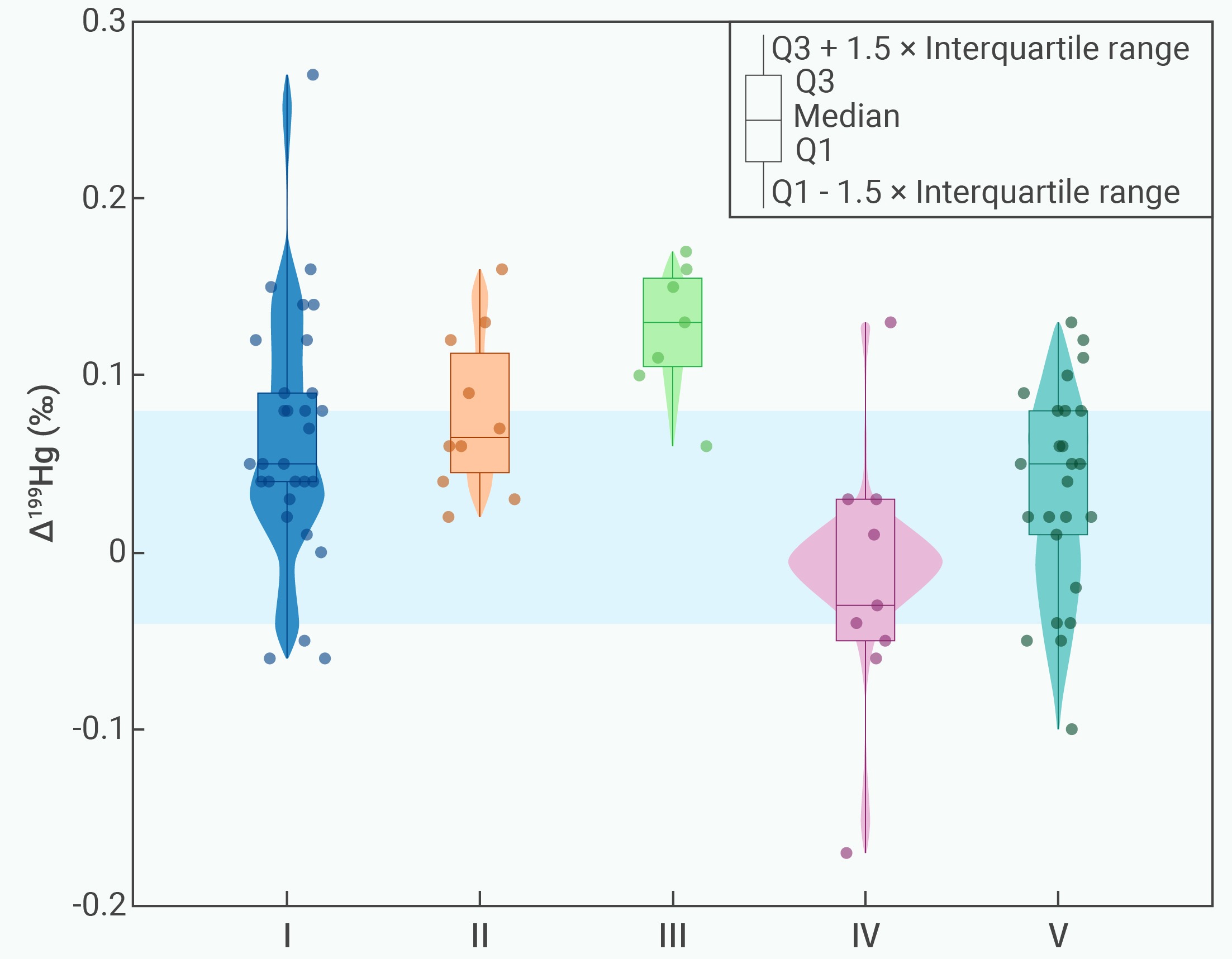
Figure 4.
Violin plot of Δ199Hg values for samples from Intervals I to V at the QL and TB sections
-
Figure 5.
Schematic cartoon model illustrating the Hg cycles across the O-S transition on the Yangtze Shelf Sea in South China (redox conditions are from refs.6,18).
