
-

-
REFERENCES
[1] Zhang G., Yao T., Xie H., et al. (2020). Response of Tibetan Plateau lakes to climate change: Trends, patterns, and mechanisms. Earth-Sci. Rev. 208:103269. DOI:10.1016/j.earscirev.2020.103269 [2] Xiong Z., Liu X., Ding L., et al. The rise and demise of the Paleogene Central Tibetan Valley. Sci. Adv. 8:eabj0944. DOI:10.1126/sciadv.abj0944. [3] Fleitmann D., Burns S. J., Mangini A., et al. (2007). Holocene ITCZ and Indian monsoon dynamics recorded in stalagmites from Oman and Yemen (Socotra). Quat. Sci. Rev. 26:170−188. DOI:10.1016/j.quascirev.2006.04.012 [4] Zhang S., Zhang J., Zhao H., et al. (2020). Spatiotemporal complexity of the “Greatest Lake Period” in the Tibetan Plateau. Sci. Bull. 65:1317−1319. DOI:10.1016/j.scib.2020.05.004 [5] Xu F., Zhang G., Woolway R. I., et al. (2024). Widespread societal and ecological impacts from projected Tibetan Plateau lake expansion. Nat. Geosci. 17:516−523. DOI:10.1038/s41561-024-01446-w -
ABOUT THIS ARTICLE
Cite this article:
Zhang G., Han X., Xu F., et al. (2025). Why are there so many lakes on the Tibetan Plateau? The Innovation Geoscience 3:100135. https://doi.org/10.59717/j.xinn-geo.2025.100135
Welcome!
To request copyright permission to republish or share portions of our works, please visit Copyright Clearance Center's (CCC) Marketplace website at marketplace.copyright.com.
Export File
Citation
Zhang G., Han X., Xu F., et al. (2025). Why are there so many lakes on the Tibetan Plateau? The Innovation Geoscience 3:100135. https://doi.org/10.59717/j.xinn-geo.2025.100135

Format
Content
 DownLoad:
-
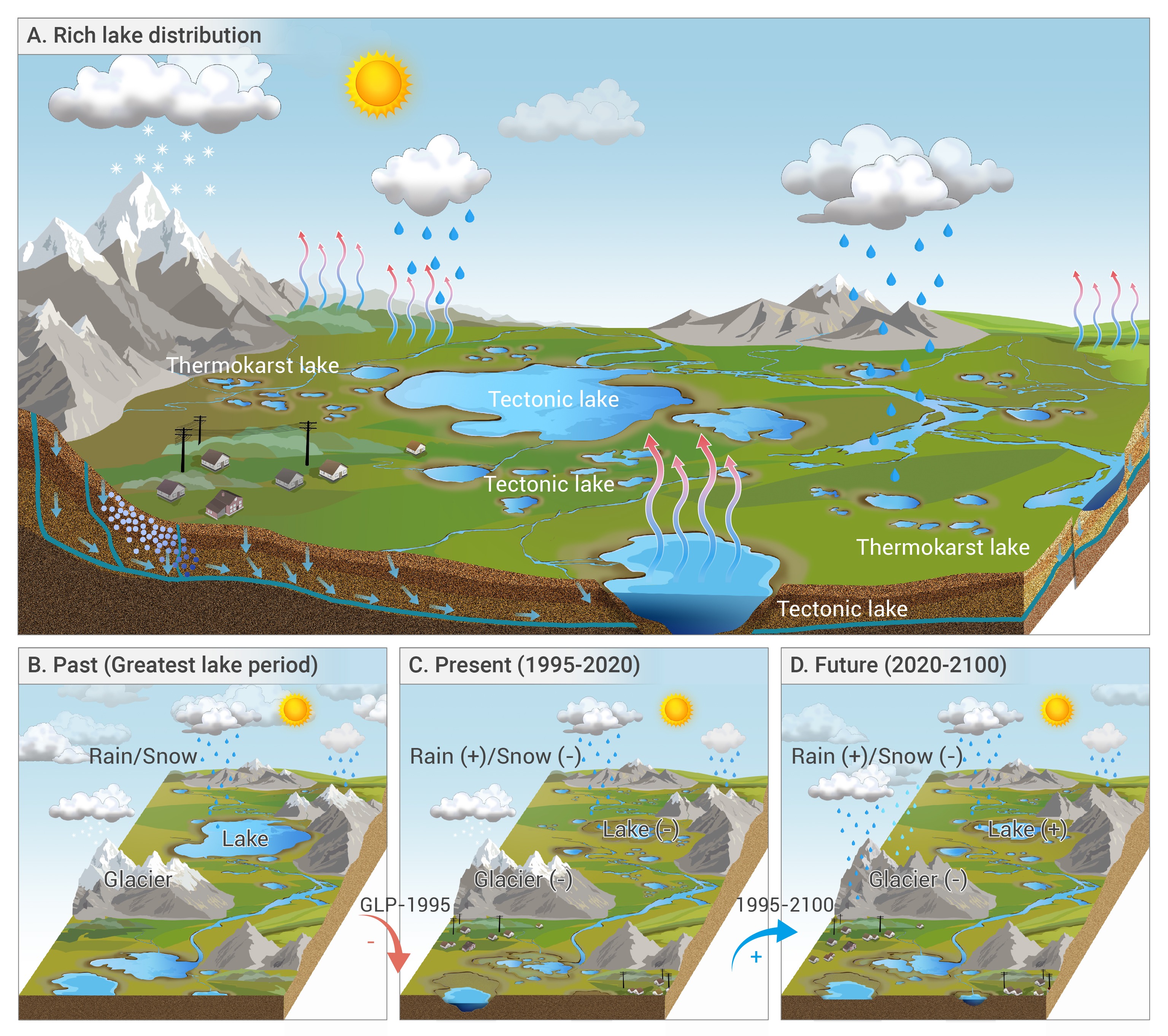
Figure 1.
Long-term evolution of lakes in the TP
