
Global humidity index integrating terrain and lateral water redistribution for enhanced hydrologic characterization
-

-
REFERENCES
[1] Greve P., Roderick M., Ukkola A., et al. (2019). The aridity index under global warming. Environ. Res. Lett. 14:124006. DOI:10.1088/1748-9326/ab5046 [2] Jobbagy E. G., Nosetto M. D., Villagra P. E., et al. (2011). Water subsidies from mountains to deserts: Their role in sustaining groundwater‐fed oases in a sandy landscape. Ecol. Appl. 21:678−694. DOI:10.1890/09-1427.1 [3] Miguez-Macho G. and Fan Y. (2025). A global humidity index with lateral hydrologic flows. Nature 644:1-7. DOI:10.1038/s41586-025-09359-3 [4] Miguez-Macho G. and Fan Y. (2021). Spatiotemporal origin of soil water taken up by vegetation. Nature 598:624−628. DOI:10.1038/s41586-021-03958-6 [5] Fan Y., Li H. and Miguez-Macho G. (2013). Global patterns of groundwater table depth. Science 339:940−943. DOI:10.1126/science.1229881 -
ABOUT THIS ARTICLE
Cite this article:
Yang Y., Wu J., Zhao W., et al. (2025). Global humidity index integrating terrain and lateral water redistribution for enhanced hydrologic characterization. The Innovation Geoscience 3:100175. https://doi.org/10.59717/j.xinn-geo.2025.100175
Welcome!
To request copyright permission to republish or share portions of our works, please visit Copyright Clearance Center's (CCC) Marketplace website at marketplace.copyright.com.
Export File
Citation
Yang Y., Wu J., Zhao W., et al. (2025). Global humidity index integrating terrain and lateral water redistribution for enhanced hydrologic characterization. The Innovation Geoscience 3:100175. https://doi.org/10.59717/j.xinn-geo.2025.100175

Format
Content
 DownLoad:
-
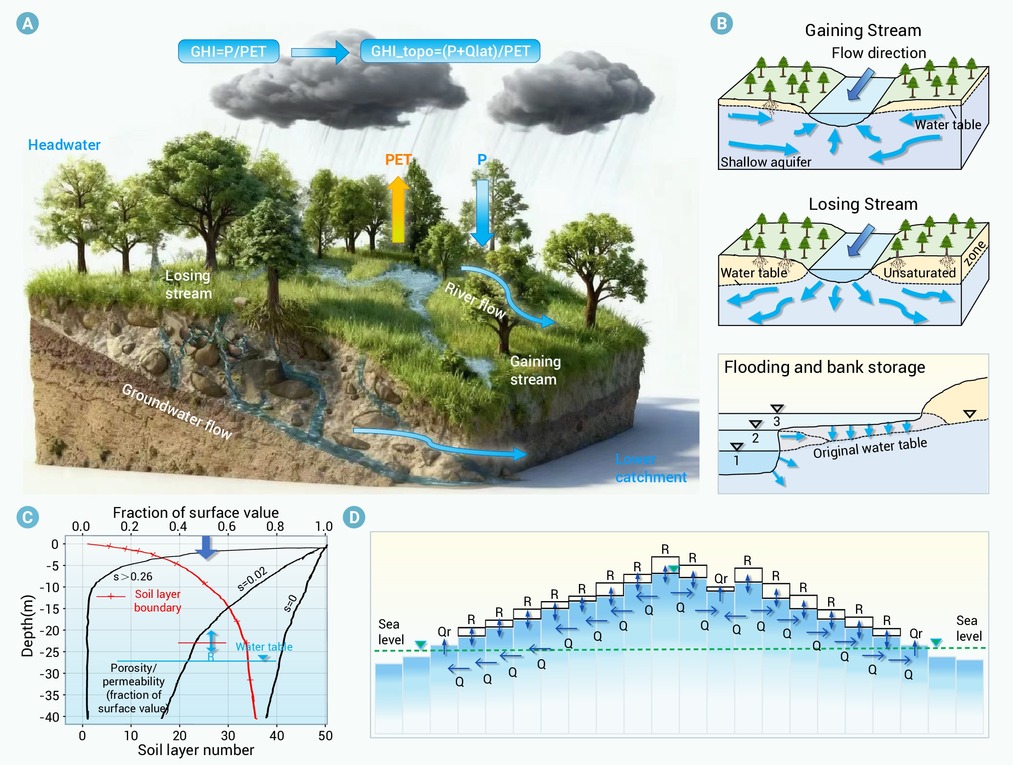
Figure 1.
Conceptual framework for integrating lateral water subsidies (Qlat) into the global humidity index (GHI)
