
Persistent disparities in urban tree exposure across global demographics
-
GRAPHICAL ABSTRACT

 DownLoad:
Full size image
DownLoad:
Full size image
-
PUBLIC SUMMARY
-
We assess global disparities in urban tree exposure across demographic groups.
We reveal a worldwide increase in overall tree exposure, regardless of city characteristics or location.
We highlight that vulnerable populations consistently experience lower tree exposure than advantaged ones.
These persistent inequities hinder progress toward Sustainable Development Goal 11.
Our findings highlight the urgent need to embed environmental justice in future urban greening.
-
-
ABSTRACT
Urban greenspaces provide various benefits for human well-being. Despite the overall improvement in greenspace exposure in the 21st century, it remains unclear whether the distribution and improvement of greenspaces, particularly urban trees, are equitable across population demographics and regions. Here, we quantified disparities in urban tree exposure across various population groups and age cohorts in 1,057 cities globally over a 15-year period (2000–2015). Our analysis revealed persistent and deepening disparities in tree exposure, with cities identified as the least or most exposed in 2000 largely remaining unchanged until 2015, indicating a lack of progress in equitable greening. Notably, the disparity between regions with higher and lower tree exposure widened from 2.7% to 5.9%, in contrast to the nearly doubling of the global average urban tree exposure during the same timeframe. Sex-based differences in exposure are minimal; however, age-related disparities are significant, with older populations experiencing the most exposure and youths the least. This trend intensified over time, while exacerbating exposure disparities and disadvantaging younger demographics. Our findings illuminate challenges in attaining Sustainable Development Goal 11, particularly the aim of universal access to green and public spaces for women, children, and older persons. These insights underscore the need for nuanced urban greening policies that not only expand green cover but also address persistent disparities and prioritize the needs of socially vulnerable subpopulations. -

-
REFERENCES
[1] Kondo M. C., Mueller N., Locke D. H., et al. (2020). Health impact assessment of Philadelphia's 2025 tree canopy cover goals. Lancet Planet. Heath 4:e149−e157. DOI:10.1016/S2542-5196(20)30058-9 [2] Sousa-Silva R., Duflos M., Barona C. O., et al. (2023). Keys to better planning and integrating urban tree planting initiatives. Landsc. Urban Plann. 231:104649. DOI:10.1016/j.landurbplan.2022.104649 [3] Wu S., Chen B., Webster C., et al. (2023). Improved human greenspace exposure equality during 21st century urbanization. Nat. Commun. 14:6460. DOI:10.1038/s41467-023-41620-z [4] Bratman G. N., Anderson C. B., Berman M. G., et al. (2019). Nature and mental health: An ecosystem service perspective. Sci. Adv. 5:eaax0903. DOI:10.1126/sciadv.aax0903 [5] Frumkin H., Bratman G. N., Breslow S. J., et al. (2017). Nature contact and human health: A research agenda. Environ. Health Perspect. 125:075001. DOI:10.1289/EHP1663 [6] Chen B., Wu S., Song Y., et al. (2022). Contrasting inequality in human exposure to greenspace between cities of Global North and Global South. Nat. Commun. 13:4636. DOI:10.1038/s41467-022-32258-4 [7] Yin Y., He L., Wennberg P. O., et al. (2023). Unequal exposure to heatwaves in Los Angeles: Impact of uneven green spaces. Sci. Adv. 9:eade8501. DOI:10.1126/sciadv.ade8501 [8] Lin J., Wang Q. and Li X. (2021). Socioeconomic and spatial inequalities of street tree abundance, species diversity, and size structure in New York City. Landsc. Urban Plann. 206:103992. DOI:10.1016/j.landurbplan.2020.103992 [9] Nesbitt L., Meitner M. J., Girling C., et al. (2019). Who has access to urban vegetation? A spatial analysis of distributional green equity in 10 US cities. Landsc. Urban Plann. 181:51-79. DOI:10.1016/j.landurbplan.2018.08.007 [10] Leng S., Sun R., Yang X., et al. (2023). Global inequities in population exposure to urban greenspaces increased amidst tree and nontree vegetation cover expansion. Commun. Earth Environ. 4:464. DOI:10.1038/s43247-023-01141-5 [11] Ellis-Soto D., Chapman M. and Locke D. H. (2023). Historical redlining is associated with increasing geographical disparities in bird biodiversity sampling in the United States. Nat. Hum. Behav. 7:1869–1877. DOI:10.1038/s41562-023-01688-5 [12] Wang Y., Liu P., Schwartz J., et al. (2023). Disparities in ambient nitrogen dioxide pollution in the United States. Proc. Natl. Acad. Sci. USA 120:e2208450120. DOI:10.1073/pnas.2208450120 [13] United Nations (2015). Sustainable development goals: 17 goals to transform our world. https://www.un.org/sustainabledevelopment/sustainable-development-goals/ [14] Rosenthal J. K., Kinney P. L. and Metzger K. B. (2014). Intra-urban vulnerability to heat-related mortality in New York City, 1997–2006. Health Place 30:45−60. DOI:10.1016/j.healthplace.2014.07.014 [15] Ballester J., Quijal-Zamorano M., Méndez Turrubiates R. F., et al. (2023). Heat-related mortality in Europe during the summer of 2022. Nat. Med. 29:1857−1866. DOI:10.1038/s41591-023-02419-z [16] Markevych I., Schoierer J., Hartig T., et al. (2017). Exploring pathways linking greenspace to health: Theoretical and methodological guidance. Environ. Res. 158:301−317. DOI:10.1016/j.envres.2017.06.028 [17] Marselle M. R., Hartig T., Cox D. T., et al. (2021). Pathways linking biodiversity to human health: A conceptual framework. Environ. Int. 150:106420. DOI:10.1016/j.envint.2021.106420 [18] Jbaily A., Zhou X., Liu J., et al. (2022). Air pollution exposure disparities across US population and income groups. Nature 601:228−233. DOI:10.1038/s41586-021-04190-y [19] Ma Y., Zang E., Opara I., et al. (2023). Racial/ethnic disparities in PM2. 5-attributable cardiovascular mortality burden in the United States. Nat. Hum. Behav. 7 :2074–2083. DOI:10.1038/s41562-023-01694-7 [20] Moonesinghe R. and Beckles G. L. (2015). Measuring health disparities: A comparison of absolute and relative disparities. PeerJ 3:e1438. DOI:10.7717/peerj.1438 [21] Colmer J., Hardman I., Shimshack J., et al. (2020). Disparities in PM2. 5 air pollution in the United States. Science 369:575-578. DOI:10.1126/science.aaz9353 [22] Tessum C. W., Paolella D. A., Chambliss S. E., et al. (2021). PM2.5 polluters disproportionately and systemically affect people of color in the United States. Sci. Adv. 7:eabf4491. DOI:10.1126/sciadv.abf4491 [23] Schwaab J., Meier R., Mussetti G., et al. (2021). The role of urban trees in reducing land surface temperatures in European cities. Nat. Commun. 12:6763. DOI:10.1038/s41467-021-26768-w [24] Song Y., Chen B., Ho H. C., et al. (2021). Observed inequality in urban greenspace exposure in China. Environ. Int. 156:106778. DOI:10.1016/j.envint.2021.106778 [25] Li X., Gong P., Zhou Y., et al. (2020). Mapping global urban boundaries from the global artificial impervious area (GAIA) data. Environ. Res. Lett. 15:094044. DOI:10.1088/1748-9326/ab9be3 [26] Sexton J. O., Song X.-P., Feng M., et al. (2013). Global, 30-m resolution continuous fields of tree cover: Landsat-based rescaling of MODIS vegetation continuous fields with lidar-based estimates of error. Int. J. Digit. Earth 6:427−448. DOI:10.1080/17538947.2013.786146 [27] Nowak D. J. and Greenfield E. J. (2010). Evaluating the National Land Cover Database tree canopy and impervious cover estimates across the conterminous United States: A comparison with photo-interpreted estimates. Environ. Manage. 46:378−390. DOI:10.1007/s00267-010-9536-9 [28] Zhao J., Zhao X., Wu D., et al. (2023). Satellite‐based evidence highlights a considerable increase of urban tree cooling benefits from 2000 to 2015. Global Change Biol. 29:3085−3097. DOI:10.1111/gcb.16667 [29] Stevens F. R., Gaughan A. E., Linard C., et al. (2015). Disaggregating census data for population mapping using random forests with remotely-sensed and ancillary data. PloS One 10:e0107042. DOI:10.1371/journal.pone.0107042 [30] Programme U. N. D. (2004). Forging a Global South: United Nations Day for South-South Cooperation, 19 December 2004 (United Nations Development Programme) https://files.acquia.undp.org/public/migration/cn/UNDP-CH-PR-Publications-UNDay-for-South-South-Cooperation.pdf [31] Song Y., Huang B., Cai J., et al. (2018). Dynamic assessments of population exposure to urban greenspace using multi-source big data. Sci. Total Environ. 634:1315−1325. DOI:10.1016/j.scitotenv.2018.04.061 [32] Ekkel E. D. and de Vries S. (2017). Nearby green space and human health: Evaluating accessibility metrics. Landsc. Urban Plann. 157:214−220. DOI:10.1016/j.landurbplan.2016.06.008 [33] Lu Y., Sun G., Gou Z., et al. (2019). A dose–response effect between built environment characteristics and transport walking for youths. J. Transp. Health 14:100616. DOI:10.1016/j.jth.2019.100616 [34] Chetty R., Hendren N., Kline P., et al. (2014). Where is the land of opportunity. The geography of intergenerational mobility in the United States. Q. J. Econ. 129:1553−1623. DOI:10.1093/qje/qju022 [35] Schwarz K., Fragkias M., Boone C. G., et al. (2015). Trees grow on money: Urban tree canopy cover and environmental justice. PloS One 10:e0122051. DOI:10.1371/journal.pone.0122051 [36] Kabisch N. and Haase D. (2014). Green justice or just green. Provision of urban green spaces in Berlin, Germany. Landsc. Urban Plann. 122:129−139. DOI:10.1016/j.landurbplan.2013.11.016 [37] Elton A. J., Harper R. W., Bullard L. F., et al. (2023). Volunteer engagement in urban forestry in the United States: Reviewing the literature. Arboric. J. 45:96−117. DOI:10.1080/03071375.2022.2030620 [38] Leff M. (2016). The sustainable urban forest: A step-by-step approach. The Davey Institute and USFS Northern Research Station, Philadelphia Urban Field Station, https://ufei.calpoly.edu/files/pubs/SustainableUrbanForestGuidev6Final%20.pdf [39] Moskell C., Broussard Allred S. and Ferenz G. (2011). Examining volunteer motivations and recruitment strategies for engagement in urban forestry. Cities and the Environment (CATE) 3:9. DOI:10.15365/cate.3192010 [40] Satterthwaite D. and Mitlin D. (2013). Reducing urban poverty in the global south (1st ed). Routledge. DOI:10.4324/9780203104330 [41] Williams G., Meth P. and Willis K. (2014). Geographies of developing areas: The Global South in a changing world (2nd ed). Routledge. DOI: 10.4324/9780203079836 [42] Lin J., Zhang H., Chen M., et al. (2023). Socioeconomic disparities in cooling and warming efficiencies of urban vegetation and impervious surfaces. Sustain. Cities Soc. 92:104464. DOI:10.1016/j.scs.2023.104464 [43] Endreny T. A. (2018). Strategically growing the urban forest will improve our world. Nat. Commun. 9:1160. DOI:10.1038/s41467-018-03622-0 [44] Herreros‐Cantis P. and McPhearson T. (2021). Mapping supply of and demand for ecosystem services to assess environmental justice in New York City. Ecol. Appl. 31:e02390. DOI:10.1002/eap.2390 [45] Mahmud A., Mazalan M. and Abdul Razak A. R. (2017). Changing population age structures and sustainable development. https://www.unpopulation.org/en/development/desa/population/publications/pdf/trends/ConciseReport2017/English.pdf [46] Lin J. (2020). Developing a composite indicator to prioritize tree planting and protection locations. Sci. Total Environ. 717:137269. DOI:10.1016/j.scitotenv.2020.137269 [47] Lin J., Kroll C. N., Nowak D. J., et al. (2019). A review of urban forest modeling: Implications for management and future research. Urban For. Urban Green. 43:126366. DOI:10.1016/j.ufug.2019.126366 [48] Hobbie S. E. and Grimm N. B. (2020). Nature-based approaches to managing climate change impacts in cities. Philos. Trans. R. Soc. Lond. B. 375:20190124. DOI:10.1098/rstb.2019.0124 [49] UN Food and Agriculture Organization (2023). The great green wall for cities initiative. https://www.fao.org/newsroom/detail/A-Great-Green-Wall-for-Cities/en [50] Yao N., van den Bosch C. C. K., Yang J., et al. (2019). Beijing’s 50 million new urban trees: Strategic governance for large-scale urban afforestation. Urban For. Urban Green. 44:126392. DOI:10.1016/j.ufug.2019.126392 [51] Lwasa S., Seto K., Bai X., et al. (2022). Urban systems and other settlements. In climate change 2022: Impacts, adaptation, and vulnerability. https://www.ipcc.ch/report/ar6/ wg3/ [52] Zhou W., Huang G., Pickett S. T., et al. (2021). Urban tree canopy has greater cooling effects in socially vulnerable communities in the US. One Earth 4:1764−1775. DOI:10.1016/j.oneear.2021.11.010 [53] Danford R. S., Cheng C., Strohbach M. W., et al. (2014). What does it take to achieve equitable urban tree canopy distribution. A Boston case study. Cities and the Environment (CATE) 7:2. DOI:10.15365/1932-7048.1123 [54] Flocks J., Escobedo F., Wade J., et al. (2011). Environmental justice implications of urban tree cover in Miami-Dade County, Florida. Environ. Justice 4:125−134. DOI:10.1089/env.2010.0018 [55] Schwarz K., Berland A. and Herrmann D. L. (2018). Green, but not just. Rethinking environmental justice indicators in shrinking cities. Sustain. Cities Soc. 41:816−821. DOI:10.1016/j.scs.2018.06.026 [56] Lin J. and Wang Q. (2021). Are street tree inequalities growing or diminishing over time. The inequity remediation potential of the MillionTreesNYC initiative. J. Environ. Manage. 285:112207. DOI:10.1016/j.jenvman.2021.112207 [57] Nesbitt L., Meitner M. J., Sheppard S. R., et al. (2018). The dimensions of urban green equity: A framework for analysis. Urban For. Urban Green. 34:240−248. DOI:10.1016/j.ufug.2018.07.009 [58] Watkins S. L., Mincey S. K., Vogt J., et al. (2017). Is planting equitable. An examination of the spatial distribution of nonprofit urban tree-planting programs by canopy cover, income, race, and ethnicity. Environ. Behav. 49:452−482. DOI:10.1177/0013916516636423 [59] Ferguson M., Roberts H. E., McEachan R. R., et al. (2018). Contrasting distributions of urban green infrastructure across social and ethno-racial groups. Landsc. Urban Plann. 175:136−148. DOI:10.1016/j.landurbplan.2018.03.020 [60] Zhou W., Wang J., Qian Y., et al. (2018). The rapid but “invisible” changes in urban greenspace: A comparative study of nine Chinese cities. Sci. Total Environ. 627:1572−1584. DOI:10.1016/j.scitotenv.2018.01.335 [61] Yang J., Hu L. and Wang C. (2019). Population dynamics modify urban residents’ exposure to extreme temperatures across the United States. Sci. Adv. 5:eaay3452. DOI:10.1126/sciadv.aay3452 -
ABOUT THIS ARTICLE
Cite this article:
Lin J., Pradhan P., Sun Z., et al. (2025). Persistent disparities in urban tree exposure across global demographics. The Innovation Geoscience 3:100186. https://doi.org/10.59717/j.xinn-geo.2026.100186
Welcome!
To request copyright permission to republish or share portions of our works, please visit Copyright Clearance Center's (CCC) Marketplace website at marketplace.copyright.com.

Article Metrics
Relative Articles
Cited by
Export File
Citation
Lin J., Pradhan P., Sun Z., et al. (2025). Persistent disparities in urban tree exposure across global demographics. The Innovation Geoscience 3:100186. https://doi.org/10.59717/j.xinn-geo.2026.100186

Format
Content
-
Figure 1.
Global distribution of the magnitude change in urban tree exposure between 2000 and 2015
-
Figure 2.
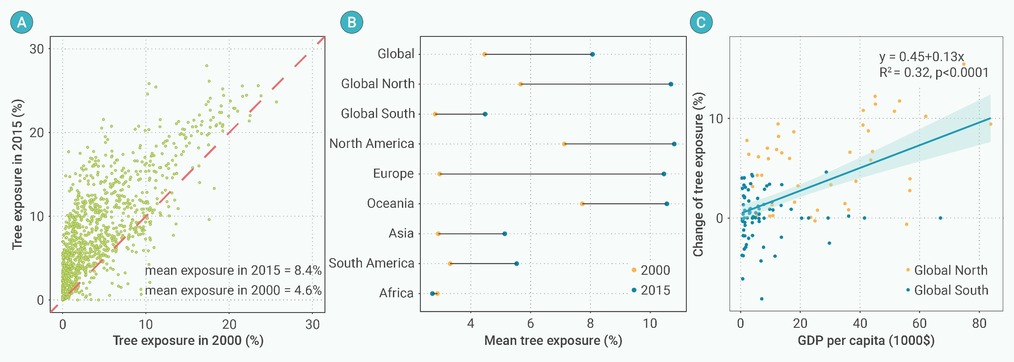
Summary of absolute urban tree exposure disparities in 1,057 global cities between 2000 and 2015
-
Figure 3.
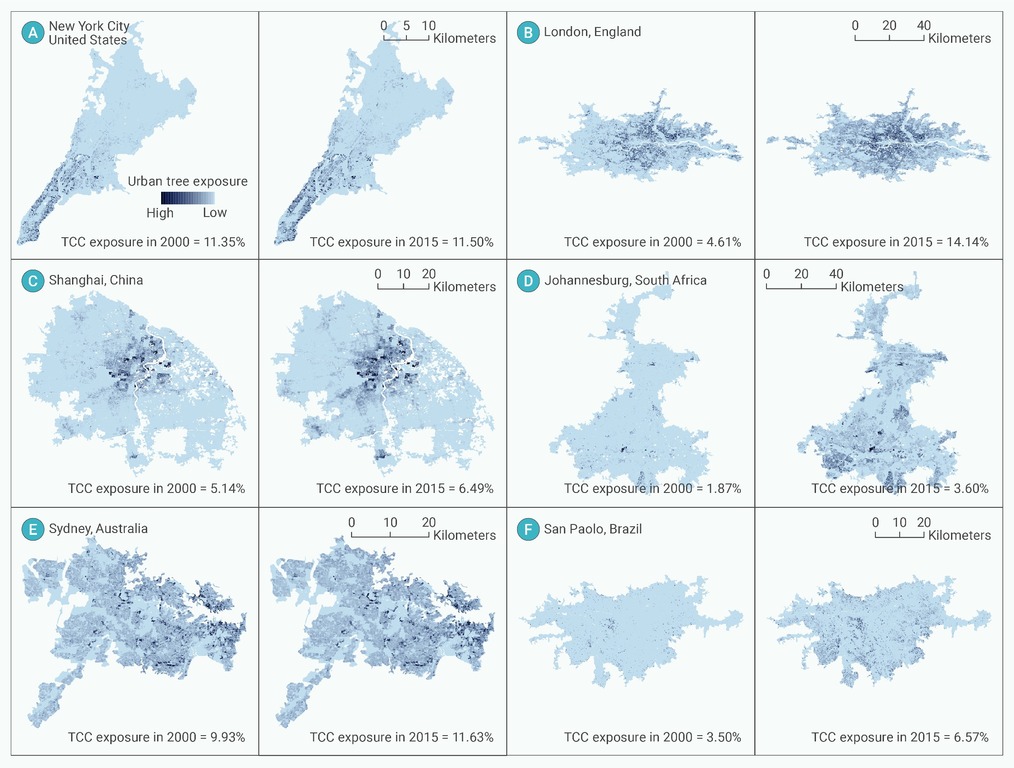
City-level comparison of urban tree exposure between 2000 and 2015 for six metropolitan cities
-
Figure 5.
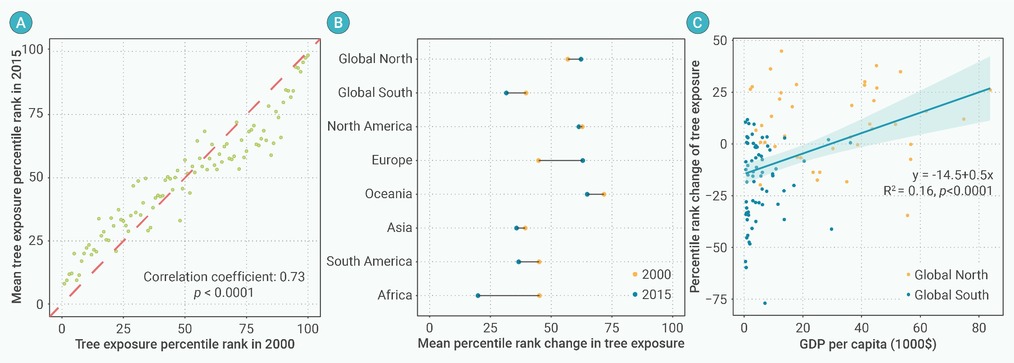
Summary of relative urban tree exposure disparities in 1,057 global cities between 2000 and 2015
-
Figure 4.
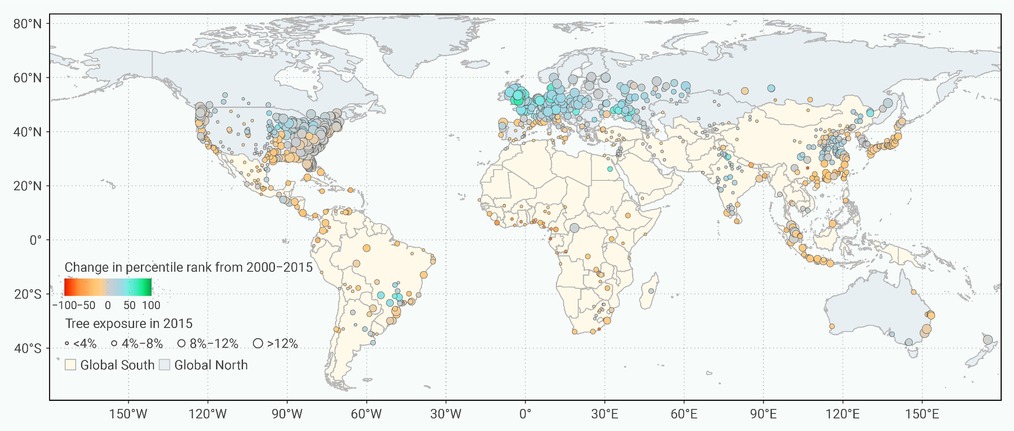
Global distribution of the rank change in urban tree exposure between 2000 and 2015
-
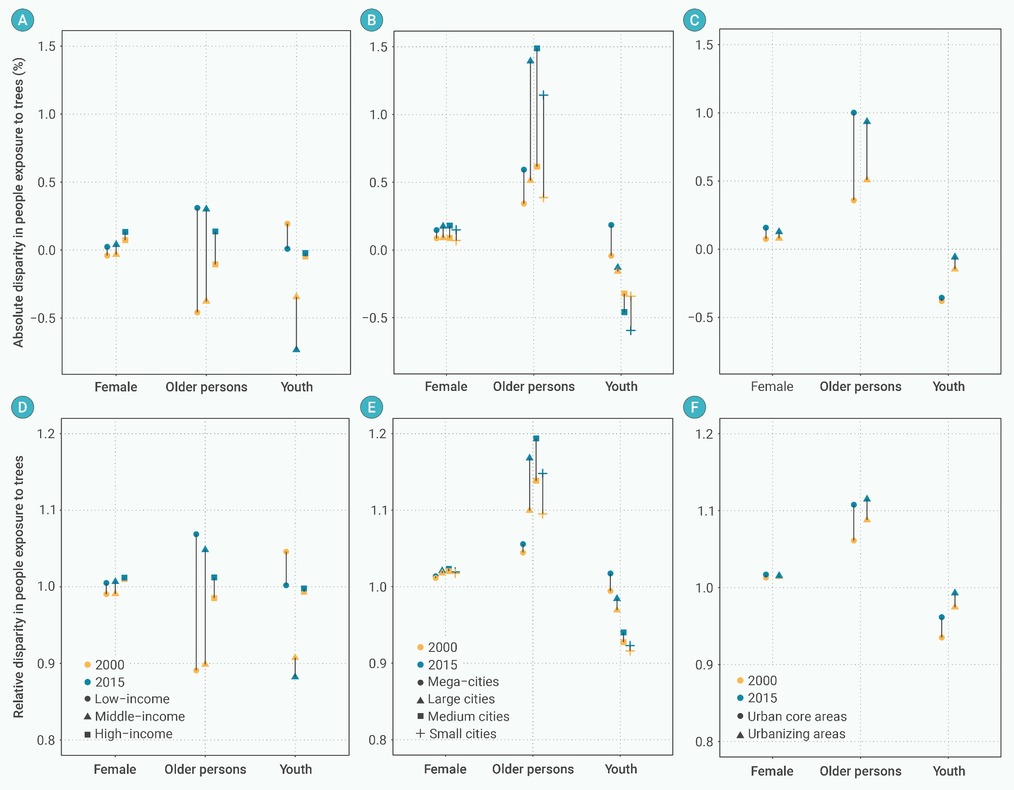
Figure 6.
Absolute and relative disparities in urban tree exposure for women, youth, and older persons by referencing their male and adult counterparts for 2000 and 2015
