
North Atlantic tropical cyclone activity promotes enhanced sea ice in the Kara-Laptev Seas
-
GRAPHICAL ABSTRACT
 DownLoad:
Full size image
DownLoad:
Full size image
-
PUBLIC SUMMARY
-
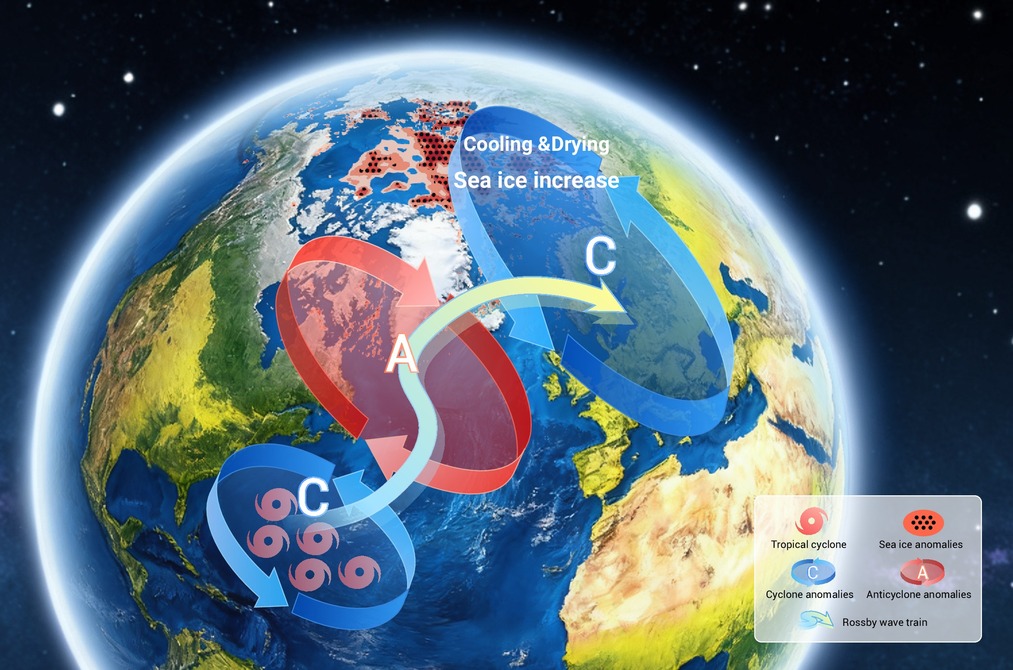
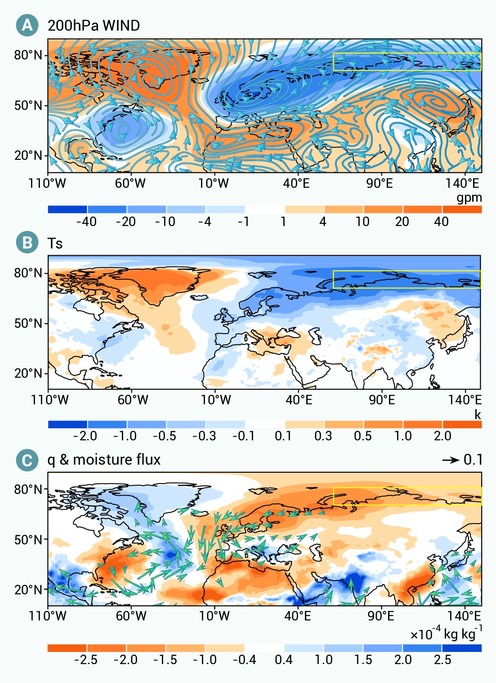
North Atlantic tropical cyclone (TC) activity is linked to more October sea ice in the Kara-Laptev Seas (KLS).
TCs excite poleward-propagating Rossby waves, which induce an anomalous cyclonic circulation over the KLS.
This cyclonic anomaly suppresses warming and reduces humidity, creating conditions favoring sea ice growth.
-
-
ABSTRACT
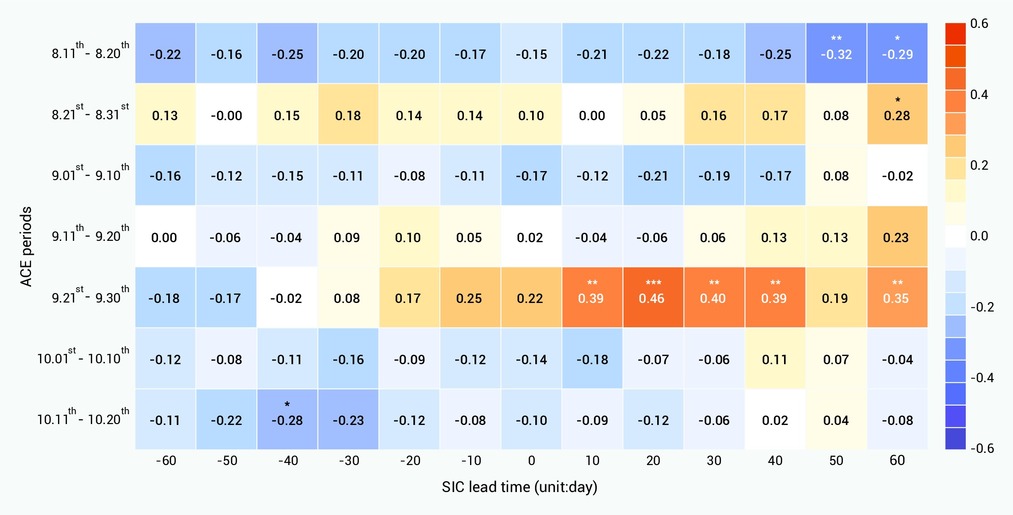
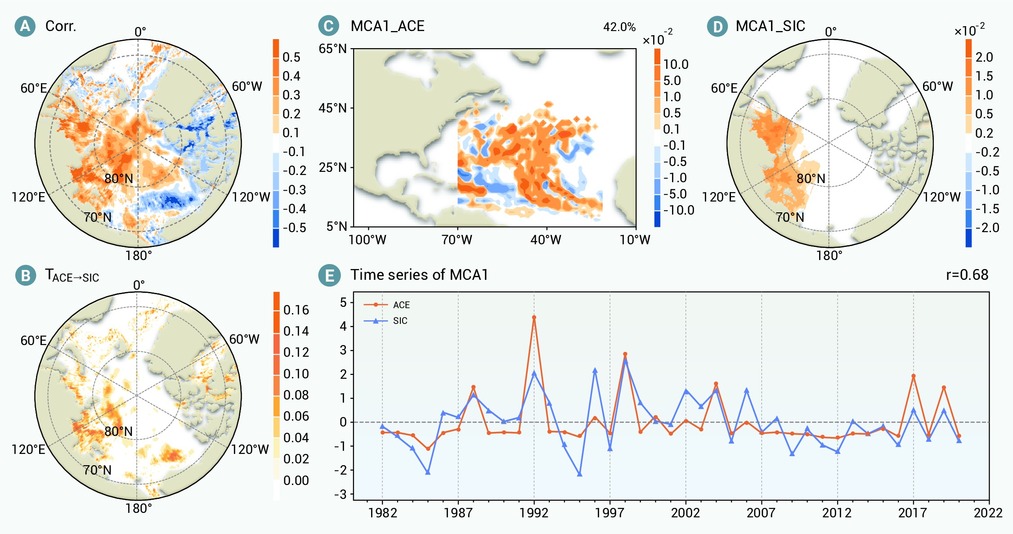
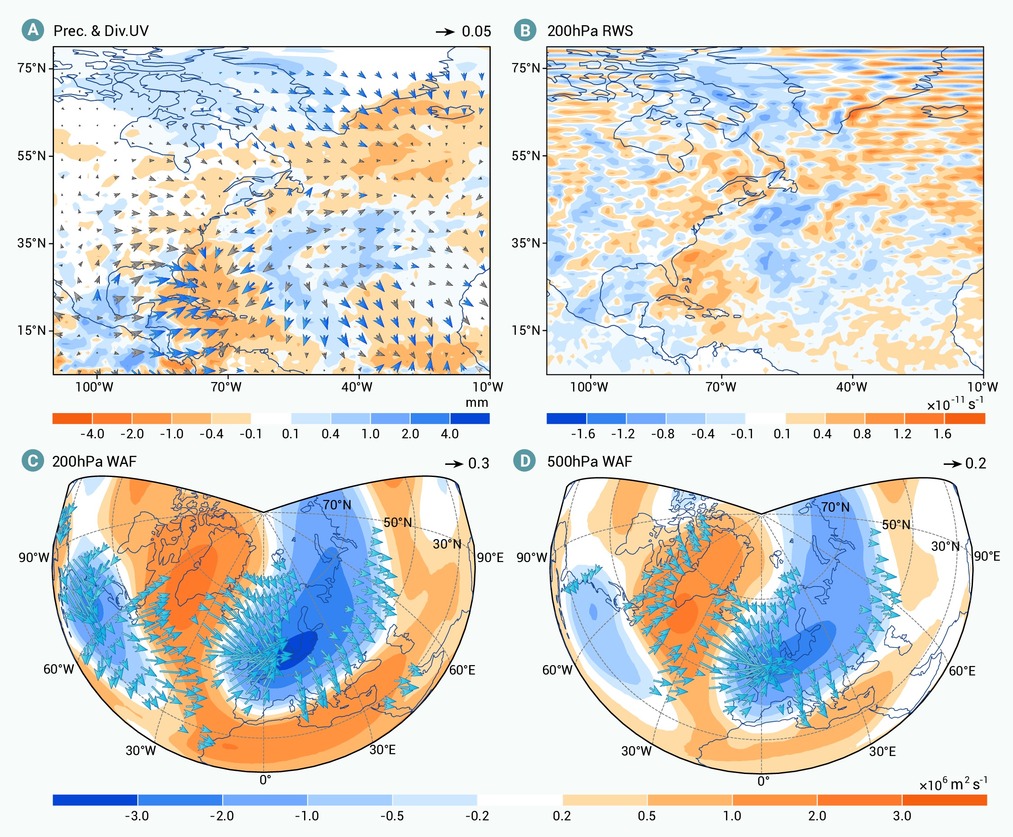
This study investigates the teleconnection mechanism linking North Atlantic (NA) tropical cyclone (TC) activity to sea ice change in the Kara-Laptev Seas (KLS). Observational analyses indicate significant positive correlations between accumulated cyclone energy over the NA in late September and KLS sea ice concentration in October. It shows that the enhanced NA TC activity excites northeastward-propagating Rossby wave trains via local diabatic heating anomalies, and the wave propagation induces a characteristic upper-tropospheric circulation anomaly pattern, featuring sequential cyclonic, anticyclonic, and cyclonic anomalies over the NA, Greenland and the European sector extending to the KLS, respectively. The cyclonic anomaly over the KLS suppresses adiabatic warming and reduces specific humidity, fostering colder and drier conditions conducive to sea ice growth. Simulations with Community Atmosphere Model version 6 (CAM6) can replicate the teleconnection pathway as well as the observed anomalous circulation structure and planetary-scale Rossby wave propagation. These findings imply that NA TC activity can act as a previously underappreciated contributor to sea ice change over KLS and advance understanding of tropical-Arctic teleconnections.-
Keywords:
- Sea ice /
- tropical cyclone /
- North Atlantic /
- Rossby waves /
- Teleconnection
-

-
REFERENCES
[1] Cavalieri D. J. and Parkinson C. L. (2012). Arctic sea ice variability and trends, 1979–2010. The Cryosphere 6:881−889. DOI:10.5194/tc-6-881-2012 [2] Yadav J., Kumar A. and Mohan R. (2020). Dramatic decline of Arctic sea ice linked to global warming. Nat. Hazards 103:2617−2621. DOI:10.1007/s11069-020-04064-y [3] Reimnitz E., Dethleff D. and Nürnberg D. (1994). Contrasts in Arctic shelf sea-ice regimes and some implications: Beaufort Sea versus Laptev Sea. Mar. Geol. 119:215−225. DOI:10.1016/0025-3227(94)90182-1 [4] Cornish S. B., Johnson H. L., Mallet R. D. C., et al. (2022). Rise and fall of sea ice production in the Arctic Ocean’s ice factories. Nat. Commun. 13:7800. DOI:10.1038/s41467-022-34785-6 [5] Zhang A., Yi D. L. and Fan K. (2024). Nonstationary thermodynamic and dynamic contributions to the interannual variability of winter sea ice growth in the Kara–Laptev Seas. Environ. Res. Lett. 19:064067. DOI:10.1088/1748-9326/ad4fa4 [6] Wang S., Nath D. and Chen W. (2021). Nonstationary relationship between sea ice over Kara–Laptev seas during August–September and Ural blocking in the following winter. Int. J. Climatol. 41:E1608−E1622. DOI:10.1002/joc.6794 [7] Cohen J., Agel L., Barlow M., et al. (2021). Linking Arctic variability and change with extreme winter weather in the United States. Science 373:1116−1121. DOI:10.1126/science.abi9167 [8] Zhang P., Wu Y., Simpson I. R., et al. (2018). A stratospheric pathway linking a colder Siberia to Barents-Kara Sea sea ice loss. Sci. Adv. 4:eaat6025. DOI:10.1126/sciadv.aat6025 [9] Zhang R. and Screen J. A. (2021). Diverse Eurasian winter temperature responses to Barents-Kara sea ice anomalies of different magnitudes and seasonality. Geophys. Res. Lett. 48:e2021GL092726. DOI:10.1029/2021GL092726 [10] Guo H., Yi Z., Xu T., et al. (2024). Different responses of surface air temperature over Eurasia in early and late winter to the autumn Kara–Laptev Sea ice. Environ. Res. Lett. 19:044042. DOI:10.1088/1748-9326/ad345f [11] Kim B.-M., Son S.-W., Min S.-K., et al. (2014). Weakening of the stratospheric polar vortex by Arctic sea-ice loss. Nat. Commun. 5:4646. DOI:10.1038/ncomms5646 [12] Li F. and Wang H. (2012). Autumn sea ice cover, winter Northern hemisphere annular mode, and winter precipitation in Eurasia. J. Clim. 26:3968−3981. DOI:10.1175/JCLI-D-12-00380.1 [13] Chen S., Chen W., Zhou W., et al. (2024). Interdecadal variation in the impact of Arctic sea ice on El Niño–Southern Oscillation: The role of atmospheric mean flow. J. Clim. 37:5483−5506. DOI:10.1175/JCLI-D-23-0733.1 [14] Chen S., Chen W., Wu R., et al. (2025). Asymmetric impacts of Arctic sea ice anomalies on El Niño-Southern Oscillation. Npj Clim. Atmospheric Sci. 8:276. DOI:10.1038/s41612-025-01168-9 [15] Cheng X., Chen S., Chen W., et al. (2025). Influence of winter Arctic sea ice anomalies on the following autumn Indian Ocean dipole development. J. Clim. 38:3109−3129. DOI:10.1175/JCLI-D-24-0419.1 [16] Chen S., Chen W., Yu B., et al. (2023). Impact of the winter Arctic sea ice anomaly on the following summer tropical cyclone genesis frequency over the western North Pacific. Clim. Dyn. 61:3971−3988. DOI:10.1007/s00382-023-06789-5 [17] Baxter I., Ding Q., Schweiger A., et al. (2019). How tropical pacific surface cooling contributed to accelerated sea ice melt from 2007 to 2012 as ice is thinned by anthropogenic forcing. J. Clim. 32:8583−8602. DOI:10.1175/JCLI-D-18-0783.1 [18] Ding Q., Wallace J. M., Battisti D. S., et al. (2014). Tropical forcing of the recent rapid Arctic warming in northeastern Canada and Greenland. Nature 509:209−212. DOI:10.1038/nature13260 [19] Meehl G. A., Chung C. T. Y., Arblaster J. M., et al. (2018). Tropical decadal variability and the rate of Arctic sea ice decrease. Geophys. Res. Lett. 45:11,326−11,333. DOI:10.1029/2018GL079989 [20] Clancy R., Bitz C. and Blanchard-Wrigglesworth E. (2021). The influence of ENSO on Arctic sea ice in large ensembles and observations. J. Clim. 34:9585−9604. DOI:10.1175/JCLI-D-20-0958.1 [21] Liu J., Curry J. A. and Hu Y. (2004). Recent Arctic sea ice variability: Connections to the Arctic Oscillation and the ENSO. Geophys. Res. Lett. 31:L09211. DOI:10.1029/2004GL019858 [22] Hu, C., Yang, S., Wu, Q., et al. (2016). Shifting El Niño inhibits summer Arctic warming and Arctic sea-ice melting over the Canada Basin. Nat. Commun. 7:11721. DOI:10.1038/ncomms11721 [23] Luo, B., Luo, D., Ge, Y., et al. (2023). Origins of Barents-Kara sea-ice interannual variability modulated by the Atlantic pathway of El Niño–Southern Oscillation. Nat. Commun. 14:585. DOI:10.1038/s41467-023-36136-5 [24] Zhou B., Song Z., Yin Z., et al. (2024). Recent autumn sea ice loss in the eastern Arctic enhanced by summer Asian-Pacific Oscillation. Nat. Commun. 15:2798. DOI:10.1038/s41467-024-47051-8 [25] Årthun M., Eldevik T., Smedsrud L. H., et al. (2012). Quantifying the influence of Atlantic heat on Barents sea ice variability and retreat. J. Clim. 25:4736−4743. DOI:10.1175/JCLI-D-11-00466.1 [26] Polyakov I. V., Pnyushkov A. V., Alkire M. B., et al. (2017). Greater role for Atlantic inflows on sea-ice loss in the Eurasian Basin of the Arctic Ocean. Science 356:285−291. DOI:10.1126/science.aai8204 [27] Woods C. and Caballero R. (2016). The role of moist intrusions in winter Arctic warming and sea ice decline. J. Clim. 29:4473−4485. DOI:10.1175/JCLI-D-15-0773.1 [28] Hofsteenge M. G., Graversen R. G., Rydsaa J. H., et al. (2022). The impact of atmospheric Rossby waves and cyclones on the Arctic sea ice variability. Clim. Dyn. 59:579−594. DOI:10.1007/s00382-022-06145-z [29] Matsumura S. and Kosaka Y. (2019). Arctic–Eurasian climate linkage induced by tropical ocean variability. Nat. Commun. 10:3441. DOI:10.1038/s41467-019-11359-7 [30] Xie Y., Duan A., Zhang C., et al. (2025). Reversed link between central pacific ENSO and Greenland–Barents sea ice. Npj Clim. Atmospheric Sci. 8:1−7. DOI:10.1038/s41612-025-00912-5 [31] Sheng Z., He Y., Wang S., et al. (2025). Dynamics, chemistry, and modeling studies in the aviation and aerospace transition zone. The Innovation 6:101012. DOI:10.1016/j.xinn.2025.101012 [32] Finocchio P. M. and Doyle J. D. (2019). How the speed and latitude of the jet stream affect the downstream response to recurving tropical cyclones. Mon. Weather Rev. 147:3261−3281. DOI:10.1175/MWR-D-19-0049.1 [33] Sardeshmukh P. D. and Hoskins B. J. (1988). The generation of global rotational flow by steady idealized tropical divergence. J. Atmospheric Sci. 45:1228−1251. DOI:2.0.CO;2">10.1175/1520-0469(1988)045<1228:TGOGRF>2.0.CO;2 [34] Li T. and Fu B. (2006). Tropical cyclogenesis associated with rossby wave energy dispersion of a preexisting typhoon. Part I: Satellite data analyses. J. Atmospheric Sci. 63:1377−1389. DOI:10.1175/JAS3692.1 [35] Li T., Ge X., Wang B., et al. (2006). Tropical cyclogenesis associated with rossby wave energy dispersion of a preexisting typhoon. Part II: Numerical simulations. J. Atmospheric Sci. 63:1390−1409. DOI:10.1175/JAS3693.1 [36] Ge X., Li T. and Peng M. S. (2010). Cyclogenesis simulation of typhoon prapiroon (2000) associated with rossby wave energy dispersion. Mon. Weather Rev. 138:42−54. DOI:10.1175/2009MWR3005.1 [37] Fan X., Li Y., Wei N., et al. (2024). Rossby wave amplified by tropical cyclones over the bay of bengal and its downstream impact on precipitation in South China. Geophys. Res. Lett. 51:e2023GL107208. DOI:10.1029/2023GL107208 [38] Kawamura R. and Ogasawara T. (2006). On the role of typhoons in generating PJ teleconnection patterns over the western north Pacific in late summer. Sola 2:37−40. DOI:10.2151/sola.2006-01039 [39] Riboldi J., Grams C. M., Riemer M., et al. (2019). A phase locking perspective on rossby wave amplification and atmospheric blocking downstream of recurving western North Pacific tropical cyclones. Mon. Weather Rev. 147:567−589. DOI:10.1175/MWR-D-18-0271.1 [40] Villarini G., Vecchi G. A. and Scoccimarro E. (2025). Tropical cyclones and associated impacts: A global perspective (Elsevier Press). DOI:10.1016/C2021-0-02882-0 [41] Zeng L., Ha Y., Zhao C., et al. (2024). Tropical cyclone activity over western North Pacific favors Arctic sea ice increase. Nat. Commun. 15:9564. DOI:10.1038/s41467-024-53991-y [42] Zeng L., Ha Y., Zhao C., et al. (2025). Possible effects of tropical cyclone activities over eastern North Pacific on Arctic sea ice. Environ. Res. Lett. 20:094020. DOI:10.1088/1748-9326/adf56b [43] Murakami H. and Wang B. (2010). Future change of North Atlantic tropical cyclone tracks: Projection by a 20-km-mesh global atmospheric model. J. Clim. 23:2699−2721. DOI:10.1175/2010JCLI3338.1 [44] Villarini G. and Vecchi G. A. (2013). Projected increases in North Atlantic tropical cyclone intensity from CMIP5 Models. J. Clim. 26:3231−3240. DOI:10.1175/JCLI-D-12-00441.1 [45] Scoccimarro E., Gualdi S. and Navarra A. (2012). Tropical cyclone effects on Arctic sea ice variability. Geophys. Res. Lett. 39:L17704. DOI:10.1029/2012GL052987 [46] Knapp K. R., Kruk M. C., Levinson D. H., et al. (2010). The international best track archive for climate stewardship (IBTrACS): Unifying tropical cyclone data. Bull. Am. Meteorol. Soc. 91:363−376. DOI:10.1175/2009BAMS2755.1 [47] Waple A. M., Lawrimore J. H., Halpert M. S., et al. (2002). Climate assessment for 2001. Bull. Am. Meteorol. Soc. 83:S1–S62. http://www.jstor.org/stable/26215369 [48] Reynolds R. W., Smith T. M., Liu C., et al. (2007). Daily high-resolution-blended analyses for sea surface temperature. J. Clim. 20:5473−5496. DOI:10.1175/2007JCLI1824.1 [49] Hersbach H., Bell B., Berrisford P., et al. (2020). The ERA5 global reanalysis. Q. J. R. Meteorol. Soc. 146:1999−2049. DOI:10.1002/qj.3803 [50] Rayner N. A., Parker D. E., Horton E. B., et al. (2003). Global analyses of sea surface temperature, sea ice, and night marine air temperature since the late nineteenth century. J. Geophys. Res. Atmospheres 108:2002JD002670. DOI:10.1029/2002JD002670 [51] Beer C., Reichstein M., Tomelleri E., et al. (2010). Terrestrial gross carbon dioxide uptake: Global distribution and covariation with climate. Science 329:834−838. DOI:10.1126/science.1184984 [52] Peng S., Piao S., Ciais P., et al. (2013). Asymmetric effects of daytime and night-time warming on Northern Hemisphere vegetation. Nature 501:88−92. DOI:10.1038/nature12434 [53] An S.-I. (2003). Conditional maximum covariance analysis and its application to the tropical Indian Ocean SST and surface wind stress anomalies. J. Clim. 16:2932−2938. DOI:2.0.CO;2">10.1175/1520-0442(2003)016<2932:CMCAAI>2.0.CO;2 [54] Zhang L., Ren X., Cai W., et al. (2024). Weakened western Indian Ocean dominance on Antarctic sea ice variability in a changing climate. Nat. Commun. 15:3261. DOI:10.1038/s41467-024-47655-0 [55] Plumb R. A. (1985). On the three-dimensional propagation of stationary waves. J. Atmospheric Sci. 42:217−229. DOI:2.0.CO;2">10.1175/1520-0469(1985)042<0217:OTTDPO>2.0.CO;2 [56] Holton J. R. and Hakim G. J. (2013). An introduction to dynamic meteorology (Academic Press). DOI:10.1016/C2009-0-63394-8 [57] Trenberth K. E., Branstator G. W., Karoly D., et al. (1998). Progress during TOGA in understanding and modeling global teleconnections associated with tropical sea surface temperatures. J. Geophys. Res. Oceans 103:14291−14324. DOI:10.1029/97JC01444 [58] Liang X. S. (2018). Causation and information flow with respect to relative entropy. Chaos Interdiscip. J. Nonlinear Sci. 28:075311. DOI:10.1063/1.5010253 [59] Bretherton C. S., Smith C. and Wallace J. M. (1992). An intercomparison of methods for finding coupled patterns in climate data. J. Clim. 5:541−560. DOI:2.0.CO;2">10.1175/1520-0442(1992)005<0541:AIOMFF>2.0.CO;2 [60] Wallace J. M., Smith C. and Bretherton C. S. (1992). Singular value decomposition of wintertime sea surface temperature and 500-mb height anomalies. J. Clim. 5:561−576. DOI:2.0.CO;2">10.1175/1520-0442(1992)005<0561:SVDOWS>2.0.CO;2 [61] Bogenschutz P. A., Gettelman A., Hannay C., et al. (2018). The path to CAM6: Coupled simulations with CAM5.4 and CAM5.5. Geosci. Model Dev. 11: 235–255. DOI:10.5194/gmd-11-235-2018 [62] Hoskins B. J. and Karoly D. J. (1981). The steady linear response of a spherical atmosphere to thermal and orographic forcing. J. Atmospheric Sci. 38:1179−1196. DOI:2.0.CO;2">10.1175/1520-0469(1981)038<1179:TSLROA>2.0.CO;2 [63] Ding ., Schweiger A., L’Heureux M., et al. (2017). Influence of high-latitude atmospheric circulation changes on summertime Arctic sea ice. Nat. Clim. Change 7:289−295. DOI:10.1038/nclimate3241 [64] Liu Z., Risi C., Codron F., et al. (2025). Anthropogenic intensification of Arctic anticyclonic circulation. Sci. Adv. 11:eads4508. DOI:10.1126/sciadv.ads4508 [65] Wernli H and Papritz L. (2018). Role of polar anticyclones and mid-latitude cyclones for Arctic summertime sea-ice melting. Nat. Geosci. 11:108−113. DOI:10.1038/s41561-017-0041-0 [66] Guo S., Chen R, Han C., et al. (2021). Five-year analysis of evaposublimation characteristics and its role on surface energy balance SEB on a midlatitude continental glacier. Earth Space Sci. 8:e2021EA001901. DOI:10.1029/2021EA001901 [67] Ding Q., Schweiger A., L’Heureux M., et al. (2019). Fingerprints of internal drivers of Arctic sea ice loss in observations and model simulations. Nat. Geosci. 12:28−33. DOI:10.1038/s41561-018-0256-8 [68] Baxter I. and Ding Q. (2022). An optimal atmospheric circulation mode in the Arctic favoring strong summertime sea ice melting and ice–albedo feedback. J. Clim. 35:6627−6645. DOI:10.1175/JCLI-D-21-0679.1 [69] Huang Y., Ding Q., Dong X., et al. (2021). Summertime low clouds mediate the impact of the large-scale circulation on Arctic sea ice. Commun. Earth Environ. 2:1−10. DOI:10.1038/s43247-021-00114-w [70] Elsner J. B., Kossin J. P. and Jagger T. H. (2008). The increasing intensity of the strongest tropical cyclones. Nature 455:92−95. DOI:10.1038/nature07234 [71] Studholme J., Fedorov A. V., Gulev S. K., et al. (2022). Poleward expansion of tropical cyclone latitudes in warming climates. Nat. Geosci. 15:14−28. DOI:10.1038/s41561-021-00859-1 [72] Cao X., Watanabe M., Wu R.,et al. (2024). The projected poleward shift of tropical cyclogenesis at a global scale under climate change in MRI-AGCM3.2H. Geophys. Res. Lett. 51:e2023GL107189. DOI:10.1029/2023GL107189 -
ABOUT THIS ARTICLE
Cite this article:
Zeng L., Ha Y., Zhao C., et al. (2026). North Atlantic tropical cyclone activity promotes enhanced sea ice in the Kara-Laptev Seas. The Innovation Geoscience 4:100190. https://doi.org/10.59717/j.xinn-geo.2026.100190
Welcome!
To request copyright permission to republish or share portions of our works, please visit Copyright Clearance Center's (CCC) Marketplace website at marketplace.copyright.com.
Article Metrics
Relative Articles
Cited by
Export File
Citation
Zeng L., Ha Y., Zhao C., et al. (2026). North Atlantic tropical cyclone activity promotes enhanced sea ice in the Kara-Laptev Seas. The Innovation Geoscience 4:100190. https://doi.org/10.59717/j.xinn-geo.2026.100190

Format
Content
-
Figure 1.
The 10 day-to-10 day lead-lag correlations between the accumulated cyclone energy (ACE) over the North Atlantic (NA) and sea ice concentration (SIC) over the Kara-Laptev Seas (KLS) for 1982–2020
-
Figure 2.
The spatial correlation and maximum covariance analysis of accumulated cyclone energy (ACE) and sea ice concentration (SIC)
-
Figure 3.
The precipitation, divergence winds and Rossby wave activity flux associated with the North Atlantic (NA) tropical cyclone activities
-
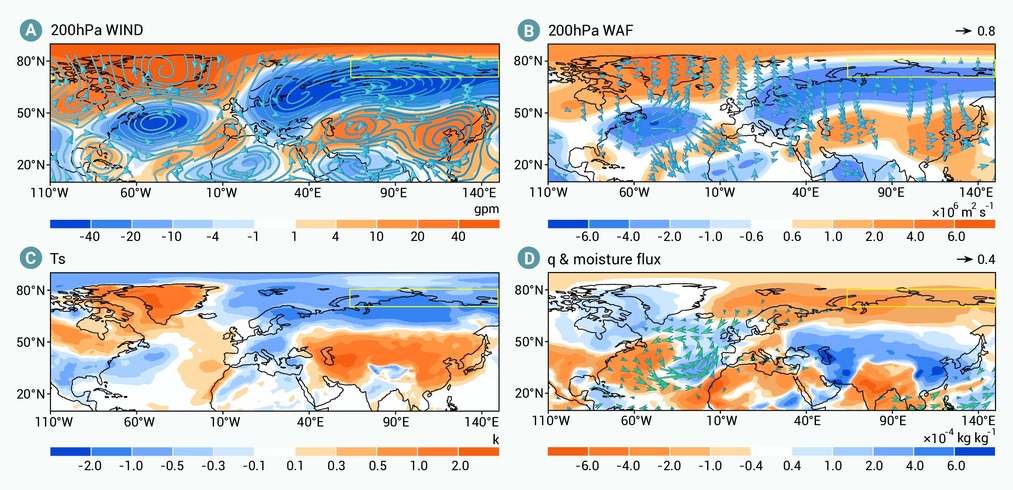
Figure 4.
The atmospheric circulation and thermodynamic variables associated with the North Atlantic (NA) tropical cyclone activities
-
Figure 5.
Ensemble mean anomalies of atmospheric circulation and thermodynamic variables simulated by the Community Atmosphere Model version 6 (CAM6)
