
-

-
REFERENCES
[1] Reid, W. V., Chen, D., Goldfarb, L., et al. (2010). Earth system science for global sustainability: Grand challenges. Science 330:916-917. DOI:10.1126/science.1196263 [2] Rockström J., Gupta J., Qin D. et al. (2023). Safe and just Earth system boundaries. Nature 619:102–111. DOI:10.1038/s41586-023-06083-8 [3] Wang, L., Zuo, B., Le, Y., et al. (2023). Penetrating remote sensing: Next-generation remote sensing for transparent earth. The Innovation 4:100519. DOI:10.1016/j.xinn.2023.100519 [4] Chen, M., Qian, Z., Boers, N., et al. (2024). Collaboration between artificial intelligence and Earth science communities for mutual benefit. Nat. Geosci. 17:949–952. DOI:10.1038/s41561-024-01550-x [5] Taylor, F. W. (2011). Comparative planetology, climatology and biology of Venus, Earth and Mars. Planetary and Space Sci. 59:889-899. DOI:10.1016/j.pss.2010.11.009 [6] Kidd C., Becker A., Huffman G. J., et al. (2017). So, how much of the Earth’s surface is covered by rain gauges. Bull. Am. Meteorol. Soc. 98:69−78. DOI:10.1175/BAMS-D-14-00283.1 -
ABOUT THIS ARTICLE
Cite this article:
The Innovation Geoscience Editorial Team. (2026). What’s next in Geoscience? The Innovation Geoscience 4:100198. https://doi.org/10.59717/j.xinn-geo.2026.100198
Welcome!
To request copyright permission to republish or share portions of our works, please visit Copyright Clearance Center's (CCC) Marketplace website at marketplace.copyright.com.
Export File
Citation
The Innovation Geoscience Editorial Team. (2026). What’s next in Geoscience? The Innovation Geoscience 4:100198. https://doi.org/10.59717/j.xinn-geo.2026.100198

Format
Content
 DownLoad:
-
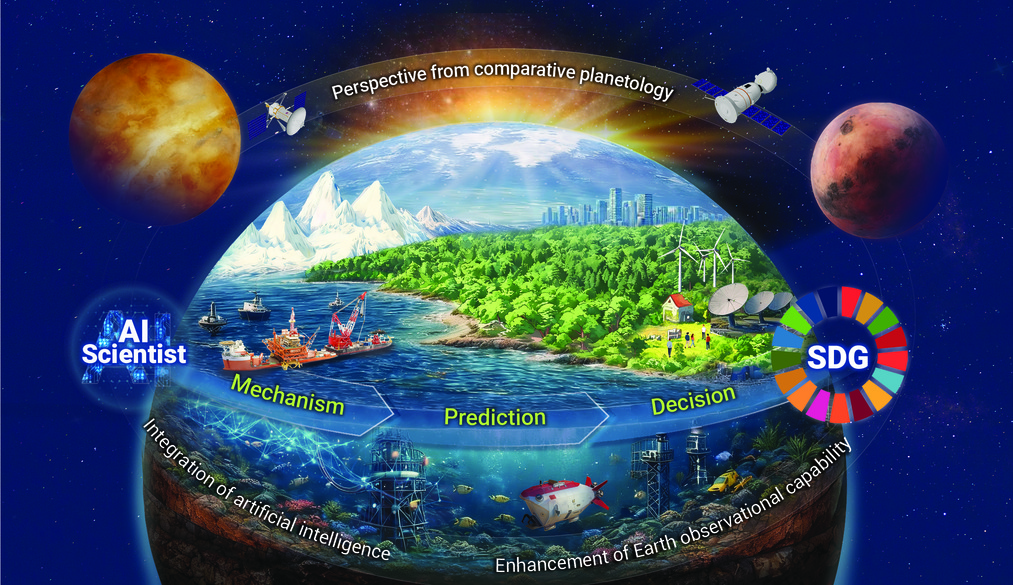
Figure 1.
The next paradigm shift in Geoscience toward an Earth system science framework.
