
Eutrophication-driven widespread surface dissolved oxygen enrichment in Chinese lakes: A warming-vulnerable transient state?
-
GRAPHICAL ABSTRACT
 DownLoad:
Full size image
DownLoad:
Full size image
-
PUBLIC SUMMARY
-
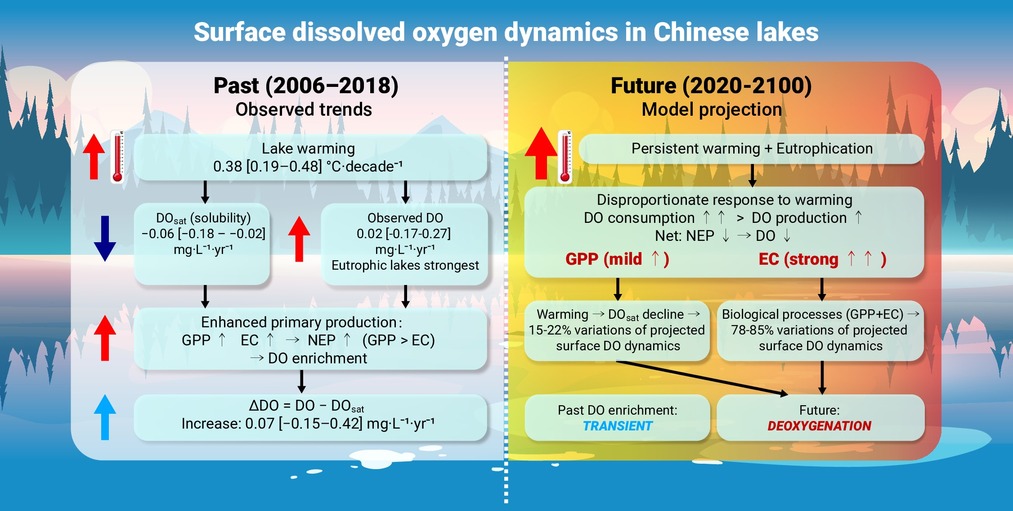
Dissolved oxygen increased in ~100 Chinese lakes with a rate of 0.07 (-0.15–0.42) mg·L−1·yr−1 (2006–2018).
DO enrichment was most pronounced in eutrophic lakes, primarily driven by elevated primary production.
Future projections suggest rising nutrient loads reverse the lake DO enrichment and lead to deoxygenation.
-
-
ABSTRACT
Dissolved oxygen (DO) is a critical determinant of lake ecosystem function and services. The interaction between climate warming and anthropogenic nutrient inputs exerts opposing effects on lake DO—warming decreases gas solubility (DOsat), while nutrient enrichment enhances net ecosystem production through eutrophication-driven primary production, potentially leading to transient DO enrichment. This creates a vulnerable state that may shift under future climate-nutrient interactions, which limits accurate predictions of lake DO dynamics. Here, we calculated ΔDO (= DO – DOsat) in the surface waters of 99 freshwater lakes in China (66 subtropical and 33 temperate), spanning a broad trophic gradient (TN: 0.1–8.3 mg·L-1; TP: 5.4–256 μg·L-1). Using a combined process-based and data-driven modeling approach, we examined DO dynamics in relation to water temperature, primary productivity, and water quality. Despite rapid lake warming (0.38 [0.19–0.48]°C·decade-1) and a corresponding decline in DOsat (-0.06 [-0.18 – -0.02] mg·L-1·yr-1), we observed widespread DO enrichment from 2006 to 2018, with an average ΔDO increase of 0.07 [-0.15–0.42] mg·L-1·yr-1. This enrichment was most pronounced in eutrophic lakes, driven by enhanced primary production. However, future projections suggest that current DO enrichment trends may be a transient state and reverse due to a disproportionate increase in DO consumption relative to production, driven by asymmetric responses to warming, potentially leading to deoxygenation. While nutrient management is widely regarded as an effective strategy against eutrophication, our findings underscore the need to carefully assess its coupled effects on lake DO before implementation. Given the accelerating warming of water bodies, developing nutrient management strategies informed by lake DO levels should be a priority. -

-
REFERENCES
[1] Jane S. F., Hansen G. J. A., Kraemer B. M., et al. (2021). Widespread deoxygenation of temperate lakes. Nature 594:66−70. DOI:10.1038/s41586-021-03550-y [2] North R. P., North R. L., Livingstone D. M., et al. (2014). Long-term changes in hypoxia and soluble reactive phosphorus in the hypolimnion of a large temperate lake: Consequences of a climate regime shift. Glob. Change Biol. 20:811−823. DOI:10.1111/gcb.12371 [3] Fernandez J. E., Peeters F. and Hofmann H. (2014). Importance of the autumn overturn and anoxic conditions in the hypolimnion for the annual methane emissions from a temperate lake. Environ. Sci. Technol. 48:7297−7304. DOI:10.1021/es4056164 [4] Michalak A. M., Anderson E. J., Beletsky D., et al. (2013). Record-setting algal bloom in Lake Erie caused by agricultural and meteorological trends consistent with expected future conditions. Proc. Natl. Acad. Sci. USA 110:6448−6452. DOI:10.1073/pnas.1216006110 [5] Harke M. J., Steffen M. M., Gobler C. J., et al. (2016). A review of the global ecology, genomics, and biogeography of the toxic cyanobacterium, Microcystis spp. Harmful Algae 54:4−20. DOI:10.1016/j.hal.2015.12.007 [6] Tong Y., Feng L., Wang X. C., et al. (2023). Global lakes are warming slower than surface air temperature due to accelerated evaporation. Nat. Water 1:929−940. DOI:10.1038/s44221-023-00148-8 [7] Piccolroaz S., Zhu S., Ladwig R., et al. (2024). Lake water temperature modeling in an Era of climate change: Data sources, models, and future prospects. Rev. Geophys. 62:e2023RG000816. DOI:10.1029/2023RG000816 [8] Jansen J., Simpson G. L., Weyhenmeyer G. A., et al. (2024). Climate-driven deoxygenation of northern lakes. Nat. Clim. Chang. 14:832−838. DOI:10.1038/s41558-024-02058-3 [9] Zhang Y., Shi K., Woolway R. I., et al. (2025). Climate warming and heatwaves accelerate global lake deoxygenation. Sci. Adv. 11:eadt5369. DOI:10.1126/sciadv.adt5369 [10] Breitburg D., Levin L. A., Oschlies A., et al. (2018). Declining oxygen in the global ocean and coastal waters. Science 359:46−56. DOI:10.1126/science.aam7240 [11] Ho J. C., Michalak A. M. and Pahlevan N. (2019). Widespread global increase in intense lake phytoplankton blooms since the 1980s. Nature 574:667−670. DOI:10.1038/s41586-019-1648-7 [12] Meerhoff M., Audet J., Davidson T. A., et al. (2022). Feedback between climate change and eutrophication: Revisiting the allied attack concept and how to strike back. Inland Waters 12:187−204. DOI:10.1080/20442041.2022.2029317 [13] Hou X. J., Feng L., Dai Y. H., et al. (2022). Global mapping reveals increase in lacustrine algal blooms over the past decade. Nat. Geosci. 15:130−134. DOI:10.1038/s41561-021-00887-x [14] Jenny J. P., Anneville O., Arnaud F., et al. (2020). Scientists' warning to humanity: Rapid degradation of the world's large lakes. J. Great Lakes Res. 46:686−702. DOI:10.1016/j.jglr.2020.05.006 [15] Saravani M. J., Noori R., Jun C., et al. (2025). Predicting Chlorophyll-a concentrations in the world’s largest lakes using Kolmogorov-Arnold networks. Environ. Sci. Technol. 59:1801−1810. DOI:10.1021/acs.est.4c11113 [16] Naderian D., Noori R., Kim D., et al. (2025). Environmental controls on the conversion of nutrients to chlorophyll in lakes. Water Res. 274:123094. DOI:10.1016/j.watres.2025.123094 [17] Marcé R., Gómez-Gener L. and Carey C. C. (2024). Chapter 11 - Oxygen. In Wetzel's Limnology (Fourth Edition), I.D. Jones, and J.P. Smol (eds). (Academic Press), pp:237-274. DOI:10.1016/B978-0-12-822701-5.00011-2 [18] Song C., Dodds W. K., Rüegg J., et al. (2018). Continental-scale decrease in net primary productivity in streams due to climate warming. Nat. Geosci. 11:415−420. DOI:10.1038/s41561-018-0125-5 [19] Tong Y. D., Xu X. W., Qi M., et al. (2021). Lake warming intensifies the seasonal pattern of internal nutrient cycling in the eutrophic lake and potential impacts on algal blooms. Water Res. 188:116570. DOI:10.1016/j.watres.2020.116570 [20] CNEMC (2024). China national environmental monitoring centre. https://www.cnemc.cn [21] Huang W., Ma C., Li W., et al. (2021). Spatial-temporal variations of dissolved oxygen and their response to global warming in China. Acta Sci. Circumst. 41:1970–1980 (in Chinese). DOI:10.13671/j.hjkxxb.2020.0330 [22] Messager M. L., Lehner B., Grill G., et al. (2016). Estimating the volume and age of water stored in global lakes using a geo-statistical approach. Nat. Commun. 7:13603. DOI:10.1038/ncomms13603 [23] Hersbach H., Bell B., Berrisford P., et al. (2020). The ERA5 global reanalysis. Q. J. R. Meteorol. Soc. 146:1999−2049. DOI:10.1002/qj.3803 [24] MEPC (2014). Water quality-determination of total nitrogen by flow injection analysis (FIA) and N-(1-Naphthyl)ethylene diamine dihydrochloride spectrophotometry, (HJ668-2013). Ministry of Environmental Protection of China. https://www.mee.gov.cn/ywgz/fgbz/bz/bzwb/jcffbz/201311/W020131106589119080353.pdf [25] Janssen A. B. G., Teurlincx S., Beusen A. H. W., et al. (2019). PCLake+: A process-based ecological model to assess the trophic state of stratified and non-stratified freshwater lakes worldwide. Ecol. Model. 396:23−32. DOI:10.1016/j.ecolmodel.2019.01.006 [26] Kong X. Z., He Q. S., Yang B., et al. (2017). Hydrological regulation drives regime shifts: Evidence from paleolimnology and ecosystem modeling of a large shallow Chinese lake. Glob. Change Biol. 23:737−754. DOI:10.1111/gcb.13416 [27] Janse J. H., Scheffer M., Lijklema L., et al. (2010). Estimating the critical phosphorus loading of shallow lakes with the ecosystem model PCLake: Sensitivity, calibration and uncertainty. Ecol. Model. 221:654−665. DOI:10.1016/j.ecolmodel.2009.07.023 [28] Nielsen A., Trolle D., Bjerring R., et al. (2014). Effects of climate and nutrient load on the water quality of shallow lakes assessed through ensemble runs by PCLake. Ecol. Appl. 24:1926−1944. DOI:10.1890/13-0790.1 [29] Janssen A. B., de Jager V. C., Janse J. H., et al. (2017). Spatial identification of critical nutrient loads of large shallow lakes: Implications for Lake Taihu (China). Water Res. 119:276−287. DOI:10.1016/j.watres.2017.04.045 [30] Harrison J. A., Maranger R. J., Alexander R. B., et al. (2009). The regional and global significance of nitrogen removal in lakes and reservoirs. Biogeochemistry 93:143−157. DOI:10.1007/s10533-008-9272-x [31] Tong Y. D., Wang M. Z., Penuelas J., et al. (2020). Improvement in municipal wastewater treatment alters lake nitrogen to phosphorus ratios in populated regions. Proc. Natl. Acad. Sci. USA 117:11566−11572. DOI:10.1073/pnas.1920759117 [32] Tong Y. D., Zhang W., Wang X. J., et al. (2017). Decline in Chinese lake phosphorus concentration accompanied by shift in sources since 2006. Nat. Geosci. 10:507−511. DOI:10.1038/ngeo2967 [33] Mahdiyan O., Filazzola A., Molot L. A., et al. (2021). Drivers of water quality changes within the Laurentian Great Lakes region over the past 40 years. Limnol. Oceanogr. 66:237−254. DOI:10.1002/lno.11600 [34] Friendly M. (2002). Corrgrams: Exploratory displays for correlation matrices. Am. Stat. 56:316−324. DOI:10.1198/000313002533 [35] Breiman L. (2001). Random forests. Mach. Learn. 45:5−32. DOI:10.1023/A:1010933404324 [36] Nelson N. G., Munoz-Carpena R., Phlips E. J., et al. (2018). Revealing biotic and abiotic controls of harmful algal blooms in a shallow subtropical lake through statistical machine learning. Environ. Sci. Technol. 52:3527−3535. DOI:10.1021/acs.est.7b05884 [37] Tong Y. D., Xu X. W., Zhang S. L., et al. (2019). Establishment of season-specific nutrient thresholds and analyses of the effects of nutrient management in eutrophic lakes through statistical machine learning. J. Hydrol. 578:124079. DOI:10.1016/j.jhydrol.2019.124079 [38] OECD (1982). Eutrophication of waters: Monitoring, assessment and control. Paris: OECD. https://www.oecd.org/env/outreach/30693798.pdf [39] O'Reilly C. M., Sharma S., Gray D. K., et al. (2015). Rapid and highly variable warming of lake surface waters around the globe. Geophys. Res. Lett. 42:10773−10781. DOI:10.1002/2015GL066235 [40] Tong Y. D., Huang Z., He W., et al. (2022). Influence of social and environmental drivers on nutrient concentrations and ratios in lakes: A comparison between China and Europe. Water Res. 227:119347. DOI:10.1016/j.watres.2022.119347 [41] European Environment Agency (2018). European waters – Assessment of status and pressures 2018. EEA Report No 7/2018. Luxembourg: European Environment Agency. DOI:10.2800/63266 [42] U.S. Environmental Protection Agency (2022). National lakes assessment: The third collaborative survey of lakes in the United States. Washington, DC: U.S. Environmental Protection Agency. DOI:10.23719/1531936 [43] Ma J. E., Loiselle S., Cao Z. G., et al. (2023). Unbalanced impacts of nature and nurture factors on the phenology, area and intensity of algal blooms in global large lakes: MODIS observations. Sci. Total Environ. 880:163376. DOI:10.1016/j.scitotenv.2023.163376 [44] Lewis A. S., Lau M. P., Jane S. F., et al. (2024). Anoxia begets anoxia: A positive feedback to the deoxygenation of temperate lakes. Glob. Change Biol. 30:e17046. DOI:10.1111/gcb.17046 [45] Ladwig R., Hanson P. C., Dugan H. A., et al. (2021). Lake thermal structure drives interannual variability in summer anoxia dynamics in a eutrophic lake over 37 years. Hydrol. Earth Syst. Sci. 25:1009−1032. DOI:10.5194/hess-25-1009-2021 [46] Jeppesen E., Canfield D. E., Bachmann R. W., et al. (2020). Toward predicting climate change effects on lakes: A comparison of 1656 shallow lakes from Florida and Denmark reveals substantial differences in nutrient dynamics, metabolism, trophic structure, and top-down control. Inland Waters 10:197−211. DOI:10.1080/20442041.2020.1711681 [47] Huisman J., Codd G. A., Paerl H. W., et al. (2018). Cyanobacterial blooms. Nat. Rev. Microbiol. 16:471−483. DOI:10.1038/s41579-018-0040-1 [48] Scharfenberger U., Jeppesen E., Beklioglu M., et al. (2019). Effects of trophic status, water level, and temperature on shallow lake metabolism and metabolic balance: A standardized pan-European mesocosm experiment. Limnol. Oceanogr. 64:616−631. DOI:10.1002/lno.11064 -
ABOUT THIS ARTICLE
Cite this article:
Tong Y., Zhao F., Huang Z., et al. (2026). Eutrophication-driven widespread surface dissolved oxygen enrichment in Chinese lakes: A warming-vulnerable transient state? The Innovation Geoscience 4:100215. https://doi.org/10.59717/j.xinn-geo.2026.100215
Welcome!
To request copyright permission to republish or share portions of our works, please visit Copyright Clearance Center's (CCC) Marketplace website at marketplace.copyright.com.
Supplementary Information
-
download_supplementary
SI-Extended
-
download_supplementary
SI-Extended
Article Metrics
Relative Articles
Cited by
Export File
Citation
Tong Y., Zhao F., Huang Z., et al. (2026). Eutrophication-driven widespread surface dissolved oxygen enrichment in Chinese lakes: A warming-vulnerable transient state? The Innovation Geoscience 4:100215. https://doi.org/10.59717/j.xinn-geo.2026.100215

Format
Content
-
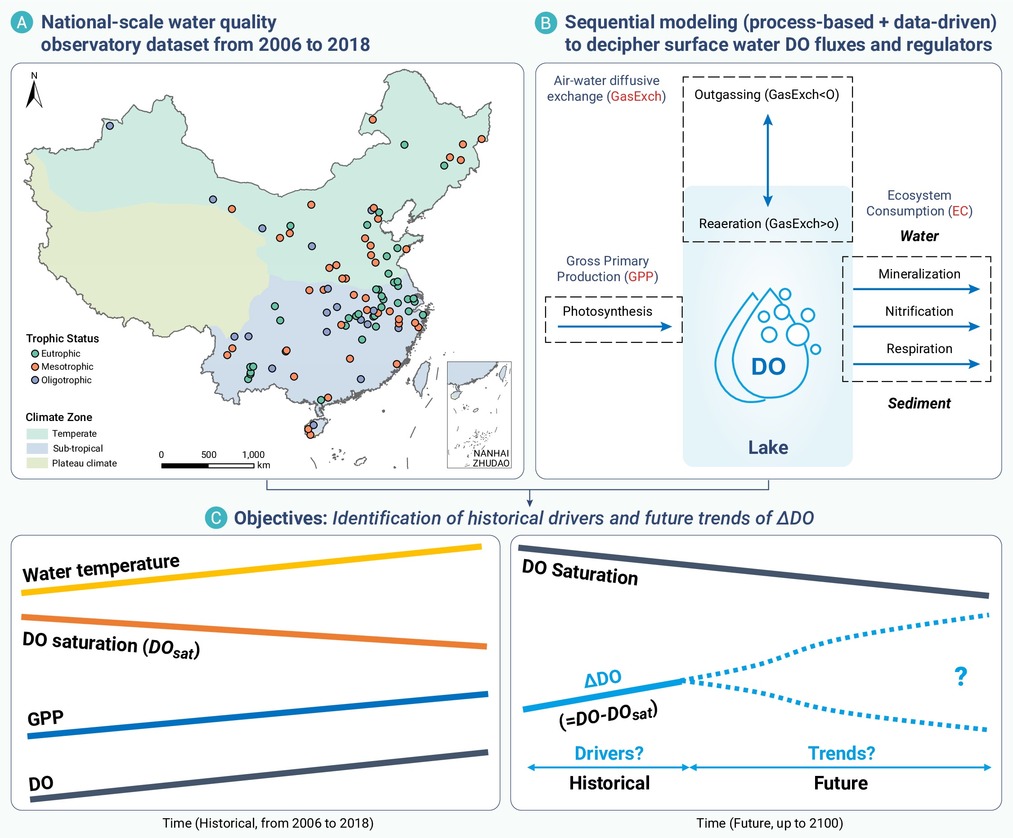
Figure 1.
Conceptual diagram of workflow, including (A) lake monitoring dataset, (B) sequential modeling, and (C) hypothesis and objectives
-
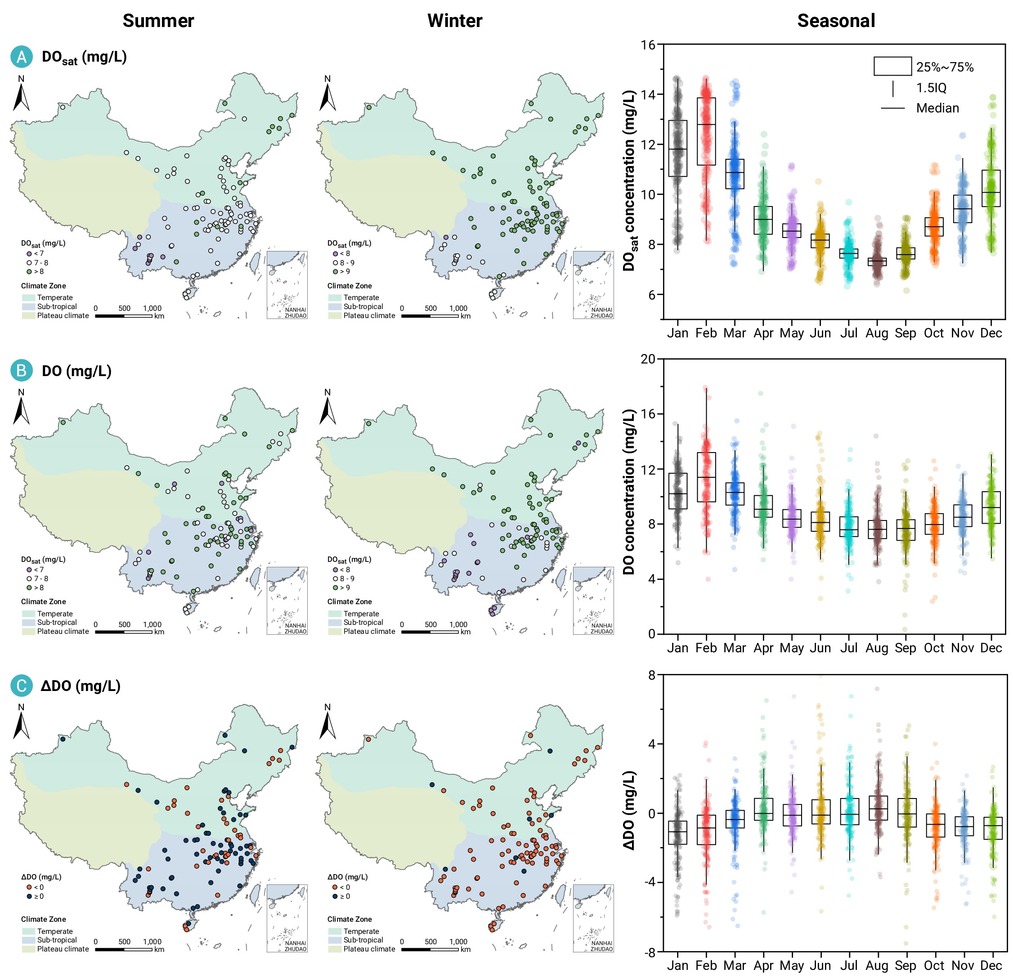
Figure 2.
Spatial versus temporal patterns of (A) DOsat, (B) DO, and (C) ∆DO in freshwater lakes across China
-
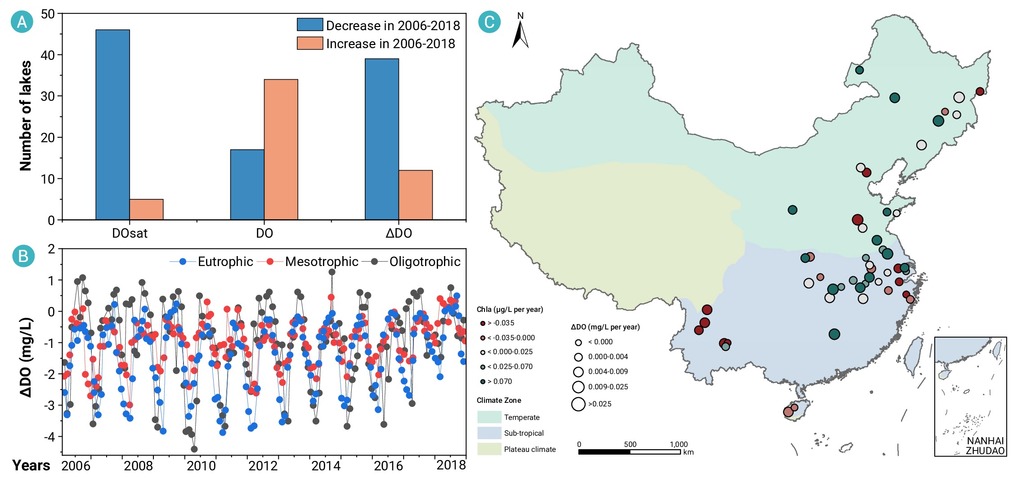
Figure 3.
Trends of DO concentrations in China’s freshwater lakes (n = 50) during 2006‒2018
-
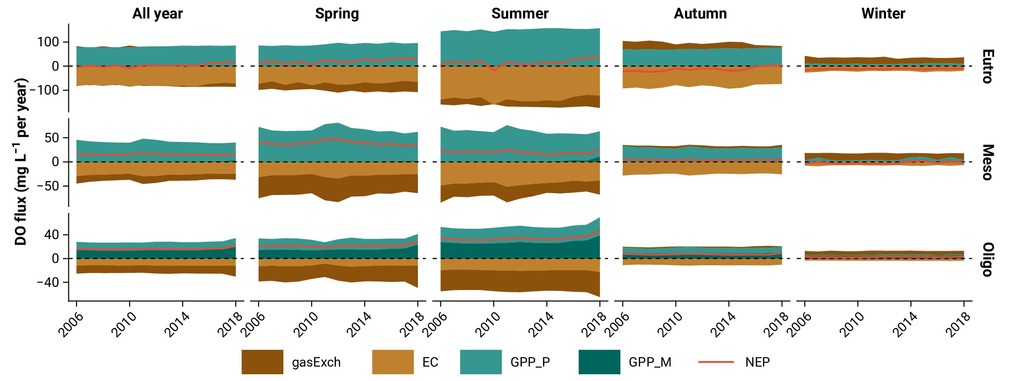
Figure 4.
Modeled DO fluxes of various process groups during 2006‒2018 in different seasons and lakes with distinct trophic states using the PCLake+ model
-
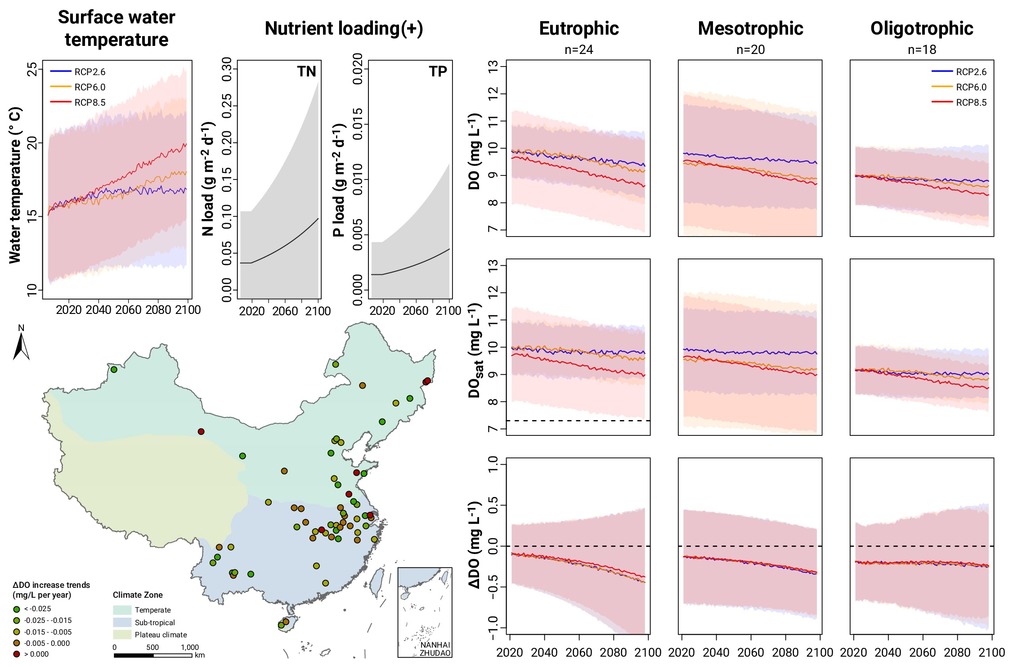
Figure 5.
Future projections of DOsat, DO, and ∆DO in lakes across China with distinct trophic states under the scenarios of climate warming (i.e., RCP 2.6/6.0/8.5) and nutrient loading increases
-
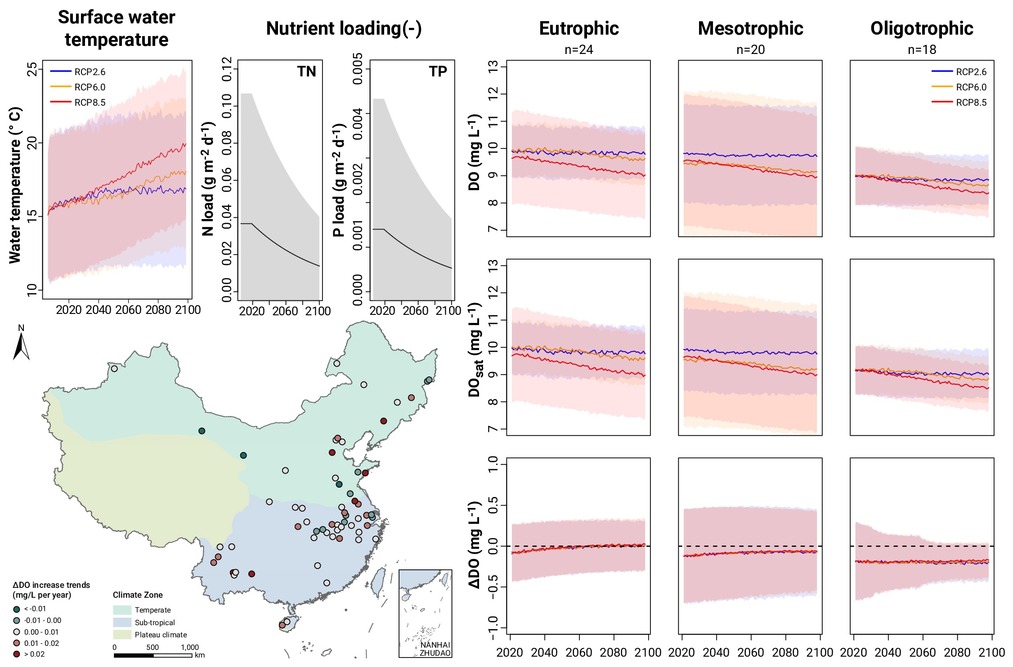
Figure 6.
Future projections of DOsat, DO, and ∆DO in lakes across China with distinct trophic states under the scenarios of climate warming (i.e., RCP 2.6/6.0/8.5) and nutrient loading decreases
-
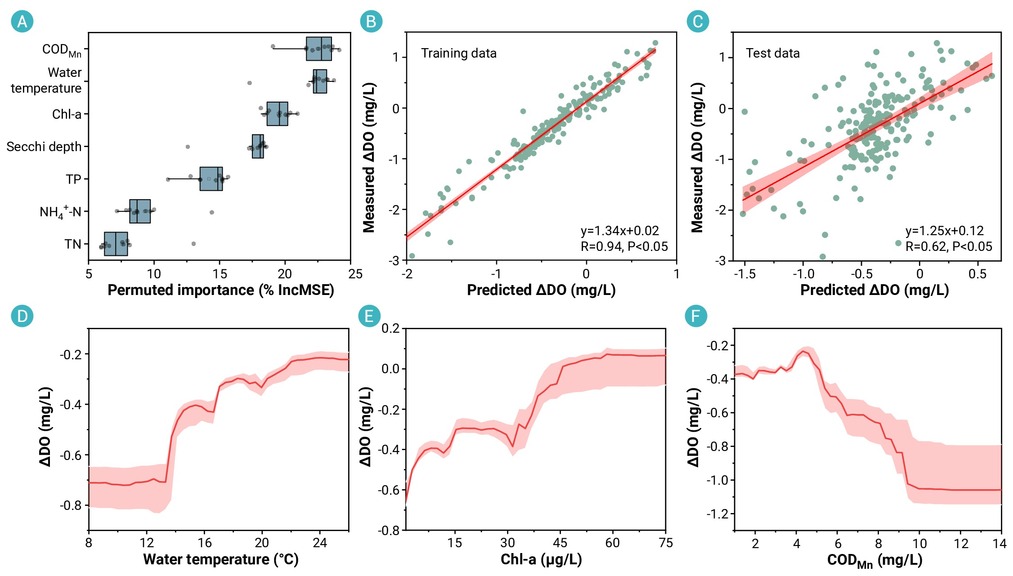
Figure 7.
Random Forests models of DO saturation in 101 lakes in 2018. A total of 10 Random Forest models were developed corresponding to 10-fold cross-validation
