
Ratoon rice as a nature-based solution towards food security and climate resilience amidst aging societies
-
ABSTRACT
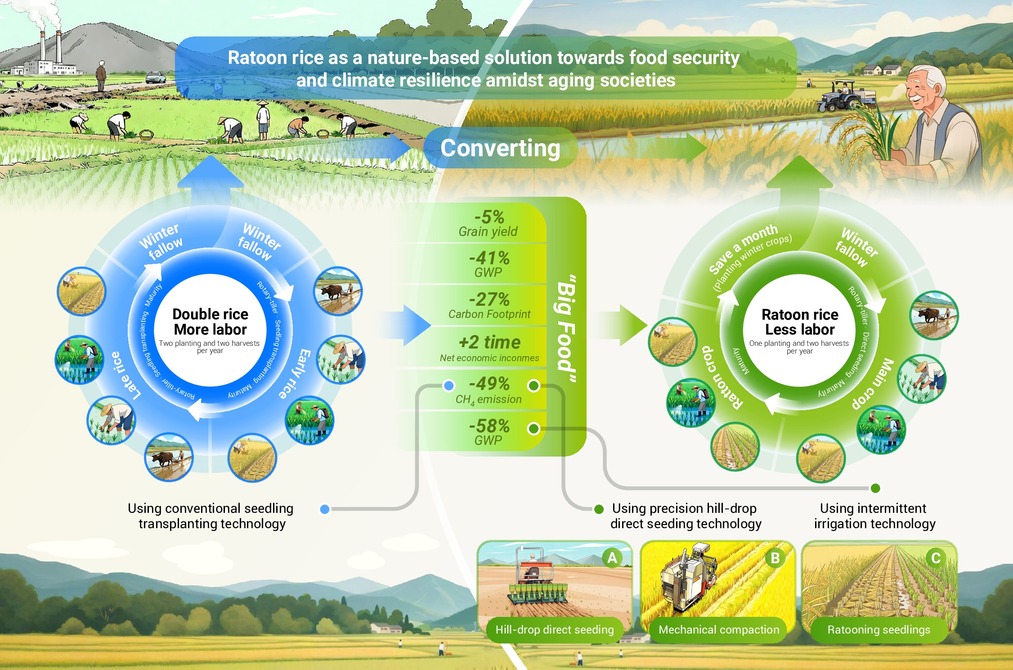
Ratoon rice cultivation, a 1,700-year-old Chinese practice, is making a comeback as a sustainable solution to meet global food demand and environmental challenges. By enabling two harvests from one planting through stalk regeneration, it boosts yields to 12.9 metric tons per hectare, doubles net income compared to traditional double rice, and cuts labor costs by nearly 50% while halving methane emissions. This low-carbon, high-yield method aligns with UN Sustainable Development Goals and offers a scalable model for global agriculture. Immediate collaboration from policymakers and researchers is essential for its widespread adoption and innovation. -

-
REFERENCES
[1] Petherick A. (2011). Food and the future. Nat. Clim. Change 1:20−21. DOI:10.1038/nclimate1052 [2] Wang F., Harindintwali J. D., Wei K., et al. (2023). Climate change: Strategies for mitigation and adaptation. Innov. Geosci. 1:100015. DOI:10.59717/j.xinn-geo.2023.100015 [3] Huang M., Chen J. and Cao F. (2022). Estimating the expected planting area of double- and single-season rice in the Hunan-Jiangxi region of China by 2030. Sci. Rep. 12:6207. DOI:10.1038/s41598-022-10357-y [4] Peng S., Zheng C. and Yu X. (2023). Progress and challenges of rice ratooning technology in China. Crop Environ. 2:5−11. DOI:10.1016/j.crope.2023.02.005 [5] Wang S., Sun P., Zhang G., et al. (2022). Contribution of periphytic biofilm of paddy soils to carbon dioxide fixation and methane emissions. The Innovation 3:100192. DOI:10.1016/j.xinn.2021.100192 [6] Nisbet E.G., Manning M.R., Dlugokencky E.J., et al. (2019). Very strong atmospheric methane growth in the 4 years 2014–2017: Implications for the paris agreement. Global Biogeochem. Cycles 33:318−342. DOI:10.1029/2018GB006009 [7] Xu Y., Liang L., Wang B., et al. (2022). Conversion from double-season rice to ratoon rice paddy fields reduces carbon footprint and enhances net ecosystem economic benefit. Sci. Total Environ. 813:152550. DOI:10.1016/j.scitotenv.2021.152550 [8] Zhang L., Tang Q., Li L., et al. (2022). Ratoon rice with direct seeding improves soil carbon sequestration in rice fields and increases grain quality. J. Environ. Manage. 317:115374. DOI:10.1016/j.jenvman.2022.115374 [9] Yu X., Tao X., Liao J., et al. (2022). Predicting potential cultivation region and paddy area for ratoon rice production in China using Maxent model. Field Crops Res. 275:108372. DOI:10.1016/j.fcr.2021.108372 -
ABOUT THIS ARTICLE
Cite this article:
Zhang L., Tang W., Tang Q., et al. (2026). Ratoon rice as a nature-based solution towards food security and climate resilience amidst aging societies. The Innovation Geoscience 4:100219. https://doi.org/10.59717/j.xinn-geo.2026.100219
Welcome!
To request copyright permission to republish or share portions of our works, please visit Copyright Clearance Center's (CCC) Marketplace website at marketplace.copyright.com.
Export File
Citation
Zhang L., Tang W., Tang Q., et al. (2026). Ratoon rice as a nature-based solution towards food security and climate resilience amidst aging societies. The Innovation Geoscience 4:100219. https://doi.org/10.59717/j.xinn-geo.2026.100219

Format
Content
 DownLoad:
-
Figure 1.
Ratoon rice as a nature-based solution towards food security and climate resilience amidst aging societies
