
Multi-year La Niña dampens the Southern Oscillation during subsequent El Niño through tropical Pacific-rooted dynamics
-
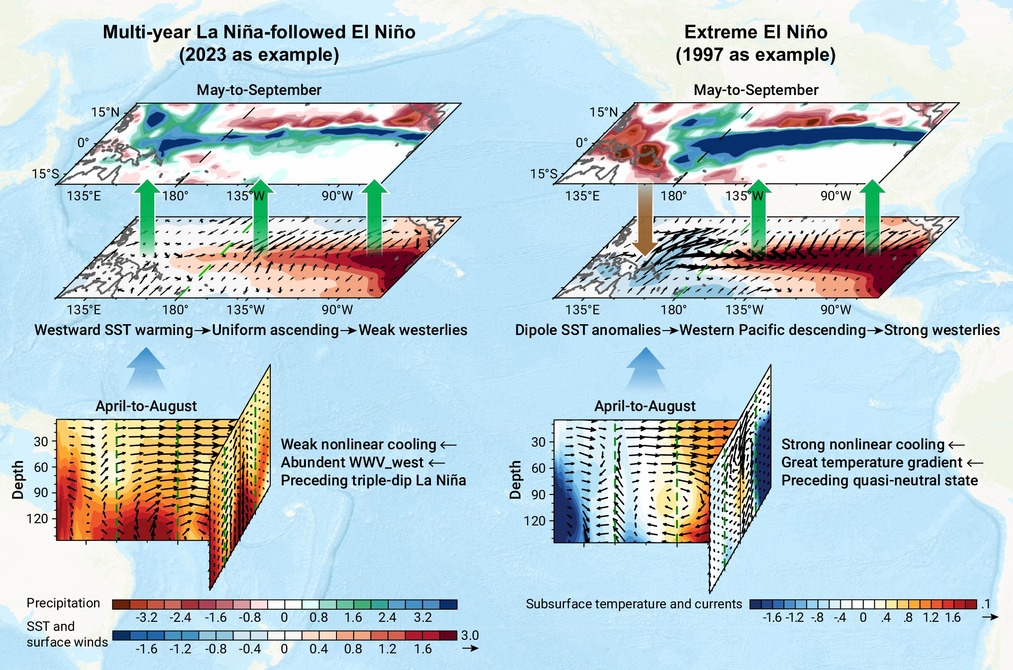
GRAPHICAL ABSTRACT
 DownLoad:
Full size image
DownLoad:
Full size image
-
PUBLIC SUMMARY
-
The 2023 strong El Nio event was unexpectedly accompanied by weak Southern Oscillation (westerly anomaly).
This phenomenon was caused by zonally uniform ascent from westward-extended equatorial SST warming.
The preceding multi-year La Nia (ML) accumulated abundant warm water in the western Pacific (WP).
This warm water suppressed the nonlinear dynamical cooling in the WP during 1997-like extreme El Nios.
This mechanism, rooted in tropical Pacific, also functioned in other El Nios after ML, especially 2009.
-
-
ABSTRACT
The 2023 El Niño, which occurred after a triple-dip La Niña, displayed several distinct features. Although the favorable warm water volume pre-condition indicated the potential for an extreme event, its actual intensity did not meet expectations. More counterintuitively, the westerly wind anomalies were much weaker relative to the sea surface temperature (SST) warming, presenting an unusual “strong El Niño but weak Southern Oscillation” characteristic. Here we propose a tropical Pacific-rooted mechanism that the relatively westward extension of SST warming in the equatorial Pacific was the primary cause of the weak westerly anomalies by suppressing the negative convection anomaly over the equatorial western Pacific. Furthermore, the relatively westward-extended SST warming can ultimately be traced back to the preceding multi-year La Niña through the chain of causation involving weak nonlinear dynamical cooling, weak anomalous subsurface temperature gradients, and abundant warm water accumulation in the western Pacific. This mechanism similarly explains other El Niño events following multi-year La Niña, especially the 2009 event, providing insights into the rare transition from a multi-year La Niña to a strong El Niño. However, current climate models demonstrate limited skill in simulating 2023-like El Niño events and associated mechanisms, primarily due to the systematic biases in the zonal distributions of SST and convection anomalies. Our proposed mechanism, rooted in tropical Pacific dynamics, offers a new perspective to improve model simulations and predictions of such events. -

-
REFERENCES
[1] Timmermann A., An S.-I., Kug J. S., et al. (2018). El Niño–Southern Oscillation complexity. Nature 559:535−545. DOI:10.1038/s41586-018-0252-6 [2] Chen D., Lian T., Fu C., et al. (2015). Strong influence of westerly wind bursts on El Niño diversity. Nat. Geosci. 8:339−345. DOI:10.1038/ngeo2399 [3] Hasan N. A., Chikamoto Y. and McPhaden M. J. (2022). The influence of tropical basin interactions on the 2020–2022 double-dip La Niña. Front. Clim. 4:1001174. DOI:10.3389/fclim.2022.1001174 [4] Li X., Hu Z. Z., McPhaden M. J., et al. (2023). Triple-dip La Niñas in 1998–2001 and 2020–2023: Impact of mean state changes. J. Geophys. Res. Atmos. 128:e2023JD038843. DOI:10.1029/2023JD038843 [5] Zhang S., Fan H., Hu X., et al. (2024). Unprecedented cross-equatorial southerly wind anomalies during the 2020–2023 triple-dip La Niña: Impacts and mechanisms. Atmos. Res. 304:107412. DOI:10.1016/j.atmosres.2024.107412 [6] Meinen C. S. and McPhaden M. J. (2001). Interannual variability in warm water volume transports in the equatorial Pacific during 1993-99. J. Phys. Oceanogr. 31:1324−1345. DOI:2.0.CO;2">10.1175/1520-0485(2001)031<1324:IVIWWV>2.0.CO;2 [7] Lian T., Wang J., Chen D., et al. (2023). A Strong 2023/24 El Niño is staged by tropical Pacific Ocean heat content buildup. Ocean-Land-Atmos. Res. 2:0011. DOI:10.34133/olar.0011 [8] Wang J. Z. and Wang C. (2021). Joint boost to super El Niño from the Indian and Atlantic Oceans. J. Climate 34:4937−4954. DOI:10.1175/JCLI-D-20-0710.1 [9] Fan H., Wang C., Yang S., et al. (2024). Coupling is key for the tropical Indian and Atlantic oceans to boost super El Niño. Sci. Adv. 10:eadp2281. DOI:10.1126/sciadv.adp2281 [10] Hu R., Lian T., Liu T., et al. (2024). Predicting the 2023/24 El Niño from a multi-scale and global perspective. Commun. Earth Environ. 5:675. DOI:10.1038/s43247-024-01867-w [11] Jia F., Cai W., Geng T., et al. (2025). Transition from multi-year La Niña to strong El Niño rare but increased under global warming. Sci. Bull. 70:756−764. DOI:10.1016/j.scib.2024.12.034 [12] Hong C. C., Sullivan A. and Chang C. C. (2024). Impact of north Atlantic tripole and extratropical north Pacific extreme SSTs on the 2023/24 El Niño. Geophys. Res. Lett. 51:e2024GL110639. DOI:10.1029/2024GL110639 [13] Zhao Y., Li T. and Pan X. (2025). Why zonal wind anomalies were “decoupled” to El Niño in July 2023. Climate Dyn. 63:140. DOI:10.1007/s00382-025-07625-8 [14] Kim J., Tian B. and Yu J.-Y. (2025). Unusual and persistent easterlies restrained the 2023/24 El Niño development after a triple-dip La Niña. npj Clim. Atmos. Sci. 8:34. DOI:10.1038/s41612-024-00890-0 [15] Lin Y.-F., Chen M., Liu L., et al. (2025). Diverse NPMM conditions deviate the 2023/24 El Niño from the 1997/1998 and 2015/2016 extreme El Niño events. npj Clim. Atmos. Sci. 8:113. DOI:10.1038/s41612-025-01013-z [16] Peng Q., Xie S.-P., Miyamoto A., et al. (2025). Strong 2023–2024 El Niño generated by ocean dynamics. Nat. Geosci. 18:471−478. DOI:10.1038/s41561-025-01700-9 [17] Huang B., Thorne P. W., Banzon V. F., et al. (2017). Extended reconstructed Sea surface temperature, Version 5 (ERSSTv5): Upgrades, validations, and intercomparisons. J. Climate 30:8179−8205. DOI:10.1175/JCLI-D-16-0836.1 [18] Rayner N. A., Parker D. E., Horton E. B., et al., (2003). Global analyses of sea surface temperature, sea ice, and night marine air temperature since the late nineteenth century. J. Geophys. Res.: Atmos. 108: 4407. DOI: 10.1029/2002JD002670 [19] Hirahara S., Ishii M. and Fukuda Y. (2014). Centennial-scale sea surface temperature analysis and its uncertainty. J. Climate 27:57−75. DOI:10.1175/JCLI-D-12-00837.1 [20] Schneider D. P., Deser C., Fasullo J., et al. (2013). Climate data guide spurs discovery and understanding. Eos, Trans. Am. Geophys. Union 94:121−122. DOI:10.1002/2013EO130001 [21] Xie P. and Arkin P. A. (1997). Global precipitation: A 17-year monthly analysis based on gauge observations, satellite estimates, and numerical model outputs. Bull. Am. Meteorol. Soc. 78:2539−2558. DOI:2.0.CO;2">10.1175/1520-0477(1997)078<2539:GPAYMA>2.0.CO;2 [22] Kanamitsu M., Ebisuzaki W., Woollen J., et al. (2002). NCEP–DOE AMIP-II reanalysis (R-2). Bull. Am. Meteorol. Soc. 83:1631−1644. DOI:10.1175/Bams-83-11-1631 [23] Hersbach H., Bell B., Berrisford P., et al. (2020). The ERA5 global reanalysis from 1940 to 2022. Q. J. R. Meteorol. Soc. 146:1999−2049. DOI:10.1002/qj.4803 [24] Kobayashi S., Ota Y., Harada Y., et al. (2015). The JRA-55 Reanalysis: General specifications and basic characteristics. J. Meteorol. Soc. of Japan. Ser. II 93:5−48. DOI:10.2151/jmsj.2015-001 [25] Huang B., Xue Y., Zhang D., et al. (2010). The NCEP GODAS ocean analysis of the tropical pacific mixed layer heat budget on seasonal to interannual time scales. J. Climate 23:4901−4925. DOI:10.1175/2010JCLI3373.1 [26] Zuo H., Balmaseda M. A., Tietsche S., et al. (2019). The ECMWF ocean reanalysis system 5 (ORAS5). Ocean Sci. 15:79−808. DOI:10.5194/os-15-779-2019 [27] Menemenlis D., Campin J. M., Heimbach P., et al. (2008). ECCO2: High resolution global ocean and sea ice data synthesis. Mercator Ocean Q. Newsl. 31:13−21. https://www.researchgate.net/publication/253471797_ECCO2_High_Resolution_Global_Ocean_and_Sea_Ice_Data_Synthesis [28] Fan H., Huang B., Yang S., et al. (2019). Seasonally-dependent impact of easterly wind bursts on the development of El Niño events. Climate Dyn. 53:1527−1546. DOI:10.1007/s00382-019-04688-2 [29] Lin S., Yang S., He S., et al. (2022). Attribution of the seasonality of atmospheric heating changes over the western tropical Pacific with a focus on the spring season. Climate Dyn. 58:2575−2592. DOI:10.1007/s00382-021-06020-3 [30] Kay J. E., Deser C., Phillips A., et al. (2015). The community earth system model (CESM) large ensemble project: A community resource for studying climate change in the presence of internal climate variability. Bull. Am. Meteorol. Soc. 96:1333−1349. DOI:10.1175/BAMS-D-13-00255.1 [31] Rodgers K. B., Lee S. S., Rosenbloom N., et al. (2021). Ubiquity of human-induced changes in climate variability. Earth Syst. Dyn. 12:1393−1411. DOI:10.5194/esd-12-1393-2021 [32] Kim J., Yu J. and Tian B. (2023). Overemphasized role of preceding strong El Niño in generating multi-year La Niña events. Nat. Commun. 14:6790. DOI:10.1038/s41467-023-42373-5 [33] Fan H., Wang C. and Yang S. (2023). Asymmetry between positive and negative phases of the Pacific Meridional Mode: A contributor to ENSO transition complexity. Geophys. Res. Lett. 50:e2023GL104000. DOI:10.1029/2023GL104000 [34] Amaya D. J., Maher N., Deser C., et al. (2025). Linking projected changes in seasonal climate predictability and ENSO amplitude. J. Climate 38:675−688. DOI:10.1175/JCLI-D-23-0648.1 [35] Danabasoglu G., Lamarque J.-F., Bacmeister J., et al. (2020). The community earth system model version 2 (CESM2). J. Adv. Model. Earth Syst. 12:e2019MS001916. DOI:10.1029/2019MS001916 [36] Neale R. B., Gettelman A., Park S., et al. (2012). Description of the NCAR Community Atmosphere Model (CAM 5.0). DOI: 10.5065/wgtk-4g06 [37] Watanabe M. and Kimoto M. (1999). Tropical‐extratropical connection in the Atlantic atmosphere‐ocean variability. Geophys. Res. Lett. 26:2247−2250. DOI:10.1029/1999GL900350 [38] Jin F. F. (1997). An equatorial ocean recharge paradigm for ENSO. Part I: Conceptual model. J. Atmos. Sci. 54:811−829. DOI:2.0.CO;2">10.1175/1520-0469(1997)054<0811:AEORPF>2.0.CO;2 [39] Rasmusson E. M. and Carpenter T. H. (1982). Variations in tropical sea surface temperature and surface wind fields associated with the Southern Oscillation/El Niño. Mon. Weather Rev. 110:354−384. DOI:2.0.CO;2">10.1175/1520-0493(1982)110<0354:VITSST>2.0.CO;2 [40] Ropelewski C. F. and Jones P. D. (1987). An extension of the Tahiti–Darwin Southern Oscillation index. Mon. Weather Rev. 115:2161−2165. DOI:2.0.CO;2">10.1175/1520-0493(1987)115<2161:AEOTTS>2.0.CO;2 [41] Lindzen R. S. and Nigam S. (1987). On the role of sea surface temperature gradients in forcing low-level winds and convergence in the tropics. J. Atmos. Sci. 44:2418−2436. DOI:2.0.CO;2">10.1175/1520-0469(1987)044<2418:OTROSS>2.0.CO;2 [42] Bjerknes J. (1969). Atmospheric teleconnections from the equatorial Pacific. Mon. Weather Rev. 97:163−172. DOI:2.3.CO;2">10.1175/1520-0493(1969)097<0163:ATFTEP>2.3.CO;2 [43] Hu Z. Z., McPhaden M. J., Kumar A., et al. (2020). Uncoupled El Niño warming. Geophys. Res. Lett. 47:e2020GL087621. DOI:10.1029/2020GL087621 [44] Johnson N. C., L’Heureux M. L., Chang C. H., et al. (2019). On the delayed coupling between ocean and atmosphere in recent weak El Niño episodes. Geophys. Res. Lett. 46:11416−11425. DOI:10.1029/2019GL084021 [45] Peng Q., Xie S. P., Passalacqua G. A., et al. (2024). The 2023 extreme coastal El Niño: Atmospheric and air-sea coupling mechanisms. Sci. Adv. 10:sciadv.adk8646. DOI:10.1126/sciadv.adk8646 [46] Tan W., Hu Z. Z., McPhaden M. J., et al. (2024). On the divergent evolution of ENSO after the coastal El Niños in 2017 and 2023. Geophys. Res. Lett. 51:2024GL108198. DOI:10.1029/2024GL108198 [47] An S.-I. and Jin F.-F. (2001). Collective role of thermocline and zonal advective feedbacks in the ENSO mode. J. Climate 14:3421−3432. DOI:2.0.CO;2">10.1175/1520-0442(2001)014<3421:CROTAZ>2.0.CO;2 [48] Kug J. S., Jin F. F. and An S. Il. (2009). Two types of El Niño events: Cold tongue El Niño and warm pool El Niño. J. Climate 22:1499−1515. DOI:10.1175/2008JCLI2624.1 [49] Yu J. Y. and Fang S. W. (2018). The distinct contributions of the seasonal footprinting and charged-discharged mechanisms to ENSO complexity. Geophys. Res. Lett. 45:6611−6618. DOI:10.1029/2018GL077664 [50] Clarke A. J. (2010). Analytical theory for the quasi-steady and low-frequency equatorial ocean response to wind forcing: The “tilt” and “warm water volume” modes. J. Phys. Oceanogr. 40:121−137. DOI:10.1175/2009JPO4263.1 [51] Izumo T., Lengaigne M., Vialard J., et al. (2019). On the physical interpretation of the lead relation between Warm Water Volume and the El Niño Southern Oscillation. Climate Dyn. 52:2923−2942. DOI:10.1007/s00382-018-4313-1 [52] Izumo T. and Colin M. (2022). Improving and harmonizing El Niño recharge indices. Geophys. Res. Lett. 49:1−10. DOI:10.1029/2022GL101003 -
ABOUT THIS ARTICLE
Cite this article:
Fan H., Lin S., Zhang L., et al. (2026). Multi-year La Niña dampens the Southern Oscillation during subsequent El Niño through tropical Pacific-rooted dynamics. The Innovation Geoscience 4:100224. https://doi.org/10.59717/j.xinn-geo.2026.100224
Welcome!
To request copyright permission to republish or share portions of our works, please visit Copyright Clearance Center's (CCC) Marketplace website at marketplace.copyright.com.
Export File
Citation
Fan H., Lin S., Zhang L., et al. (2026). Multi-year La Niña dampens the Southern Oscillation during subsequent El Niño through tropical Pacific-rooted dynamics. The Innovation Geoscience 4:100224. https://doi.org/10.59717/j.xinn-geo.2026.100224

Format
Content
-
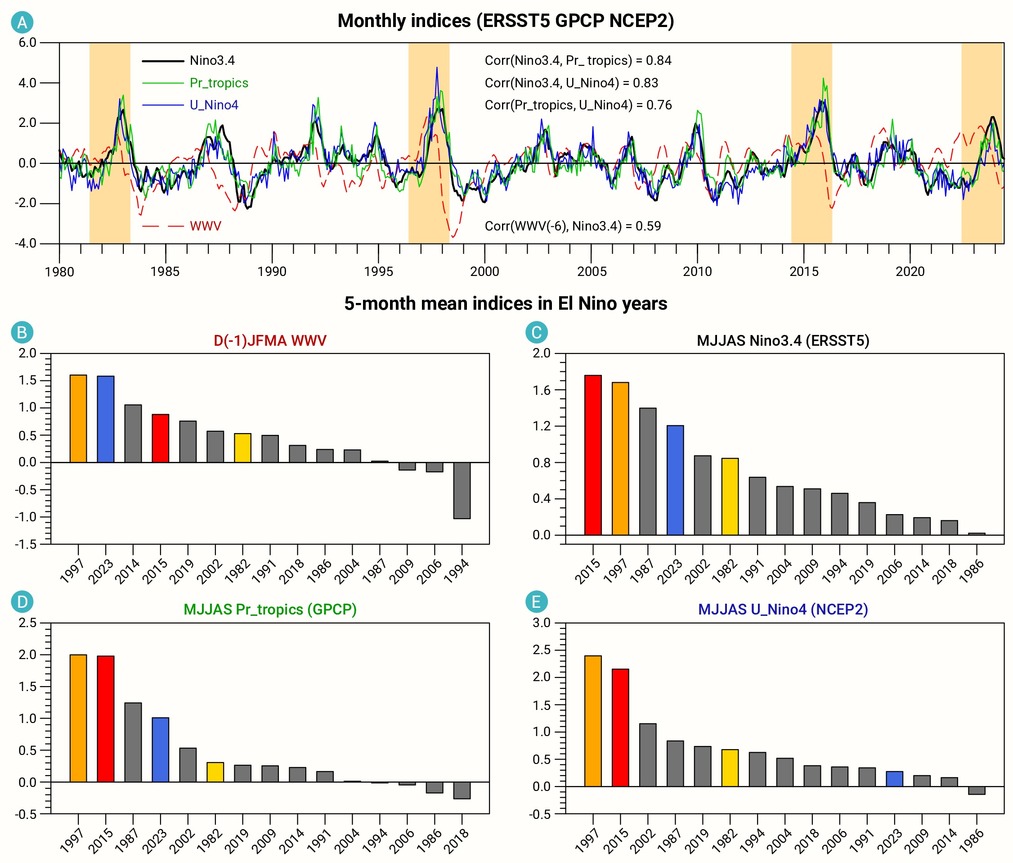
Figure 1.
The strong El Niño but weak Southern Oscillation in 2023
-
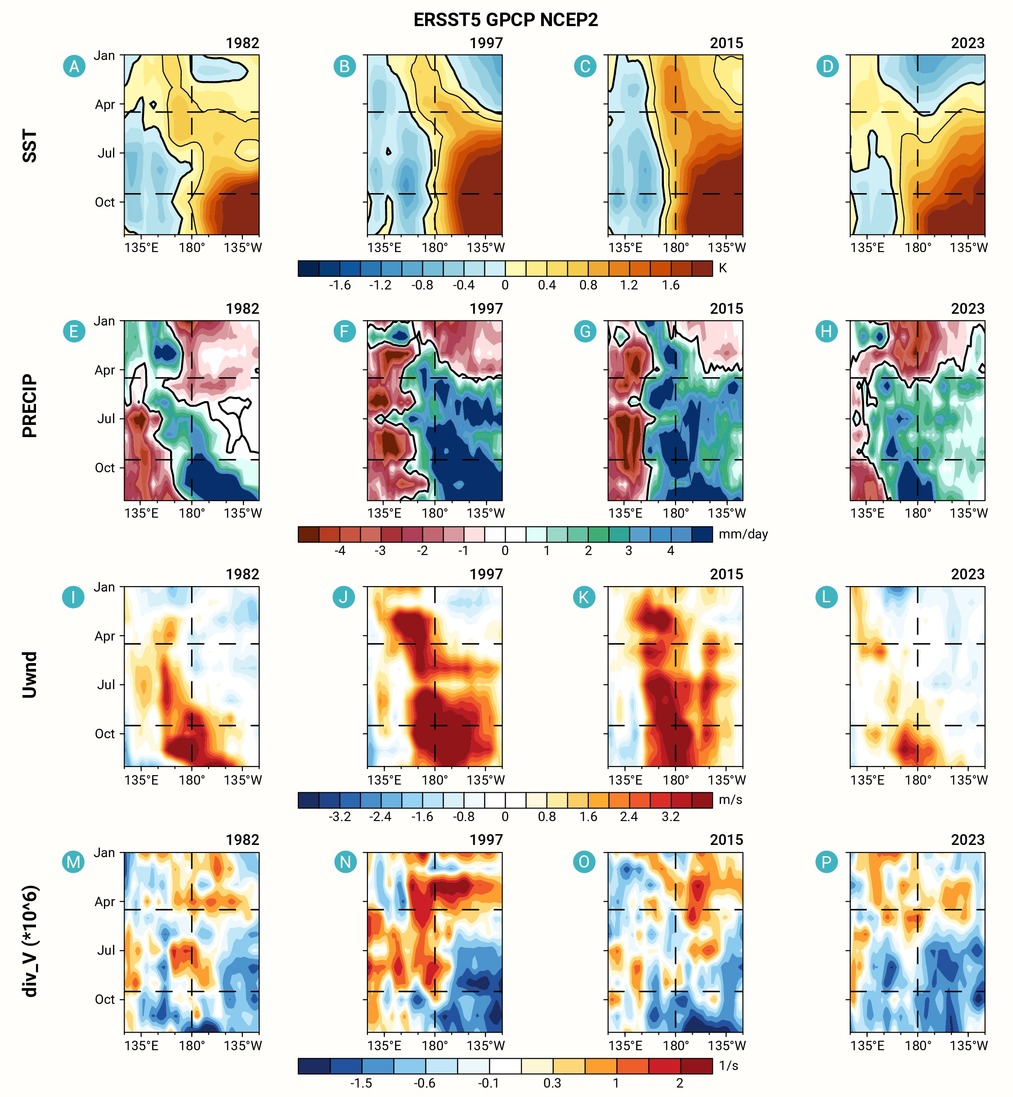
Figure 2.
Different zonal distribution of ocean-atmosphere variables in the equatorial Pacific between the three extreme El Niño events and the 2023 El Niño event
-
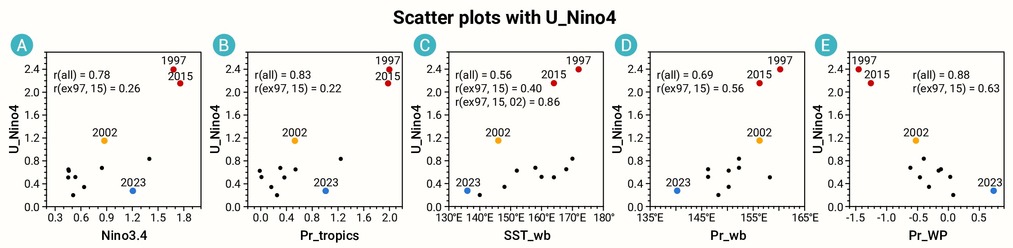
Figure 3.
Relationships between westerly wind anomalies and the zonal extent of SST and convection
-
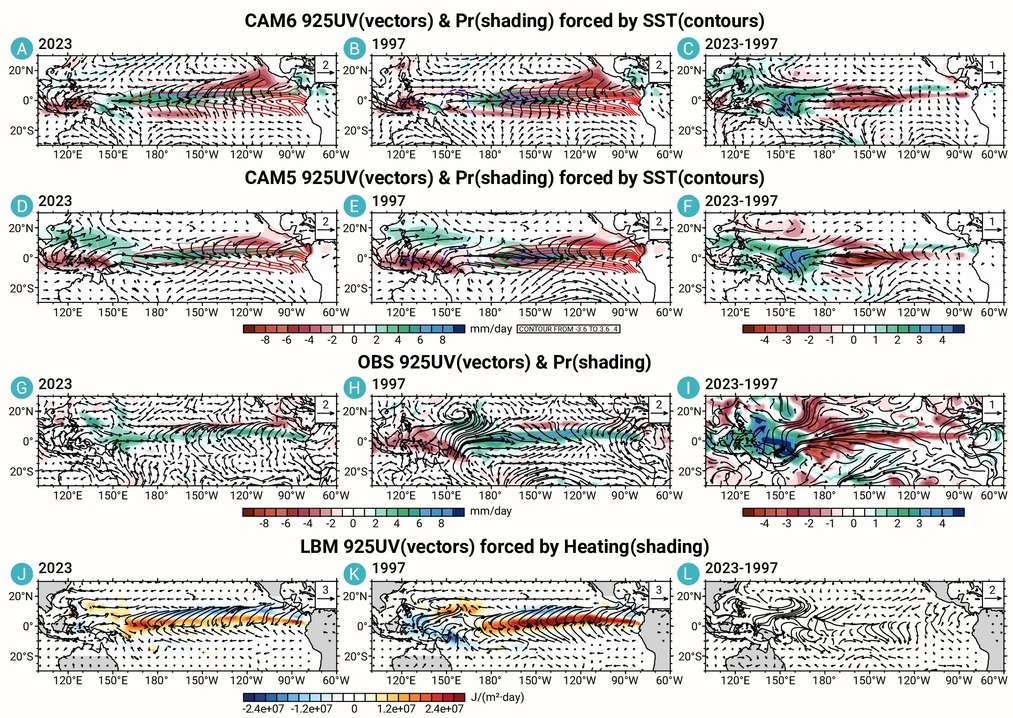
Figure 4.
Forcings and responses of the model experiments and corresponding observed patterns
-
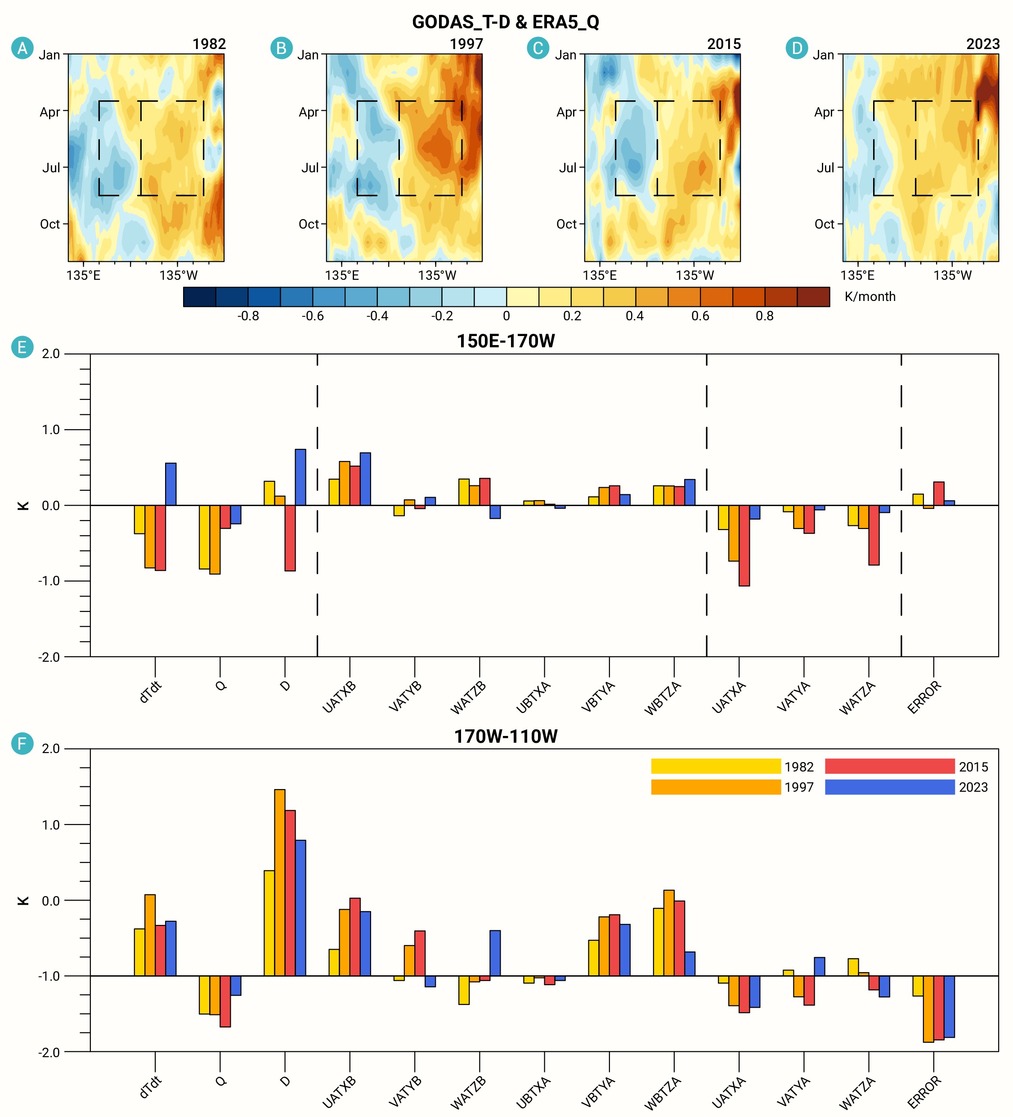
Figure 5.
Mixed layer heat budget analysis across three longitudinal ranges in the equatorial Pacific
-
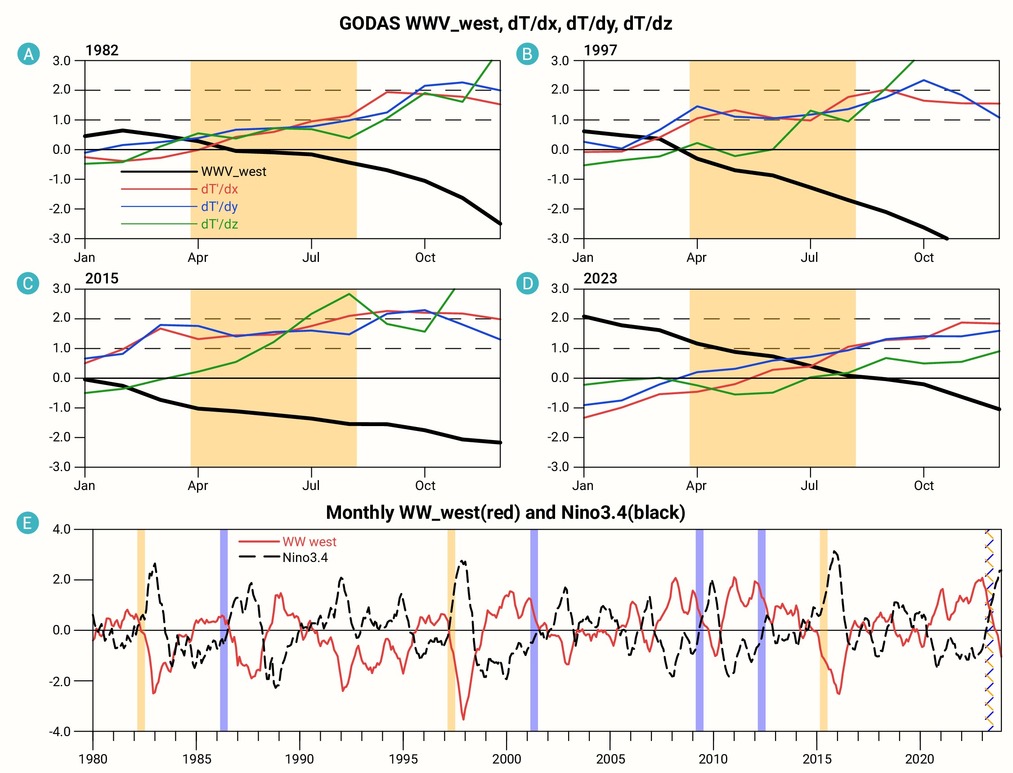
Figure 6.
Weak temperature gradient related to high warm water volume in the western Pacific (WWV_west) during 2023 El Niño event
-
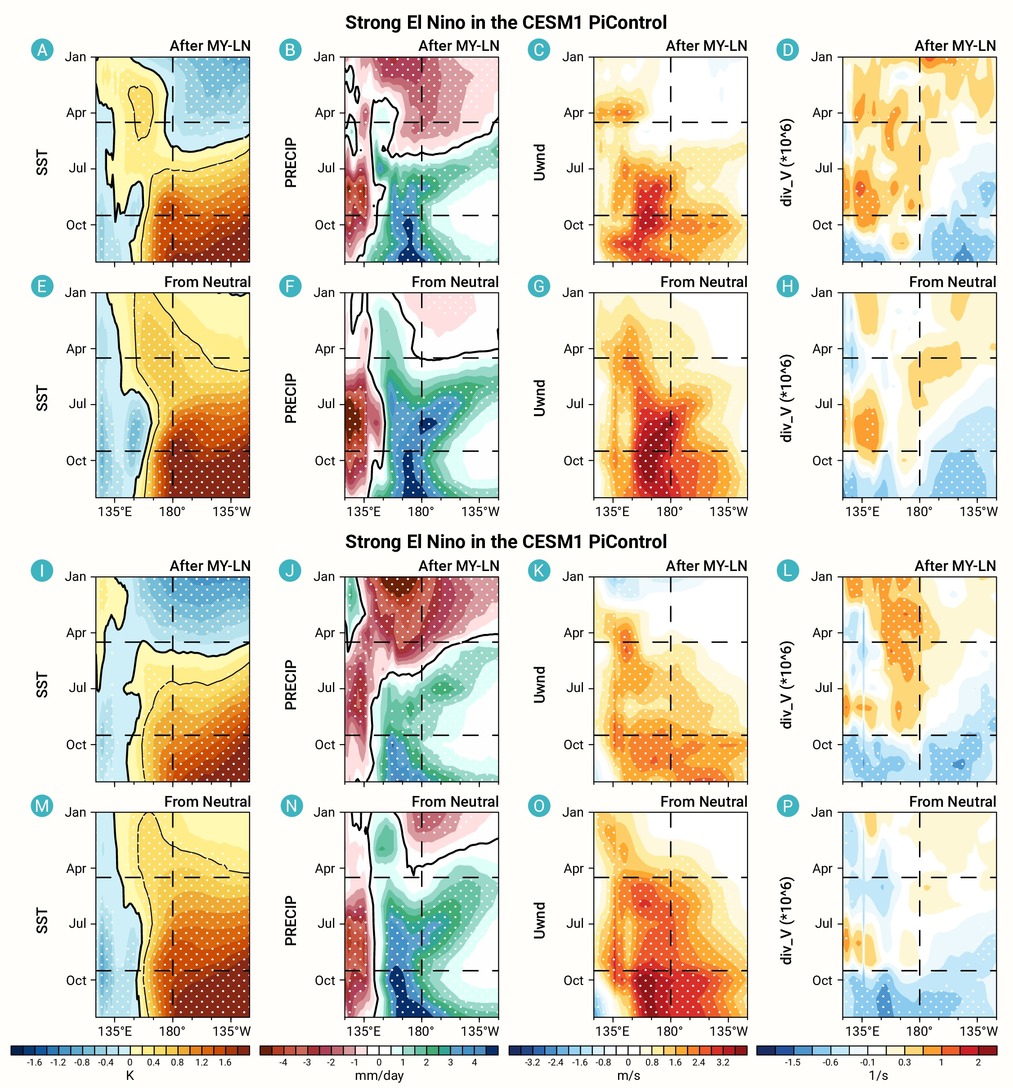
Figure 7.
Zonal distribution of ocean-atmosphere variables in the equatorial Pacific during strong El Niño events in the CESM1/2 piControl simulations
