
Stoichiometric acclimation of phytoplankton shapes the nitracline
-
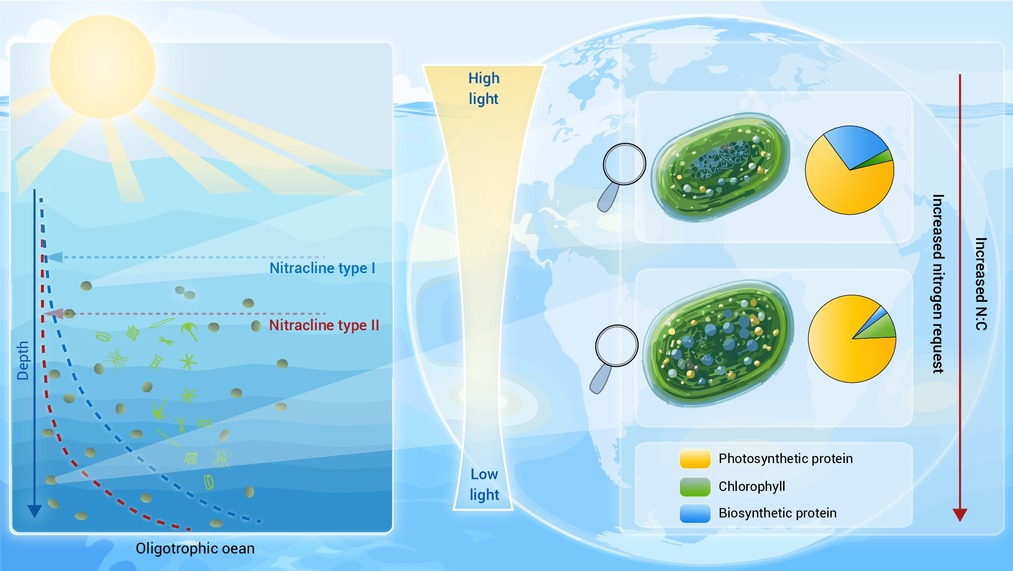
GRAPHICAL ABSTRACT
 DownLoad:
Full size image
DownLoad:
Full size image
-
PUBLIC SUMMARY
-
A novel water column model bridges the cellular mechanism and systematical vertical nutrient distributions.
Low-light conditions increase phytoplankton N:C ratio, deepening the nitracline by raising nitrogen demand.
Higher biological N demand depletes ambient nitrate and reshapes the nitracline beyond physical mixing.
-
-
ABSTRACT
Nitracline is a critical boundary in the ocean, regulating nitrate supply and primary productivity. However, the explicit mechanisms governing its depth in the vast oligotrophic ocean remain a puzzle. Although traditionally regarded as a structure imposed by physical processes, the nitracline may also be modulated by ecological feedback from phytoplankton, which has received far less attention. Here, by combining the mechanistic model of phytoplankton with a water column framework, we identify that the physiological acclimation of phytoplankton plays a central role in deepening the nitracline. Near the bottom of the euphotic zone, light availability becomes scarce. However, phytoplankton can still sustain photosynthesis and growth there by allocating more carbon and nitrogen to photosynthetic molecules. Because these photosynthetic molecules are nitrogen-rich, phytoplankton increases their nitrogen uptake to maintain photosynthetic function, thereby drawing down nitrate and deepening the nitracline. The influence of this physiological acclimation on nitracline depth is demonstrated by comparing simulations with variable versus fixed cellular C:N ratios. The flexiable C:N contributes to the nitracline deepening while the fixed C:N ratio yielded a significantly shallower nitracline. Our study mechanistically connects plankton physiology and the depth profile of marine chemistry, the knowledge essential in predicting future shifts in marine biogeochemical cycling.-
Keywords:
- nitracline /
- cell flux model /
- stoichiometry /
- phytoplankton
-

-
REFERENCES
[1] Du C., Liu Z., Kao S., et al. (2017). Diapycnal fluxes of nutrients in an oligotrophic oceanic regime: The South China Sea. Geophys. Res. Lett. 44:11510−11518. DOI:10.1002/2017GL074921 [2] Bahamón N., Velásquez Z. and Cruzado A. (2003). Chlorophyll a and nitrogen flux in the tropical North Atlantic Ocean. Deep Sea Res. Part I Oceanogr. Res. Pap. 50:1189−1203. DOI:10.1016/S0967-0637(03)00145-6 [3] Mouriño-Carballido B., Otero Ferrer J.L., Fernández Castro B., et al. (2021). Magnitude of nitrate turbulent diffusion in contrasting marine environments. Sci. Rep. 11:18804. DOI:10.1038/s41598-021-97731-4 [4] Sridevi B., Ashitha M.K., Sarma V.V.S.S., et al. (2024). A new climatology of depth of nitracline in the Bay of Bengal for improving model simulations. J. Geophys. Res. Biogeosci. 129:e2024JG008211. DOI:10.1029/2024JG008211 [5] Wan X.S., Sheng H.-X., Dai M., et al. (2018). Ambient nitrate switches the ammonium consumption pathway in the euphotic ocean. Nat. Commun. 9:915. DOI:10.1038/s41467-018-03363-0 [6] Sato T., Shiozaki T., Hashihama F., et al. (2022). Low nitrogen fixation related to shallow nitracline across the Eastern Indian Ocean. J. Geophys. Res. Biogeosci. 127:e2022JG007104. DOI:10.1029/2022JG007104 [7] Xing X., Xiu P., Laws E.A., et al. (2023). Light‐driven and nutrient‐driven displacements of subsurface chlorophyll maximum depth in subtropical gyres. Geophys. Res. Lett. 50:e2023GL104510. DOI:10.1029/2023GL104510 [8] Wan X.S., Sheng H., Dai M., et al. (2021). Phytoplankton‐nitrifier interactions control the geographic distribution of nitrite in the upper ocean. Global Biogeochem. Cycles 35:e2021GB007072. DOI:10.1029/2021GB007072 [9] Wilson C. (2021). Evidence of episodic nitrate injections in the oligotrophic North Pacific associated with surface chlorophyll blooms. J. Geophys. Res. Oceans 126:e2021JC017169. DOI:10.1029/2021JC017169 [10] Letelier R.M., Karl D.M., Abbott M.R., et al. (2004). Light driven seasonal patterns of chlorophyll and nitrate in the lower euphotic zone of the North Pacific Subtropical Gyre. Limnol. Oceanogr. 49:508−519. DOI:10.4319/lo.2004.49.2.0508 [11] Gong X., Jiang W., Wang L., et al. (2017). Analytical solution of the nitracline with the evolution of subsurface chlorophyll maximum in stratified water columns. Biogeosciences 14:2371−2386. DOI:10.5194/bg-14-2371-2017 [12] Fawcett S.E., Ward B.B., Lomas M.W., et al. (2015). Vertical decoupling of nitrate assimilation and nitrification in the Sargasso Sea. Deep Sea Res. Part I Oceanogr. Res. Pap. 103:64−72. DOI:10.1016/j.dsr.2015.05.004 [13] Cornec M., Claustre H., Mignot A., et al. (2021). Deep chlorophyll maxima in the global ocean: Occurrences, drivers and characteristics. Global Biogeochem. Cycles 35:e2020GB006759. DOI:10.1029/2020GB006759 [14] Zakem E.J., Al-Haj A., Church M.J., et al. (2018). Ecological control of nitrite in the upper ocean. Nat. Commun. 9:1206. DOI:10.1038/s41467-018-03553-w [15] Garcia N.S., Bonachela J.A. and Martiny A.C. (2016). Interactions between growth-dependent changes in cell size, nutrient supply and cellular elemental stoichiometry of marine Synechococcus. ISME J. 10:2715−2724. DOI:10.1038/ismej.2016.50 [16] Kana T.M. and Glibert P.M. (1987). Effect of irradiances up to 2000 μE m−2 s−1 on marine Synechococcus WH7803—I. growth, pigmentation, and cell composition. Deep Sea Res. Part A Oceanogr. Res. Pap. 34:479−495. DOI:10.1016/0198-0149(87)90001-X [17] Liu H., Bidigare R., Laws E., et al. (1999). Cell cycle and physiological characteristics of Synechococcus (WH7803) in chemostat culture. Mar. Ecol. Prog. Ser. 189:17−25. DOI:10.3354/meps189017 [18] Six C., Thomas J., Brahamsha B., et al. (2004). Photophysiology of the marine cyanobacterium Synechococcus sp. WH8102, a new model organism. Aquat. Microb. Ecol. 35: 17–29. DOI: 10.3354/ame035017 [19] Baer S.E., Lomas M.W., Terpis K.X., et al. (2017). Stoichiometry of Prochlorococcus, Synechococcus, and small eukaryotic populations in the western North Atlantic Ocean. Environ. Microbiol. 19:1568−1583. DOI:10.1111/1462-2920.13672 [20] Dutkiewicz S., Hickman A.E., Jahn O., et al. (2015). Capturing optically important constituents and properties in a marine biogeochemical and ecosystem model. Biogeosciences 12:4447−4481. DOI:10.5194/bg-12-4447-2015 [21] Geider R., MacIntyre H. and Kana T. (1997). Dynamic model of phytoplankton growth and acclimation:responses of the balanced growth rate and the chlorophyll a:carbon ratio to light, nutrient-limitation and temperature. Mar. Ecol. Prog. Ser. 148:187−200. DOI:10.3354/meps148187 [22] Inomura K., Omta A.W., Talmy D., et al. (2020). A mechanistic model of macromolecular allocation, elemental stoichiometry, and growth rate in phytoplankton. Front. Microbiol. 11:86. DOI:10.3389/fmicb.2020.00086 [23] Inomura K., Deutsch C., Jahn O., et al. (2022). Global patterns in marine organic matter stoichiometry driven by phytoplankton ecophysiology. Nat. Geosci. 15:1034−1040. DOI:10.1038/s41561-022-01066-2 [24] Ward B.B. (1985). Light and substrate concentration relationships with marine ammonium assimilation and oxidation rates. Mar. Chem. 16:301−316. DOI:10.1016/0304-4203(85)90052-0 [25] Ward B.B. (2008). Chapter 5 - Nitrification in marine systems. Nitrogen in the marine environment (Elsevier), pp:199–261. DOI: 10.1016/B978-0-12-372522-6.00005-0 [26] Olson R.J. (1981). 15N tracer studies of the primary nitrite maximum. J. Mar. Res. 39: 203–226. https://elischolar.library.yale.edu/journal_of_marine_research/1540/ [27] Smith J.M., Chavez F.P. and Francis C.A. (2014). Ammonium uptake by phytoplankton regulates nitrification in the sunlit ocean. PLoS ONE 9:e108173. DOI:10.1371/journal.pone.0108173 [28] Armstrong R.A. (2006). Optimality-based modeling of nitrogen allocation and photoacclimation in photosynthesis. Deep Sea Res. Part II Top. Stud. Oceanogr. 53:513−531. DOI:10.1016/j.dsr2.2006.01.020 [29] Grosse J., Burson A., Stomp M., et al. (2017). From ecological stoichiometry to biochemical composition: Variation in N and P supply alters key biosynthetic rates in marine phytoplankton. Front. Microbiol. 8:1299. DOI:10.3389/fmicb.2017.01299 [30] Liefer J.D., Garg A., Fyfe M.H., et al. (2019). The macromolecular basis of phytoplankton C:N:P under nitrogen starvation. Front. Microbiol. 10:763. DOI:10.3389/fmicb.2019.00763 [31] Masuda Y., Yamanaka Y., Smith S.L., et al. (2021). Photoacclimation by phytoplankton determines the distribution of global subsurface chlorophyll maxima in the ocean. Commun. Earth Environ. 2:128. DOI:10.1038/s43247-021-00201-y [32] McCarthy J.J. and Goldman J.C. (1979). Nitrogenous nutrition of marine phytoplankton in nutrient-depleted waters. Science 203:670−672. DOI:10.1126/science.203.4381.670 [33] Aksnes D.L., Ohman M.D. and Rivière P. (2007). Optical effect on the nitracline in a coastal upwelling area. Limnol. Oceanogr. 52:1179−1187. DOI:10.4319/lo.2007.52.3.1179 [34] Liefer J.D., White A.E., Finkel Z.V., et al. (2024). Latitudinal patterns in ocean C:N:P reflect phytoplankton acclimation and macromolecular composition. Proc. Natl. Acad. Sci. USA 121:e2404460121. DOI:10.1073/pnas.2404460121 [35] Gui J. and Sun J. (2024). Phytoplankton carbon to chlorophyll a model development: A review. Front. Mar. Sci. 11:1466072. DOI:10.3389/fmars.2024.1466072 [36] Smyth T., Moffat D., Tarran G., et al. (2023). Determining drivers of phytoplankton carbon to chlorophyll ratio at Atlantic Basin scale. Front. Mar. Sci. 10:1191216. DOI:10.3389/fmars.2023.1191216 [37] Lomas M.W., Baer S.E., Mouginot C., et al. (2021). Varying influence of phytoplankton biodiversity and stoichiometric plasticity on bulk particulate stoichiometry across ocean basins. Commun. Earth Environ. 2:143. DOI:10.1038/s43247-021-00212-9 [38] Yan X., Yang J.-Y.T., Xu M.N., et al. (2022). Isotope constraints on nitrogen dynamics in the upper water column of the South China Sea. Front. Mar. Sci. 9:1104135. DOI:10.3389/fmars.2022.1104135 [39] Yang J.T., Tang J., Kang S., et al. (2022). Comparison of nitrate isotopes between the South China Sea and western North Pacific ocean: Insights into biogeochemical signals and water exchange. J. Geophys. Res. Oceans 127:e2021JC018304. DOI:10.1029/2021JC018304 [40] Kessouri F., Ulses C., Estournel C., et al. (2017). Nitrogen and phosphorus budgets in the northwestern mediterranean deep convection region. J. Geophys. Res. Oceans 122:9429−9454. DOI:10.1002/2016JC012665 [41] Wirtz K. and Smith S.L. (2020). Vertical migration by bulk phytoplankton sustains biodiversity and nutrient input to the surface ocean. Sci. Rep. 10:1142. DOI:10.1038/s41598-020-57890-2 -
ABOUT THIS ARTICLE
Cite this article:
Du M., Camps-Castellà J., Gao M., et al. (2026). Stoichiometric acclimation of phytoplankton shapes the nitracline. The Innovation Geoscience 4:100230. https://doi.org/10.59717/j.xinn-geo.2026.100230
Welcome!
To request copyright permission to republish or share portions of our works, please visit Copyright Clearance Center's (CCC) Marketplace website at marketplace.copyright.com.
Export File
Citation
Du M., Camps-Castellà J., Gao M., et al. (2026). Stoichiometric acclimation of phytoplankton shapes the nitracline. The Innovation Geoscience 4:100230. https://doi.org/10.59717/j.xinn-geo.2026.100230

Format
Content
-
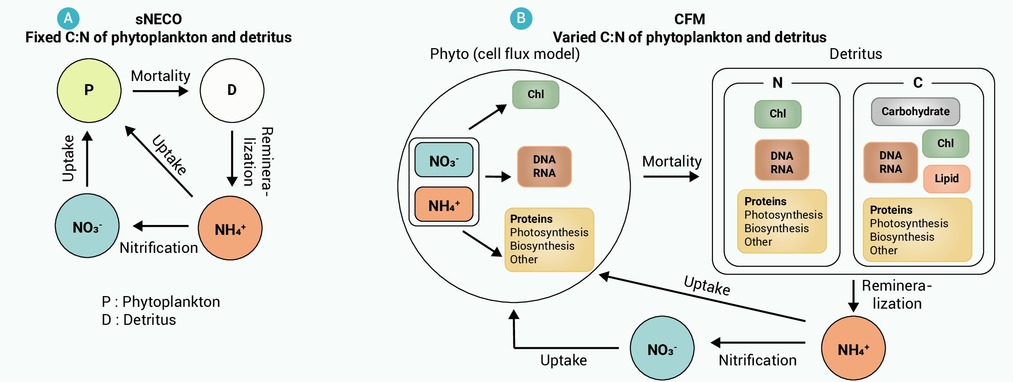
Figure 1.
Structures of simplified nitrogen ecosystem model (sNECO) and cell flux model (CFM).
-
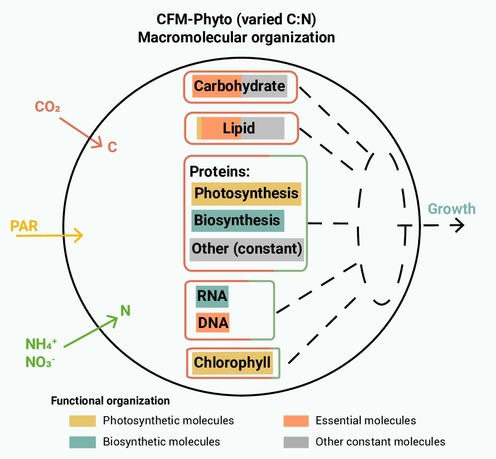
Figure 2.
Schematic of macromolecular allocation of cell flux model.
-
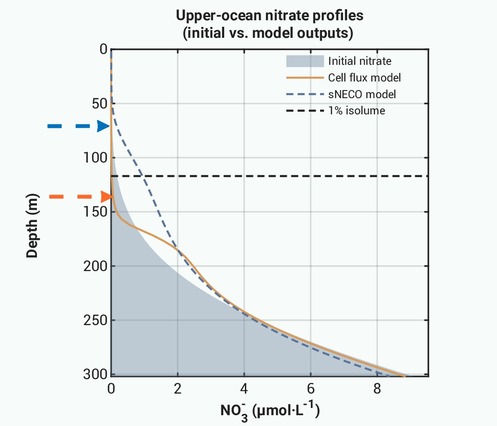
Figure 3.
Vertical distribution of simulated nitrate.
-
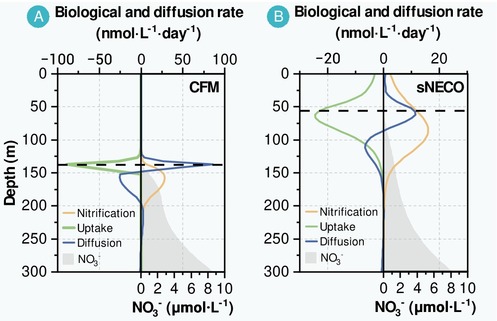
Figure 4.
Vertical profiles of nitrate dynamics simulated by (A) CFM and (B) sNECO.
-
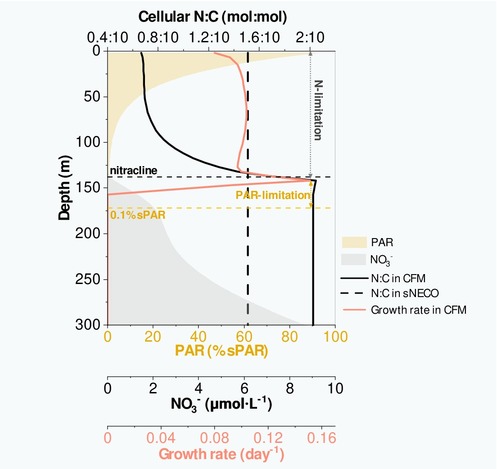
Figure 5.
Vertical distribution of cellular nitrogen to carbon ratio and phytoplankton growth rate.
-
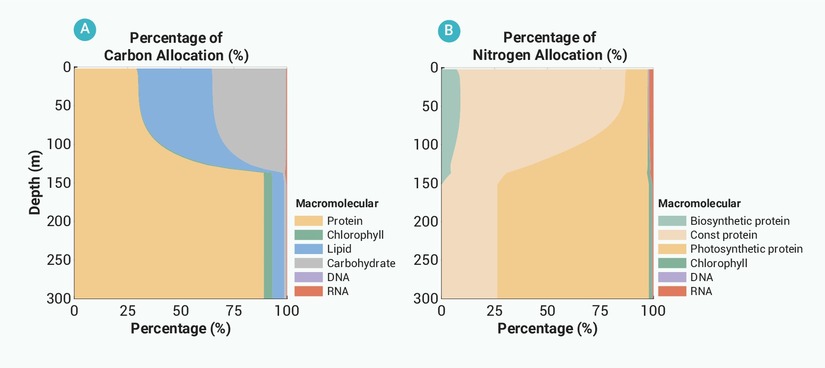
Figure 6.
Cellular macromolecular allocation in vertical scale
-
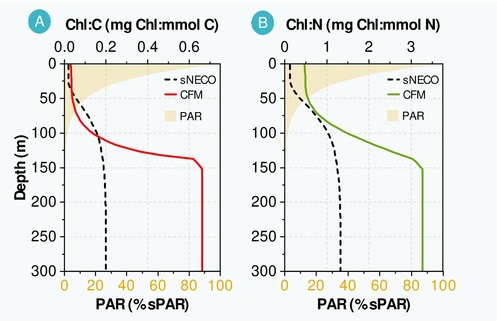
Figure 7.
Depth profiles of Chl:C (A) and Chl: N (B) overlaid with PAR (as % of surface) Shaded areas indicate the PAR distribution
