
Transforming evapotranspiration from hydrological variable to decision-ready dataset in water management: Challenges and pathways
-

-
REFERENCES
[1] Richardson K., Steffen W., Lucht W., et al. (2023). Earth beyond six of nine planetary boundaries. Sci. Adv. 9:eadh2458. DOI:10.1126/sciadv.adh2458 [2] Wu B., Zhu W., Yan N., et al. (2020). Regional actual evapotranspiration estimation with land and meteorological variables derived from multi-source satellite data. Remote Sens. 12:332. DOI:10.3390/rs12020332 [3] Wu B., Tian F., Zhang M., et al. (2022). Quantifying global agricultural water appropriation with data derived from earth observations. J. Clean. Prod. 358:131891. DOI:10.1016/j.jclepro.2022.131891 [4] Wang-Erlandsson L., Tobian A., van der Ent R. J., et al. (2022). A planetary boundary for green water. Nat. Rev. Earth Environ. 3:380−392. DOI:10.1038/s43017-022-00287-8 [5] Scanlon B. R., Fakhreddine S., Rateb A., et al. (2023). Global water resources and the role of groundwater in a resilient water future. Nat. Rev. Earth Environ. 4:87−101. DOI:10.1038/s43017-022-00378-6 -
ABOUT THIS ARTICLE
Cite this article:
Zeng H., Wu H., Sun L., et al. (2026). Transforming evapotranspiration from hydrological variable to decision-ready dataset in water management: Challenges and pathways. The Innovation Geoscience 4:100231. https://doi.org/10.59717/j.xinn-geo.2026.100231
Welcome!
To request copyright permission to republish or share portions of our works, please visit Copyright Clearance Center's (CCC) Marketplace website at marketplace.copyright.com.
Export File
Citation
Zeng H., Wu H., Sun L., et al. (2026). Transforming evapotranspiration from hydrological variable to decision-ready dataset in water management: Challenges and pathways. The Innovation Geoscience 4:100231. https://doi.org/10.59717/j.xinn-geo.2026.100231

Format
Content
 DownLoad:
-
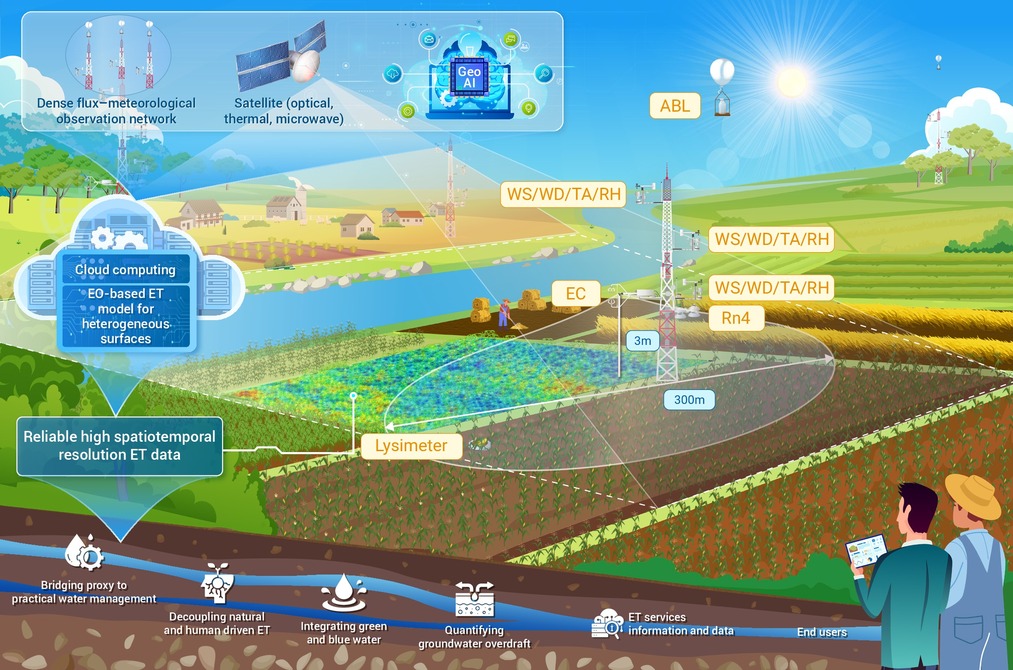
Figure 1.
Conceptual framework for ET-based water consumption management
