
A strong El Niño developing in 2026 could drive global surface temperatures to record highs
-

-
REFERENCES
[1] Hu Z. -Z., Xue Y., Huang B., et al. (2022). Global ocean monitoring and forecast at NOAA climate prediction center: 15 years of operations. Bull. Amer. Meteor. Soc. 103:E2701−E2718. DOI:10.1175/BAMS-D-22-0056.1 [2] Li K., Zheng F., Cheng L., et al. (2023). Record-breaking global temperature and crises with strong El Niño in 2023-2024. Innov. Geosci. 1:100030. DOI:10.59717/j.xinn-geo.2023.100030 [3] Jiang N., Zhu C., McPhaden M. J., et al. (2025). Atypical warming pattern of strong 2023-24 El Niño boosts global temperatures to new 1.5°C record. Commun. Earth & Environ. 6:1012. DOI:10.1038/s43247-025-02971-1 [4] Hu Z. -Z., Kumar A., Zhu J., et al. (2019). On the challenge for ENSO cycle prediction: An example from NCEP climate forecast system version 2. J. Climate 32:183−194. DOI:10.1175/JCLI-D-18-0285.1 [5] Liu Y., Hu Z. -Z., Wu R., et al. (2024). Evolution of ENSO-related seasonal precipitation anomalies in East Asia: A robustness revisit. Int. J. Climatol. 44:269−285. DOI:10.1002/joc.8327 -
ABOUT THIS ARTICLE
Cite this article:
Liu Y., Hu Z.-Z., Zhang S., et al. (2026). A strong El Niño developing in 2026 could drive global surface temperatures to record highs. The Innovation Geoscience 4:100236. https://doi.org/10.59717/j.xinn-geo.2026.100236
Welcome!
To request copyright permission to republish or share portions of our works, please visit Copyright Clearance Center's (CCC) Marketplace website at marketplace.copyright.com.
Export File
Citation
Liu Y., Hu Z.-Z., Zhang S., et al. (2026). A strong El Niño developing in 2026 could drive global surface temperatures to record highs. The Innovation Geoscience 4:100236. https://doi.org/10.59717/j.xinn-geo.2026.100236

Format
Content
 DownLoad:
-
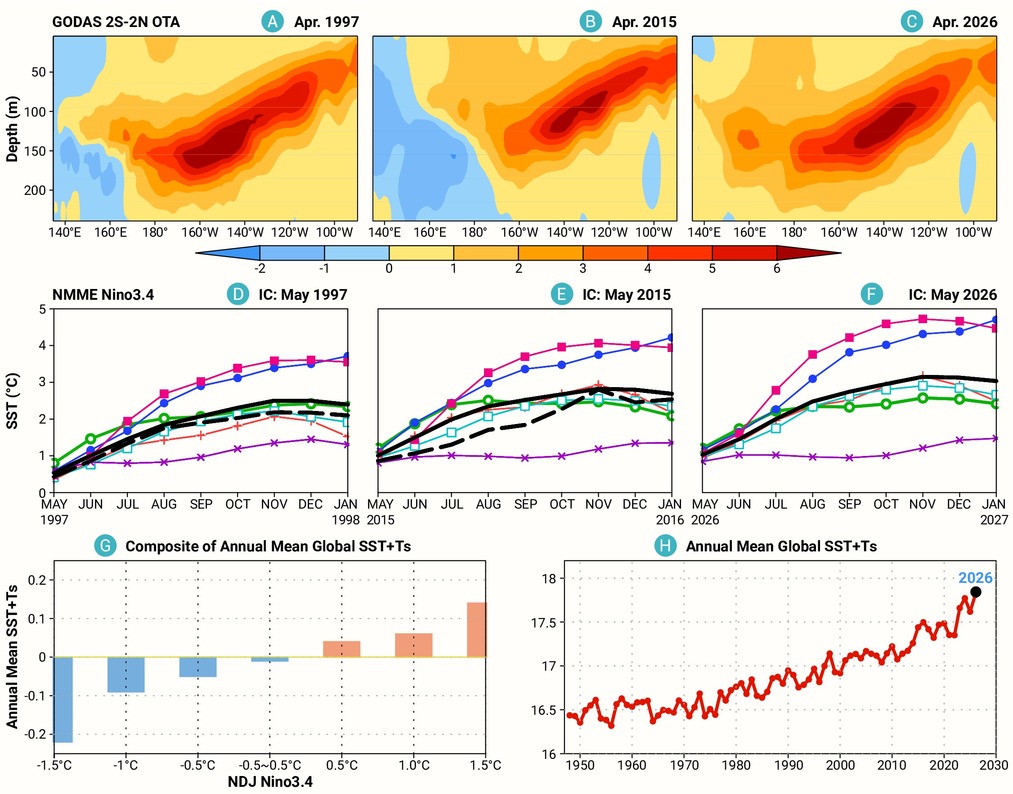
Figure 1.
Pacific Ocean subsurface temperature anomalies averaged in 2°S-2°N in April (a) 1997, (b) 2015, and (c) 2026
