
A decade of shifting priorities between economic growth and eco-environmental protection along China’s Yangtze River waterfront
-

-
REFERENCES
[1] Duan X., Zou H., Wang L., et al. (2021). Assessing ecological sensitivity and economic potentials and regulation zoning of the riverfront development along the Yangtze River, China. J. Clean. Prod. 291:125963. DOI:10.1016/j.jclepro.2021.125963 [2] Yang H., Xie P., Ni L., et al. (2012). Pollution in the Yangtze. Science 337:410−410. DOI:10.1126/science.337.6093.410-a [3] WWF, Living Yangtze Report. (2020). https://wwfint.awsassets.panda.org/downloads/wwf_livingyangtzereport2020.pdf [4] Chen Y., Zhang S., Huang D., et al. (2017). The development of China’s Yangtze River Economic Belt: How to make it in a green way? Sci. Bull. 2017. 62: 648-651. DOI: 10.1016/j.scib.2017.04.009 [5] Xiong F., Li Z., Brosse S., et al. (2026). Fishing ban halts seven decades of biodiversity decline in the Yangtze River. Science 391:719−723. DOI:10.1126/science.adu5160 -
ABOUT THIS ARTICLE
Cite this article:
Duan X., Zou H., Song C., et al. (2026). A decade of shifting priorities between economic growth and eco-environmental protection along China’s Yangtze River waterfront. The Innovation Geoscience 4:100238. https://doi.org/10.59717/j.xinn-geo.2026.100238
Welcome!
To request copyright permission to republish or share portions of our works, please visit Copyright Clearance Center's (CCC) Marketplace website at marketplace.copyright.com.
Export File
Citation
Duan X., Zou H., Song C., et al. (2026). A decade of shifting priorities between economic growth and eco-environmental protection along China’s Yangtze River waterfront. The Innovation Geoscience 4:100238. https://doi.org/10.59717/j.xinn-geo.2026.100238

Format
Content
 DownLoad:
-
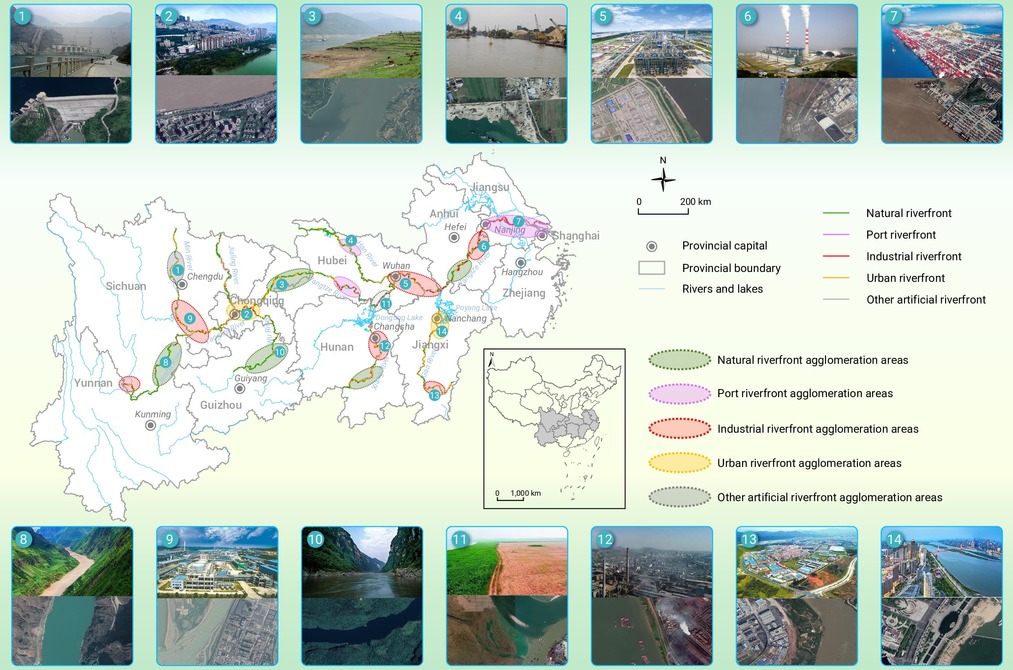
Figure 1.
The spatial pattern of waterfront types of main rivers in the YREB.
