
Coupled erosion, climate, and vegetation drove post-MPT maxima in Asian dust activity
-
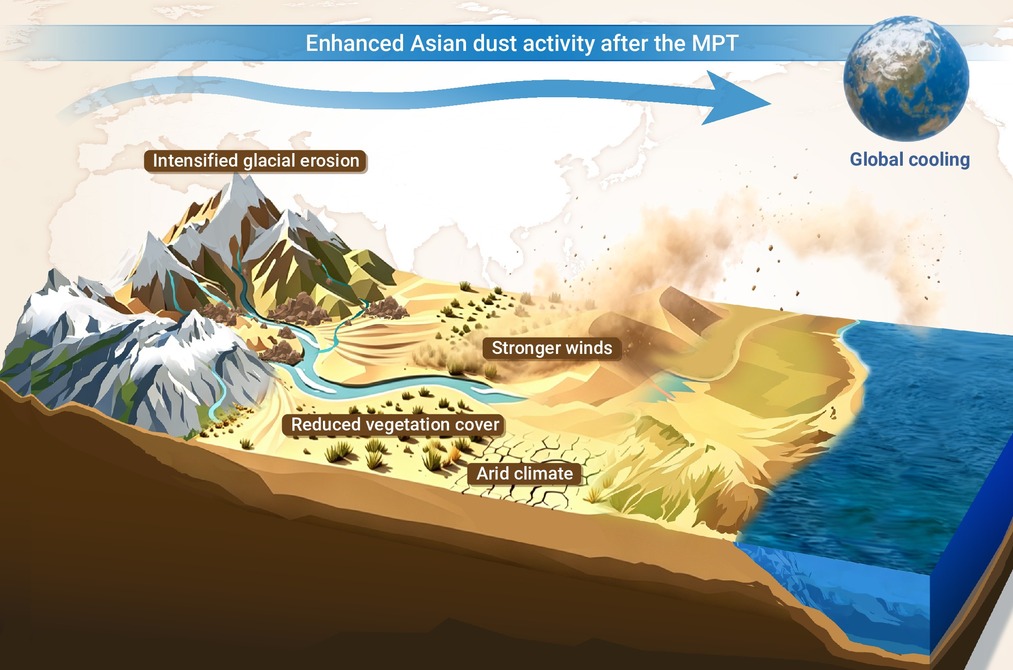
GRAPHICAL ABSTRACT
 DownLoad:
Full size image
DownLoad:
Full size image
-
PUBLIC SUMMARY
-
Central Asia showed enhanced aridification after ~0.8 Ma, with periodicity shifting from 41 kyr to 100 kyr.
Asian dust emissions and transport peaked after ~1.0–0.8 Ma, with enhanced glacial–interglacial variability.
Global cooling drove Asian dust activity by influencing erosion, climate, and vegetation.
-
-
ABSTRACT
The mid-latitude Asian regions are the world’s second-largest dust source and are sensitive to global climate change. However, the paucity of inland dust records limits our understanding of regional atmospheric circulation, Asian aridification, and the global climatic and ecological impacts of dust emissions. Here, we present the first high-resolution dust flux record from the arid regions of Central Asia, west of the Pamir Plateau, covering the past 2.7 Myr. By integrating this new record with a compilation of existing datasets, we show that enhanced aridification occurred in Central Asia after ~0.8 Ma, with a dominant periodicity shift from 41-kyr to 100-kyr during the Mid-Pleistocene Transition (MPT). Further, a source-to-sink spatial comparison of dust fluxes indicates that Asian dust activity reached its highest levels after the MPT, accompanied by increased amplitude of glacial–interglacial fluctuations. These patterns correspond strongly with variations in global ice volume across the time–frequency domains, implying a strong coupling between Asian dust activity and global cooling. We propose that, in addition to an arid climate, intensified glacial erosion, and reduced vegetation cover are critical drivers of enhanced Asian dust emissions and transport during periods of global cooling. Under ongoing and projected future global warming, the rapid glacier retreat across the Tibetan Plateau and surrounding mountains, along with regionally increased precipitation and enhanced vegetation cover in dust source regions, may reduce the availability of fine-grained, erodible sediments and stabilize surface soils, gradually weakening Asian dust emissions and their influence on marine productivity and biodiversity in downwind oceans.-
Keywords:
- Central Asian loess /
- Dust activity /
- Quaternary paleoclimate /
- Global cooling /
- Glacial erosion
-

-
REFERENCES
[1] Kok J.F., Storelvmo T., Karydis V.A., et al. (2023). Mineral dust aerosol impacts on global climate and climate change. Nat. Rev. Earth Environ. 4:71−86. DOI:10.1038/s43017-022-00379-5 [2] Huang J., Minnis P., Chen B., et al. (2008). Long-range transport and vertical structure of Asian dust from CALIPSO and surface measurements during PACDEX. J. Geophys. Res. Atmos. 113:2008JD010620. DOI:10.1029/2008JD010620 [3] Sun J. (2002). Provenance of loess material and formation of loess deposits on the Chinese Loess Plateau. Earth Planet. Sci. Lett. 203:845−859. DOI:10.1016/S0012-821X(02)00921-4 [4] Uno I., Eguchi K., Yumimoto K., et al. (2009). Asian dust transported one full circuit around the globe. Nat. Geosci. 2:557−560. DOI:10.1038/ngeo583 [5] Jickells T.D., An Z.S., Andersen K.K., et al. (2005). Global iron connections between desert dust, ocean biogeochemistry, and climate. Science 308:67−71. DOI:10.1126/science.1105959 [6] Maher B.A., Prospero J.M., Mackie D., et al. (2010). Global connections between aeolian dust, climate and ocean biogeochemistry at the present day and at the last glacial maximum. Earth Sci. Rev. 99:61−97. DOI:10.1016/j.earscirev.2009.12.001 [7] Shao Y., Wyrwoll K.H., Chappell A., et al. (2011). Dust cycle: An emerging core theme in Earth system science. Aeolian Res. 2:181−204. DOI:10.1016/j.aeolia.2011.02.001 [8] Zan J., Maher B.A., Yamazaki T., et al. (2023). Mid-Pleistocene links between Asian dust, Tibetan glaciers, and Pacific iron fertilization. Proc. Natl. Acad. Sci. USA 120:e2304773120. DOI:10.1073/pnas.2304773120 [9] Zan J., Maher B.A., Fang X., et al. (2025). Global dust impacts on biogeochemical cycles and climate. Nat. Rev. Earth Environ. 6:789−807. DOI:10.1038/s43017-025-00734-2 [10] Yang X. (1999). The grain size of the windborne sediments in the areas of Keriya river (northwestern China) and its paleoenvironmental interpretation. Quat. Sci. 19:373–379. http://www.dsjyj.com.cn/en/article/id/dsjyj_9590 [11] Sun Y. (2020). Source-to-sink fluctuations of Asian aeolian deposits since the late Oligocene. Earth Sci. Rev. 200:102963. DOI:10.1016/j.earscirev.2019.102963 [12] Lu H., Wang X., Wang X., et al. (2019). Formation and evolution of Gobi Desert in central and eastern Asia. Earth Sci. Rev. 194:251−263. DOI:10.1016/j.earscirev.2019.04.014 [13] Guo Z.T., Ruddiman W.F., Hao Q.Z., et al. (2002). Onset of Asian desertification by 22 Myr ago inferred from loess deposits in China. Nature 416:159−163. DOI:10.1038/416159a [14] Fang X., An Z., Clemens S.C., et al. (2020). The 3.6-Ma aridity and westerlies history over midlatitude Asia linked with global climatic cooling. Proc. Natl. Acad. Sci. USA 117:24729–24734. DOI:10.1073/pnas.1922710117 [15] Ding Z.L., Derbyshire E., Yang S.L., et al. (2005). Stepwise expansion of desert environment across northern China in the past 3.5 Ma and implications for monsoon evolution. Earth Planet. Sci. Lett. 237:45–55. DOI:10.1016/j.epsl.2005.06.036 [16] Porter S.C. and An Z. (1995). Correlation between climate events in the North Atlantic and China during the last glaciation. Nature 375:305−308. DOI:10.1038/375305a0 [17] Han Y., An Z., Marlon J.R., et al. (2020). Asian inland wildfires driven by glacial–interglacial climate change. Proc. Natl. Acad. Sci. USA 117:5184−5189. DOI:10.1073/pnas.1822035117 [18] Sun Y. and An Z. (2002). History and variability of Asian interior aridity recorded by eolian flux in the Chinese Loess Plateau during the past 7 Ma. Sci. China Earth Sci. 45:420−429. DOI:10.1360/02yd9044 [19] Sun Y. and An Z. (2005). Late Pliocene-Pleistocene changes in mass accumulation rates of eolian deposits on the central Chinese Loess Plateau. J. Geophys. Res. Atmos. 110:2005JD006064. DOI:10.1029/2005JD006064 [20] Li B., Sun D., Xu W., et al. (2017). Paleomagnetic chronology and paleoenvironmental records from drill cores from the Hetao Basin and their implications for the formation of the Hobq Desert and the Yellow River. Quat. Sci. Rev. 156:69−89. DOI:10.1016/j.quascirev.2016.11.023 [21] Li Z., Sun D., Chen F., et al. (2014). Chronology and paleoenvironmental records of a drill core in the central Tengger Desert of China. Quat. Sci. Rev. 85:85−98. DOI:10.1016/j.quascirev.2013.12.003 [22] Wang F., Sun D., Chen F., et al. (2015). Formation and evolution of the Badain Jaran Desert, North China, as revealed by a drill core from the desert centre and by geological survey. Palaeogeogr. Palaeoclimatol. Palaeoecol. 426:139−158. DOI:10.1016/j.palaeo.2015.03.011 [23] Wang X., Yu Z., Luo C., et al. (2024). Spatial heterogeneity in the formation of large deserts in midlatitude Asia revealed by drill core evidence. Sci. Bull. 69:3512−3515. DOI:10.1016/j.scib.2024.09.044 [24] Zhao H., Sun Y. and Qiang X. (2022). Mid-Pleistocene formation of modern-like desert landscape in North China. Catena 216:106399. DOI:10.1016/j.catena.2022.106399 [25] Wang X., Yu Z., Hu H., et al. (2026). Formation and evolution of sandy deserts in China: A review. Earth Sci. Rev. 277:105459. DOI:10.1016/j.earscirev.2026.105459 [26] Zhong Y., Liu Y., Yang H., et al. (2024). Orbital controls on North Pacific dust flux during the Late Quaternary. Geophys. Res. Lett. 51:e2023GL106631. DOI:10.1029/2023GL106631 [27] Tang Y., Wan S., Clift P.D., et al. (2022). Northward shift of the Northern Hemisphere westerlies in the Early to Late Miocene and its links to Tibetan uplift. Geophys. Res. Lett. 49:e2022GL099311. DOI:10.1029/2022GL099311 [28] Rea D.K., Snoeckx H. and Joseph L.H. (1998). Late Cenozoic eolian deposition in the North Pacific: Asian drying, Tibetan uplift, and cooling of the Northern Hemisphere. Paleoceanography 13:215−224. DOI:10.1029/98PA00123 [29] Ding Z.L., Ranov V., Yang S.L., et al. (2002). The loess record in southern Tajikistan and correlation with Chinese loess. Earth Planet. Sci. Lett. 200:387−400. DOI:10.1016/S0012-821X(02)00637-4 [30] Forster T. and Heller F. (1994). Loess deposits from the Tajik depression (Central Asia): Magnetic properties and paleoclimate. Earth Planet. Sci. Lett. 128:501−512. DOI:10.1016/0012-821X(94)90166-X [31] Zan J., Ning W., Heller F., et al. (2022). Intensified Northern Hemisphere glaciation facilitates continuous accumulation of Late Pliocene loess on the western margin of the Pamir. Geophys. Res. Lett. 49:e2022GL099629. DOI:10.1029/2022GL099629 [32] Wu C., Lin Z., Liu X., et al. (2021). Description of dust emission parameterization in CAS-ESM2 and its simulation of global dust cycle and East Asian dust events. J. Adv. Model. Earth Syst. 13:e2020MS002456. DOI:10.1029/2020MS002456 [33] Muhs D.R. (2007). Loess deposits, origins and properties. Elias S.A. (ed.) Encyclopedia of Quaternary Science (Elsevier), pp:1405–1418. DOI:10.1016/B0-444-52747-8/00158-7 [34] Wu H., Lu H., Wang J., et al. (2022). A new estimate of global desert area and quantity of dust emission. Chin. Sci. Bull. 67:860−871. DOI:10.1360/TB-2021-1215 [35] Yang S. and Ding Z. (2010). Drastic climatic shift at ~2.8 Ma as recorded in eolian deposits of China and its implications for redefining the Pliocene-Pleistocene boundary. Quat. Int. 219:37–44. DOI:10.1016/j.quaint.2009.10.029 [36] Westerhold T., Marwan N., Drury A.J., et al. (2020). An astronomically dated record of Earth’s climate and its predictability over the last 66 million years. Science 369:1383−1387. DOI:10.1126/science.aba6853 [37] Kohfeld K.E. and Harrison S.P. (2001). DIRTMAP: The geological record of dust. Earth Sci. Rev. 54:81−114. DOI:10.1016/S0012-8252(01)00042-3 [38] Kohfeld K. (2003). Glacial-interglacial changes in dust deposition on the Chinese Loess Plateau. Quat. Sci. Rev. 22:1859−1878. DOI:10.1016/S0277-3791(03)00166-5 [39] Pye K. (1987). Aeolian dust and dust deposits (Academic Press). DOI:10.1016/C2013-0-05007-4 [40] Kukla G., Heller F., Ming L.X., et al. (1988). Pleistocene climates in China dated by magnetic susceptibility. Geology 16:811−814. DOI:2.3.CO;2">10.1130/0091-7613(1988)016<0811:PCICDB>2.3.CO;2 [41] Janecek T.R. (1985). Eolian sedimentation in the Northwest Pacific Ocean: A preliminary examination of the data from Deep Sea Drilling Project sites 576 and 578. Initial reports of the Deep Sea Drilling Project (U.S. Government Printing Office), pp:399–417. DOI:10.2973/dsdp.proc.86.1985 [42] Rea D.K. and Janecek T.R. (1982). Late Cenozoic changes in atmospheric circulation deduced from North Pacific eolian sediments. Mar. Geol. 49:149−167. DOI:10.1016/0025-3227(82)90034-2 [43] Lee A.M.F., Maruyama A., Lu S., et al. (2022). Quantification of Asian dust source variabilities in silt and clay fractions since 10 Ma by Parallel Factor (PARAFAC) Endmember Modeling at IODP site U1425 in the Japan Sea. Lithosphere 2022:6818103. DOI:10.2113/2022/6818103 [44] Rea D.K. (1994). The paleoclimatic record provided by eolian deposition in the deep sea: The geologic history of wind. Rev. Geophys. 32:159−195. DOI:10.1029/93RG03257 [45] Gylesjö S. (2005). Data report: Late Pleistocene terrigenous input to Shatsky Rise, Site 1208. Bralower T.J., Premoli Silva I. and Malone M.J. (eds). Proceedings of the Ocean Drilling Program, Scientific Results, pp:1–7. https://www-odp.tamu.edu/publications//198_SR/VOLUME/CHAPTERS/105.PDF [46] Abell J.T., Winckler G., Anderson R.F., et al. (2021). Poleward and weakened westerlies during Pliocene warmth. Nature 589:70−75. DOI:10.1038/s41586-020-03062-1 [47] Tian S., Sun J., Zhang Z., et al. (2021). Loess deposits in the Tajik Basin, Central Asia: Chronology, provenance and palaeoclimatic implications since the Last Glacial. Boreas 50:147−166. DOI:10.1111/bor.12467 [48] Wang X., Carrapa B., Chapman J.B., et al. (2019). Parathethys last gasp in Central Asia and Late Oligocene accelerated uplift of the Pamirs. Geophys. Res. Lett. 46:11773−11781. DOI:10.1029/2019GL084838 [49] Lisiecki L.E. and Raymo M.E. (2005). A Pliocene-Pleistocene stack of 57 globally distributed benthic δ18O records. Paleoceanography 20:PA1003. DOI:10.1029/2004PA001071 [50] Ma Z., Zan J., Heller F., et al. (2024). Mineralogical and magnetic variations of periglacial loess in SE Tibet reveal mid-Pleistocene expansion of Tibetan glacial activity. Quat. Sci. Rev. 330:108592. DOI:10.1016/j.quascirev.2024.108592 [51] Ning W., Zan J., Heller F., et al. (2023). Magnetic proxy of Eurasian loess revealing enhanced physical erosion since the Mid-Pleistocene Transition. Geophys. Res. Lett. 50:e2023GL104411. DOI:10.1029/2023GL104411 [52] Wang S., Zan J., Heller F., et al. (2024). Dynamic coupling between intensified physical erosion and Asian dust activity under Late Cenozoic global cooling. Geophys. Res. Lett. 51:e2024GL110717. DOI:10.1029/2024GL110717 [53] Zan J., Fang X., Li X., et al. (2019). Long-term variations in the lithogenic susceptibility of Chinese eolian deposits since the Late Pliocene. Geophys. Res. Lett. 46:726−735. DOI:10.1029/2018GL080726 [54] Hu Z., Zan J., Yang Y., et al. (2025). Continental erosion controls the geochemical, mineralogical and weathering trends of central North Pacific sediments. Glob. Planet. Change 255:105051. DOI:10.1016/j.gloplacha.2025.105051 [55] Wang X., Carrapa B., Sun Y., et al. (2020). The role of the westerlies and orography in Asian hydroclimate since the late Oligocene. Geology 48:728−732. DOI:10.1130/G47400.1 [56] Yang L., Zhang W., Fang X., et al. (2020). Aridification recorded by lithofacies and grain size in a continuous Pliocene-Quaternary lacustrine sediment record in the western Qaidam Basin, NE Tibetan Plateau. Palaeogeogr. Palaeoclimatol. Palaeoecol. 556:109903. DOI:10.1016/j.palaeo.2020.109903 [57] Zeng L., Yi S., Zhang W., et al. (2020). Provenance of loess deposits and stepwise expansion of the desert environment in NE China since ~1.2 Ma: Evidence from Nd-Sr isotopic composition and grain-size record. Glob. Planet. Change 185:103087. DOI:10.1016/j.gloplacha.2019.103087 [58] Zeng L., Lu H., Yi S., et al. (2016). New magnetostratigraphic and pedostratigraphic investigations of loess deposits in north-east China and their implications for regional environmental change during the Mid-Pleistocene climatic transition. J. Quat. Sci. 31:20−32. DOI:10.1002/jqs.2829 [59] Fang X. (2002). Loess in the Tian Shan and its implications for the development of the Gurbantunggut Desert and drying of northern Xinjiang. Chin. Sci. Bull. 47:1381. DOI:10.1360/02tb9305 [60] Serno S., Winckler G., Anderson R.F., et al. (2014). Eolian dust input to the Subarctic North Pacific. Earth Planet. Sci. Lett. 387:252−263. DOI:10.1016/j.epsl.2013.11.008 [61] Zhang W., Chen J., Ji J., et al. (2016). Evolving flux of Asian dust in the North Pacific Ocean since the late Oligocene. Aeolian Res. 23:11−20. DOI:10.1016/j.aeolia.2016.09.004 [62] Zhong Y., Shi X., Yang H., et al. (2022). Humidification of Central Asia and equatorward shifts of westerly winds since the late Pliocene. Commun. Earth Environ. 3:274. DOI:10.1038/s43247-022-00604-5 [63] Smalley I.J. (1966). The properties of glacial loess and the formation of loess deposits. SEPM J. Sediment. Res. 36:669−676. DOI:10.1306/74D7153C-2B21-11D7-8648000102C1865D [64] Youn J.H., Seong Y.B., Choi J.H., et al. (2014). Loess deposits in the northern Kyrgyz Tien Shan: Implications for the paleoclimate reconstruction during the Late Quaternary. Catena 117:81−93. DOI:10.1016/j.catena.2013.09.007 [65] Wright J.S. (2001). “Desert” loess versus “glacial” loess: Quartz silt formation, source areas and sediment pathways in the formation of loess deposits. Geomorphology 36:231−256. DOI:10.1016/S0169-555X(00)00060-X [66] Smalley I., O’Hara-Dhand K., Wint J., et al. (2009). Rivers and loess: The significance of long river transportation in the complex event-sequence approach to loess deposit formation. Quat. Int. 198:7−18. DOI:10.1016/j.quaint.2008.06.009 [67] Hodell D.A., Channell J.E.T., Curtis J.H., et al. (2008). Onset of “Hudson Strait” Heinrich events in the eastern North Atlantic at the end of the middle Pleistocene transition (~640 ka). Paleoceanography 23:2008PA001591. DOI:10.1029/2008PA001591 [68] Bintanja R. and Van De Wal R.S.W. (2008). North American ice-sheet dynamics and the onset of 100,000-year glacial cycles. Nature 454:869−872. DOI:10.1038/nature07158 [69] Balco G. and Rovey C.W. (2010). Absolute chronology for major Pleistocene advances of the Laurentide Ice Sheet. Geology 38:795−798. DOI:10.1130/G30946.1 [70] Knutz P.C., Newton A.M.W., Hopper J.R., et al. (2019). Eleven phases of Greenland Ice Sheet shelf-edge advance over the past 2.7 million years. Nat. Geosci. 12:361–368. DOI:10.1038/s41561-019-0340-8 [71] Mangerud J., Jansen E. and Landvik J.Y. (1996). Late Cenozoic history of the Scandinavian and Barents Sea ice sheets. Glob. Planet. Change 12:11−26. DOI:10.1016/0921-8181(95)00009-7 [72] Knies J., Matthiessen J., Vogt C., et al. (2009). The Plio-Pleistocene glaciation of the Barents Sea–Svalbard region: A new model based on revised chronostratigraphy. Quat. Sci. Rev. 28:812−829. DOI:10.1016/j.quascirev.2008.12.002 [73] Böse M., Lüthgens C., Lee J.R., et al. (2012). Quaternary glaciations of northern Europe. Quat. Sci. Rev. 44:1−25. DOI:10.1016/j.quascirev.2012.04.017 [74] Lien Ø.F., Hjelstuen B.O., Zhang X., et al. (2022). Late Plio-Pleistocene evolution of the Eurasian Ice Sheets inferred from sediment input along the northeastern Atlantic continental margin. Quat. Sci. Rev. 282:107433. DOI:10.1016/j.quascirev.2022.107433 [75] Jansen E., Fronval T., Rack F., et al. (2000). Pliocene-Pleistocene ice rafting history and cyclicity in the Nordic Seas during the last 3.5 Myr. Paleoceanography 15:709–721. DOI:10.1029/1999PA000435 [76] Marković S.B., Fitzsimmons K.E., Sprafke T., et al. (2016). The history of Danube loess research. Quat. Int. 399:86−99. DOI:10.1016/j.quaint.2015.09.071 [77] Nie J., Pullen A., Garzione C.N., et al. (2018). Pre-Quaternary decoupling between Asian aridification and high dust accumulation rates. Sci. Adv. 4:eaao6977. DOI:10.1126/sciadv.aao6977 [78] Nie J., Stevens T., Rittner M., et al. (2015). Loess Plateau storage of Northeastern Tibetan Plateau-derived Yellow River sediment. Nat. Commun. 6:8511. DOI:10.1038/ncomms9511 [79] Stevens T., Carter A., Watson T.P., et al. (2013). Genetic linkage between the Yellow River, the Mu Us desert and the Chinese Loess Plateau. Quat. Sci. Rev. 78:355−368. DOI:10.1016/j.quascirev.2012.11.032 [80] Herman F., Seward D., Valla P.G., et al. (2013). Worldwide acceleration of mountain erosion under a cooling climate. Nature 504:423−426. DOI:10.1038/nature12877 [81] Zhang P., Molnar P. and Downs W.R. (2001). Increased sedimentation rates and grain sizes 2-4 Myr ago due to the influence of climate change on erosion rates. Nature 410:891−897. DOI:10.1038/35073504 [82] Molnar P. and England P. (1990). Late Cenozoic uplift of mountain ranges and global climate change: chicken or egg? Nature 346:29−34. DOI:10.1038/346029a0 [83] Liu W., Liu Z., Sun J., et al. (2020). Onset of permanent Taklimakan Desert linked to the mid-Pleistocene transition. Geology 48:782−786. DOI:10.1130/G47406.1 [84] Zan J., Louys J., Dennell R., et al. (2024). Mid-Pleistocene aridity and landscape shifts promoted Palearctic hominin dispersals. Nat. Commun. 15:10279. DOI:10.1038/s41467-024-54767-0 [85] Wang P., Hu G., Wang H., et al. (2024). Onset of Mid-Pleistocene glaciation in the Eastern Himalayan syntaxis. Commun. Earth Environ. 5:346. DOI:10.1038/s43247-024-01517-1 [86] Zhou S., Li J., Zhao J., et al. (2011). Quaternary Glaciations. Ehlers J. and Gibbard P.L. (eds). Developments in Quaternary Sciences (Elsevier), pp:981–1002. DOI:10.1016/B978-0-444-53447-7.00070-2 [87] Zhou S., Xie J., Ou X., et al. (2021). Evidence for glaciation predating MIS-6 in the eastern Nyainqêntanglha Range, southeastern Tibet. Sci. China Earth Sci. 64:559−570. DOI:10.1007/s11430-020-9711-2 [88] Heyman J. (2014). Paleoglaciation of the Tibetan Plateau and surrounding mountains based on exposure ages and ELA depression estimates. Quat. Sci. Rev. 91:30−41. DOI:10.1016/j.quascirev.2014.03.018 [89] Chen Y., Li Y., Zhang M., et al. (2018). Much late onset of Quaternary glaciations on the Tibetan Plateau: Determining the age of the Shishapangma Glaciation using cosmogenic 26Al and 10Be dating. Sci. Bull. 63:306−313. DOI:10.1016/j.scib.2018.01.020 [90] Yan Q., Owen L.A., Wei T., et al. (2025). Regime shift to extensive valley glaciations over High Mountain Asia during the Early-Middle Pleistocene. Nat. Commun. 16:5185. DOI:10.1038/s41467-025-60438-5 [91] Lawrence K.T., Sosdian S., White H.E., et al. (2010). North Atlantic climate evolution through the Plio-Pleistocene climate transitions. Earth Planet. Sci. Lett. 300:329−342. DOI:10.1016/j.epsl.2010.10.013 [92] Ao H., Ruan J., Martinón-Torres M., et al. (2024). Concurrent Asian monsoon strengthening and early modern human dispersal to East Asia during the last interglacial. Proc. Natl. Acad. Sci. USA 121:e2308994121. DOI:10.1073/pnas.2308994121 [93] Yuan B., Cui J., Zhu R., et al. (1996). The age, subdivision and correlation of Nihewan Group. Sci. China Earth Sci. 26:67−73. DOI:10.1360/zd1996-26-1-67 [94] Li J., Li X., Fan B., et al. (2021). Characteristics of environmental changes during the Mid-Pleistocene transition period in the Changzhi Basin, Shanxi Province. Acta Geol. Sin. 95:3532−3543. DOI:10.19762/j.cnki.dizhixuebao.2021196 [95] Wu F., Fang X., Ma Y., et al. (2007). Plio–Quaternary stepwise drying of Asia: Evidence from a 3-Ma pollen record from the Chinese Loess Plateau. Earth Planet. Sci. Lett. 257:160−169. DOI:10.1016/j.epsl.2007.02.029 [96] Shen H., Zhao K., Ge J., et al. (2021). Early and Middle Pleistocene vegetation and its impact on faunal succession on the Liaodong Peninsula, Northeast China. Quat. Int. 591:15−23. DOI:10.1016/j.quaint.2020.11.034 [97] Cai M., Fang X., Wu F., et al. (2012). Pliocene–Pleistocene stepwise drying of Central Asia: Evidence from paleomagnetism and sporopollen record of the deep borehole SG-3 in the western Qaidam Basin, NE Tibetan Plateau. Glob. Planet. Change 94–95:72–81. DOI:10.1016/j.gloplacha.2012.07.002 [98] Cai M., Xu D., Wei M., et al. (2015). Vegetation and climate change in the Beijing plain during the last million years and implications for Homo erectus occupation in North China. Palaeogeogr. Palaeoclimatol. Palaeoecol. 432:29−35. DOI:10.1016/j.palaeo.2015.05.001 [99] Zhao Y., Tzedakis P.C., Li Q., et al. (2020). Evolution of vegetation and climate variability on the Tibetan Plateau over the past 1.74 million years. Sci. Adv. 6:eaay6193. DOI:10.1126/sciadv.aay6193 [100] Zhou X., Yang J., Wang S., et al. (2018). Vegetation change and evolutionary response of large mammal fauna during the Mid-Pleistocene Transition in temperate northern East Asia. Palaeogeogr. Palaeoclimatol. Palaeoecol. 505:287−294. DOI:10.1016/j.palaeo.2018.06.007 [101] Li J., Fang X., Song C., et al. (2014). Late Miocene–Quaternary rapid stepwise uplift of the NE Tibetan Plateau and its effects on climatic and environmental changes. Quat. Res. 81:400−423. DOI:10.1016/j.yqres.2014.01.002 [102] De Boer B., Lourens L.J. and Van De Wal R.S.W. (2014). Persistent 400,000-year variability of Antarctic ice volume and the carbon cycle is revealed throughout the Plio-Pleistocene. Nat. Commun. 5:2999. DOI:10.1038/ncomms3999 [103] Clark P.U., Shakun J.D., Rosenthal Y., et al. (2024). Global and regional temperature change over the past 4.5 million years. Science 383:884–890. DOI:10.1126/science.adi1908 -
ABOUT THIS ARTICLE
Cite this article:
Ning W., Zan J., Zeeden C., et al. (2026). Coupled erosion, climate, and vegetation drove post-MPT maxima in Asian dust activity. The Innovation Geoscience 4:100239. https://doi.org/10.59717/j.xinn-geo.2026.100239
Welcome!
To request copyright permission to republish or share portions of our works, please visit Copyright Clearance Center's (CCC) Marketplace website at marketplace.copyright.com.
Export File
Citation
Ning W., Zan J., Zeeden C., et al. (2026). Coupled erosion, climate, and vegetation drove post-MPT maxima in Asian dust activity. The Innovation Geoscience 4:100239. https://doi.org/10.59717/j.xinn-geo.2026.100239

Format
Content
-
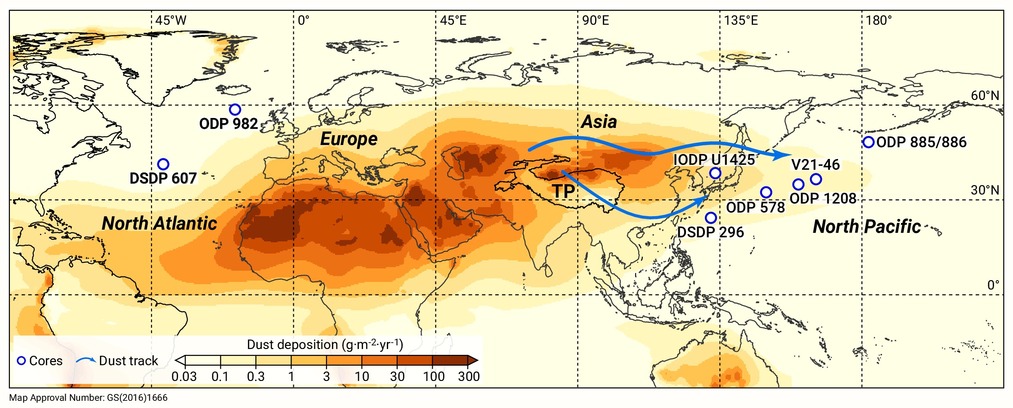
Figure 1.
Spatial distribution of atmospheric dust deposition across the Eurasian continent for the period 1998–2010
-
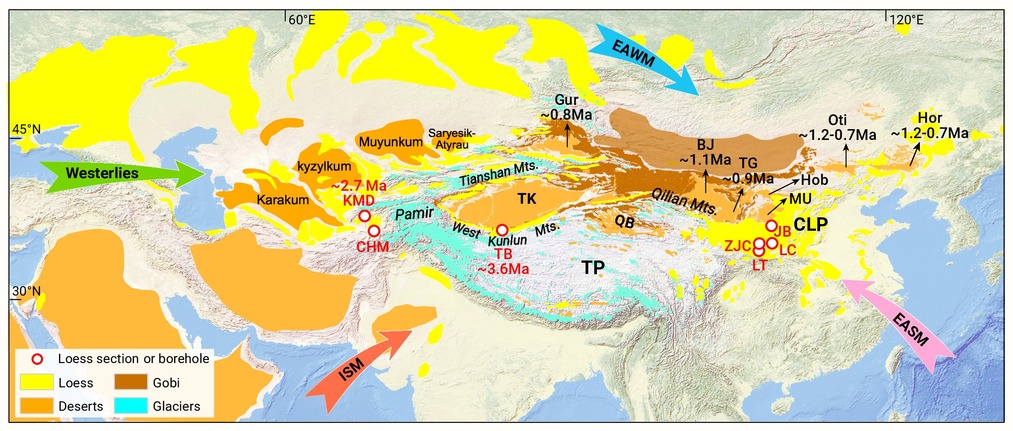
Figure 2.
Synthesis of the initiation time and spatial distribution of major deserts and loess deposits in Asia
-
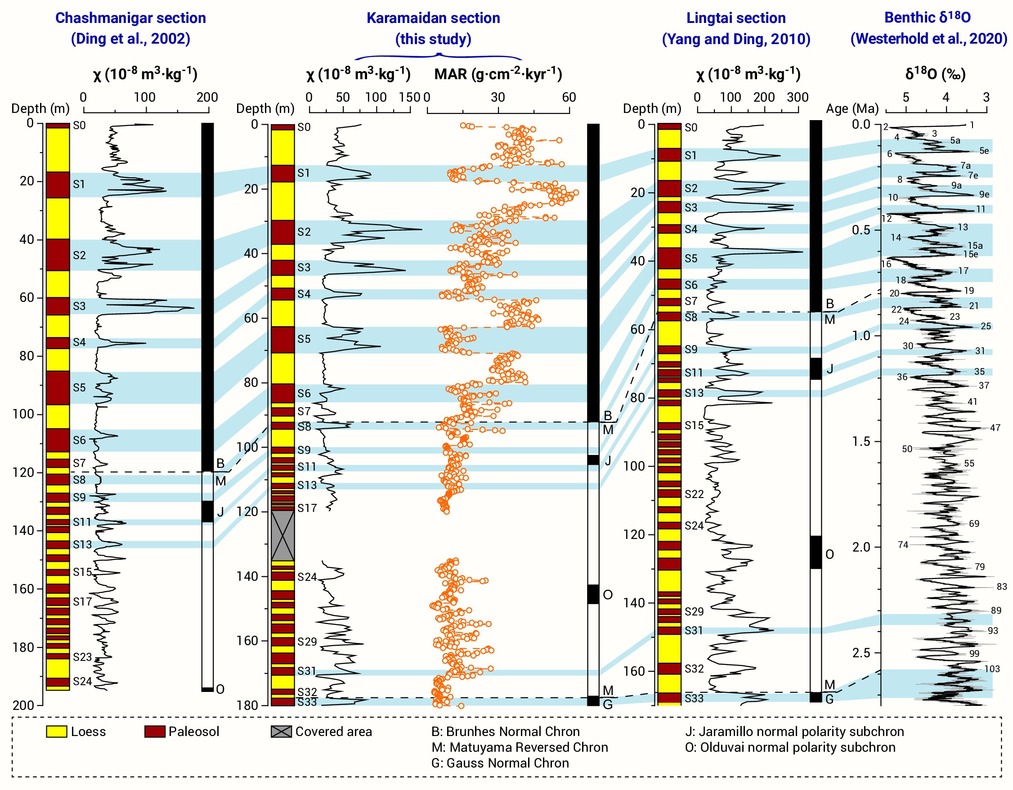
Figure 3.
Correlations of lithostratigraphy, magnetostratigraphy, and magnetic susceptibility (χ) records of the Chashmanigar and Karamaidan sections in southern Tajikistan, the Lingtai section on the Chinese Loess Plateau, and the benthic δ18O stack
-
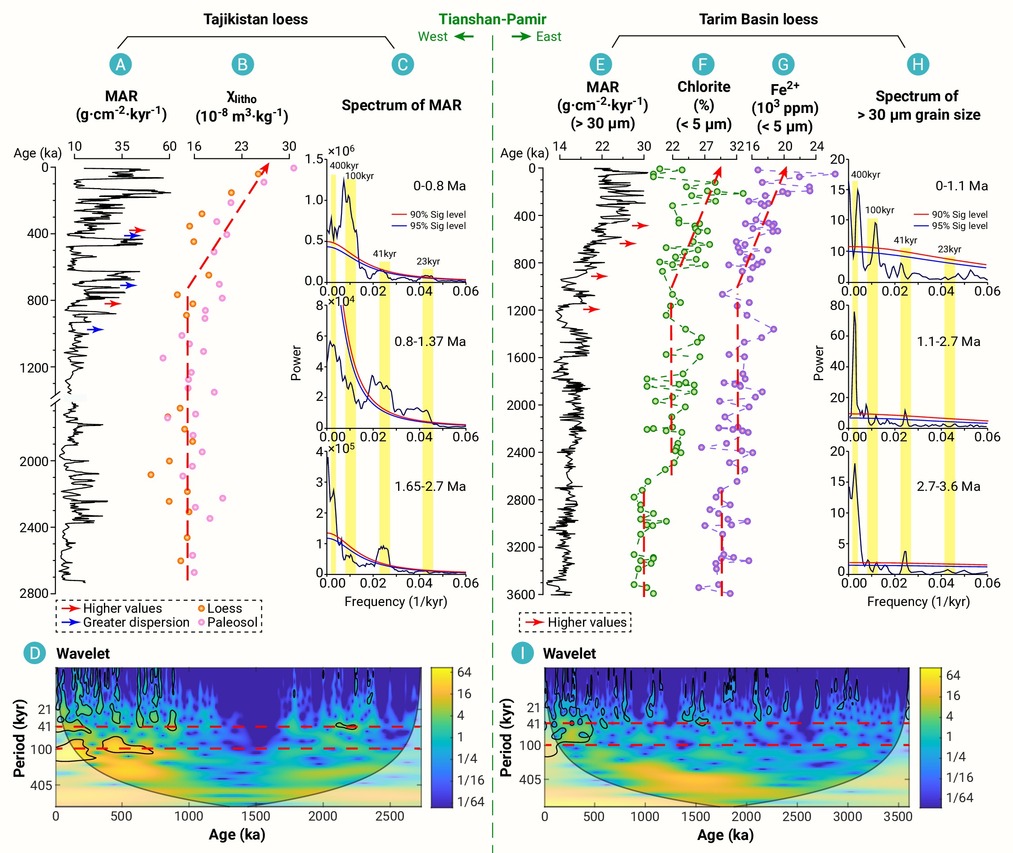
Figure 4.
Comparison of dust fluxes, properties, and periodicities between Tajikistan and Tarim Basin loess records
-
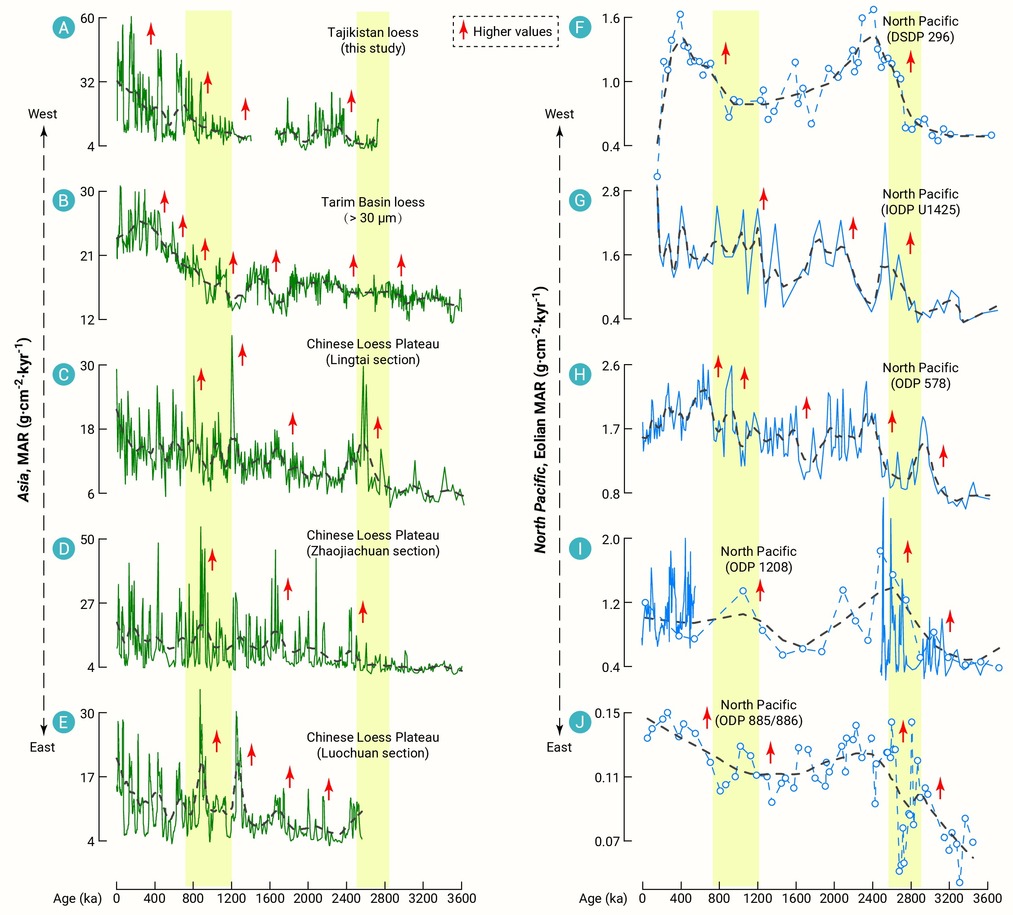
Figure 5.
Temporal and spatial variations of eolian dust fluxes in Asia and the North Pacific over the past 3.6 Myr
-
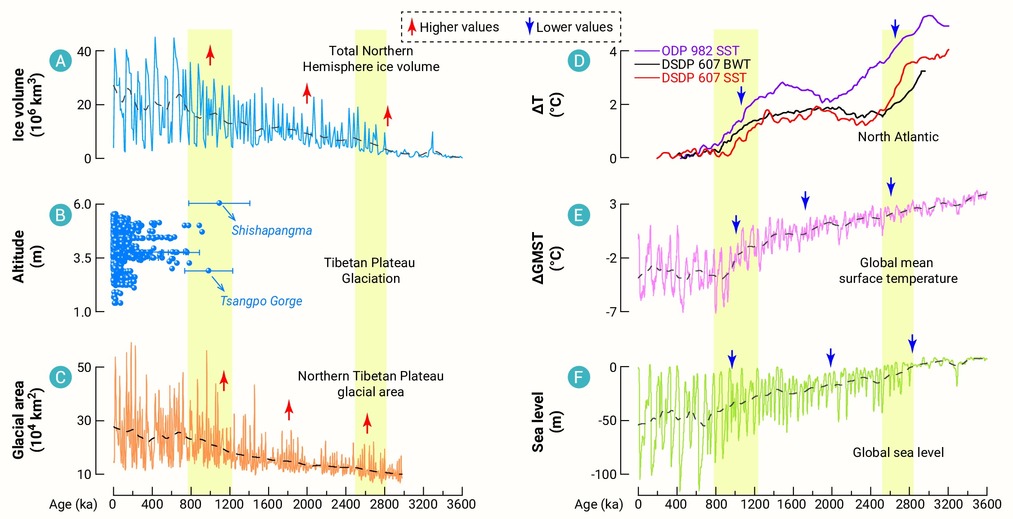
Figure 6.
Temporal variations of various paleoclimate proxies over the past 3.6 Myr
-
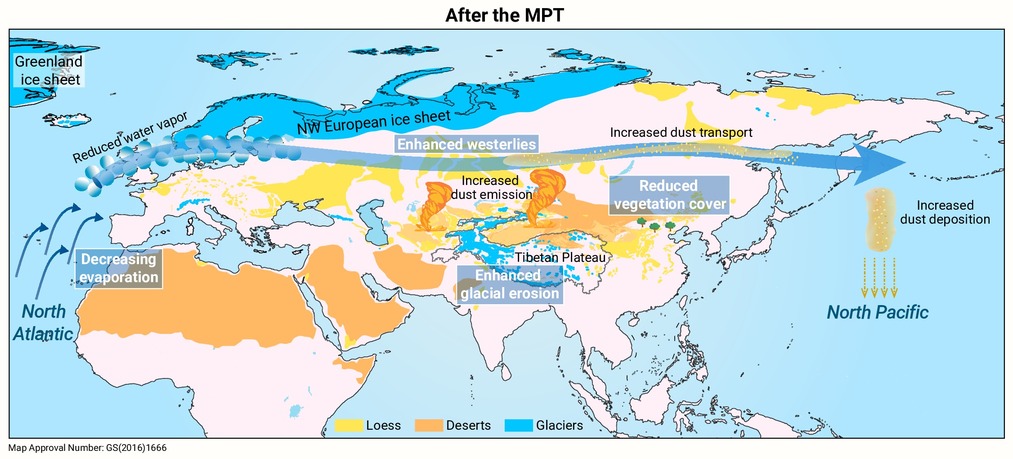
Figure 7.
Conceptual model of the driving mechanisms of dust emission and transport in the Asian interior during geological intervals of global cooling
