
A low-latitude framework for climate variability over the last 60,000 years
-
GRAPHICAL ABSTRACT
 DownLoad:
Full size image
DownLoad:
Full size image
-
PUBLIC SUMMARY
-
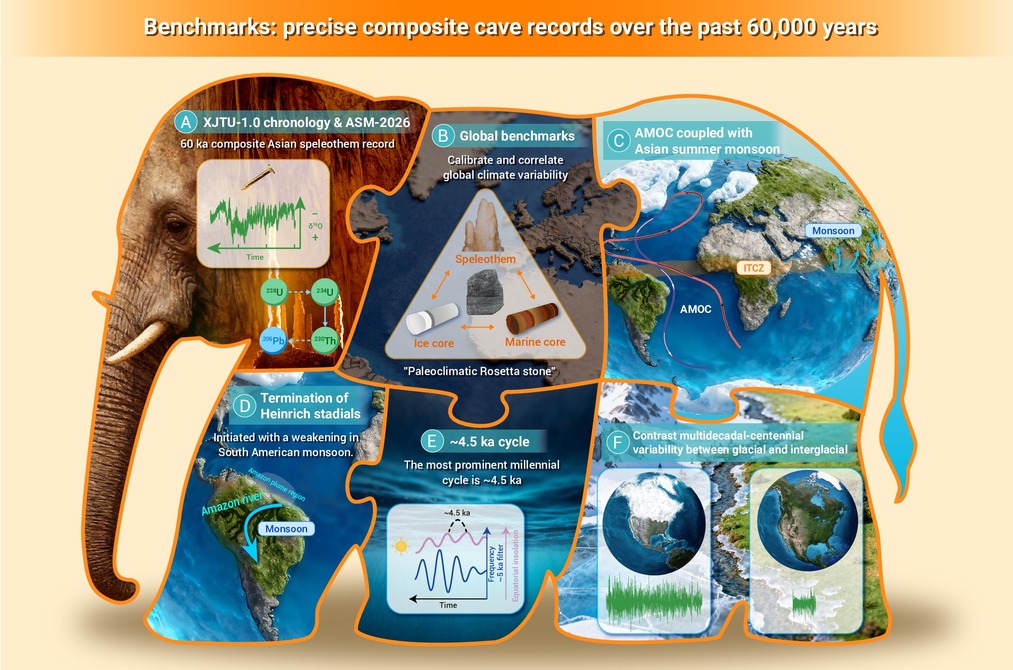
A new high-resolution and precisely dated Asian composite cave record covers past 60,000 years.
The record’s precise chronology provides benchmarks for calibrating and correlating global climate variability.
The monsoon dynamics were coupled with the Atlantic Meridional Overturning Circulation instead of ice volume.
The most prominent millennial cycle is ~4.5-ka, close to precession cycles, implying an external forcing.
Multidecadal-centennial climate variations in periodicity and amplitude changed from glacial to interglacial.
-
-
ABSTRACT
Climate variability during the last 60,000 years exhibited pronounced fluctuations on glacial-interglacial to sub-orbital timescales, yet fundamental questions remain regarding the timing, phasing, and cyclical structure of global climate fluctuations. Here we present ASM-2026, a composite of multiple high-resolution speleothem oxygen isotope (δ18O) records from the Asian summer monsoon (ASM) domain spanning the last 60 ka. Anchored by a rigorously constrained U-Th chronology (XJTU-1.0), this record resolves monsoon variability at multidecadal to millennial scales and provides robust geochronological benchmarks for correlating inter-regional climate variability. Our analysis indicates that ASM dynamic variability is only weakly linked to high-latitude ice-sheet forcing in either hemisphere, but closely tracks changes in the Atlantic Meridional Overturning Circulation (AMOC). Terminations of Heinrich Stadials are consistently preceded by centennial-scale weakening of the South American monsoon, likely associated with a shift in the Antarctic Oscillation from positive to negative phase, implicating a low-latitude and/or Southern Hemisphere trigger for abrupt climate reorganization. The record contains pronounced ~4.5-ka cycle close to one-quarter of the precession period, consistent with the modulation by the equatorial insolation forcing. At multidecadal to centennial timescales, the amplitude and periodicity of variability in the ASM and Greenland climate records diminish from glacial to interglacial conditions, whereas Antarctic variability displays an opposing response, highlighting a fundamental reorganization of teleconnections and forcing pathways across climate states. -

-
REFERENCES
[1] Dansgaard W., Johnsen S.J., Clausen H.B. et al. (1993). Evidence for general instability of past climate from a 250-kyr ice-core record. Nature 364:218−220. DOI:10.1038/364218a0 [2] Rasmussen S.O., Bigler M., Blockley S.P. et al. (2014). A stratigraphic framework for abrupt climatic changes during the last glacial period based on three synchronized Greenland ice-core records: Refining and extending the INTIMATE event stratigraphy. Quat. Sci. Rev. 106:14−28. DOI:10.1016/j.quascirev.2014.09.007 [3] Heinrich H. (1988). Origin and consequences of cyclic ice rafting in the northeast Atlantic Ocean during the past 130,000 years. Quat. Res. 29:142−152. DOI:10.1016/0033-5894(88)90057-9 [4] Hemming S.R. (2004). Heinrich events: Massive late Pleistocene detritus layers of the North Atlantic and their global climate imprint. Rev. Geophys. 42:RG1005. DOI:10.1029/2003rg000128 [5] Barker S., Diz P., Vautravers M.J. et al. (2009). Interhemispheric Atlantic seesaw response during the last deglaciation. Nature 457:1097−1102. DOI:10.1038/nature07770 [6] Hodell D.A., Nicholl J.A., Bontognali T.R.R. et al. (2017). Anatomy of Heinrich Layer 1 and its role in the last deglaciation. Paleoceanography 32:284−303. DOI:10.1002/2016pa003028 [7] Dong X.Y., Kathayat G., Rasmussen S.O. et al. (2022). Coupled atmosphere-ice-ocean dynamics during Heinrich Stadial 2. Nat. Commun. 13:5867. DOI:10.1038/s41467-022-33583-4 [8] Cheng H., Fleitmann D., Edwards R.L. et al. (2009). Timing and structure of the 8.2 kyr BP event inferred from δ18O records of stalagmites from China, Oman, and Brazil. Geology 37:1007–1010. DOI:10.1130/g30126a.1 [9] Cheng H., Zhang H.W., Spötl C. et al. (2020). Timing and structure of the Younger Dryas event and its underlying climate dynamics. Proc. Natl. Acad. Sci. USA 117:23408−23417. DOI:10.1073/pnas.2007869117 [10] Menviel L.C., Skinner L.C., Tarasov L. et al. (2020). An ice-climate oscillatory framework for Dansgaard-Oeschger cycles. Nat. Rev. Earth Environ. 1:677−693. DOI:10.1038/s43017-020-00106-y [11] Broccoli A.J., Dahl K.A., Stouffer R.J. et al. (2006). Response of the ITCZ to Northern Hemisphere cooling. Geophys. Res. Lett. 33:L01702. DOI:10.1029/2005gl024546 [12] Deplazes G., Lückge A., Peterson L.C. et al. (2013). Links between tropical rainfall and North Atlantic climate during the last glacial period. Nat. Geosci. 6:213−217. DOI:10.1038/ngeo1712 [13] Chiang J.C.H., Fung I.Y., Wu C.H. et al. (2015). Role of seasonal transitions and westerly jets in East Asian paleoclimate. Quat. Sci. Rev. 108:111−129. DOI:10.1016/j.quascirev.2014.11.009 [14] Cheng H., Edwards R.L., Wang Y.J. et al. (2006). A penultimate glacial monsoon record from Hulu Cave and two-phase glacial terminations. Geology 34:217−220. DOI:10.1130/g22289.1 [15] Cheng H., Xu Y., Dong X.Y. et al. (2021). Onset and termination of Heinrich Stadial 4 and the underlying climate dynamics. Commun. Earth Environ. 2:230. DOI:10.1038/s43247-021-00304-6 [16] Dong X.Y., Zhang X., Zhang H.W. et al. (2025). Interstadial diversity of East Asian summer monsoon linked to changes of the Northern Westerlies. Nat. Commun. 16:7765. DOI:10.1038/s41467-025-63057-2 [17] Cheng H., Sinha A., Cruz Jr F.W. et al. (2013). Climate change patterns in Amazonia and biodiversity. Nat. Commun. 4:1411. DOI:10.1038/ncomms2415 [18] Cruz Jr F.W., Burns S.J., Karmann I. et al. (2005). Insolation-driven changes in atmospheric circulation over the past 116,000 years in subtropical Brazil. Nature 434:63−66. DOI:10.1038/nature03365 [19] Leduc G., Vidal L., Tachikawa K. et al. (2007). Moisture transport across Central America as a positive feedback on abrupt climatic changes. Nature 445:908−911. DOI:10.1038/nature05578 [20] Wang X.F., Auler A.S., Edwards R.L. et al. (2004). Wet periods in northeastern Brazil over the past 210 kyr linked to distant climate anomalies. Nature 432:740−743. DOI:10.1038/nature03067 [21] Wang X.F., Edwards R.L., Auler A.S. et al. (2017). Hydroclimate changes across the Amazon lowlands over the past 45,000 years. Nature 541:204−207. DOI:10.1038/nature20787 [22] Pedro J.B., Jochum M., Buizert C. et al. (2018). Beyond the bipolar seesaw: Toward a process understanding of interhemispheric coupling. Quat. Sci. Rev. 192:27−46. DOI:10.1016/j.quascirev.2018.05.005 [23] Brook E. J. and Buizert C. (2018). Antarctic and global climate history viewed from ice cores. Nature 558:200−208. DOI:10.1038/s41586-018-0172-5 [24] Buizert C., Sigl M., Severi M. et al. (2018). Abrupt ice-age shifts in southern westerly winds and Antarctic climate forced from the north. Nature 563:681−685. DOI:10.1038/s41586-018-0727-5 [25] Wendt K.A., Nehrbass-Ahles C., Niezgoda K. et al. (2024). Southern Ocean drives multidecadal atmospheric CO2 rise during Heinrich Stadials. Proc. Natl. Acad. Sci. USA 121:e2319652121. DOI:10.1073/pnas.2319652121 [26] Stocker T.F. and Johnsen S.J. (2003). A minimum thermodynamic model for the bipolar seesaw. Paleoceanogr. Paleoclimatol. 18:1087−1088. DOI:10.1029/2003pa000920 [27] WAIS Divide Project Members. (2015). Precise interpolar phasing of abrupt climate change during the last ice age. Nature 520:661−665. DOI:10.1038/nature14401 [28] Svensson A., Dahl-Jensen D., Steffensen J.P. et al. (2020). Bipolar volcanic synchronization of abrupt climate change in Greenland and Antarctic ice cores during the last glacial period. Clim. Past 16:1565−1580. DOI:10.5194/cp-16-1565-2020 [29] Dong X.Y., Zhang X., Sun Y.C. et al. (2026). Glacial abrupt transitions in ocean circulation were much slower than ice-core records imply. Science (in review). [30] Cheng H., Edwards R.L., Shen C.-C. et al. (2013). Improvements in 230Th dating, 230Th and 234U half-life values, and U-Th isotopic measurements by multi-collector inductively coupled plasma mass spectrometry. Earth Planet. Sci. Lett. 371–372:82–91. DOI:10.1016/j.epsl.2013.04.006 [31] Cheng H., Edwards R.L., Broecker W.S. et al. (2009). Ice age terminations. Science 326:248−252. DOI:10.1126/science.1177840 [32] Zhao J.Y., Pérez‐Mejías C., Dong X.Y. et al (2025). Resonant Asian monsoon during intermediate conditions of the last deglaciation: Insights from speleothem records. J. Geophys. Res. Atmos. 130:e2024JD042523. DOI:10.1029/2024JD042523 [33] Cheng H., Edwards R.L., Sinha A. et al. (2016). The Asian monsoon over the past 640,000 years and ice age terminations. Nature 534:640−646. DOI:10.1038/nature18591 [34] Cheng H., Li H.Y., Sha L.J. et al. (2022). Milankovitch theory and monsoon. The Innovation 3:100338. DOI:10.1016/j.xinn.2022.100338 [35] Sinha A., Cheng J., Li H.Y. et al. (2026). ENSO modulated upstream convection as the primary control on interannual δ18O variability in East Asia. npj Clim. Atmos. Sci. 9:64. DOI:10.1038/s41612-026-01333-8 [36] Edwards R.L., Chen J.H., Wasserburg G.J. (1987). 238U-234U-230Th-232Th systematics and the precise measurement of time over the past 500,000 years. Earth Planet. Sci. Lett. 81:175−192. DOI:10.1016/0012-821x(87)90154-3 [37] Cheng H., Edwards R.L., Hoff J. et al. (2000). The half-lives of uranium-234 and thorium-230. Chem. Geol. 169:17−33. DOI:10.1016/S0009-2541(99)00157-6 [38] Scholz D. and Hoffmann D.L. (2011). StalAge - An algorithm designed for construction of speleothem age models. Quat. Geochron. 6:369−382. DOI:10.1016/j.quageo.2011.02.002 [39] Ramsey C.B. (2009). Deposition models for chronological records. Quat. Sci. Rev. 27:42−60. DOI:10.1016/j.quascirev.2007.01.019 [40] Cheng H., Edwards R.L., Southon J. et al. (2018). Atmospheric 14C/12C changes during the last glacial period from Hulu Cave. Science 362:1293−1297. DOI:10.1126/science.aau0747 [41] Wang Y.J., Cheng H., Edwards R.L. et al. (2005). The Holocene Asian monsoon: links to solar changes and North Atlantic climate. Science 308:854−857. DOI:10.1126/science.1106296 [42] Dykoski C.A., Edwards R.L., Cheng H. et al. (2005). A high-resolution, absolute-dated Holocene and deglacial Asian monsoon record from Dongge Cave, China. Earth Planet. Sci. Lett. 233:71−86. DOI:10.1016/j.epsl.2005.01.036 [43] Zhang W.H., Wu J.Y., Wang Y.J. et al. (2014). A detailed East Asian monsoon history surrounding the “Mystery Interval” derived from three Chinese speleothem records. Quat. Res. 82:154−163. DOI:10.1016/j.yqres.2014.01.010 [44] Liu D.B., Wang Y.J., Cheng H. et al (2010). Sub-millennial variability of Asian monsoon intensity during the early MIS 3 and its analogue to the ice age terminations. Quat. Sci. Rev. 29:1107–1115. DOI:10.1016/j.quascirev.2010.01.008 [45] Wang Y.J., Cheng H., Edwards R.L. et al. (2001). A high-resolution absolute-dated late Pleistocene monsoon record from Hulu Cave, China. Science 294:2345−2348. DOI:10.1126/science.1064618 [46] Zhao K., Wulder M.A., Hu T.X. et al. (2019). Detecting change-point, trend, and seasonality in satellite time series data to track abrupt changes and nonlinear dynamics: A Bayesian ensemble algorithm. Remote Sens. Environ. 232:111181. DOI:10.1016/j.rse.2019.04.034 [47] Yuan D.X., Cheng H., Edwards R.L. et al. (2004). Timing, duration, and transitions of the last interglacial Asian monsoon. Science 304:575−578. DOI:10.1126/science.1091220 [48] Li Y., Qiu W.Y., Gao K. et al. (2025) Millennial-scale East Asian summer monsoon hydroclimate variability during 47–39 kyr B.P. inferred from a stalagmite IRMsoft-flux record in Southeastern China. Global Planet. Change 253: 104954. DOI:10.1016/j.gloplacha.2025.104954 [49] Wang Y.J., Cheng H., Edwards R.L. et al. (2008). Millennial- and orbital-scale changes in the East Asian monsoon over the past 224,000 years. Nature 451:1090−1093. DOI:10.1038/nature06692 [50] Buizert C., Cuffey K.M., Severinghaus J.P. et al. (2015). The WAIS divide deep ice core WD2014 chronology - part 1: Methane synchronization (68-31 ka BP) and the gas age-ice age difference. Clim. Past 11:153−173. DOI:10.5194/cp-11-153-2015 [51] Corrick E.C., Drysdale R.N., Hellstrom J.C. et al. (2020). Synchronous timing of abrupt climate changes during the last glacial period. Science 369:963−969. DOI:10.1126/science.aay5538 [52] Liu D.B., Mi X., Liu S.S. et al. (2022). Multi-phased Asian hydroclimate variability during Heinrich Stadial 5. Clim. Dyn. 60:4003−4016. DOI:10.1007/s00382-022-06566-w [53] Du W.J., Cheng H., Xu Y. et al. (2019). Timing and structure of the weak Asian Monsoon event about 73,000 years ago. Quat. Geochron. 53:101003. DOI:10.1016/j.quageo.2019.05.002 [54] Waelbroeck C., Lougheed B.C., Vázquez Riveiros N. et al. (2019). Consistently dated Atlantic sediment cores over the last 40 thousand years. Sci. Data 6:165. DOI:10.1038/s41597-019-0173-8 [55] Andersen K.K., Svensson A., Johnsen S.J. et al. (2006). The greenland ice core chronology 2005, 15-42 ka. part 1: Constructing the time scale. Quat. Sci. Rev. 25:3246–3257. DOI:10.1016/j.quascirev.2006.08.002. [56] Rasmussen S.O., Andersen K.K., Svensson A.M. et al. (2006). A new Greenland ice core chronology for the last glacial termination. J. Geophys. Res. Atmospheres 111:D06102. DOI:10.1029/2005JD006079 [57] Svensson A., Andersen K.K., Bigler M. et al. (2006). The greenland ice core chronology 2005, 15-42 ka. part 2: comparison to other records. Quat. Sci. Rev. 25:3258–3267. DOI:10.1016/j.quascirev.2006.08.003 [58] Svensson A., Andersson K.K., Bigler M. et al. (2008). A 60,000 year Greenland stratigraphic ice core chronology. Clim. Past 4:47−57. DOI:10.5194/cp-4-47-2008 [59] An Z.S., Kukla G.J., Porter S.C. et al. (1991) Magnetic susceptibility evidence of monsoon variation on the Loess Plateau of central China during the last 130,000 years. Quat. Res. 36:29-36. DOI:10.1016/0033-5894(91)90015-W [60] Laskar J., Robutel P., Joutel F. et al. (2004). A long-term numerical solution for the insolation quantities of the Earth. Astron. Astrophys. 428:261−285. DOI:10.1051/0004-6361:20041335 [61] North Greenland Ice Core Project members. (2004). High-resolution record of Northern Hemisphere climate extending into the last interglacial period. Nature 431:147−151. DOI:10.1038/nature02805 [62] Böhm E., Lippold J., Gutjahr M. et al. (2015). Strong and deep Atlantic Meridional Overturning Circulation during the last glacial cycle. Nature 517:73−76. DOI:10.1038/nature14059 [63] Henry L.G., McManus J.F., Curry W.B. et al. (2016). North Atlantic Ocean circulation and abrupt climate change during the last glaciation. Science 353:470−474. DOI:10.1126/science.aaf5529 [64] Toucanne S., Soulet G., Vázquez Riveiros N. et al. (2021). The North Atlantic glacial rastern boundary current as a key driver for ice-sheet—AMOC interactions and climate instability. Paleoceanogr. Paleoclimatol. 36:e2020PA004068. DOI:10.1029/2020pa004068 [65] Davtian N. and Bard E. (2023). A new view on abrupt climate changes and the bipolar seesaw based on paleotemperatures from Iberian Margin sediments. Proc. Natl. Acad. Sci. USA 120:e2209558120. DOI:10.1073/pnas.2209558120 [66] Siddall M., Rohling E.J., Almogi-Labin A. et al. (2003). Sea-level fluctuations during the last glacial cycle. Nature 423:853−858. DOI:10.1038/nature01690 [67] Margari V., Skinner L.C., Menviel L. et al. (2020). Fast and slow components of interstadial warming in the North Atlantic during the last glacial. Commun. Earth Environ. 1:6. DOI:10.1038/s43247-020-0006-x [68] Rhodes R.H., Brook E.J., Chiang J.C.H. et al. (2015). Enhanced tropical methane production in response to iceberg discharge in the North Atlantic. Science 348:1016−1019. DOI:10.1126/science.1262005 [69] Bauska T.K., Marcott S.A., Brook E.J. et al. (2021). Abrupt changes in the global carbon cycle during the last glacial period. Nat. Geosci. 14:91−96. DOI:10.1038/s41561-020-00680-2 [70] Mosblech N., Bush M., Gosling W. et al. (2012). North Atlantic forcing of Amazonian precipitation during the last ice age. Nat. Geosci. 5:817−820. DOI:10.1038/ngeo1588 [71] Martin K., Buizert C., Edwards J. et al. (2023). Bipolar impact and phasing of Heinrich-type climate variability. Nature 617:1−5. DOI:10.1038/s41586-023-05875-2 [72] Muschitiello F. and Aquino-Lopez M.A. (2024). Continuous synchronization of the Greenland ice-core and U–Th timescales using probabilistic inversion. Clim. Past 20:1415−1435. DOI:10.5194/cp-20-1415-2024 [73] Hodell D.A., Crowhurst S.J., Lourens L. et al. (2023). A 1.5-million-year record of orbital and millennial climate variability in the North Atlantic. Clim. Past 19:607–636. DOI:10.5194/cp-19-607-2023 [74] Wolff E. W., Fischer H., Röthlisberger R. et al. (2009). Glacial terminations as southern warmings without northern control. Nat. Geosci. 2:206−209. DOI:10.1038/ngeo442 [75] Cai Y.J., An Z.S., Cheng H. et al. (2006). High-resolution absolute-dated Indian Monsoon record between 53 and 36 ka from Xiaobailong Cave, southwestern China. Geology 34:621−624. DOI:10.1130/g22567 [76] Rohling E.J., Liu Q.S., Roberts A.P. et al. (2009). Controls on the East Asian monsoon during the last glacial cycle, based on comparison between Hulu Cave and polar ice-core records. Quat. Sci. Rev. 28:3291−3302. DOI:10.1016/j.quascirev.2009.09.007 [77] An Z.S., Clemens S.C., Shen J. et al. (2011). Glacial-interglacial Indian summer monsoon dynamics. Science 333:719−723. DOI:10.1126/science.1203752 [78] Chen X., Zhao J.Y., Wang K.X. et al. (2025). Nonlinear feedback of Asian summer monsoon to abrupt events in North Atlantic: Evidence from a precisely dated speleothem record during late MIS3. Global Planet. Change 247:104733. DOI:10.1016/j.gloplacha.2025.104733 [79] Svensson, A., Vettoretti G., Lin J.M. et al. (2026) Bipolar volcanic ice-core synchronization of the entire last glacial period. Quat. Sci. Rev. 375:109755. DOI:10.1016/j.quascirev.2025.109755 [80] Pollard D. and DeConto R.M. (2009). Modelling West Antarctic ice sheet growth and collapse through the past five million years. Nature 458:329−333. DOI:10.1038/nature07809 [81] Gottschalk J., Skinner L.C., Jaccard S.L. et al. (2020). Southern Ocean link between changes in atmospheric CO2 levels and northern-hemisphere climate anomalies during the last two glacial periods. Quat. Sci. Rev. 230:106067. DOI:10.1016/j.quascirev.2019.106067 [82] Menviel L. and Spence P. (2024). Southern Ocean circulation’s impact on atmospheric CO2 concentration. Front. Mar. Sci. 10:1328534. DOI:10.3389/fmars.2023.1328534 [83] Markle B.R., Steig E.J., Buizert C. et al. (2017). Global atmospheric teleconnections during Dansgaard-Oeschger events. Nat. Geosci. 10:36−40. DOI:10.1038/ngeo2848 [84] Zhang R. and Delworth T.L. (2005). Simulated tropical response to a substantial weakening of the Atlantic thermohaline circulation. J. Clim. 18:1853−1860. DOI:10.1175/jcli3460.1 [85] Erhardt T., Capron E., Rasmussen S.O. et al. (2019). Decadal-scale progression of the onset of Dansgaard–Oeschger warming events. Clim. Past 15:811−825. DOI:10.5194/cp-15-811-2019 [86] He C.F., Liu Z.Y., Otto-Bliesner B.L. et al. (2021). Abrupt Heinrich Stadial 1 cooling missing in Greenland oxygen isotopes. Sci. Adv. 7:eabh1007. DOI:10.1126/sciadv.abh1007 [87] Yu T., Cheng J., Lin P. et al. (2018). Responses and mechanisms of East Asian winter and summer monsoons to weakened Atlantic meridional overturning circulation using the FGOALS-g2 model. Int. J. Clim. 38:2618−2626. DOI:10.1002/joc.5373 [88] Manabe S. and Stouffer R. (1997). Coupled ocean-atmosphere model response to freshwater input: Comparison to Younger Dryas Event. Paleoceanography 12:321−336. DOI:10.1029/96pa03932 [89] Otto-Bliesner B. and Brady E. (2010). Sensitivity of the climate response to the magnitude and location of freshwater forcing: Last glacial maximum experiments. Quat. Sci. Rev. 29:56−73. DOI:10.1016/j.quascirev.2009.07.004 [90] Rahmstorf S. (2002). Ocean circulation and climate during the past 120,000 years. Nature 419:207−214. DOI:10.1038/nature01090 [91] Scafetta N., Milani F., Bianchini A. et al. (2016). On the astronomical origin of the Hallstatt oscillation found in radiocarbon and climate records throughout the Holocene. Earth Sci. Rev. 162:24−43. DOI:10.1016/j.earscirev.2016.09.004 [92] Keigwin L.D. and Jones G.A. (1994). Western North Atlantic evidence for millennial-scale changes in ocean circulation and climate. J. Geophys. Res. -Oceans 99:12397−12410. DOI:10.1029/94jc00525 [93] Weirauch D. and Billups K., Martin P. (2008). Evolution of millennial-scale climate variability during the mid Pleistocene. Paleoceanography 23:PA3216. DOI:10.1029/2007pa001584 [94] Billups K. and Scheinwald A. (2014). Origin of millennial-scale climate signals in the subtropical North Atlantic. Paleoceanography 29:612−627. DOI:10.1002/2014pa002641 [95] Kravchinsky V.A., Zhang R., Borowiecki R. et al. (2025). Millennial cycles in Greenland and Antarctic ice core records: Evidence of astronomical influence on global climate. J. Geophys. Res.-Atmos. 130:e2024JD042810. DOI:10.1029/2024JD042810 [96] Gorbarenko S.A., Harada N., Malakhov M.I. et al. (2012). Responses of the Okhotsk Sea environment and sedimentology to global climate changes at the orbital and millennial scale during the last 350 kyr. Deep Sea Res. Part II Top. Stud. Oceanogr. 61:73−84. DOI:10.1016/j.dsr2.2011.05.016 [97] Zhang X., Barker S., Knorr G. et al. (2021). Direct astronomical influence on abrupt climate variability. Nat. Geosci. 14:819−826. DOI:10.1038/s41561-021-00846-6 [98] Niu X.W., Wang J., Kang L. et al. (2025). Millennial-scale climate variability of the Asian summer monsoon over the last 690,000 years: Insights from cave records. Sci. Bull. 70:1513−1522. DOI:10.1016/j.scib.2025.02.011 [99] Zhang Z.F., Huang Y.J., Wang T.T. et al. (2025). Precession-induced millennial climate cycles in greenhouse Cretaceous. Nat. Commun. 16:10696. DOI:10.1038/s41467-025-66219-4 [100] Berger A., Loutre M.F., Mélice J.L. et al. (2006). Equatorial insolation: From precession harmonics to eccentricity frequencies. Clim. Past 2:519−533. DOI:10.5194/cp-2-131-2006,2006 [101] Jaeschke A., Rühlemann C., Arz H. et al. (2007). Coupling of millennial-scale changes in sea surface temperature and precipitation off northeastern Brazil with high-latitude climate shifts during the last glacial period. Paleoceanography 22:PA4206. DOI:10.1029/2006pa001391 [102] Nace T.E., Baker P.A., Dwyer G.S. et al. (2014). The role of North Brazil Current transport in the paleoclimate of the Brazilian Nordeste margin and paleoceanography of the western tropical Atlantic during the late Quaternary. Palaeogeogr. Palaeoclimatol. Palaeoecol. 415:3−13. DOI:10.1016/j.palaeo.2014.05.030 [103] Zhang Y., Chiessi C.M., Mulitza S. et al. (2017). Different precipitation patterns across tropical South America during Heinrich and Dansgaard-Oeschger stadials. Quat. Sci. Rev. 177:1−9. DOI:10.1016/j.quascirev.2017.10.012 [104] Campos M.C., Chiessi C.M., Prange M. et al. (2019). A new mechanism for millennial scale positive precipitation anomalies over tropical South America. Quat. Sci. Rev. 225:105990. DOI:10.1016/j.quascirev.2019.105990 [105] Venancio I.M., Shimizu M.H., Santos T.P. et al. (2020). Changes in surface hydrography at the western tropical Atlantic during the Younger Dryas. Global Planet. Change 184:103047. DOI:10.1016/j.gloplacha.2019.103047 [106] Venancio I.M., Nascimento R.A., Santos T.P. et al. (2022). Tropical South American rainfall response to Dansgaard-Oeschger Stadials of Marine Isotope Stage 5. Front. Earth Sci. 10:826993. DOI:10.3389/feart.2022.826993 [107] Thompson D.W.J. and Wallace J.M. (2000). Annular modes in the extratropical circulation. Part I: month-to-month variability. J. Clim. 13:1000−1016. DOI:2.0.CO;2">10.1175/1520-0442(2000)013<1000:AMITEC>2.0.CO;2 [108] Gong D. and Wang S. (1998). Antarctic oscillation: concept and applications. Sci. Bull. 43:734−738. DOI:10.1007/bf02898949 [109] Gkinis V., Simonsen S.B., Buchardt S.L. et al. (2014). Water isotope diffusion rates from the NorthGRIP ice core for the last 16,000 years—Glaciological and paleoclimatic implications. Earth Planet. Sci. Lett. 405:132−141. DOI:10.1016/j.epsl.2014.08.022 [110] Cheng J., Liu Z.Y., Zhang S.Q. et al. (2016). Reduced interdecadal variability of Atlantic Meridional Overturning Circulation under global warming. Proc. Natl. Acad. Sci. USA 113:3175−3178. DOI:10.1073/pnas.1519827113 [111] Zhao J.Y., Cheng H., Cao J. et al. (2023). Orchestrated decline of Asian summer monsoon and Atlantic meridional overturning circulation in global warming period. Innov. Geosci. 1:100011. DOI:10.59717/j.xinn-geo.2023.100011 [112] Wang K.X., Zhao J.Y., Wang J.J. et al. (2024). Past decadal climate variability of East Asian summer monsoon: Characteristics and mechanisms (in Chinese). Chin. Sci. Bull. 70:240−261. DOI:10.1360/tb-2024-0161 [113] Wu Z. and Huang N.E. (2009). Ensemble empirical mode decomposition: A noise-assisted data analysis method. Adv. Adapt. Data Anal. 1:1−41. DOI:10.1142/s1793536909000047 [114] Grinsted A., Moore J.C., Jevrejeva S. et al. (2004). Application of the cross wavelet transform and wavelet coherence to geophysical time series. Nonlinear Proc. Geophys. 11:561−566. DOI:10.5194/npg-11-561-2004 [115] Sigl M., Fudge T.J., Winstrup M. et al. (2016). The WAIS Divide deep ice core WD2014 chronology - Part 2: Annual-layer counting (0-31 ka BP). Clim. Past 12:769−786. DOI:10.5194/cp-12-769-2016 [116] Jones T.R., Roberts W.H.G., Steig E.J. et al. (2018). Southern Hemisphere climate variability forced by Northern Hemisphere ice-sheet topography. Nature 554:351−355. DOI:10.1038/nature24669 [117] Weber M.E., Clark P.U., Kuhn G. et al. (2014). Millennial-scale variability in Antarctic ice-sheet discharge during the last deglaciation. Nature 510:134−138. DOI:10.1038/nature13397 [118] Bakker P., Clark P.U., Golledge N.R. et al. (2016). Iceberg-rafted debris stack of sediment cores MD07-3133 and MD07-3134, 0-10 ka (dataset). PANGAEA. DOI: 10.1594/PANGAEA.865349 [119] Bakker P., Clark P.U., Golledge N.R. et al. (2017). Centennial-scale Holocene climate variations amplified by Antarctic Ice Sheet discharge. Nature 541:72−76. DOI:10.1038/nature20582 [120] Noble T.L., Rohling E.J., Aitken A.R.A. et al. (2020). The sensitivity of the Antarctic Ice Sheet to a changing climate: past, present, and future. Rev. Geophys. 58:e2019RG000663. DOI:10.1029/2019rg000663 [121] Weber M.E., Golledge N.R., Fogwill C.J. et al. (2021). Decadal-scale onset and termination of Antarctic ice-mass loss during the last deglaciation. Nat. Commun. 12:6683. DOI:10.1038/s41467-021-27053-6 -
ABOUT THIS ARTICLE
Cite this article:
Cheng H., Dong X., Li H., et al. (2026). A low-latitude framework for climate variability over the last 60,000 years. The Innovation Geoscience 4:100243. https://doi.org/10.59717/j.xinn-geo.2026.100243
Welcome!
To request copyright permission to republish or share portions of our works, please visit Copyright Clearance Center's (CCC) Marketplace website at marketplace.copyright.com.
Export File
Citation
Cheng H., Dong X., Li H., et al. (2026). A low-latitude framework for climate variability over the last 60,000 years. The Innovation Geoscience 4:100243. https://doi.org/10.59717/j.xinn-geo.2026.100243

Format
Content
-
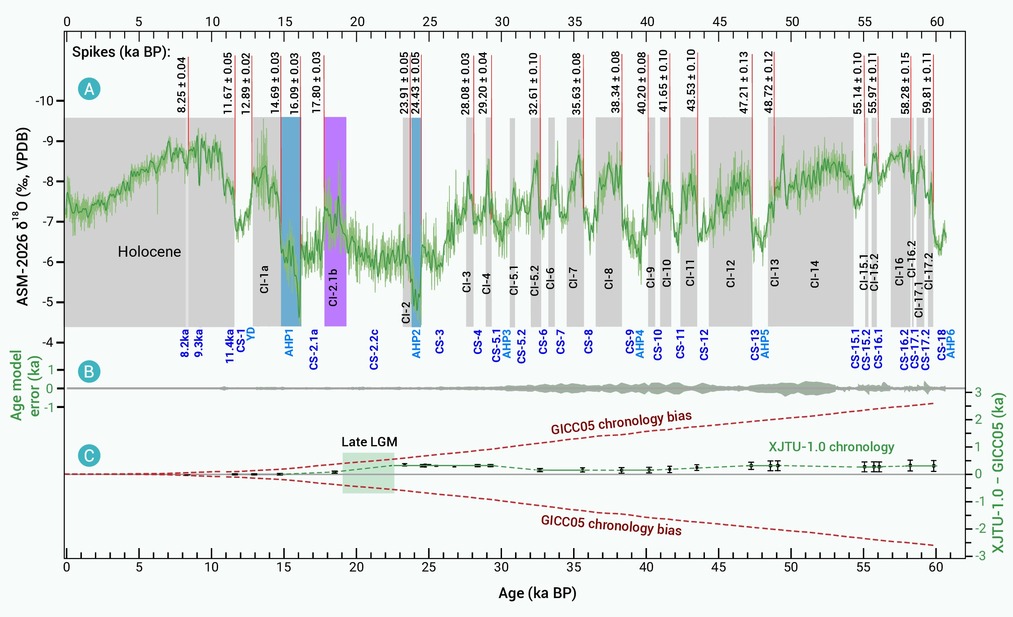
Figure 1.
Speleothem-based XJTU-1.0 geochronology and uncertainties
-
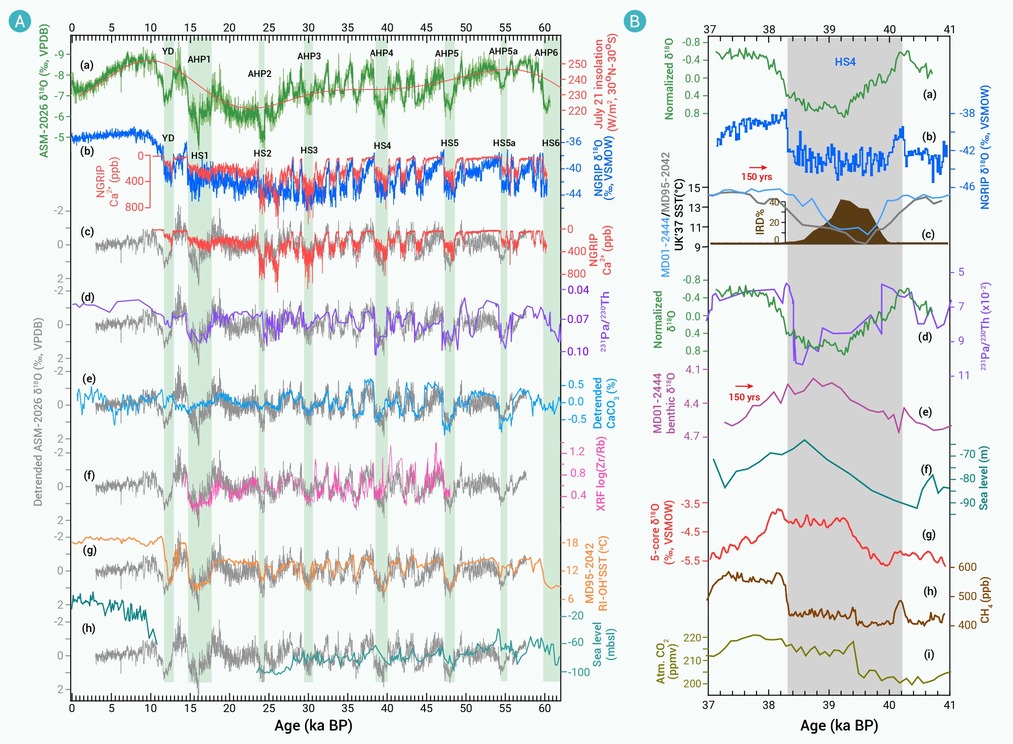
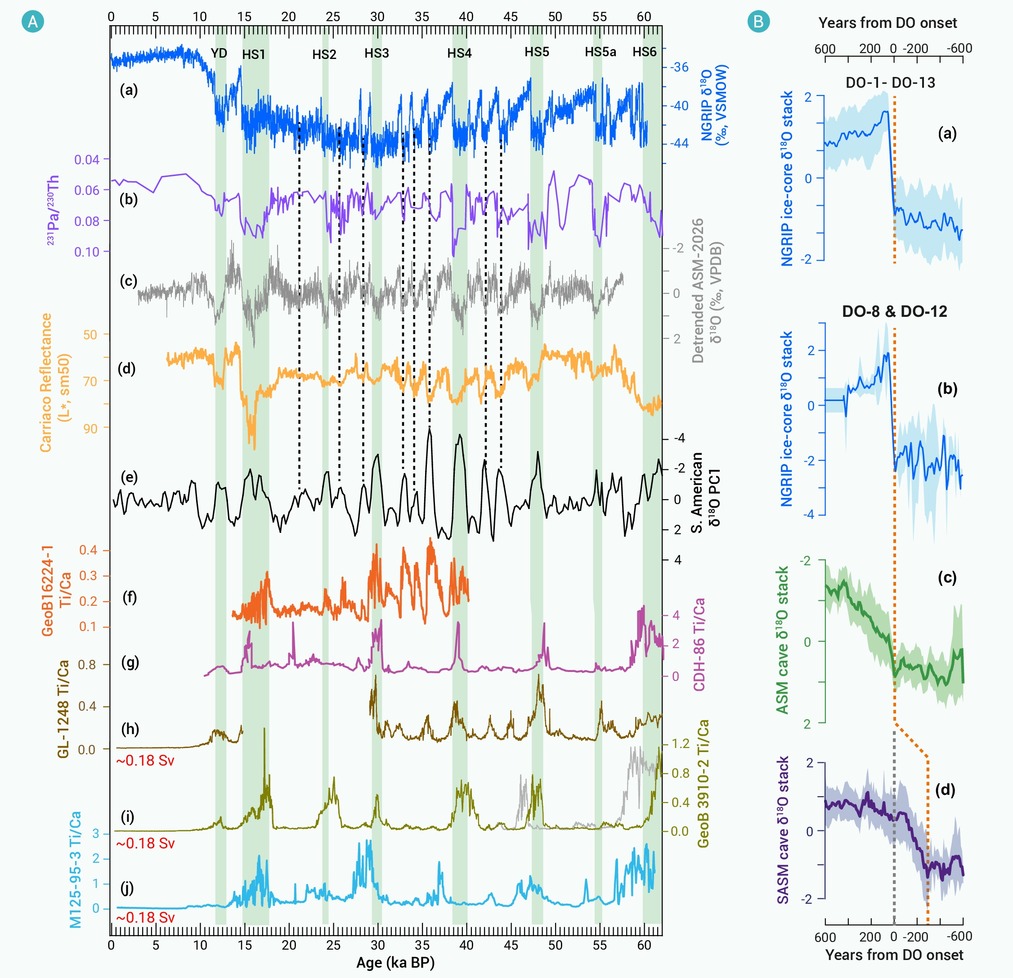
Figure 2.
Relation between ice volume and ASM on millennial-scales
-
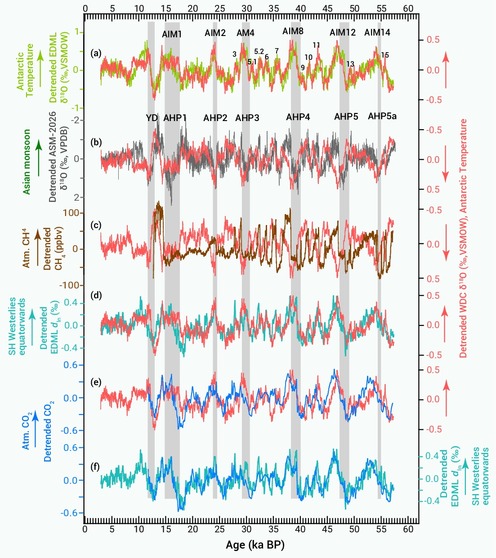
Figure 3.
Comparison between detrended Asian monsoon, Greenland and Antarctic ice-core records for the last 60 ka
-
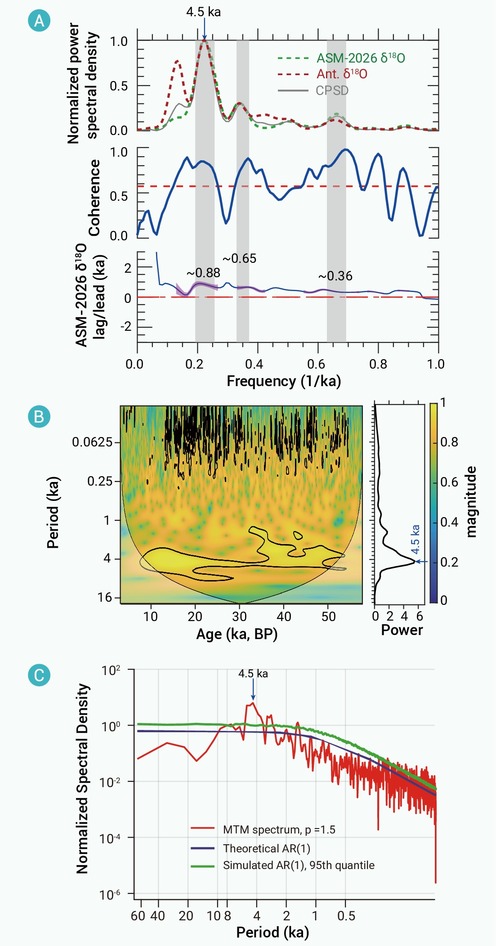
Figure 4.
Spectral and wavelet analyses of millennial-scale variations
-
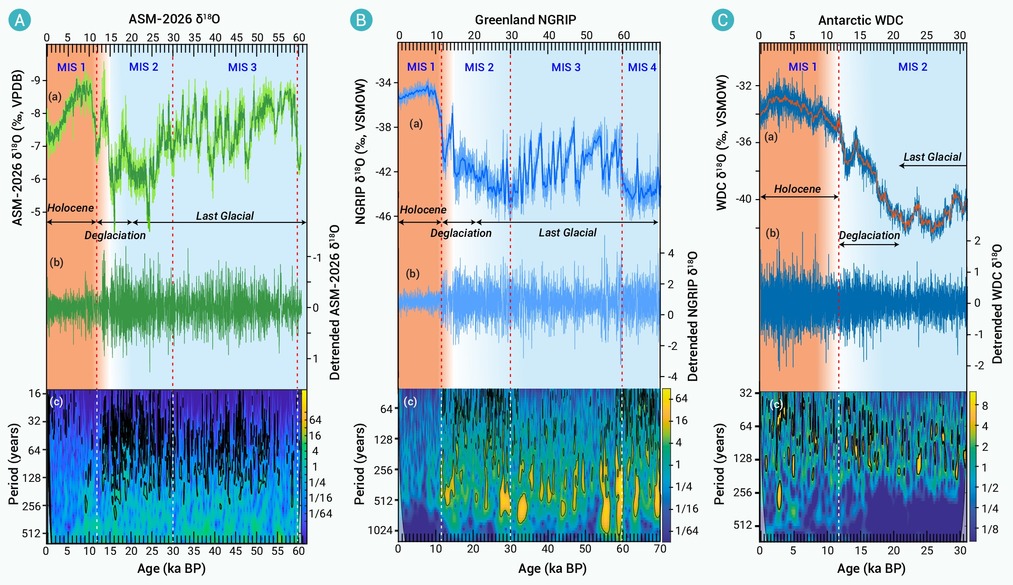
Figure 5.
Climate variability across the last 60 ka
-
Figure 6.
Climate variability across the last 60 ka
