
Into Earth’s depths: China’s 10-kilometer well refines the ultra-deep petroleum frontier
-

-
REFERENCES
[1] Zhu G., Huang H., Tan Q. (2026). Petroleum signals from the deep earth: Evidence from the world's deepest sedimentary rock borehole (11,156 m). The Innovation 7:101423. DOI:10.1016/j.xinn.2026.101423 [2] Yang X., Wang X., Zhang H., et al. (2025). Geological characteristics and resource potential of the Cambrian gas reservoirs in ten thousand-meter ultra-deep formation in the Well Shendi Take 1. Deep Earth Energy Sci. Technol. 1:61-73. https://link.cnki.net/urlid/10.2036.TK.20250925.1426.038 [3] Seewald J. S. (2003). Organic-inorganic interactions in petroleum-producing sedimentary basins. Nature 426:327−333. DOI:10.1038/nature02132 [4] Toffolo L., Tumiati S., Villa A., et al. (2023). Experimental dissolution of carbonaceous materials in water at 1 GPa and 550°C: Assessing the role of carbon forms and redox state on COH fluid production and composition during forearc subduction of organic matter. Front. Earth Sci. 11:1013014. DOI:10.3389/feart.2023.1013014 [5] Yang H., Wang P., Sun C., et al. (2025). Characteristics and genesis of high-quality dolomite reservoir in the Well Shendi Take 1 in ten thousand-meter deep formations. Deep Earth Energy Sci. Technol. 1:49-60. https://link.cnki.net/urlid/10.2036.TK.20250925.1425.036 -
ABOUT THIS ARTICLE
Cite this article:
Zhu G., Huang H. and Tan Q. (2026). Into Earth’s depths: China’s 10-kilometer well refines the ultra-deep petroleum frontier. The Innovation Geoscience 4:100245. https://doi.org/10.59717/j.xinn-geo.2026.100245
Welcome!
To request copyright permission to republish or share portions of our works, please visit Copyright Clearance Center's (CCC) Marketplace website at marketplace.copyright.com.
Export File
Citation
Zhu G., Huang H. and Tan Q. (2026). Into Earth’s depths: China’s 10-kilometer well refines the ultra-deep petroleum frontier. The Innovation Geoscience 4:100245. https://doi.org/10.59717/j.xinn-geo.2026.100245

Format
Content
 DownLoad:
-
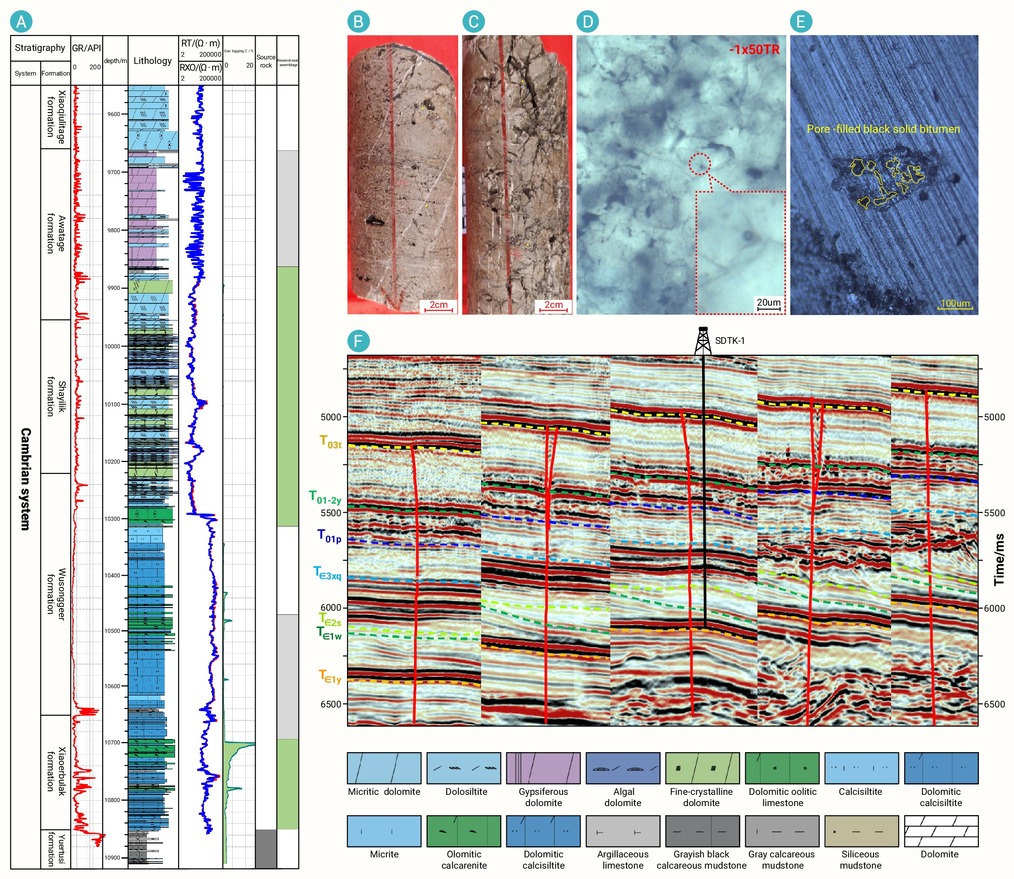
Figure 1.
High-resolution seismic profile, representative ultra-deep cores, and hydrocarbon-related microscopic features from the SDTK-1 well
