
Integrated framework for tracking phosphorus flows across human–terrestrial–aquatic interfaces in watersheds
-

-
REFERENCES
[1] Wang S., Li J., Zhang B., et al. (2018). Trophic state assessment of global inland waters using a MODIS-derived Forel-Ule index. Remote Sens. of Environ. 217:444−460. DOI:10.1016/j.rse.2018.08.026 [2] Liu W., Qin T., Wu M., et al. (2023). Analyzing the phosphorus flow characteristics in the largest freshwater lake (Poyang Lake) watershed of China from 1950 to 2020 through a bottom-up approach of watershed-scale phosphorus substance flow model. Water Res. 245:120546. DOI:10.1016/j.watres.2023.120546 [3] Yuan Z., Jiang S., Sheng H., et al. (2018). Human perturbation of the global phosphorus cycle: Changes and consequences. Environ. Sci. Technol. 52:2438−2450. DOI:10.1021/acs.est.7b03910 [4] Bian Z., Pan S., Sun G., et al. (2026). Extreme precipitation reshapes nutrient flows and balance in North America's largest river basin. Sci. Adv. 12. eaea3260. DOI:10.1126/sciadv.aea3260 [5] Tian Y., Shi C., Malo C. U., et al. (2023). Long-term soil warming decreases microbial phosphorus utilization by increasing abiotic phosphorus sorption and phosphorus losses. Nat. Commun. 14:864. DOI:10.1038/s41467-023-36527-8 -
ABOUT THIS ARTICLE
Cite this article:
Yang L., Yang W., Sun Y., et al. (2026). Integrated framework for tracking phosphorus flows across human–terrestrial–aquatic interfaces in watersheds. The Innovation Geoscience 4:100246. https://doi.org/10.59717/j.xinn-geo.2026.100246
Welcome!
To request copyright permission to republish or share portions of our works, please visit Copyright Clearance Center's (CCC) Marketplace website at marketplace.copyright.com.
Export File
Citation
Yang L., Yang W., Sun Y., et al. (2026). Integrated framework for tracking phosphorus flows across human–terrestrial–aquatic interfaces in watersheds. The Innovation Geoscience 4:100246. https://doi.org/10.59717/j.xinn-geo.2026.100246

Format
Content
 DownLoad:
-
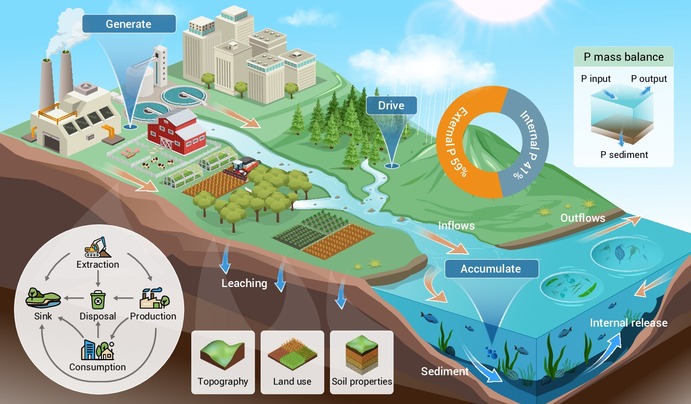
Figure 1.
Conceptual diagram of the P flows “Generate–Drive–Accumulate” framework in the watershed.
