
-
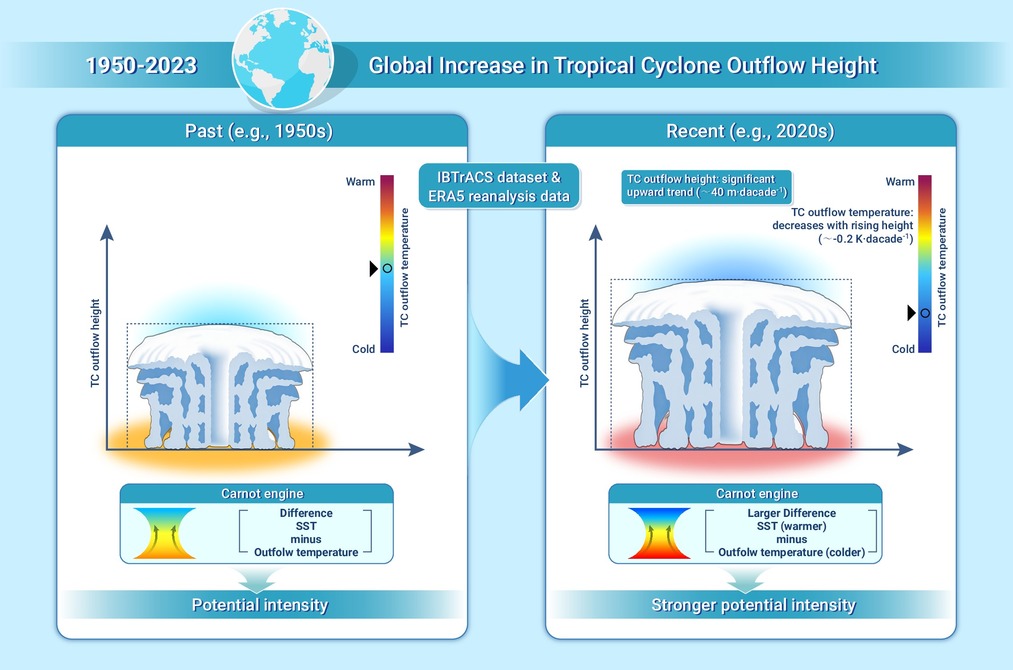
GRAPHICAL ABSTRACT
 DownLoad:
Full size image
DownLoad:
Full size image
-
PUBLIC SUMMARY
-
Global tropical cyclone (TC) outflow height has risen significantly over 74 years.
Anthropogenic forcing, not natural variability, is the primary cause of increasing TC outflow height.
Rising outflow height cools the outflow layer, indirectly enhancing TC potential intensity under warming.
-
-
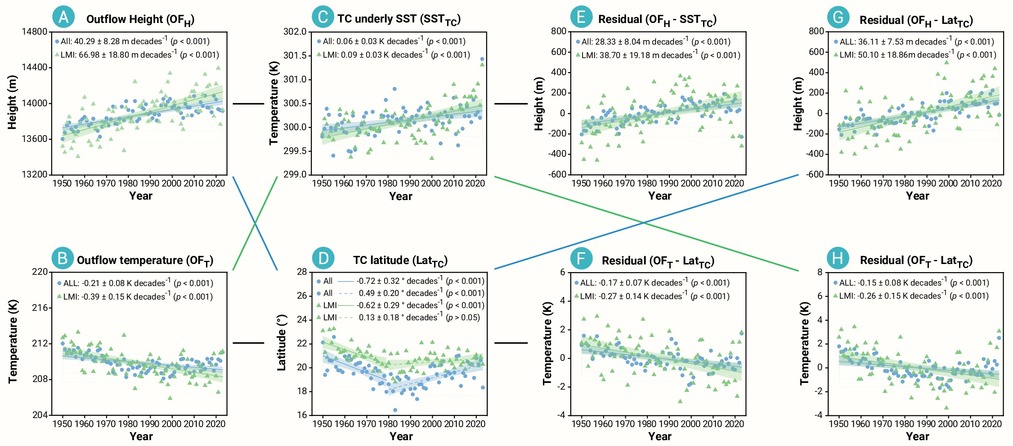
ABSTRACT
Compared to air–sea interactions, relatively little is known about the impact of global warming on tropical cyclone (TC) outflow environment, even though it makes an important contribution to TC intensity. Here we present a global trend analysis of TC outflow height for 1950–2023 based on the IBTrACS and ERA5 data. TC outflow height has increased globally by 40.29 ± 8.28 m·decade-1, and all six basins exhibit notable upward trends beyond natural variability, likely due to global warming. The increase in TC outflow height leads to decreased outflow temperature (-0.21 ± 0.08 K·decade-1), thereby indirectly enhancing TC potential intensity (PI). The contributions of TC outflow environment change to TC PI variations were quantitatively assessed. Under global warming, TC outflow height is expected to continue increasing, potentially leading to significant changes in TC outflow environment and ultimately driving an increase in future TC intensity.-
Keywords:
- tropical cyclone /
- outflow height /
- global warming /
- global trend /
- potential intensity
-

-
REFERENCES
[1] Emanuel K. (2005). Increasing destructiveness of tropical cyclones over the past 30 years. Nature 436:686−688. DOI:10.1038/nature03906 [2] Patricola C.M., Cassidy D.J. and Klotzbach P.J. (2022). Tropical oceanic influences on observed global tropical cyclone frequency. Geophys. Res. Lett. 49:e2022GL099354. DOI:10.1029/2022GL099354 [3] Huang P., Lin I.I., Chou C., et al. (2015). Change in ocean subsurface environment to suppress tropical cyclone intensification under global warming. Nat. Commun. 6:7188. DOI:10.1038/ncomms8188 [4] Kossin J.P., Emanuel K.A. and Vecchi G.A. (2014). The poleward migration of the location of tropical cyclone maximum intensity. Nature 509:349−352. DOI:10.1038/nature13278 [5] Xu J., Zhao P., Chan J.C.L., et al. (2024). Increasing tropical cyclone intensity in the western North Pacific partly driven by warming Tibetan Plateau. Nat. Commun. 15:310. DOI:10.1038/s41467-023-44403-8 [6] Peduzzi P., Chatenoux B., Dao H., et al. (2012). Global trends in tropical cyclone risk. Nat. Clim. Change 2:289−294. DOI:10.1038/NCLIMATE1410 [7] Bryan G.H. and Rotunno R. (2009). The maximum intensity of tropical cyclones in axisymmetric numerical model simulations. Mon. Weather Rev. 137:1770−1789. DOI:10.1175/2008MWR2709.1 [8] Camargo S.J. and Wing A.A. (2016). Tropical cyclones in climate models. Wiley Interdiscip. Rev. Clim. Change 7:211−237. DOI:10.1002/wcc.373 [9] Knutson T.R., Sirutis J.J., Garner S.T., et al. (2008). Simulated reduction in Atlantic hurricane frequency under twenty-first-century warming conditions. Nat. Geosci. 1:359−364. DOI:10.1038/ngeo202 [10] Sobel A.H., Camargo S.J., Hall T.M., et al. (2016). Human influence on tropical cyclone intensity. Science 353:242−246. DOI:10.1126/science.aaf6574 [11] Emanuel K.A. (1986). An air-sea interaction theory for tropical cyclones. Part I: Steady-state maintenance. J. Atmos. Sci. 43:585−605. DOI:2.0.CO;2">10.1175/1520-0469(1986)043<0585:AASITF>2.0.CO;2 [12] Shimada U., Sawada M. and Yamada H. (2016). Evaluation of the accuracy and utility of tropical cyclone intensity estimation using single ground-based Doppler radar observations. Mon. Weather Rev. 144:1823−1840. DOI:10.1175/MWR-D-15-0254.1 [13] Emanuel K., Solomon S., Folini D., et al. (2013). Influence of tropical tropopause layer cooling on Atlantic hurricane activity. J. Clim. 26:2288−2301. DOI:10.1175/JCLI-D-12-00242.1 [14] Wing A.A., Emanuel K. and Solomon S. (2015). On the factors affecting trends and variability in tropical cyclone potential intensity. Geophys. Res. Lett. 42:8669−8677. DOI:10.1002/2015GL066145 [15] Trabing B.C., Bell M.M. and Brown B.R. (2019). Impacts of radiation and upper-tropospheric temperatures on tropical cyclone structure and intensity. J. Atmos. Sci. 76:135−153. DOI:10.1175/JAS-D-18-0165.1 [16] Emanuel K. and Rotunno R. (2011). Self-stratification of tropical cyclone outflow. Part I: Implications for storm structure. J. Atmos. Sci. 68:2236−2249. DOI:10.1175/JAS-D-10-05024.1 [17] Komaromi W.A. and Doyle J.D. (2017). Tropical cyclone outflow and warm core structure as revealed by HS3 dropsonde data. Mon. Weather Rev. 145:1339−1359. DOI:10.1175/MWR-D-16-0172.1 [18] Merrill R.T. and Velden C.S. (1996). A three-dimensional analysis of the outflow layer of Supertyphoon Flo (1990). Mon. Weather Rev. 124:47−63. DOI:2.0.CO;2">10.1175/1520-0493(1996)124<0047:ATDAOT>2.0.CO;2 [19] He C. and Zhou W. (2020). Different enhancement of the East Asian summer monsoon under global warming and interglacial epochs simulated by CMIP6 models: Role of the subtropical high. J. Clim. 33:9721−9733. DOI:10.1175/JCLI-D-20-0304.1 [20] Knapp K.R., Kruk M.C., Levinson D.H., et al. (2010). The international best track archive for climate stewardship (IBTrACS) unifying tropical cyclone data. Bull. Am. Meteorol. Soc. 91:363−376. DOI:10.1175/2009BAMS2755.1 [21] Hersbach H., Bell B., Berrisford P., et al. (2020). The ERA5 global reanalysis. Q. J. R. Meteorol. Soc. 146:1999−2049. DOI:10.1002/qj.3803 [22] Nakamura R. and Mäll M. (2021). Pseudo global warming sensitivity experiments of subtropical cyclone Anita (2010) under RCP 8.5 scenario. J. Geophys. Res. Atmos. 126:e2021JD035261. DOI:10.1029/2021JD035261 [23] Vidale P.L., Hodges K., Vannière B., et al. (2021). Impact of stochastic physics and model resolution on the simulation of tropical cyclones in climate GCMs. J. Clim. 34:4315−4341. DOI:10.1175/JCLI-D-20-0507.1 [24] Sun Y., Zhong Z., Li T., et al. (2017). Impact of ocean warming on tropical cyclone track over the western North Pacific: A numerical investigation based on two case studies. J. Geophys. Res. Atmos. 122:8617−8630. DOI:10.1002/2017JD026959 [25] Neu U., Akperov M.G., Bellenbaum N., et al. (2013). A community effort to intercompare extratropical cyclone detection and tracking algorithms: Assessing method-related uncertainties. Bull. Am. Meteorol. Soc. 94:529−547. DOI:10.1175/BAMS-D-11-00154.1 [26] Shi J., Feng X., Toumi R., et al. (2024). Global increase in tropical cyclone ocean surface waves. Nat. Commun. 15:174. DOI:10.1038/s41467-023-43532-4 [27] Hodges K., Cobb A. and Vidale P.L. (2017). How well are tropical cyclones represented in reanalysis datasets. J. Clim. 30:5243−5264. DOI:10.1175/JCLI-D-16-0557.1 [28] Chen B.F., Davis C.A. and Kuo Y.H. (2021). Examination of the combined effect of deep-layer vertical shear direction and lower-tropospheric mean flow on tropical cyclone intensity and size based on the ERA5 reanalysis. Mon. Weather Rev. 149:4057−4076. DOI:10.1175/MWR-D-21-0120.1 [29] Klotzbach P.J. and Oliver E.C.J. (2015). Variations in global tropical cyclone activity and the Madden-Julian Oscillation since the midtwentieth century. Geophys. Res. Lett. 42:4199−4207. DOI:10.1002/2015GL063966 [30] Camargo S.J., Robertson A.W., Gaffney S.J., et al. (2007). Cluster analysis of typhoon tracks. Part II: Large-scale circulation and ENSO. J. Clim. 20:3654−3676. DOI:10.1175/JCLI4203.1 [31] Li S., Mei W. and Xie S.P. (2022). Effects of tropical sea surface temperature variability on Northern Hemisphere tropical cyclone genesis. J. Clim. 35:4719−4739. DOI:10.1175/JCLI-D-21-0084.1 [32] Patricola C.M., Cassidy D.J. and Klotzbach P.J. (2022). Tropical oceanic influences on observed global tropical cyclone frequency. Geophys. Res. Lett. 49:e2022GL099354. DOI:10.1029/2022GL099354 [33] Mazza E. and Chen S.S. (2023). Modulation of tropical cyclone tracks and rainfall by the North Atlantic Oscillation. J. Geophys. Res. Atmos. 128:e2022JD038107. DOI:10.1029/2022JD038107 [34] Klotzbach P.J. and Gray W.M. (2008). Multidecadal variability in North Atlantic tropical cyclone activity. J. Clim. 21:3929−3935. DOI:10.1175/2008JCLI2162.1 [35] Saji N.H., Goswami B.N., Vinayachandran P.N., et al. (1999). A dipole mode in the tropical Indian Ocean. Nature 401:360−363. DOI:10.1038/43854 [36] Xie S.P., Hu K., Hafner J., et al. (2009). Indian Ocean capacitor effect on Indo-western Pacific climate during the summer following El Niño. J. Clim. 22:730−747. DOI:10.1175/2008JCLI2544.1 [37] Park C.H., Choi J., Son S.W., et al. (2023). Sub-seasonal variability of ENSO teleconnections in Western North America and its prediction skill. J. Geophys. Res. Atmos. 128:e2022JD037985. DOI:10.1029/2022JD037985 [38] Mao R., Gong D.Y., Yang J., et al. (2013). Is there a linkage between the tropical cyclone activity in the southern Indian Ocean and the Antarctic Oscillation. J. Geophys. Res. Atmos. 118:8519−8535. DOI:10.1002/jgrd.50666 [39] Emanuel K.A. (1995). Sensitivity of tropical cyclones to surface exchange coefficients and a revised steady-state model incorporating eye dynamics. J. Atmos. Sci. 52:3969−3976. DOI:2.0.CO;2">10.1175/1520-0469(1995)052<3969:SOTCTS>2.0.CO;2 [40] Bister M. and Emanuel K.A. (2002). Low frequency variability of tropical cyclone potential intensity 2. Climatology for 1982–1995. J. Geophys. Res. Atmos. 107:ACL 5-1-4. DOI:10.1029/2001JD000780 [41] Bister M. and Emanuel K.A. (2002). Low frequency variability of tropical cyclone potential intensity 1. Interannual to interdecadal variability. J. Geophys. Res. Atmos. 107:ACL 26-1-15. DOI:10.1029/2001JD000776 [42] Gu L., Yin J., Gentine P., et al. (2023). Large anomalies in future extreme precipitation sensitivity driven by atmospheric dynamics. Nat. Commun. 14:3197. DOI:10.1038/s41467-023-39039-7 [43] Norris J., Chen G. and Neelin J.D. (2019). Thermodynamic versus dynamic controls on extreme precipitation in a warming climate from the community Earth system model large ensemble. J. Clim. 32:1025−1045. DOI:10.1175/JCLI-D-18-0302.1 [44] Shi L., Olabarrieta M., Nolan D.S., et al. (2020). Tropical cyclone rainbands can trigger meteotsunamis. Nat. Commun. 11:678. DOI:10.1038/s41467-020-14423-9 [45] Bell M.M. and Montgomery M.T. (2008). Observed structure, evolution, and potential intensity of category 5 Hurricane Isabel (2003) from 12 to 14 September. Mon. Weather Rev. 136:2023−2046. DOI:10.1175/2007MWR1858.1 [46] Kieu C., Zhao M., Tan Z., et al. (2023). On the role of sea surface temperature in the clustering of global tropical cyclone formation. J. Clim. 36:3145−3162. DOI:10.1175/JCLI-D-22-0623.1 [47] Yu J. and Wang Y. (2009). Response of tropical cyclone potential intensity over the north Indian Ocean to global warming. Geophys. Res. Lett. 36:L03709. DOI:10.1029/2008GL036742 [48] Klotzbach P.J. and Oliver E.C.J. (2015). Variations in global tropical cyclone activity and the Madden-Julian Oscillation since the midtwentieth century. Geophys. Res. Lett. 42:4199−4207. DOI:10.1002/2015GL063966 [49] Done J.M., Lackmann G.M. and Prein A.F. (2022). The response of tropical cyclone intensity to changes in environmental temperature. Weather Clim. Dyn. 3:693−711. DOI:10.5194/wcd-3-693-2022 [50] Vecchi G.A. and Soden B.J. (2007). Effect of remote sea surface temperature change on tropical cyclone potential intensity. Nature 450:1066−1070. DOI:10.1038/nature06423 [51] Vecchi G.A., Fueglistaler S., Held I.M., et al. (2013). Impacts of atmospheric temperature trends on tropical cyclone activity. J. Clim. 26:3877−3891. DOI:10.1175/JCLI-D-12-00503.1 [52] Guan S., Huang M., Cai W., et al. (2026). Weak self-induced cooling of tropical cyclones amid fast sea surface warming. Nat. Geosci. 19:153–158. DOI:10.1038/s41561-025-01879-x -
ABOUT THIS ARTICLE
Cite this article:
Feng Z., Sun Y., Zhong W., et al. (2026). Global increase in tropical cyclone outflow height. The Innovation Geoscience 4:100248. https://doi.org/10.59717/j.xinn-geo.2026.100248
Welcome!
To request copyright permission to republish or share portions of our works, please visit Copyright Clearance Center's (CCC) Marketplace website at marketplace.copyright.com.
Export File
Citation
Feng Z., Sun Y., Zhong W., et al. (2026). Global increase in tropical cyclone outflow height. The Innovation Geoscience 4:100248. https://doi.org/10.59717/j.xinn-geo.2026.100248

Format
Content
-
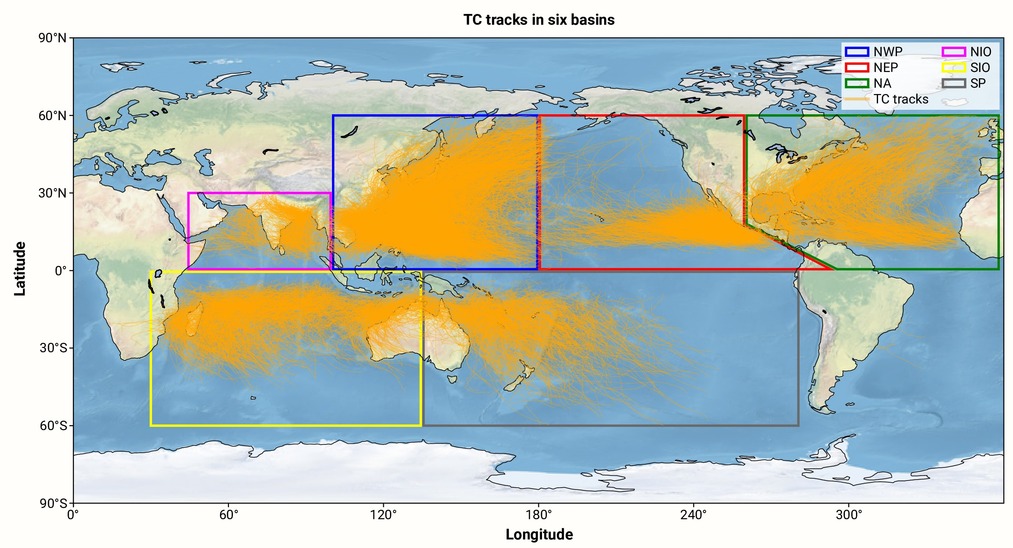
Figure 1.
TC tracks in the six basins. The tracks are based on the IBTrACS dataset and the ERA5 reanalysis data from 1950 to 2023.
-
Figure 2.
Temporal trends in TC outflow height and temperature from 1950 to 2023
-
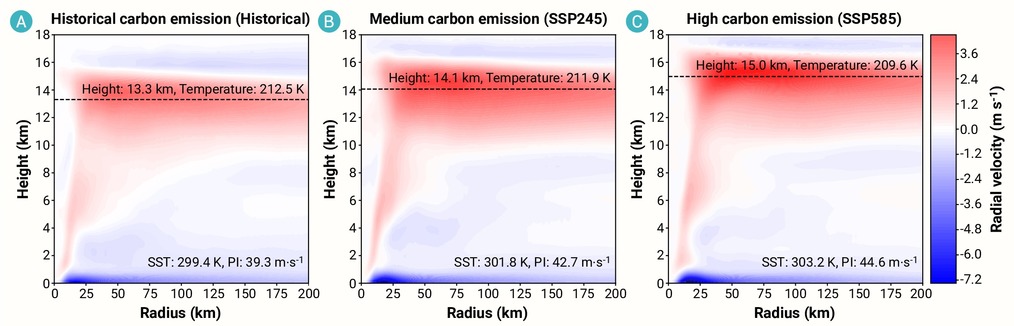
Figure 3.
Azimuthal-averaged TC structures in the three carbon emission experiments
-
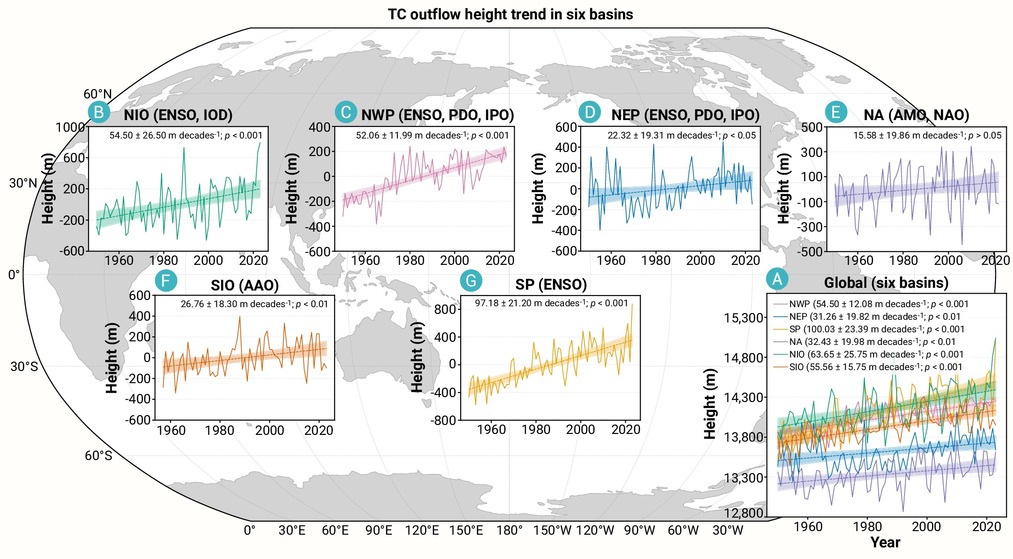
Figure 4.
Temporal trends in TC outflow height from 1950 to 2023
-
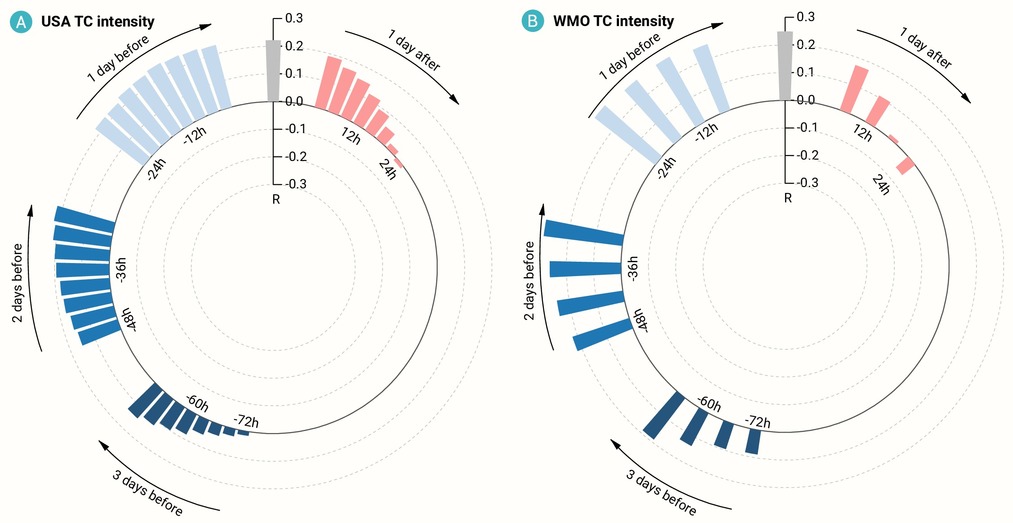
Figure 5.
Correlation coefficients for antecedent and consequent variations in TC outflow height and TC intensity
