
Land footprints of the food system reveal telecoupled biodiversity impacts
-

-
REFERENCES
[1] Yu Y., Feng K. and Hubacek K. (2013). Tele-connecting local consumption to global land use. Global Environ. Chang. 23:1178−1186. DOI:10.1016/j.gloenvcha.2013.04.006 [2] Wiebe R. A. and Wilcove D. S. (2025). Global biodiversity loss from outsourced deforestation. Nature 639:389−394. DOI:10.1038/s41586-024-08569-5 [3] Liu J. (2023). Leveraging the metacoupling framework for sustainability science and global sustainable development. Natl. Sci. Rev. 10:nwad090. DOI:10.1093/nsr/nwad090 [4] Ball T. S., Dales M., Eyres A., et al. (2025). Food impacts on species extinction risks can vary by three orders of magnitude. Nat. Food 6:848−856. DOI:10.1038/s43016-025-01224-w [5] Read Q. D., Hondula K. L. and Muth M. K. (2022). Biodiversity effects of food system sustainability actions from farm to fork. P. Natl. Acad. Sci. USA 119:e2113884119. DOI:10.1073/pnas.2113884119 -
ABOUT THIS ARTICLE
Cite this article:
Zhao J., Li X., Chai L., et al. (2026). Land footprints of the food system reveal telecoupled biodiversity impacts. The Innovation Geoscience 4:100249. https://doi.org/10.59717/j.xinn-geo.2026.100249
Welcome!
To request copyright permission to republish or share portions of our works, please visit Copyright Clearance Center's (CCC) Marketplace website at marketplace.copyright.com.
Export File
Citation
Zhao J., Li X., Chai L., et al. (2026). Land footprints of the food system reveal telecoupled biodiversity impacts. The Innovation Geoscience 4:100249. https://doi.org/10.59717/j.xinn-geo.2026.100249

Format
Content
 DownLoad:
-
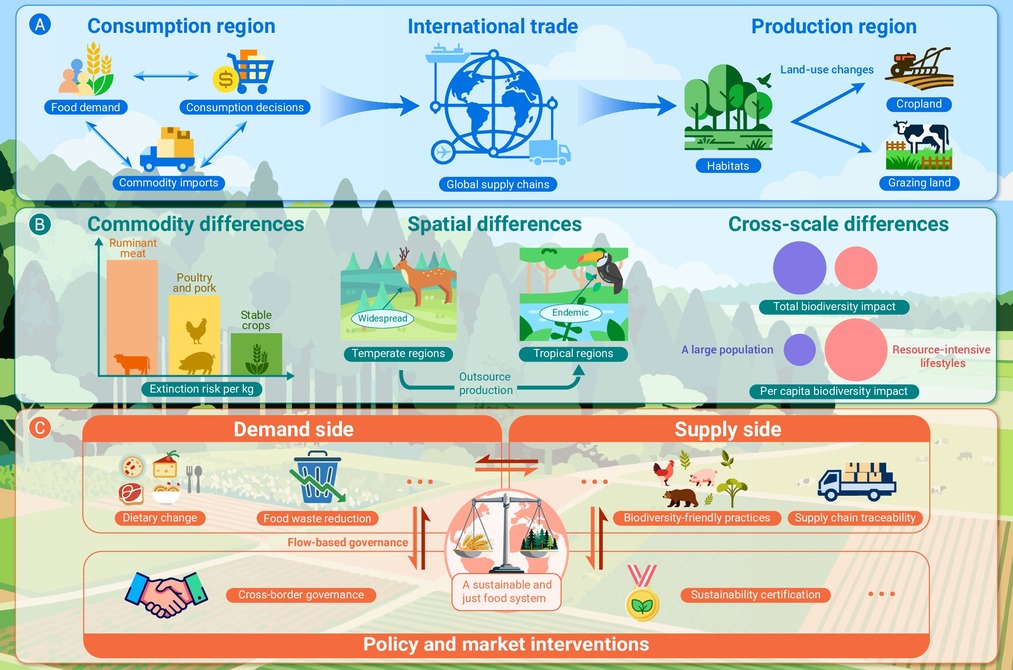
Figure 1.
Schematic diagram of telecoupled land footprints and biodiversity impacts in the global food system
