
A trustworthy AI-empowered framework for low-altitude system-of-systems safety
-

-
REFERENCES
[1] Wang K. and Qu X. (2023). Urban aerial mobility: Reshaping the future of urban transportation. The Innovation 4:100392. DOI:10.1016/j.xinn.2023.100392 [2] Lal B., Calvin K., Barbier C., et al. (2022). NASA's responsible AI plan (No. NASA/TM-20220013225). NASA. https://ntrs.nasa.gov/citations/2022001347 [3] Song M., Lin Y., Wang J., et al. (2025). Trustworthy intelligent networks for low-altitude economy. IEEE Commun. Mag. 63:72−79. DOI:10.1109/MCOM.001.2400692 [4] Wing D., Lacher A., Ryan W., et al. (2022). Digital flight: A new cooperative operating mode to complement VFR and IFR (No. NASA/TM-20220013225). NASA. https://ntrs.nasa.gov/citations/20220013225 [5] Li D., Yao A., Feng K., Zhou H., et al. (2025). Next frontiers of aviation safety: System-of-systems safety. Eng J. 52:262−277. DOI:10.1016/j.eng.2025.01.002 -
ABOUT THIS ARTICLE
Cite this article:
Yu J., Wang R., Li S., et al. (2025). A trustworthy AI-empowered framework for low-altitude system-of-systems safety. The Innovation Informatics 1:100009. https://doi.org/10.59717/j.xinn-inform.2025.100009
Welcome!
To request copyright permission to republish or share portions of our works, please visit Copyright Clearance Center's (CCC) Marketplace website at marketplace.copyright.com.
Export File
Citation
Yu J., Wang R., Li S., et al. (2025). A trustworthy AI-empowered framework for low-altitude system-of-systems safety. The Innovation Informatics 1:100009. https://doi.org/10.59717/j.xinn-inform.2025.100009

Format
Content
 DownLoad:
-
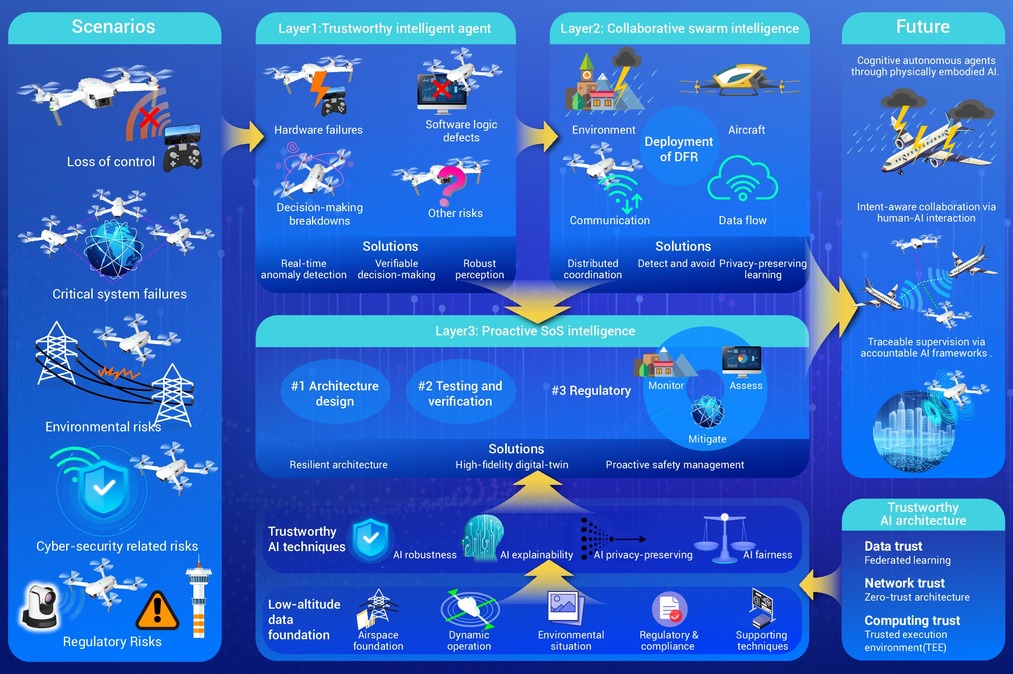
Figure 1.
Trustworthy AI conception for low-altitude system-of-systems safety.
