
Biomedical AI: Evolving from digital to physical and biological intelligence
-
ABSTRACT
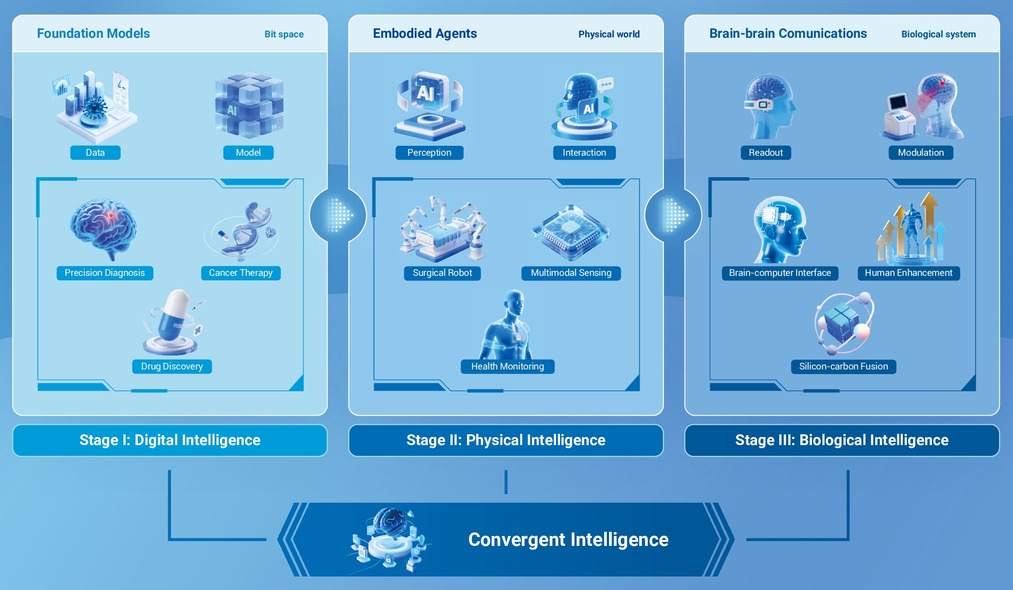
Biomedical artificial intelligence (AI) is advancing toward integrated systems that bridge the digital, physical, and biological domains. What emerges from the convergence of these realms? This perspective article outlines the evolution of biomedical AI from digital models trained on vast biomedical datasets, to physically intelligent systems such as surgical robots that interact with and learn from their environments, and further toward biological intelligence that enables direct communication between human brains and AI. We explore how foundation models, physical embodiment, and brain-brain communications open new possibilities in predictive medicine and personalized intervention. These advances point toward a future in which AI not only comprehends biological processes but also actively collaborates with them, ushering in an era of proactive healthcare where diseases can be prevented, lifelong health maintained, and human capabilities enhanced through the convergence of digital, physical, and biological intelligence. -

-
REFERENCES
[1] Acosta J.N., Falcone G.J., Rajpurkar P., et al. (2022). Multimodal biomedical AI. Nat. Med. 28:1773−1784. DOI:10.1038/s41591-022-01981-2 [2] Thirunavukarasu A.J., Ting D.S.J., Elangovan K., et al. (2023). Large language models in medicine. Nat. Med. 29:1930−1940. DOI:10.1038/s41591-023-02448-8 [3] Xiang J., Wang X., Zhang X., et al. (2025). A vision-language foundation model for precision oncology. Nature 638:769−778. DOI:10.1038/s41586-024-08378-w [4] Gao S., Fang A., Huang Y., et al. (2024). Empowering biomedical discovery with AI agents. Cell 187:6125−6151. DOI:10.1016/j.cell.2024.09.022 [5] Mengaldo G., Renda F., Brunton S.L., et al. (2022). A concise guide to modelling the physics of embodied intelligence in soft robotics. Nat. Rev. Phys. 4:595−610. DOI:10.1038/s42254-022-00481-z [6] Mahato K., Saha T., Ding S., et al. (2024). Hybrid multimodal wearable sensors for comprehensive health monitoring. Nat. Electron. 7:735−750. DOI:10.1038/s41928-024-01247-4 [7] Zheng H., Niu L., Qiu W., et al. (2023). The emergence of functional ultrasound for noninvasive brain-computer interface. Research 6:0200. DOI:10.34133/research.0200 [8] Qiu W., Bouakaz A., Konofagou E.E., et al. (2020). Ultrasound for the brain: A review of physical and engineering principles, and clinical applications. IEEE T. Ultrason. Ferr. 68:6−20. DOI:10.1109/TUFFC.2020.3019932 [9] Liu Z., Wu Y., Xu H., et al. (2025). Multimodal fusion of radio-pathology and proteogenomics identify integrated glioma subtypes with prognostic and therapeutic opportunities. Nat. Commun. 16:3510. DOI:10.1038/s41467-025-58675-9 [10] Huang T., Xu H., Wang H., et al. (2023). Artificial intelligence for medicine: Progress, challenges, and perspectives. Innov. Medicine 1:100030. DOI:10.59717/j.xinn-med.2023.100030 -
ABOUT THIS ARTICLE
Cite this article:
Li Z.-C., Qin W., Liang D., et al. (2025). Biomedical AI: Evolving from digital to physical and biological intelligence. The Innovation Informatics 1:100010. https://doi.org/10.59717/j.xinn-inform.2025.100010
Welcome!
To request copyright permission to republish or share portions of our works, please visit Copyright Clearance Center's (CCC) Marketplace website at marketplace.copyright.com.
Export File
Citation
Li Z.-C., Qin W., Liang D., et al. (2025). Biomedical AI: Evolving from digital to physical and biological intelligence. The Innovation Informatics 1:100010. https://doi.org/10.59717/j.xinn-inform.2025.100010

Format
Content
 DownLoad:
-
Figure 1.
The evolution of biomedical AI from digital to physical and biological intelligence.
