
-
GRAPHICAL ABSTRACT
 DownLoad:
Full size image
DownLoad:
Full size image
-
PUBLIC SUMMARY
-
Soft robot design is challenging as the materials, actuation and control patterns differ from rigid robots.
Methodologies including forward biomimetic methods and inverse morphological computations are reviewed.
Challenges and perspectives on morphological design of soft robots for new application scenarios are given.
-
-
ABSTRACT
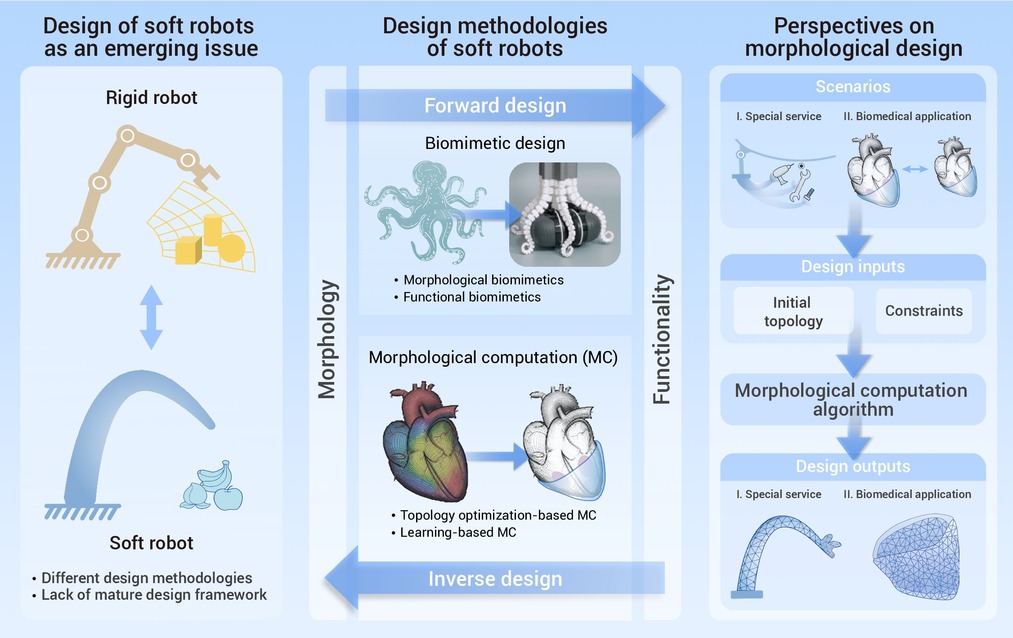
Over the past decade, robots have gradually extended from rigid robots to soft robots regarding the morphology. Because of their good environmental adaptability, dexterous flexibility, and functional characteristics, soft robots have shown good potentials in application scenarios such as special services and biomedical applications. Traditional design methodologies for rigid robots, which typically proceed from functional requirements to mechanism and joints and then to sensing and actuations, are difficult to apply directly to soft robots because of the different materials, morphologies, actuations and control patterns. In contrast, the morphological design of soft robots must consider the properties of soft materials, the continuum-level infinite degrees of freedom, actuation and control patterns, which make the morphological design of soft robots a new and challenging issue. Although studies on soft robots have been frequently reported in recent years, a mature framework of the design methods has not yet been given. Therefore, this survey aims to construct a systematic framework of morphological design methodologies of soft robots. In this survey, existing morphological design methods are divided into two categories, forward design using biomimetic methods and inverse design using morphological computation, and each category is introduced respectively with subcategories. The survey also analyzes the challenges of design of soft robots for new applications. As a perspective, a framework of morphological computation of soft robots for multi-object manipulation or time-varying object interaction is given to provides a reference for design of soft robots with growing applications in special services or biomedical scenarios. -

-
REFERENCES
[1] Rus D. and Tolley M.T. (2015). Design, fabrication and control of soft robots. Nature 521:467−475. DOI:10.1038/nature14543 [2] Sadeghi A., Del Dottore E., Mondini A., et al. (2020). Passive morphological adaptation for obstacle avoidance in a self-growing robot produced by additive manufacturing. Soft Robot. 7:85−94. DOI:10.1089/soro.2019.0025 [3] Ghazi-Zahedi K., Deimel R., Montúfar G., et al. (2017). Morphological computation: The good, the bad, and the ugly. IROS 2017: 464–469. DOI:10.1109/IROS.2017.8202194 [4] Shorthose O., He L., Albini A., et al. (2021). Design of a multimaterial 3D-printed soft actuator with bi-directional variable stiffness. In Fox, C., Gao, J., Ghalamzan Esfahani, A., et al. (eds), TAROS 13054:238–248. Springer International Publishing. DOI:10.1007/978-3-030-89177-0_25 [5] Armanini C., Boyer F., Mathew A.T., et al. (2023). Soft robots modeling: A structured overview. IEEE Trans. Robot. 39:1728−1748. DOI:10.1109/TRO.2022.3231360 [6] Joshi S. and Paik J. (2021). Pneumatic supply system parameter optimization for soft actuators. Soft Robot. 8:152−163. DOI:10.1089/soro.2019.0134 [7] Chen F. and Wang M.Y. (2020). Design optimization of soft robots: A review of the state of the art. IEEE Robot. Autom. Mag. 27:27−43. DOI:10.1109/MRA.2020.3024280 [8] Johnson C., Philippides A. and Husbands P. (2019). Simulating soft-bodied swimmers with particle-based physics. Soft Robot. 6:263−275. DOI:10.1089/soro.2018.0027 [9] Cianchetti M., Laschi C., Menciassi A., et al. (2018). Biomedical applications of soft robotics. Nat. Rev. Mater. 3:143−153. DOI:10.1038/s41578-018-0022-y [10] Li T., Li G., Liang Y., et al. (2017). Fast-moving soft electronic fish. Sci. Adv. 3:e1602045. DOI:10.1126/sciadv.1602045 [11] Qu J., Xu Y., Li Z., et al. (2024). Recent advances on underwater soft robots. Adv. Intell. Syst. 6:2300299. DOI:10.1002/aisy.202300299 [12] Pan F., Liu J., Zuo Z., et al. (2025). Miniature deep-sea morphable robot with multimodal locomotion. Sci. Robot. 10:eadp7821. DOI:10.1126/scirobotics.adp7821 [13] Gu G., Zhang N., Xu H., et al. (2021). A soft neuroprosthetic hand providing simultaneous myoelectric control and tactile feedback. Nat. Biomed. Eng. 7:589−598. DOI:10.1038/s41551-021-00767-0 [14] Kim S., Laschi C. and Trimmer B. (2013). Soft robotics: A bioinspired evolution in robotics. Trends Biotechnol. 31:287−294. DOI:10.1016/j.tibtech.2013.03.002 [15] George Thuruthel T., Ansari Y., Falotico E., et al. (2018). Control strategies for soft robotic manipulators: A survey. Soft Robot. 5:149−163. DOI:10.1089/soro.2017.0007 [16] Pinskier J. and Howard D. (2022). From bioinspiration to computer generation: Developments in autonomous soft robot design. Adv. Intell. Syst. 4:2100086. DOI:10.1002/aisy.202100086 [17] Wang Z., Freris N.M., Wei X. (2025). SpiRobs: Logarithmic spiral-shaped robots for versatile grasping across scales. Device 3. DOI:10.1016/j.device.2024.100646 [18] Sheng Y., Nie W., Liu Z., et al. (2025). Biomimetic robotics and intelligence: A survey. SmartBot 1:e12010. DOI:10.1002/smb2.12010 [19] Li G., Chen X., Zhou F., et al. (2021). Self-powered soft robot in the mariana trench. Nature 591:66−71. DOI:10.1038/s41586-020-03153-z [20] Katzschmann R.K., DelPreto J., MacCurdy R., et al. (2018). Exploration of underwater life with an acoustically controlled soft robotic fish. Sci. Robot. 3:eaar3449. DOI:10.1126/scirobotics.aar3449 [21] Galloway K.C., Becker K.P., Phillips B., et al. (2016). Soft robotic grippers for biological sampling on deep reefs. Soft Robot. 3:23−33. DOI:10.1089/soro.2015.0019 [22] Sinatra N.R., Teeple C.B., Vogt D.M., et al. (2019). Ultragentle manipulation of delicate structures using a soft robotic gripper. Sci. Robot. 4:eaax5425. DOI:10.1126/scirobotics.aax5425 [23] Wehner M., Truby R.L., Fitzgerald D.J., et al. (2016). An integrated design and fabrication strategy for entirely soft, autonomous robots. Nature 536:451−455. DOI:10.1038/nature19100 [24] Aubin C.A., Choudhury S., Jerch R., et al. (2019). Electrolytic vascular systems for energy-dense robots. Nature 571:51−57. DOI:10.1038/s41586-019-1313-1 [25] Che J., Yang X., Peng J., et al. (2025). Arc-heating actuated active-morphing insect robots. Nat. Commun. 16:3014. DOI:10.1038/s41467-025-58258-8 [26] Del Dottore E., Mondini A., Rowe N., et al. (2024). A growing soft robot with climbing plant–inspired adaptive behaviors for navigation in unstructured environments. Sci. Robot. 9:eadi5908. DOI:10.1126/scirobotics.adi5908 [27] Umrao S., Tabassian R., Kim J., et al. (2019). MXene artificial muscles based on ionically cross-linked Ti3C2Tx electrode for kinetic soft robotics. Sci. Robot. 4:eaaw7797. DOI:10.1126/scirobotics.aaw7797 [28] Helps T., Romero C., Taghavi M., et al. (2022). Liquid-amplified zipping actuators for micro-air vehicles with transmission-free flapping. Sci. Robot. 7:eabi8189. DOI:10.1126/scirobotics.abi8189 [29] Itahara S., Nishio T., Ishigaki T., et al. (2025). Modeling and control of aerial robot SERPENT: A soft structure incorporated multirotor aerial robot capable of in-flight flexible deformation. ICRA 2025: 6364–6370. DOI: 10.1109/ICRA55743.2025.11128294 [30] Robertson M.A., Efremov F., Paik J. (2019). RoboScallop: A bivalve inspired swimming robot. IEEE Robot. Autom. Lett. 4:2078−2085. DOI:10.1109/LRA.2019.2897144 [31] Fei Y., Wang J., Pang W. (2019). A novel fabric-based versatile and stiffness-tunable soft gripper integrating soft pneumatic fingers and wrist. Soft Robot. 6:1−20. DOI:10.1089/soro.2018.0015 [32] Zhang Y.-F., Zhang N., Hingorani H., et al. (2019). Fast-response, stiffness-tunable soft actuator by hybrid multimaterial 3D printing. Adv. Funct. Mater. 29:1806698. DOI:10.1002/adfm.201806698 [33] Yue T., Lu C., Tang K., et al. (2025). Embodying soft robots with octopus-inspired hierarchical suction intelligence. Sci. Robot. 10:eadr4264. DOI:10.1126/scirobotics.adr4264 [34] Wu P., Wang J. and Fei Y. (2018). The structure, design, and closed-loop motion control of a differential drive soft robot. Soft Robot. 5:71−80 DOI:10.1089/soro.2017.0042 [35] Du Pasquier C., Chen T., Tibbits S., et al. (2019). Design and computational modeling of a 3D printed pneumatic toolkit for soft robotics. Soft Robot. 6:657−663. DOI:10.1089/soro.2018.0095 [36] Wang X., Li S., Chang J.-C., et al. (2024). Multimodal locomotion ultra-thin soft robots for exploration of narrow spaces. Nat. Commun. 15:6296. DOI:10.1038/s41467-024-50598-1 [37] Zhu P., Shang K., Huang Y., et al. (2024). Light-driven amphibious mini soft robot mimicking the locomotion gait of inchworm and water strider. Adv. Intell. Syst. 6:2300466. DOI:10.1002/aisy.202300466 [38] Ching T., Lee J.Z.W., Win S.K.H., et al. (2024). Crawling, climbing, perching, and flying by FiBa soft robots. Sci. Robot. 9:eadk4533. DOI:10.1126/scirobotics.adk4533 [39] Guix M., Mestre R., Patiño T., et al. (2021). Biohybrid soft robots with self-stimulating skeletons. Sci. Robot. 6:eabe7577. DOI:10.1126/scirobotics.abe7577 [40] Park Y.-L., Chen B., Pérez-Arancibia N.O., et al. (2014). Design and control of a bio-inspired soft wearable robotic device for ankle–foot rehabilitation. Bioinspir. Biomim. 9:016007. DOI:10.1088/1748-3182/9/1/016007 [41] Roche E.T., Horvath M.A., Wamala I., et al. (2017). Soft robotic sleeve supports heart function. Sci. Transl. Med. 9:eaaf3925. DOI:10.1126/scitranslmed.aaf3925 [42] Park C., Fan Y., Hager G., et al. (2020). An organosynthetic dynamic heart model with enhanced biomimicry guided by cardiac diffusion tensor imaging. Sci. Robot. 5:eaay9106. DOI:10.1126/scirobotics.aay9106 [43] McMahan W., Chitrakaran V., Csencsits M., et al. (2006). Field trials and testing of the OctArm continuum manipulator. ICRA 2006:2336−2341.DOI: 10.1109/ROBOT.2006.1642051 [44] Trimmer B.A., Lin H.-T., Baryshyan A., et al. (2012). Towards a biomorphic soft robot: Design constraints and solutions. BioRob 2012:599−605.DOI: 10.1109/BioRob.2012.6290698 [45] Sigmund O. (1997). On the design of compliant mechanisms using topology optimization. Mech. Struct. Mach. 25:493−524. DOI:10.1080/08905459708945415 [46] De Souza E.M. and Silva E.C.N. (2020). Topology optimization applied to the design of actuators driven by pressure loads. Struct. Multidiscip. Optim. 61:1763−1786. DOI:10.1007/s00158-019-02421-5 [47] Wang R., Zhang X., Zhu B., et al. (2020). Topology optimization of a cable-driven soft robotic gripper. Struct. Multidiscip. Optim. 62:2749−2763. DOI:10.1007/s00158-020-02619-y [48] Zolfagharian A., Denk M., Kouzani A.Z., et al. (2020). Effects of topology optimization in multimaterial 3D bioprinting of soft actuators. Int. J. Bioprinting 6:260. DOI:10.18063/ijb.v6i2.260 [49] Tian J., Zhao X., Gu X.D., et al. (2020). Designing ferromagnetic soft robots (FerroSoRo) with level-set-based multiphysics topology optimization. ICRA 2020:10067–10074.DOI:10.1109/ICRA40945.2020.9197457 [50] Wang N., Guo H., Chen B., et al. (2019). Design of dielectric elastomer actuator using topology optimization method based on genetic algorithm. Smart Mater. Struct. 28:065013. DOI:10.1088/1361-665X/ab15c6 [51] Zhang H., Kumar A.S., Fuh J.Y.H., et al. (2018). Design and development of a topology-optimized three-dimensional printed soft gripper. Soft Robot. 5:650−661. DOI:10.1089/soro.2017.0058 [52] Krishnakumar A. and Suresh K. (2015). Hinge-free compliant mechanism design via the topological level-set. J. Mech. Des. 137:031406. DOI:10.1115/1.4029335 [53] Liu C.-H., Chen T.-L., Chiu C.-H., et al. (2018). Optimal design of a soft robotic gripper for grasping unknown objects. Soft Robot. 5:452−465. DOI:10.1089/soro.2017.0121 [54] Sigmund O. and Maute K. (2013). Topology optimization approaches. Struct. Multidiscip. Optim. 48:1031−1055. DOI:10.1007/s00158-013-0978-6 [55] Deaton J.D. and Grandhi R.V. (2014). A survey of structural and multidisciplinary continuum topology optimization: Post 2000. Struct. Multidiscip. Optim. 49:1−38. DOI:10.1007/s00158-013-0956-z [56] Rozvany G.I.N. (2009). A critical review of established methods of structural topology optimization. Struct. Multidiscip. Optim. 37:217−237. DOI:10.1007/s00158-007-0217-0 [57] Van Dijk N.P., Maute K., Langelaar M., et al. (2013). Level-set methods for structural topology optimization: A review. Struct. Multidiscip. Optim. 48:437−472. DOI:10.1007/s00158-013-0912-y [58] Huang X. and Xie Y.-M. (2010). A further review of ESO type methods for topology optimization. Struct. Multidiscip. Optim. 41:671−683. DOI:10.1007/s00158-010-0487-9 [59] Kobayashi H., Gholami F., Montgomery S.M., et al. (2024). Computational synthesis of locomotive soft robots by topology optimization. Sci. Adv. 10:eadn6129. DOI:10.1126/sciadv.adn6129 [60] Chen F., Chen S., Wang Y., et al. (2025). Multimaterial soft gripper design with dual-mode pinches for grasping in confined spaces. IEEEASME Trans. Mechatron. 30:1900−1911. DOI:10.1109/TMECH.2024.3422485 [61] Caasenbrood B., Pogromsky A. and Nijmeijer H. (2020). A computational design framework for pressure-driven soft robots through nonlinear topology optimization. RoboSoft 2020: 633–638. DOI: 10.1109/RoboSoft48309.2020.9116010 [62] Hiller J. and Lipson H. (2012). Automatic design and manufacture of soft robots. IEEE Trans. Robot. 28:457−466. DOI:10.1109/TRO.2011.2172702 [63] Chen F., Liu K., Wang Y., et al. (2019). Automatic design of soft dielectric elastomer actuators with optimal spatial electric fields. IEEE Trans. Robot. 35:1150−1165. DOI:10.1109/TRO.2019.2920108 [64] Zhang P., Yan Z., Luo K., et al. (2023). Optimal design of electrode topology of dielectric elastomer actuators based on the parameterized level set method. Soft Robot. 10:106−118. DOI:10.1089/soro.2021.0169 [65] Wang Y., Zhang L., Daynes S., et al. (2018). Design of graded lattice structure with optimized mesostructures for additive manufacturing. Mater. Des. 142:114−123. DOI:10.1016/j.matdes.2018.01.011 [66] Chen Y., Xia Z. and Zhao Q. (2019). Optimal design of soft pneumatic bending actuators subjected to design-dependent pressure loads. IEEEASME Trans. Mechatron. 24:2873−2884. DOI:10.1109/TMECH.2019.2943418 [67] Yao Y., Chen Y., He L., et al. (2023). Design optimization for bellow soft pneumatic actuators in shape-matching. RoboSoft 2023:1–7. DOI:10.1109/RoboSoft55895.2023.10121957 [68] Allaire G. and Jouve F. (2002). Optimal design of micro-mechanisms by the homogenization method. Eur. J. Comput. Mech. 11:405–416. DOI:10.3166/reef.11.405-416 [69] Rozvany G.I.N., Zhou M. and Birker T. (1992). Generalized shape optimization without homogenization. Struct. Optim. 4:250−252. DOI:10.1007/BF01742754 [70] Bendsøe M. P. and Kikuchi N. (1988). Generating optimal topologies in structural design using a homogenization method. Comput. Methods Appl. Mech. Eng. 71:197−224. DOI:10.1016/0045-7825(88)90086-2 [71] Bruyneel M. and Duysinx P. (2005). Note on topology optimization of continuum structures including self-weight. Struct. Multidiscip. Optim. 29:245−256. DOI:10.1007/s00158-004-0484-y [72] Zhao Z. and Zhang X.S. (2021). Design of graded porous bone-like structures via a multi-material topology optimization approach. Struct. Multidiscip. Optim. 64:677−698. DOI:10.1007/s00158-021-02870-x [73] Chi J.-C. and Liu C.-H. (2025). Topology optimization of a soft pneumatic actuator considering design-dependent loads. IEEEASME Trans. Mechatron. 30:2853−2861. DOI:10.1109/TMECH.2025.3562663 [74] Garzon-Hernandez S., Garcia-Gonzalez D., Jérusalem A., et al. (2020). Design of FDM 3D printed polymers: An experimental-modelling methodology for the prediction of mechanical properties. Mater. Des. 188:108414. DOI:10.1016/j.matdes.2019.108414 [75] Yuan C., Wang F., Rosen D.W., et al. (2021). Voxel design of additively manufactured digital material with customized thermomechanical properties. Mater. Des. 197:109205. DOI:10.1016/j.matdes.2020.109205 [76] Hiller J.D. and Lipson H. (2009). Multi material topological optimization of structures and mechanisms. GECCO 2009:1521–1528.DOI:10.1145/1569901.1570105 [77] Stanley K.O. (2007). Compositional pattern producing networks: A novel abstraction of development. Genet. Program. Evolvable Mach. 8:131−162. DOI:10.1007/s10710-007-9028-8 [78] Wang N., Guo H., Chen B., et al. (2019). Design of dielectric elastomer actuator using topology optimization method based on genetic algorithm. Smart Mater. Struct. 28:065013. DOI:10.1088/1361-665X/ab15c6 [79] Wang L., Zheng D., Harker P., et al. (2021). Evolutionary design of magnetic soft continuum robots. Proc. Natl. Acad. Sci. USA 118:e2021922118. DOI:10.1073/pnas.2021922118 [80] Pagoli A., Chapelle F., Corrales-Ramon J.-A., et al. (2020). Design and optimization of a dextrous robotic finger: Incorporating a sliding, rotating, and soft-bending mechanism while maximizing dexterity and minimizing dimensions. IEEE Robot. Autom. Mag. 27:56−64. DOI:10.1109/MRA.2020.3024283 [81] Mannam P., Liu X., Zhao D., et al. (2024). Design and control co-optimization for automated design iteration of dexterous anthropomorphic soft robotic hands. RoboSoft 2024:332−339. DOI:10.48550/arXiv.2403.09933 [82] Querin O.M., Steven G.P. and Xie Y.M. (2000). Evolutionary structural optimisation using an additive algorithm. Finite Elem. Anal. Des. 34:291−308. DOI:10.1016/S0168-874X(99)00044-X [83] Querin O.M., Young V., Steven G.P., et al. (2000). Computational efficiency and validation of bi-directional evolutionary structural optimisation. Comput. Methods Appl. Mech. Eng. 189:559−573. DOI:10.1016/S0045-7825(99)00309-6 [84] Querin O.M., Steven G.P. and Xie Y.M. (1998) Evolutionary structural optimisation (ESO) using a bidirectional algorithm. Eng. Comput. 15:1031–1048. DOI:10.1108/02644409810244129 [85] Xie Y.M. and Steven G.P. (1993). A simple evolutionary procedure for structural optimization. Comput. Struct. 49:885−896. DOI:10.1016/0045-7949(93)90035-C [86] Huang X. and Xie Y.M. (2007). Convergent and mesh-independent solutions for the bi-directional evolutionary structural optimization method. Finite Elem. Anal. Des. 43:1039−1049. DOI:10.1016/j.finel.2007.06.006 [87] Xia L. and Breitkopf P. (2014). Concurrent topology optimization design of material and structure within FE 2 nonlinear multiscale analysis framework. Comput. Methods Appl. Mech. Eng. 278:524−542. DOI:10.1016/j.cma.2014.05.022 [88] Feng Z., Gu P., Zheng M., et al. (2022). Environmental data-driven performance-based topological optimisation for morphology evolution of artificial taihu stone. CDRF 2021:117–128.DOI:10.1007/978-981-16-5983-6_11 [89] Azevedo F.M., Moura M.S., Vicente W.M., et al. (2018). Topology optimization of reactive acoustic mufflers using a bi-directional evolutionary optimization method. Struct. Multidiscip. Optim. 58:2239−2252. DOI:10.1007/s00158-018-2012-5 [90] Li Q., Chen W., Liu S., et al. (2018). Topology optimization design of cast parts based on virtual temperature method. Comput.-Aided Des. 94:28−40. DOI:10.1016/j.cad.2017.08.002 [91] Huang Y., Wu D., Zhang K., et al. (2021). Topological designs of mechanical-electromagnetic integrated laminate metastructure for broadband microwave absorption based on bi-directional evolutionary optimization. Compos. Sci. Technol. 213:108898. DOI:10.1016/j.compscitech.2021.108898 [92] Picelli R., Vicente W.M., Pavanello R. (2015). Bi-directional evolutionary structural optimization for design-dependent fluid pressure loading problems. Eng. Optim. 47:1324−1342. DOI:10.1080/0305215X.2014.963069 [93] Zou J., Feng M., Ding N., et al. (2021). Muscle-fiber array inspired, multiple-mode, pneumatic artificial muscles through planar design and one-step rolling fabrication. Natl. Sci. Rev. 8:nwab048. DOI:10.1093/nsr/nwab048 [94] Xing Y. and Tong L. (2025). A stochastic gradient online learning and prediction method for accelerating structural topology optimization using recurrent neural network. Eng. Struct. 338:120507. DOI:10.1016/j.engstruct.2025.120507 [95] Kim D., Kim S.-H., Kim T., et al. (2021). Review of machine learning methods in soft robotics. PLOS ONE 16:e0246102. DOI:10.1371/journal.pone.0246102 [96] Wang X., Wang B., Pinskier J., et al. (2024). Fin-bayes: A multi-objective bayesian optimization framework for soft robotic fingers. Soft Robot. 11:791−801. DOI:10.1089/soro.2023.0134 [97] Ghoreishi S.F., Sochol R.D., Gandhi D., et al. (2021). Bayesian optimization for design of multi-actuator soft catheter robots. IEEE Trans. Med. Robot. Bionics 3:725−737. DOI:10.1109/TMRB.2021.3098119 [98] Kaczmarski B., Moulton D.E., Goriely A., et al. (2023). Bayesian design optimization of biomimetic soft actuators. Comput. Methods Appl. Mech. Eng. 408:115939. DOI:10.1016/j.cma.2023.115939 [99] Yao Y., He L. and Maiolino P. (2024). SPADA: A toolbox of designing soft pneumatic actuators for shape matching based on surrogate modeling. Robot. Rep. 2:1−14. DOI:10.1089/rorep.2023.0029 [100] Karacakol A.C., Alapan Y., Demir S.O., et al. (2025). Data-driven design of shape-programmable magnetic soft materials. Nat. Commun. 16:2946. DOI:10.1038/s41467-025-58091-z [101] Song J., Yang Y., Peng W., et al. (2024). MorphVAE: Advancing morphological design of voxel-based soft robots with variational autoencoders. Proc. AAAI Conf. Artif. Intell. 38:10368−10376. DOI:10.1609/aaai.v38i9.28904 [102] Wang T.-H., Zheng J., Ma P., et al. (2023). DiffuseBot: Breeding soft robots with physics-augmented generative diffusion models. Adv. Neural Inf. Process. Syst. 36:44398−44423. DOI:10.5555/3666122.3668044 [103] Chen F., Song Z., Chen S., et al. (2023). Morphological design for pneumatic soft actuators and robots with desired deformation behavior. IEEE Trans. Robot. 39:4408−4428. DOI:10.1109/TRO.2023.3323825 -
ABOUT THIS ARTICLE
Cite this article:
Zhang B., Shen J., He Z., et al. (2025). Morphological design methodologies of soft robots. The Innovation Informatics 1:100012. https://doi.org/10.59717/j.xinn-inform.2025.100012
Welcome!
To request copyright permission to republish or share portions of our works, please visit Copyright Clearance Center's (CCC) Marketplace website at marketplace.copyright.com.
Export File
Citation
Zhang B., Shen J., He Z., et al. (2025). Morphological design methodologies of soft robots. The Innovation Informatics 1:100012. https://doi.org/10.59717/j.xinn-inform.2025.100012

Format
Content




-
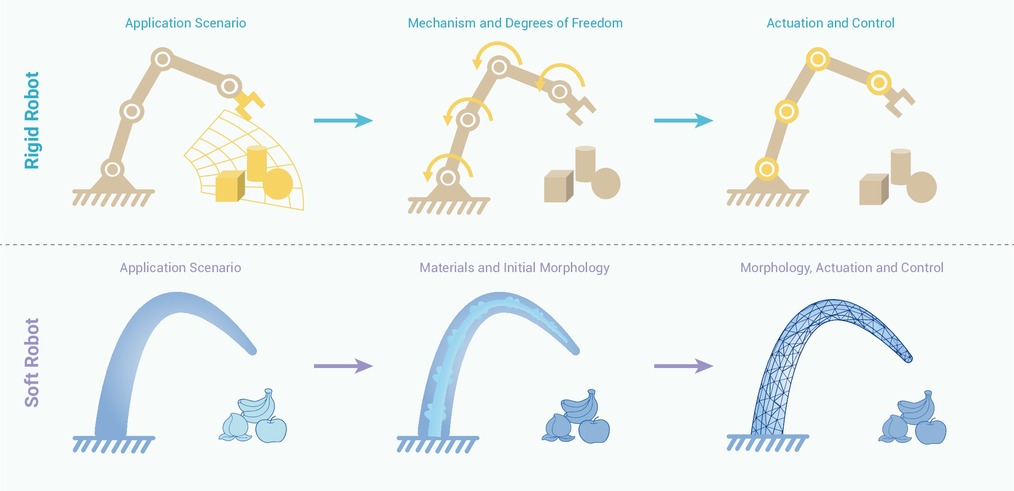
Figure 1.
Comparison of design fundamentals of rigid robot and soft robot.
-
Figure 2.
Conceptual illustration of forward design and inverse design of soft robots.
-
Figure 3.
Overall framework of design methodologies of soft robots.
-
Figure 4.
Morphological biomimetics for soft robot design
-
Figure 5.
Functional biomimetics for soft robot design
-
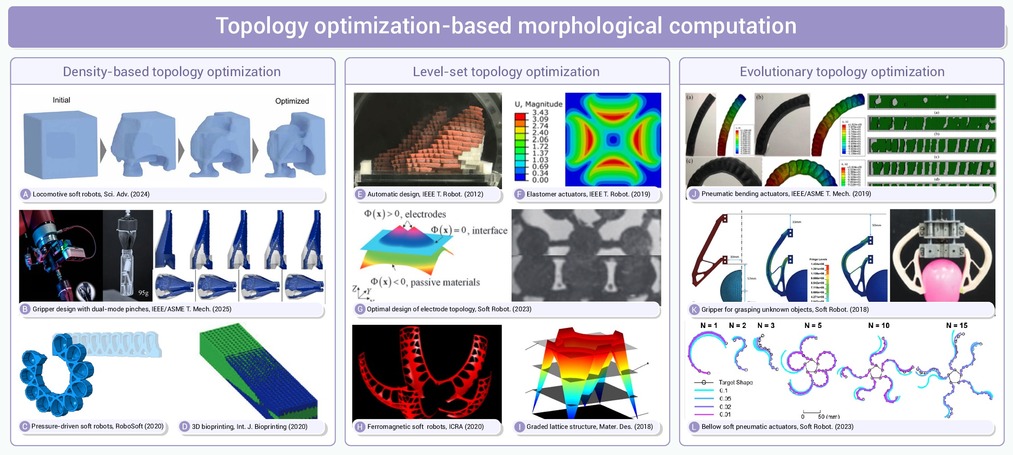
Figure 6.
Topology optimization-based morphological computation for soft robot design
-
Figure 7.
Learning-based morphological computation for soft robot design
-
Figure 8.
A preliminary morphological design of soft robots for new application scenarios for special services or biomedical applications.
