
Accelerating materials discovery through active learning: Methods, challenges and opportunities
-
GRAPHICAL ABSTRACT

 DownLoad:
Full size image
DownLoad:
Full size image
-
PUBLIC SUMMARY
-
Active Learning (AL) selects the most informative experiments to improve models efficiently, saving cost and time.
Under constraints, AL prioritizes knowledge gaps and reduces redundant tests, boosting exploration efficiency.
This review offers an AL framework for interaction, integrating domain know-how and a practical roadmap.
-
-
ABSTRACT
The convergence of large-scale experimentation and computation has transformed materials science into a discipline where data plays a central role. However, the vast design space and high costs of experiments and simulations still slow progress. In contrast to traditional approaches, active learning (AL) identifies which experiments or simulations will provide the most valuable information. This minimizes unnecessary work and cost. By prioritizing the most informative data points, AL enables more efficient and targeted exploration, particularly when resources are limited. This approach accelerates breakthroughs in complex systems, such as superconductors, catalysts, and batteries. This review introduces a framework that categorizes AL in both experimental and computational settings. It highlights the importance of integrating domain knowledge and addresses interpretability challenges. By providing a pragmatic roadmap, it makes a strong case for adopting AL, especially to maximize impact in resource-constrained materials research.To facilitate provide additional details, we have made the supplementary materials available in the repository at https://github.com/kg4sci/awsome-AL.-
Keywords:
- AI for materials science /
- active learning /
- artificial intelligence
-

-
REFERENCES
[1] Batra R., Song L. and Ramprasad R. (2021). Emerging materials intelligence ecosystems propelled by machine learning. Nat. Rev. Mater. 6:655−678. DOI:10.1038/s41578-020-00255-y [2] Gubernatis J. and Lookman T. (2018). Machine learning in materials design and discovery: Examples from the present and suggestions for the future. Phys. Rev. Mater. 2:120301. DOI:10.1103/PhysRevMaterials.2.120301 [3] Liu Y., Zhao T., Ju W., et al. (2017). Materials discovery and design using machine learning. J. Materiomics 3:159−177. DOI:10.1016/j.jmat.2017.08.002 [4] Zheng Y., Xu H., Li Z., et al. (2025). Artificial intelligence-driven approaches in semiconductor research. Adv. Mater. 37:2504378. DOI:10.1002/adma.202504378 [5] Slattery A., Wen Z., Tenblad P., et al. (2024). Automated self-optimization, intensification, and scale-up of photocatalysis in flow. Science 383:eadj1817. DOI:10.1126/science.adj1817 [6] Lookman T., Balachandran P.V., Xue D., et al. (2019). Active learning in materials science with emphasis on adaptive sampling using uncertainties for targeted design. npj Comput. Mater. 5:21. DOI:10.1038/s41524-019-0153-8 [7] Bai X. and Zhang X. (2025). Artificial intelligence-powered materials science. Nano-Micro Lett. 17:135. DOI:10.1007/s40820-024-01634-8 [8] Shahriari B., Swersky K., Wang Z., et al. (2015). Taking the human out of the loop: A review of bayesian optimization. Proc.IEEE 104:148−175. DOI:10.1109/jproc.2015.2494218 [9] Szymanski N.J., Rendy B., Fei Y., et al. (2023). An autonomous laboratory for the accelerated synthesis of novel materials. Nature 624:86−91. DOI:10.1038/s41586-023-06734-w [10] MacLeod B.P., Parlane F.G., Morrissey T.D., et al. (2020). Self-driving laboratory for accelerated discovery of thin-film materials. Sci. Adv. 6:eaaz8867. DOI:10.1126/sciadv.aaz8867 [11] Settles B. (1995). Active learning literature survey. Computer Sci. Tech. Rep.TR1648. http://digital.library.wisc.edu/1793/60660 [12] Schmidt J., Marques M.R., Botti S., et al. (2019). Recent advances and applications of machine learning in solid-state materials science. npj Comput. Mater. 5:83. DOI:10.1038/s41524-019-0221-0 [13] Kumar P. and Gupta A. (2020). Active learning query strategies for classification, regression, and clustering: A survey. J. Comput. Sci. Technol. 35:913−945. DOI:10.1007/s11390-020-9487-4 [14] Saal J.E., Oliynyk A.O. and Meredig B. (2020). Machine learning in materials discovery: confirmed predictions and their underlying approaches. Annu. Rev. Mater. Res. 50:49−69. DOI:10.1146/annurev-matsci-090319-010954 [15] Yunfan W., Yuan T., Yumei Z., et al. (2023). Progress on active learning assisted materials discovery. J. Chin. Ceram. Soc. 51:544−551. DOI:10.14062/j.issn.0454-5648.20220924 [16] Lewis D.D. (1995). A sequential algorithm for training text classifiers: Corrigendum and additional data. ACM SIGIR Forum 29:13−19. DOI:10.1145/219587.219592 [17] Beluch W.H., Genewein T., Nürnberger A., et al. (2018). The power of ensembles for active learning in image classification. CVPR 2018:9368–9377. DOI:10.1109/CVPR.2018.00976 [18] Zhu M., Fan C., Chen H., et al. (2024). Generative active learning for long-tailed instance segmentation. ICML. 2024:62349–62368. DOI:10.48550/arXiv.2406.02435 [19] Zhu J.J. and Bento J. (2017). Generative adversarial active learning.arXiv preprint. DOI:10.48550/arXiv.1702.07956 [20] Liu Y., Li Z., Zhou C., et al. (2019). Generative adversarial active learning for unsupervised outlier detection. IEEE Trans. Knowl. Data Eng. 32:1517−1528. DOI:10.1109/TKDE.2019.2905606 [21] Gui J., Sun Z., Wen Y., et al. (2021). A review on generative adversarial networks: Algorithms, theory, and applications. IEEE Trans. Knowl. Data Eng. 35:3313−3332. DOI:10.1109/TKDE.2021.3130191 [22] Rao Z., Tung P.Y., Xie R., et al. (2022). Machine learning–enabled high-entropy alloy discovery. Science 378:78−85. DOI:10.1126/science.abo4940 [23] Sohail Y., Zhang C., Xue D., et al. (2025). Machine-learning design of ductile FeNiCoAlTa alloys with high strength. Nature 643:119−124. DOI:10.1038/s41586-025-09160-2 [24] Moon J., Beker W., Siek M., et al. (2024). Active learning guides discovery of a champion four-metal perovskite oxide for oxygen evolution electrocatalysis. Nat. Mater. 23:108−115. DOI:10.1038/s41563-023-01707-w [25] Suvarna M., Zou T., Chong S.H., et al. (2024). Active learning streamlines development of high performance catalysts for higher alcohol synthesis. Nat. Commun. 15:5844. DOI:10.1038/s41467-024-50215-1 [26] Merchant A., Batzner S., Schoenholz S.S., et al. (2023). Scaling deep learning for materials discovery. Nature 624:80−85. DOI:10.1038/s41586-023-06735-9 [27] Lee J.A., Park J., Sagong M.J., et al. (2025). Active learning framework to optimize process parameters of additive-manufactured ti-6al-4v with high strength and ductility. Nat. Commun. 16:931. DOI:10.1038/s41467-025-56267-1 [28] Zhang R., Xu J., Zhang H., et al. (2025). Active learning-guided exploration of thermally conductive polymers under strain. Digit. Discov. 4:812−823. DOI:10.1039/D4DD00267A [29] Johnson N.S., Mishra A.A., Kirsch D.J., et al. (2024). Active learning for rapid targeted synthesis of compositionally complex alloys. Materials 17:4038. DOI:10.3390/ma17164038 [30] Verduzco J.C., Marinero E.E. and Strachan A. (2021). An active learning approach for the design of doped llzo ceramic garnets for battery applications. Integr. Mater. Manuf. Innov. 10:299−310. DOI:10.1007/s40192-021-00214-7 [31] Pedersen J.K., Clausen C.M., Krysiak O.A., et al. (2021). Bayesian optimization of high-entropy alloy compositions for electrocatalytic oxygen reduction. Angew. Chem. 133:24346−24354. DOI:10.1002/ange.202108116 [32] Terayama K., Tamura R., Nose Y., et al. (2019). Efficient construction method for phase diagrams using uncertainty sampling. Phys. Rev. Mater. 3:033802. DOI:10.1103/PhysRevMaterials.3.033802 [33] Talapatra A., Boluki S., Duong T., et al. (2018). Autonomous efficient experiment design for materials discovery with bayesian model averaging. Phys. Rev. Mater. 2:113803. DOI:10.1103/PhysRevMaterials.2.113803 [34] Niu X., Chen Y., Sun M., et al. (2025). Bayesian learning-assisted catalyst discovery for efficient iridium utilization in electrochemical water splitting. Sci. Adv. 11:eadw0894. DOI:10.1126/sciadv.eadw0894 [35] Wang G., Mine S., Chen D., et al. (2023). Accelerated discovery of multi-elemental reverse water-gas shift catalysts using extrapolative machine learning approach. Nat. Commun. 14:5861. DOI:10.1038/s41467-023-41341-3 [36] Farache D.E., Verduzco J.C., McClure Z.D., et al. (2022). Active learning and molecular dynamics simulations to find high melting temperature alloys. Comput. Mater. Sci. 209:111386. DOI:10.1016/j.commatsci.2022.111386 [37] Harwani M., Verduzco J.C., Lee B.H., et al. (2025). Accelerating active learning materials discovery with fair data and workflows: A case study for alloy melting temperatures. Comput. Mater. Sci. 249:113640. DOI:10.1016/j.commatsci.2024.113640 [38] Nie S., Xiang Y., Wu L., et al. (2024). Active learning guided discovery of high entropy oxides featuring high h2-production. J. Am. Chem. Soc. 146:29325−29334. DOI:10.1021/jacs.4c06272 [39] Cao B., Su T., Yu S., et al. (2024). Active learning accelerates the discovery of high strength and high ductility lead-free solder alloys. Mater. Des. 241:112921. DOI:10.1016/j.matdes.2024.112921 [40] Jablonka K.M., Jothiappan G.M., Wang S., et al. (2021). Bias free multiobjective active learning for materials design and discovery. Nat. Commun. 12:2312. DOI:10.1038/s41467-021-22437-0 [41] Xu S., Chen Z., Qin M., et al. (2024). Developing new electrocatalysts for oxygen evolution reaction via high throughput experiments and artificial intelligence. npj Comput. Mater. 10:194. DOI:10.1038/s41524-024-01386-4 [42] Behler J. and Parrinello M. (2007). Generalized neural-network representation of high-dimensional potential-energy surfaces. Phys. Rev. Lett. 98:146401. DOI:10.1103/PhysRevLett.98.146401 [43] Smith J.S., Isayev O. and Roitberg A.E. (2017). Ani-1: An extensible neural network potential with dft accuracy at force field computational cost. Chem. Sci. 8:3192−3203. DOI:10.1039/C6SC05720A [44] Liu Y., Kelley K.P., Vasudevan R.K., et al. (2022). Experimental discovery of structure–property relationships in ferroelectric materials via active learning. Nat. Mach. Intell. 4:341−350. DOI:10.1038/s42256-022-00460-0 [45] Bulanadi R., Chowdhury J., Hiroshi F., et al. (2025). Beyond optimization: Exploring novelty discovery in autonomous experiments. arXiv preprint. DOI:10.48550/arXiv.2508.20254 [46] Reiser P., Neubert M., Eberhard A., et al. (2022). Graph neural networks for materials science and chemistry. Commun. Mater. 3:93. DOI:10.1038/s43246-022-00315-6 [47] Chen C., Ye W., Zuo Y., et al. (2019). Graph networks as a universal machine learning framework for molecules and crystals. Chem. Mater. 31:3564−3572. DOI:10.1021/acs.chemmater.9b01294 [48] Gal Y. and Ghahramani Z. (2016). Dropout as a bayesian approximation: Representing model uncertainty in deep learning. PMLR 2016:1050–1059. DOI:10.5555/3045390.3045502 [49] Lakshminarayanan B., Pritzel A. and Blundell C. (2017). Simple and scalable predictive uncertainty estimation using deep ensembles. Adv. Neural Inf. Process. Syst. 30:6405–6416. DOI:10.5555/3295222.3295387 [50] Xie T. and Grossman J.C. (2018). Crystal graph convolutional neural networks for an accurate and interpretable prediction of material properties. Phys. Rev. Lett. 120:145301. DOI:10.1103/PhysRevLett.120.145301 [51] Ge X., Yin J., Ren Z., et al. (2024). Atomic design of alkyne semihydrogenation catalysts via active learning. J. Am. Chem. Soc. 146:4993−5004. DOI:10.1021/jacs.3c14495 [52] Chun H., Lunger J.R., Kang J.K., et al. (2024). Active learning accelerated exploration of single-atom local environments in multimetallic systems for oxygen electrocatalysis. npj Comput. Mater. 10:246. DOI:10.1038/s41524-024-01432-1 [53] Xu W., Diesen E., He T., et al. (2024). Discovering high entropy alloy electrocatalysts in vast composition spaces with multiobjective optimization. J. Am. Chem. Soc. 146:7698−7707. DOI:10.1021/jacs.3c14486 [54] Vasudevan R.K., Kelley K.P., Hinkle J., et al. (2021). Autonomous experiments in scanning probe microscopy and spectroscopy: choosing where to explore polarization dynamics in ferroelectrics. ACS Nano 15:11253−11262. DOI:10.1021/acsnano.0c10239 [55] Ziatdinov M., Liu Y., Kelley K., et al. (2022). Bayesian active learning for scanning probe microscopy: From gaussian processes to hypothesis learning. ACS Nano 16:13492−13512. DOI:10.1021/acsnano.2c05303 [56] Lubbers N., Lookman T. and Barros K. (2017). Inferring low-dimensional microstructure representations using convolutional neural networks. Phys. Rev. E 96:052111. DOI:10.1103/PhysRevE.96.052111 [57] DeCost B.L., Lei B., Francis T., et al. (2019). High throughput quantitative metallography for complex microstructures using deep learning: A case study in ultrahigh carbon steel. Microsc. Microanal. 25:21−29. DOI:10.1017/S1431927618015635 [58] Mozaffari M.H. and Tay L.L. (2021). Raman spectral analysis of mixtures with one-dimensional convolutional neural network. arXiv preprint. DOI:10.48550/arXiv.2106.05316 [59] Szymanski N.J., Bartel C.J., Zeng Y., et al. (2023). Adaptively driven x-ray diffraction guided by machine learning for autonomous phase identification. npj Comput. Mater. 9:31. DOI:10.1038/s41524-023-00984-y [60] Tang W.T., Chakrabarty A. and Paulson J.A. (2024). Beacon: A bayesian optimization strategy for novelty search in expensive black-box systems. arXiv preprint. DOI:10.48550/arXiv.2406.03616 [61] Kingma D.P. and Welling M. (2014). Auto-encoding variational bayes. stat 1050:1. DOI:10.48550/arXiv.1312.6114 [62] Goodfellow I.J., Pouget-Abadie J., Mirza M., et al. (2014). Generative adversarial nets. Adv. Neural Inf. Process. Syst. 27:2672−2680. DOI:10.5555/2969033.2969125 [63] Deb K., Pratap A., Agarwal S., et al. (2002). A fast and elitist multiobjective genetic algorithm: Nsga-ii. IEEE transactions on evolutionary computation 6:182−197. DOI:10.1109/4235.996017 [64] Raju R.K., Sivakumar S., Wang X., et al. (2023). Cluster-mlp: An active learning genetic algorithm framework for accelerated discovery of global minimum configurations of pure and alloy nanoclusters. Chem. Inf. Model 63:6192−6197. DOI:10.1021/acs.jcim.3c01431 [65] Wu S., Hamel C.M., Ze Q., et al. (2020). Evolutionary algorithm-guided voxel-encoding printing of functional hard-magnetic soft active materials. Adv. Intell. Syst. 2:2000060. DOI:10.1002/aisy.202000060 [66] Wolters M.A. (2015). A genetic algorithm for selection of fixed-size subsets with application to design problems. J. Stat. Softw. 68:1−18. DOI:10.18637/jss.v068.c01 [67] Xie T., Fu X., Ganea O., et al. (2022). Crystal diffusion variational autoencoder for periodic material generation. Bull. Am. Phys. Soc. 67. DOI:10.48550/arXiv.2110.06197 [68] Lim J., Ryu S., Kim J.W., et al. (2018). Molecular generative model based on conditional variational autoencoder for de novo molecular design. J. Cheminform. 10:31. DOI:10.1186/s13321-018-0288-5 [69] Xin R., Siriwardane E.M., Song Y., et al. (2021). Active-learning-based generative design for the discovery of wide-band-gap materials. J. Phys. Chem. C 125:16118−16128. DOI:10.1021/acs.jpcc.1c06460 [70] Guo W., Li F., Wang L., et al. (2025). Accelerated discovery of near-zero ablation ultra-high temperature ceramics via gan-enhanced directionally constrained active learning. APM 4:100287. DOI:10.1016/j.apmate.2025.100287 [71] Kim M., Ha M.Y., Jung W.B., et al. (2022). Searching for an optimal multi-metallic alloy catalyst by active learning combined with experiments. Adv. Mater. 34:2108900. DOI:10.1002/adma.202108900 [72] Mok D.H., Li H., Zhang G., et al. (2023). Data-driven discovery of electrocatalysts for co2 reduction using active motifs-based machine learning. Nat. Commun. 14:7303. DOI:10.1038/s41467-023-43118-0 [73] Gómez-Bombarelli R., Aguilera-Iparraguirre J., Hirzel T.D., et al. (2016). Design of efficient molecular organic light-emitting diodes by a high-throughput virtual screening and experimental approach. Nat. Mater. 15:1120−1127. DOI:10.1038/nmat4717 [74] Zhu J.Y., Park T., Isola P., et al. (2017). Unpaired image-to-image translation using cycle-consistent adversarial networks. Proc. IEEE Int. Conf. Comput. Vis. 2017:2223–2232. DOI:10.1109/ICCV.2017.244 [75] Panisilvam J., Hajizadeh E., Weeratunge H., et al. (2023). Asymmetric cyclegans for inverse design of photonic metastructures. APL mach. learn. 1:4. DOI:10.1063/5.0159264 [76] M. Bran A., Cox S., Schilter O., et al. (2024). Augmenting large language models with chemistry tools. Nat. Mach. Intell. 6:525−535. DOI:10.1038/s42256-024-00832-8 [77] Xie T., Wan Y., Liu Y., et al. (2025). Large language models as materials science adapted learners.Res. Square. Preprint. DOI:10.21203/rs.3.rs-6752901/v1 [78] Boiko D.A., MacKnight R., Kline B., et al. (2023). Autonomous chemical research with large language models. Nature 624:570−578. DOI:10.1038/s41586-023-06695-5 [79] Buehler M.J. (2025). Preflexor: Preference-based recursive language modeling for exploratory optimization of reasoning and agentic thinking. npj Artif. Intell. 1:4. DOI:10.1038/s44387-025-00003-z [80] Buehler M.J. (2024). Cephalo: Multi-modal vision-language models for bio-inspired materials analysis and design. Adv. Funct. Mater. 34:2409531. DOI:10.1002/adfm.202409531 [81] Buehler M.J. (2025). In situ graph reasoning and knowledge expansion using graph-preflexor. Adv. intell. discov. 2025:202500006. DOI:10.1002/aidi.202500006 [82] Zhang Y., Han Y., Chen S., et al. (2025). Large language models to accelerate organic chemistry synthesis. Nat. Mach. Intell. 2015:1–13. DOI:10.1038/s42256-025-01066-y [83] Ghafarollahi A. and Buehler M.J. (2024). Protagents: Protein discovery via large language model multi-agent collaborations combining physics and machine learning. Digit. Discov. 3:1389−1409. DOI:10.1039/d4dd00013g [84] Ghafarollahi A. and Buehler M.J. (2025). Sparks: Multi-agent artificial intelligence model discovers protein design principles. arXiv preprint. DOI:10.48550/arXiv.2504.19017 [85] Snoek J., Larochelle H. and Adams R.P. (2012). Practical bayesian optimization of machine learning algorithms. Adv. Neural Inf. Process. Syst. 25:2951–2959. DOI:10.48550/arXiv.1206.2944 [86] Asprion N., Böttcher R., Pack R., et al. (2019). Gray-box modeling for the optimization of chemical processes. Chem. Ing. Tech. 91:305−313. DOI:10.1002/cite.201800086 [87] Psichogios D.C. and Ungar L.H. (1992). A hybrid neural network-first principles approach to process modeling. AIChE J. 38:1499−1511. DOI:10.1002/aic.690381003 [88] Molga E. (2003). Neural network approach to support modelling of chemical reactors: problems, resolutions, criteria of application. Chem. Eng. Process. 42:675−695. DOI:10.1016/S0255-2701(02)00205-2 [89] Ziatdinov M.A., Ghosh A. and Kalinin S.V. (2022). Physics makes the difference: Bayesian optimization and active learning via augmented gaussian process. Mach. Learn.: Sci. Technol. 3:015003. DOI:10.1088/2632-2153/ac5a6b [90] Ladygin V., Beniya I., Makarov E., et al. (2021). Bayesian learning of thermodynamic integration and numerical convergence for accurate phase diagrams. Phys. Rev. B 104:104102. DOI:10.1103/PhysRevB.104.104102 [91] Vela B., Khatamsaz D., Acemi C., et al. (2023). Data-augmented modeling for yield strength of refractory high entropy alloys: A bayesian approach. Acta Mater. 261:119351. DOI:10.1016/j.actamat.2023.119351 [92] Khatamsaz D., Neuberger R., Roy A.M., et al. (2023). A physics informed bayesian optimization approach for material design: Application to niti shape memory alloys. npj Comput. Mater. 9:221. DOI:10.1038/s41524-023-01270-6 [93] Zhao C., Zhang F., Lou W., et al. (2024). A comprehensive review of advances in physics-informed neural networks and their applications in complex fluid dynamics. Phys. Fluids 36:101301. DOI:10.1063/5.0226562 [94] Anagnostopoulos S.J., Toscano J.D., Stergiopulos N., et al. (2025). Learning in pinns: Phase transition, diffusion equilibrium, and generalization. Neural Netw.181:107983. DOI:10.1016/j.neunet.2025.107983 [95] Gebauer N., Gastegger M. and Schütt K. (2019). Symmetry-adapted generation of 3d point sets for the targeted discovery of molecules. Adv. Neural Inf. Process. Syst. 32:7566–7578. DOI:10.48550/arXiv.1906.00957 [96] Xie T., Fu X., Ganea O., et al. (2022). Crystal diffusion variational autoencoder for periodic material generation. Bull. Am. Phys. Soc. 67:S48.003. DOI:10.48550/arXiv.2110.06197 [97] Buehler M.J. (2022). Modeling atomistic dynamic fracture mechanisms using a progressive transformer diffusion model. J. Appl. Mech. 89:121009. DOI:10.1115/1.4055730 [98] Gelbart M.A., Snoek J. and Adams R.P. (2014). Bayesian optimization with unknown constraints. UAI 2014: 250–259. DOI:10.5555/3020751.3020778 [99] Harris S.B., Vasudevan R. and Liu Y. (2025). Active oversight and quality control in standard bayesian optimization for autonomous experiments. npj Comput. Mater. 11:23. DOI:10.1038/s41524-024-01485-2 [100] Sun S., Tiihonen A., Oviedo F., et al. (2021). A data fusion approach to optimize compositional stability of halide perovskites. Matter 4:1305−1322. DOI:10.1016/j.matt.2021.02.004 [101] Liu Z., Rolston N., Flick A.C., et al. (2022). Machine learning with knowledge constraints for process optimization of open-air perovskite solar cell manufacturing. Joule 6:834−849. DOI:10.1016/j.joule.2022.02.011 [102] Kusne A.G., Yu H., Wu C., et al. (2020). On-the-fly closed-loop materials discovery via bayesian active learning. Nat. Commun. 11:5966. DOI:10.1038/s41467-020-19597-w [103] Tian Y., Li T., Pang J., et al. (2025). Materials design with target-oriented bayesian optimization. npj Comput. Mater. 11:209. DOI:10.1038/s41524-025-01704-4 [104] Vlachos A. (2008). A stopping criterion for active learning. Comput. Speech Lang. 22:295−312. DOI:10.1016/j.csl.2007.12.001 [105] Bloodgood M. and Vijay-Shanker K. (2009). A method for stopping active learning based on stabilizing predictions and the need for user-adjustable stopping. CoNLL 39:39–47. DOI:10.48550/arXiv.1409.5165 [106] Ishibashi H. and Hino H. (2020). Stopping criterion for active learning based on deterministic generalization bounds. AISTATS 108:386–397. DOI:10.48550/arXiv.2005.07402 [107] Pullar-Strecker Z., Dost K., Frank E., et al. (2024). Hitting the target: Stopping active learning at the cost-based optimum. Mach. Learn. 113:1529−1547. DOI:10.1007/s10994-022-06253-1 [108] Callaghan M.W. and Müller-Hansen F. (2020). Statistical stopping criteria for automated screening in systematic reviews. Syst. Rev. 9:273. DOI:10.1186/s13643-020-01521-4 [109] Boetje J. and van de Schoot R. (2024). The safe procedure: A practical stopping heuristic for active learning-based screening in systematic reviews and meta-analyses. Syst. Rev. 13:81. DOI:10.1186/s13643-024-02502-7 [110] Sholokhov A., Liu Y., Mansour H., et al. (2023). Physics-informed neural ode (pinode): Embedding physics into models using collocation points. Sci. Rep. 13:10166. DOI:10.1038/s41598-023-36799-6 [111] Qin X., Zhong B., Lv S., et al. (2024). A zero-voltage-writing artificial nervous system based on biosensor integrated on ferroelectric tunnel junction. Adv. Mater. 36:2404026. DOI:10.1002/adma.202404026 [112] Li Z., Xu H., Zheng Y., et al. (2025). A reconfigurable heterostructure transistor array for monocular 3d parallax reconstruction. Nat. Electron. 8:46−55. DOI:10.1038/s41928-024-01261-6 [113] Batzner S., Musaelian A., Sun L., et al. (2022). E (3)-equivariant graph neural networks for data-efficient and accurate interatomic potentials. Nat. Commun. 13:2453. DOI:10.1038/s41467-022-29939-5 [114] Buehler M.J. (2022). Prediction of atomic stress fields using cycle-consistent adversarial neural networks based on unpaired and unmatched sparse datasets. Mater. Adv. 3:6280−6290. DOI:10.1039/D2MA00223J [115] Kandasamy K., Dasarathy G., Oliva J.B., et al. (2016). Gaussian process bandit optimisation with multi-fidelity evaluations. Adv. Neural Inf. Process. Syst. 29:992–1000. DOI:10.5555/3157096.3157208 [116] Leonov A.I., Hammer A.J., Lach S., et al. (2024). An integrated self-optimizing programmable chemical synthesis and reaction engine. Nat. Commun. 15:1240. DOI:10.1038/s41467-024-45444-3 [117] Rauschen R., Ayme J.F., Matysiak B.M., et al. (2025). A programmable modular robot for the synthesis of molecular machines. Chem. 11:102504. DOI:10.1016/j.chempr.2025.102504 [118] Gao F., Li H., Chen Z., et al. (2025). A chemical autonomous robotic platform for end-to-end synthesis of nanoparticles. Nat. Commun. 16:7558. DOI:10.1038/s41467-025-62994-2 -
ABOUT THIS ARTICLE
Cite this article:
Ma Y., Gao Y., Wang L., et al. (2025). Accelerating materials discovery through active learning: Methods, challenges and opportunities. The Innovation Informatics 1:100013. https://doi.org/10.59717/j.xinn-inform.2025.100013
Welcome!
To request copyright permission to republish or share portions of our works, please visit Copyright Clearance Center's (CCC) Marketplace website at marketplace.copyright.com.
Export File
Citation
Ma Y., Gao Y., Wang L., et al. (2025). Accelerating materials discovery through active learning: Methods, challenges and opportunities. The Innovation Informatics 1:100013. https://doi.org/10.59717/j.xinn-inform.2025.100013

Format
Content

-
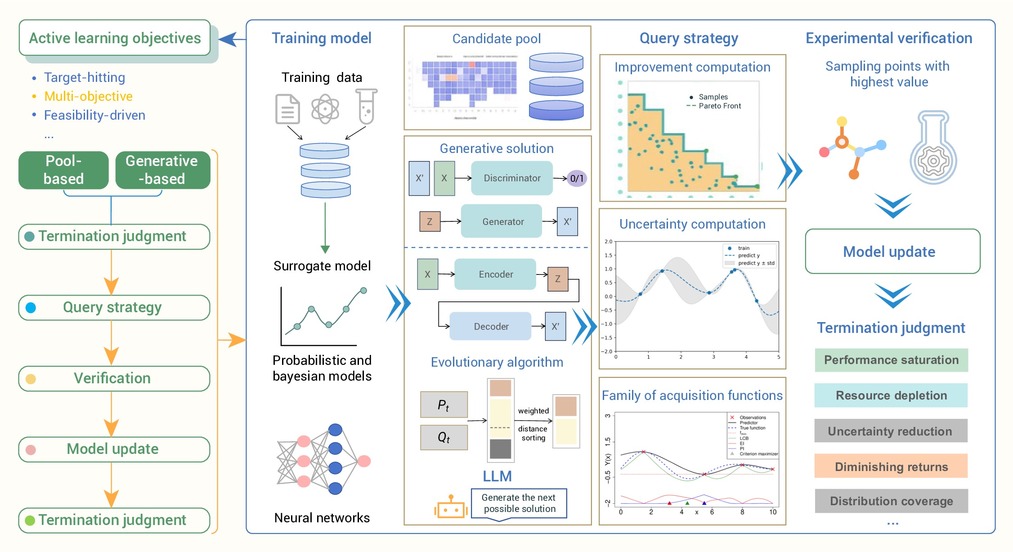
Figure 1.
Schematic overview of the domain knowledge–informed materials discovery workflow, showing the integration of heterogeneous data sources, physics/chemistry-based feasibility filters, machine-learning models, and a closed-loop acquisition and validation cycle.
-
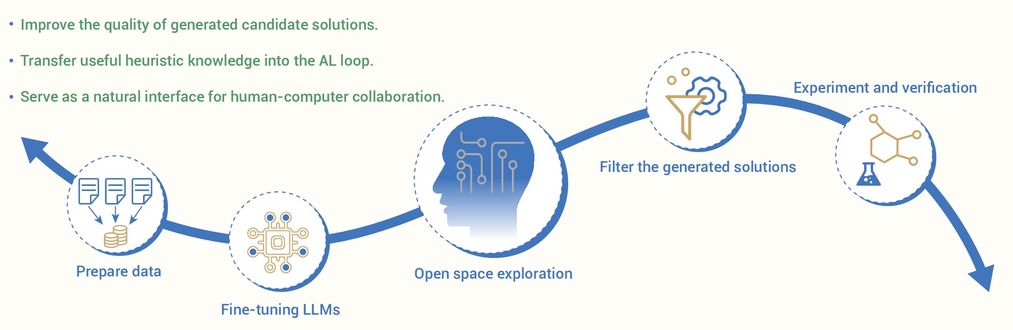
Figure 2.
Schematic of the open-space exploration process for generative materials design using LLMs.
-
Figure 3.
The domain knowledge–informed AL loop
