
PsyRTDevice: Open-source toolkit for sub-millisecond evaluation of reaction time device accuracy
-
GRAPHICAL ABSTRACT
 DownLoad:
Full size image
DownLoad:
Full size image
-
PUBLIC SUMMARY
-
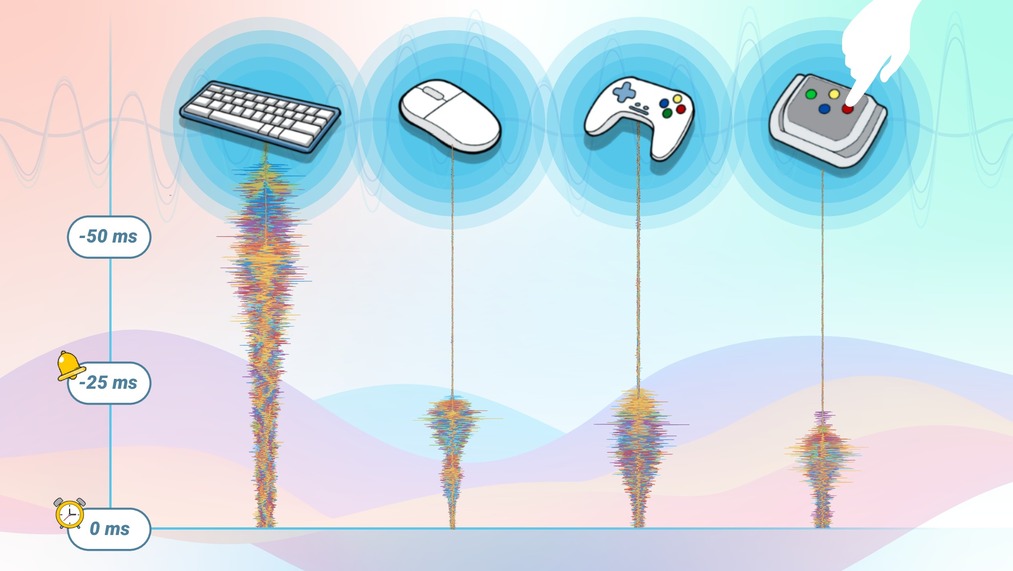
We introduce an open-source toolkit for fast, convenient assessment of reaction time device precision.
PsyRTDevice uses sound-wave technology to achieve sub-millisecond accuracy within 10 minutes of testing.
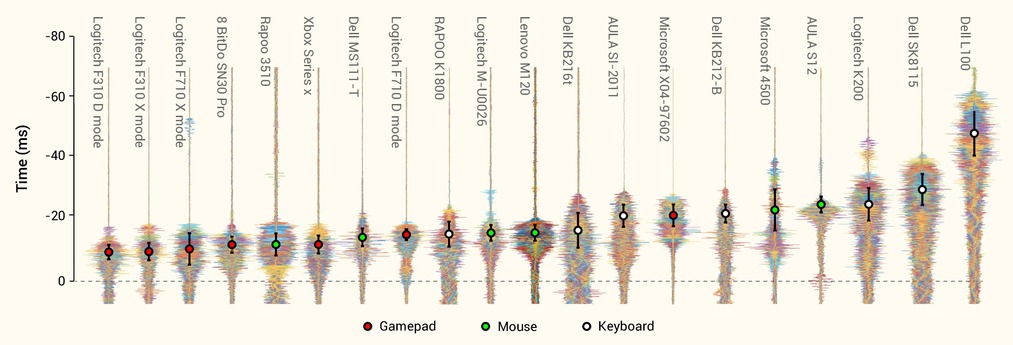
Evaluation of 20 devices reveals substantial variability in response delays (7.58–47.46 ms) and precision.
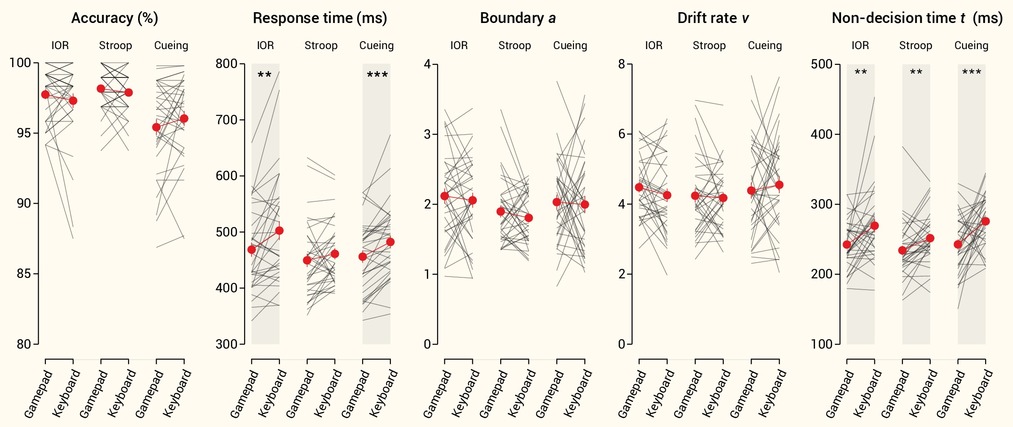
Low-precision devices yield longer absolute RTs but do not significantly affect cognitive effect magnitudes.
PsyRTDevice enables transparent reporting of device accuracy, enhancing experimental rigor and replicability.
-
-
ABSTRACT
Reaction time (RT) measurement—the interval between stimulus onset and response—provides a crucial window into cognitive processing speed and neural efficiency. Although widely used across cognitive science, psychology, neuroscience, and behavioral science, systematic validation of RT measurement devices remains scarce due to high testing costs and the lack of accessible toolkits. Here, we introduce PsyRTDevice, an open-source toolkit employing sound-wave technology to assess RT measurement latency and variability with sub-millisecond precision and within 10 minutes. Our evaluation of 20 popular wired and wireless response devices revealed substantial variability in response latency and precision. Comparing cognitive task performance between the most and least precise devices across three classic cognitive tasks showed that the lower-precision device consistently yielded longer RT measurements, but differences in device precision did not significantly affect cognitive effects based on RT differences (i.e., between conditions). Hierarchical drift diffusion modelling further revealed that these device-related differences primarily impacted non-decision time. PsyRTDevice thus offers researchers and educators an accessible toolkit to quantify device response latency and variability, supporting informed device selection and enhancing experimental rigor in RT-based research. -

-
REFERENCES
[1] Segalowitz S.J. and Graves R.E. (1990). Suitability of the IBM XT, AT, and PS/2 keyboard, mouse, and game port as response devices in reaction time paradigms. Behav. Res. Methods Instrum. Comput. 22:283−289. DOI:10.3758/BF03209817 [2] Myors B. (1998). A simple graphical technique for assessing timer accuracy of computer systems. Behav. Res. Methods Instrum. Comput. 30:454−456. DOI:10.3758/bf03200679 [3] Plant R.R., Hammond N. and Whitehouse T. (2003). How choice of mouse may affect response timing in psychological studies. Behav. Res. Methods Instrum. Comput. 35:276−284. DOI:10.3758/BF03202553 [4] Shimizu H. (2002). Measuring keyboard response delays by comparing keyboard and joystick inputs. Behav. Res. Methods Instrum. Comput. 34:250−256. DOI:10.3758/BF03195452 [5] Neath I., Earle A., Hallett D., et al. (2011). Response time accuracy in Apple Macintosh computers. Behav. Res. Methods 43:353−362. DOI:10.3758/s13428-011-0069-9 [6] Bockes F., Wimmer R. and Schmid A. (2018). LagBox-Measuring the latency of USB-connected input devices. CHI EA'18:1-6. DOI:10.1145/3170427.3188632 [7] Zhang Y. and Zhang M. (2010). Measure the time accuracy of response device: An accuracy yet easy-to-implement method. J. Northeast Norm. Univ. Nat. Sci. Ed. 42:66−70. https://qikan.cqvip.com/Qikan/Article/Detail?id=35396226 [8] Van Drongelen W. (2007). Signal processing for neuroscientists (Academic Press). DOI:10.1016/B978-0-12-370867-0.X5000-1 [9] Tang N., Li A.S., Chen B., et al. (2025). PsyRTDevice code. https://github.com/yangzhangpsy/PsyRTDevice. [10] Lin Z., Yang Z., Feng C., et al. (2022). PsyBuilder: An open-source, cross-platform graphical experiment builder for Psychtoolbox with built-in performance optimization. Adv. Meth. Pract. Psychol. Sci. 5:25152459211070573. DOI:10.1177/25152459211070573 [11] Brainard D.H. (1997). The psychophysics toolbox. Spat. Vis. 10:433−436. DOI:10.1163/156856897x00357 [12] Pelli D.G. (1997). The VideoToolbox software for visual psychophysics: Transforming numbers into movies. Spat. Vis. 10:437−442. DOI:10.1163/156856897x00366 [13] Thapar A., Ratcliff R. and McKoon G. (2003). A diffusion model analysis of the effects of aging on letter discrimination. Psychol. Aging 18:415−429. DOI:10.1037/0882-7974.18.3.415 [14] Ratcliff R., Thapar A. and McKoon G. (2003). A diffusion model analysis of the effects of aging on brightness discrimination. Percept. Psychophys. 65:523−535. DOI:10.3758/BF03194580 [15] Ratcliff R., Gomez P. and McKoon G. (2004). A diffusion model account of the lexical decision task. Psychol. Rev. 111:159–182. DOI:10.1037/0033-295X.111.1.159 [16] Pan W., Geng H., Zhang L., et al. (2025). dockerHDDM: A user-friendly environment for Bayesian hierarchical drift-diffusion modeling. Adv. Meth. Pract. Psychol. Sci. 8:25152459241298700. DOI:10.1177/25152459241298700 [17] Faul F., Erdfelder E., Buchner A., et al. (2009). Statistical power analyses using G* Power 3.1: Tests for correlation and regression analyses. Behav. Res. Methods 41:1149-1160. DOI:10.3758/BRM.41.4.1149 [18] Zhang G.L., Li A.S., Miao C.G., et al. (2018). A consumer-grade LCD monitor for precise visual stimulation. Behav. Res. Methods 50:1496−1502. DOI:10.3758/s13428-018-1018-7 [19] Li X., Liang Z., Kleiner M., et al. (2010). RTbox: A device for highly accurate response time measurements. Behav. Res. Methods 42:212−225. DOI:10.3758/BRM.42.1.212 [20] Weindel G., Gajdos T., Burle B., et al. (2021). The decisive role of non-decision time for interpreting the parameters of decision making models. PsyArXiv preprint. DOI:10.31234/osf.io/gewb3 [21] Voss A., Rothermund K. and Voss J. (2004). Interpreting the parameters of the diffusion model: An empirical validation. Mem. Cogn. 32:1206−1220. DOI:10.3758/BF03196893 [22] Ratcliff R. and McKoon G. (2008). The diffusion decision model: Theory and data for two-choice decision tasks. Neural Comput. 20:873−922. DOI:10.1162/neco.2008.12-06-420 [23] Ratcliff R. (2006). Modeling response signal and response time data. Cogn. Psychol. 53:195−237. DOI:10.1016/j.cogpsych.2005.10.002 [24] Miller J., Patterson T. and Ulrich R. (1998). Jackknife-based method for measuring LRP onset latency differences. Psychophysiology 35:99−115. DOI:10.1111/1469-8986.3510099 [25] Kojouharova P., Nagy B., Czigler I., et al. (2023). Mechanisms of spatial contextual cueing in younger and older adults. Psychophysiology 60:e14361. DOI:10.1111/psyp.14361 [26] Jaśkowski P., Kurczewska M., Nowik A., et al. (2007). Locus of the intensity effect in simple reaction time tasks. Percept. Psychophys. 69:1334−1343. DOI:10.3758/bf03192950 [27] Levelt W.J. (1965). On binocular rivalry. (Doctoral dissertation, Van Gorcum Assen). https://pure.mpg.de/rest/items/item_77195/component/file_2424565/content [28] Blake R. and Logothetis N.K. (2002). Visual competition. Nat. Rev. Neurosci. 3:13−21. DOI:10.1038/nrn701 -
ABOUT THIS ARTICLE
Cite this article:
Tang N., Li A., Chen B., et al. (2025). PsyRTDevice: Open-source toolkit for sub-millisecond evaluation of reaction time device accuracy. The Innovation Informatics 1:100017. https://doi.org/10.59717/j.xinn-inform.2025.100017
Welcome!
To request copyright permission to republish or share portions of our works, please visit Copyright Clearance Center's (CCC) Marketplace website at marketplace.copyright.com.

Export File
Citation
Tang N., Li A., Chen B., et al. (2025). PsyRTDevice: Open-source toolkit for sub-millisecond evaluation of reaction time device accuracy. The Innovation Informatics 1:100017. https://doi.org/10.59717/j.xinn-inform.2025.100017

Format
Content

-
Figure 1.
Illustration of the PsyRTDevice measurement method based on sound waves
-
Figure 2.
Recording delay distribution across 20 different reaction time devices measured with PsyRTDevice
-
Figure 3.
Procedures of the three cognitive tasks used to evaluate device performance
-
Figure 4.
Comparison of behavioral performance and HDDM parameters between the most precise device (gamepad) and least precise device (keyboard) across three cognitive tasks
