
Informative missingness and its implications in semi-supervised learning
-
ABSTRACT
Semi-supervised learning (SSL) constructs classifiers using both labelled and unlabelled data. It leverages information from labelled samples, whose acquisition is often costly or labour-intensive, together with unlabelled data to enhance prediction performance. This defines an incomplete-data problem, which statistically can be formulated within the likelihood framework for finite mixture models that can be fitted using the expectation-maximisation (EM) algorithm. Ideally, one would prefer a completely labelled sample, as one would anticipate that a labelled observation provides more information than an unlabelled one. However, when the mechanism governing label absence depends on the observed features or the class labels or both, the missingness indicators themselves contain useful information. In certain situations, the information gained from modelling the missing-label mechanism can even outweigh the loss due to missing labels, yielding a classifier with a smaller expected error than one based on a completely labelled sample analysed.1 This improvement arises particularly when class overlap is moderate, labelled data are sparse, and the missingness is informative. Modelling such informative missingness thus offers a coherent statistical framework that compares likelihood-based inference with the behaviour of empirical SSL methods. -

-
REFERENCES
[1] Ahfock D. and McLachlan G.J. (2020). An apparent paradox: A classifier based on a partially classified sample may have smaller expected error rate than that if the sample were completely classified. Stat. Comput. 30:1779−1790. DOI:10.1007/s11222-020-09971-5 [2] Rubin D.B. (1976). Inference and missing data. Biometrika 63:581−592. DOI:10.1093/biomet/63.3.581 [3] Dempster A.P., Laird N.M. and Rubin D.B. (1977). Maximum likelihood from incomplete data via the EM algorithm. J. R. Stat. Soc. B 39:1−22. DOI:10.1111/j.2517-6161.1977.tb01600.x [4] Ahfock D. and McLachlan G.J. (2023). Semi-supervised learning of classifiers from a statistical perspective: A brief review. Econ. Stat. 26:124−138. DOI:10.1016/j.ecosta.2022.03.007 [5] McLachlan G.J., Lee S.X. and Rathnayake S.I. (2019). Finite mixture models. Annu. Rev. Stat. Appl. 6:355−378. DOI:10.1146/annurev-statistics-031017-100325 [6] Grandvalet Y. and Bengio Y. (2004). Semi-supervised learning by entropy minimization. Adv. Neural Inf. Process. Syst. 17:529−536. DOI:10.5555/2976040.2976107 [7] Sohn K., Berthelot D., Carlini N., et al. (2020). FixMatch: Simplifying semi-supervised learning with consistency and confidence. Adv. Neural Inf. Process. Syst. 33:596−608. DOI:10.5555/3495724.3495775 [8] Yang X., Song Z., King I., et al. (2023). A survey on deep semi-supervised learning. IEEE Trans. Knowl. Data Eng. 35:8934−8954. DOI:10.1109/TKDE.2022.3220219 [9] Gui Q., Zhou H., Guo N., et al. (2024). A survey of class-imbalanced semi-supervised learning. Mach. Learn. 113:5057−5086. DOI:10.1007/s10994-023-06344-7 -
ABOUT THIS ARTICLE
Cite this article:
Wu J., Wang Y. G. and McLachlan G. J. (2026). Informative missingness and its implications in semi-supervised learning. The Innovation Informatics 2:100033. https://doi.org/10.59717/j.xinn-inform.2026.100033
Welcome!
To request copyright permission to republish or share portions of our works, please visit Copyright Clearance Center's (CCC) Marketplace website at marketplace.copyright.com.
Export File
Citation
Wu J., Wang Y. G. and McLachlan G. J. (2026). Informative missingness and its implications in semi-supervised learning. The Innovation Informatics 2:100033. https://doi.org/10.59717/j.xinn-inform.2026.100033

Format
Content
 DownLoad:
-
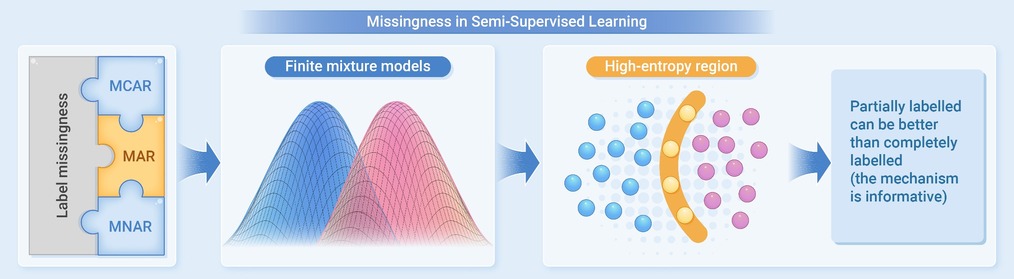
Figure 1.
Schematic illustration showing how MCAR, MAR, and MNAR missingness mechanisms influence model-based inference and classification boundaries in SSL
