
AION: Physics-informed machine learning advances forecasting of high-dimensional ionospheric spatiotemporal states
-
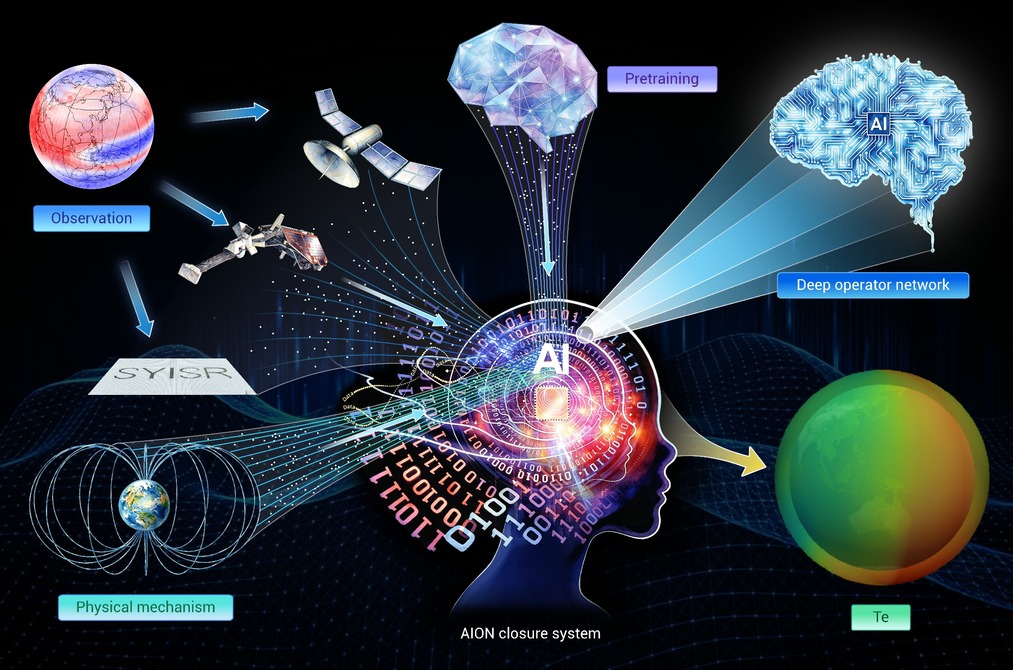
GRAPHICAL ABSTRACT
 DownLoad:
Full size image
DownLoad:
Full size image
-
PUBLIC SUMMARY
-
We propose AION, an innovation-informatics framework uniting data and physics for ionosphere modeling.
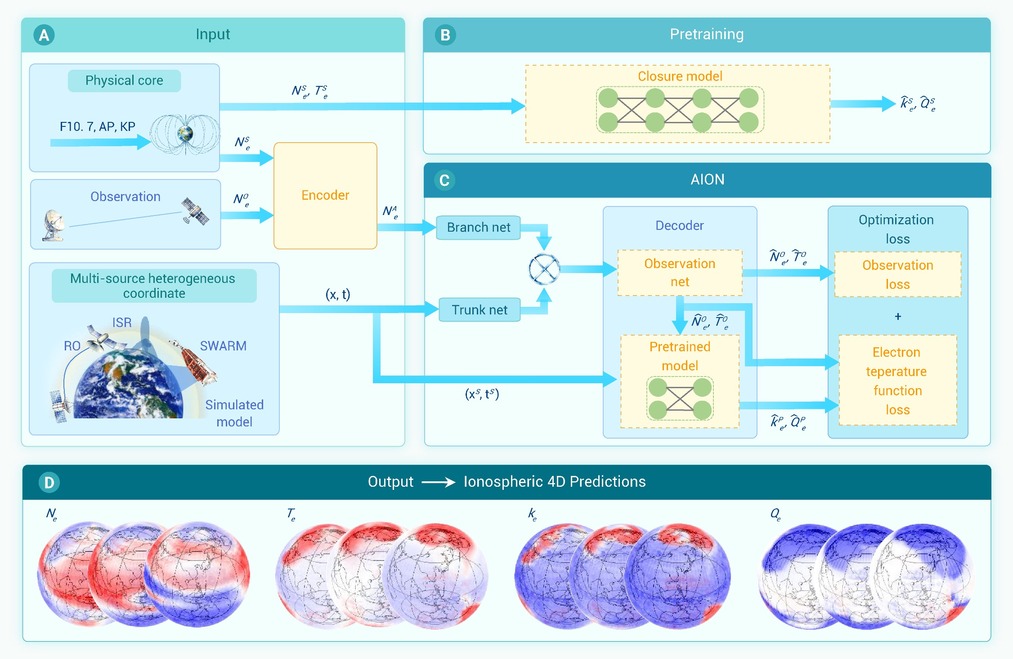
Built on deep operator network (DeepONet), it learns mappings between drivers and ionospheric states.
A pretrained closure model encodes plasma transport and heating knowledge within the system.
This enables electron temperature equation to be embedded directly into the assimilation process.
AION achieves 54.5% error reduction versus International Reference Ionosphere, benefiting satellite safety.
-
-
ABSTRACT
Modeling the Earth’s ionosphere (50–5000 km) remains a fundamental challenge due to sparse and heterogeneous observations and incomplete physical representations of plasma energy transfer. Existing empirical and physics-based approaches lack a unified mechanism to integrate data-driven learning with first-principles knowledge. We present AION, an innovation-informatics–driven framework that establishes a unified representation of observational data, physical knowledge, and system dynamics for ionospheric modeling. Built upon the deep operator network (DeepONet) architecture, AION learns functional mappings between external drivers and ionospheric states while enforcing physical consistency through differentiable governing equations. A pretrained closure model serves as an explicit representation of plasma transport and heating knowledge, enabling the electron temperature equation to be embedded directly within the assimilation process across varying solar conditions. Across diverse solar activity regimes, AION achieves 24-h electron-temperature forecast errors of 387–413 K, corresponding to a 54.5% improvement over the International Reference Ionosphere, together with a 38.2% enhancement in electron-density prediction. The framework efficiently generates full four-dimensional ionospheric states for complex geometries, demonstrating a scalable and transferable informatics paradigm for data–physics integrated intelligent modeling of complex space environments, with implications for satellite communications, navigation, and spacecraft safety. -

-
REFERENCES
[1] Minnis C.M. (1958). Solar activity and the ionosphere. Nature 181:543−544. DOI:10.1038/181543a0 [2] Markson R. (1978). Solar modulation of atmospheric electrification and possible implications for the Sun–weather relationship. Nature 273:103−109. DOI:10.1038/273103a0 [3] Minnis C. (1954). The ionosphere during the solar eclipse of February 25, 1952. Nature 174:1137−1138. DOI:0.1038/1741137a0. DOI:10.1038/1741137a0 [4] Cole K. (1976). Physical argument and hypothesis for Sun–weather relationships. Nature 260:229−230. DOI:10.1038/260229a0 [5] Lotko W., Smith R.H., Zhang B., et al. (2014). Ionospheric control of magnetotail reconnection. Science 345:184−187. DOI:10.1126/science.1252907 [6] Kelly M.C. (2009). The Earth's ionosphere: Plasma physics and electrodynamics, Second Edition. Academic Press. DOI:10.1016/C2009-0-01818-9 [7] Munro G.H. (1961). Possible solar flare effects in the F region of the ionosphere. Nature 192:347−347. DOI:10.1038/192347a0 [8] Kitchen F.A. and Joy W.R.R. (1958). Some effects of the fine structure of the ionosphere on transmissions received from the Russian Earth satellite 1958δ. Nature 181:1759−1761. DOI:10.1038/1811759a0 [9] Baker D.N. J.S. (2002). How to cope with space weather. Science 297:1486−1487. DOI:10.1126/science.1074956 [10] Huba J.D., Joyce G. and Fedder J.A. (2000). SAMI2 is another model of the ionosphere (SAMI2): A new low-latitude ionosphere model. J. Geophys. Res. Space Phys. 105:23035−23053. DOI:10.1029/2000ja000035 [11] Huba J.D., Joyce G. and Krall J.J.G.R.L. (2008). Three-dimensional equatorial spread F modeling. Geophys. Res. Lett. 35:L10102. DOI:10.1029/2008gl033509 [12] Ridley A.J., Deng Y. and Tóth G. (2006). The global ionosphere-thermosphere model. J. Atmos. Sol.-Terr. Phys. 68:839−864. DOI:10.1016/j.jastp.2006.01.008 [13] Roble R.G., Ridley E.C., Richmond A.D., et al. (2012). A coupled thermosphere/ionosphere general circulation model. Geophys. Res. Lett. 15:1325−1328. DOI:10.1029/GL015i012p01325 [14] Wang W., Killeen T.L., Burns A.G., et al. (1999). A high-resolution, three-dimensional, time dependent, nested grid model of the coupled thermosphere–ionosphere. J. Atmos. Sol.-Terr. Phys. 61:385−397. DOI:10.1016/S1364-6826(98)00079-0 [15] Bilitza D. (2018). IRI the international standard for the ionosphere. Adv. Radio Sci. 16:1−11. DOI:10.5194/ars-16-1-2018 [16] Nava B., Coïsson P. and Radicella S.M. (2008). A new version of the NeQuick ionosphere electron density model. J. Atmos. Sol.-Terr. Phys. 70:1856−1862. DOI:10.1016/j.jastp.2008.01.015 [17] He J., Yue X., Wang W., et al. (2019). EnKF ionosphere and thermosphere data assimilation algorithm through a sparse matrix method. J. Geophys. Res. Space Phys. 124:7356−7365. DOI:10.1029/2019JA026554 [18] Scherliess L., Schunk R.W., Sojka J.J., et al. (2006). Utah State University global assimilation of ionospheric measurements Gauss-Markov Kalman filter model of the ionosphere: model description and validation. J. Geophys. Res. Space Phys. 111:A11S11. DOI:10.1029/2006JA011712 [19] Yue X., Wan W., Ning B., et al. (2022). An active phased array radar in China. Nature Astronomy 6:619−619. DOI:10.1038/s41550-022-01684-1 [20] Wang C., Xu J., Chen Z., et al. (2024). China's ground‐based space environment monitoring network—Chinese Meridian Project (CMP). Space Weather 22:e2024SW003972. DOI:10.1029/2024SW003972 [21] Bain H.M., Steenburgh R.A., Onsager T.G., et al. (2021). A summary of National Oceanic and Atmospheric Administration Space Weather Prediction Center proton event forecast performance and skill. Space Weather 19:e2020SW002670. DOI:10.1029/2020SW002670 [22] Smith J., Kast A., Geraschenko A., et al. (2024). Mapping the ionosphere with millions of phones. Nature 635:365−369. DOI:10.1038/s41586-024-08520-8 [23] Vance T.C., Huang T. and Butler K.A. (2024). Big data in Earth science: Emerging practice and promise. Science 383:1193−1193. DOI:10.1126/science.adh9607 [24] Yuval J. and O'Gorman P.A. (2020). Stable machine-learning parameterization of subgrid processes for climate modeling at a range of resolutions. Nat. Commun. 11:3295. DOI:10.1038/s41467-020-17142-3 [25] Camps-Valls G., Fernández-Torres M.-A., Cohrs K.H., et al. (2025). Artificial intelligence for modeling and understanding extreme weather and climate events. Nat. Commun. 16:1919. DOI:10.1038/s41467-025-56573-8 [26] Dax M., Green S.R., Gair J., et al. (2025). Real-time inference for binary neutron star mergers using machine learning. Nature 639:49−53. DOI:10.1038/s41586-025-08593-z [27] Degrave J., Felici F., Buchli J., et al. (2022). Magnetic control of tokamak plasmas through deep reinforcement learning. Nature 602:414−419. DOI:10.1038/s41586-021-04301-9 [28] Brunton S.L. and Kutz J.N. (2024). Promising directions of machine learning for partial differential equations. Nat. Comput. Sci. 4:483−494. DOI:10.1038/s43588-024-00643-2 [29] Solera-Rico A., Sanmiguel Vila C., Gómez-López M., et al. (2024). β-variational autoencoders and transformers for reduced-order modelling of fluid flows. Nat. Commun. 15:1361. DOI:10.1038/s41467-024-45578-4 [30] Karniadakis G.E., Kevrekidis I.G., Lu L., et al. (2021). Physics-informed machine learning. Nat. Rev. Phys. 3:422−440. DOI:10.1038/s42254-021-00314-5 [31] Ham Y.G., Joo Y.S., Kim J.H., et al. (2024). Partial-convolution-implemented generative adversarial network for global oceanic data assimilation. Nat. Mach. Intell. 6:834−843. DOI:10.1038/s42256-024-00867-x [32] Cheng S., Quilodrán-Casas C., Ouala S., et al. (2023). Machine learning with data assimilation and uncertainty quantification for dynamical systems: A review. IEEE/CAA J. Autom. Sin. 10:1361−1387. DOI:10.1109/JAS.2023.123537 [33] Vinuesa R. and Brunton S.L. (2022). Enhancing computational fluid dynamics with machine learning. Nat. Comput. Sci. 2:358−366. DOI:10.1038/s43588-022-00264-7 [34] Lu L., Jin P., Pang G., et al. (2021). Learning nonlinear operators via DeepONet based on the universal approximation theorem of operators. Nat. Mach. Intell. 3:218−229. DOI:10.1038/s42256-021-00302-5 [35] Wang S., Wang H. and Perdikaris P. (2021). Learning the solution operator of parametric partial differential equations with physics-informed DeepONets. Sci. Adv. 7:eabi8605. DOI:10.1126/sciadv.abi8605 [36] Kurth T., Subramanian S., Harrington P., et al. (2022). FourCastNet: Accelerating global high-resolution weather forecasting using adaptive Fourier neural operators. PASC Conf. Proc. 1:1−11. DOI:10.1145/3592979.3593412 [37] Hao Z., Wang Z., Su H., et al. (2023). GNOT: A general neural operator transformer for operator learning. Proc. 40th Int. Conf. Mach. Learn. PMLR. DOI:10.48550/arXiv.2302.14376 [38] Sui Y., Fu H., Dai Y., et al. (2025). Global ionospheric 4-D tomography and forecast based on multisource DMD data assimilation. IEEE Trans. Geosci. Remote Sens. 63:1−10. DOI:10.1109/TGRS.2025.363370 [39] Ma J., Fu H., Huba J., et al. (2024). A novel ionospheric inversion model: PINN‐SAMI3 (physics informed neural network based on SAMI3). Space Weather 22:e2023SW003823. DOI:10.1029/2023SW003823 [40] Hammett G.W. and Perkins F.W. (1990). Fluid moment models for Landau damping with application to the ion-temperature-gradient instability. Phys. Rev. Lett. 64:3019−3022. DOI:10.1103/PhysRevLett.64.3019 [41] Daughton W., Roytershteyn V., Karimabadi H., et al. (2011). Role of electron physics in the development of turbulent magnetic reconnection in collisionless plasmas. Nat. Phys. 7:539−542. DOI:10.1038/nphys1965 [42] Huang Z., Tóth G., van der Holst B., et al. (2019). A six-moment multi-fluid plasma model. J. Comput. Phys. 387:134−153. DOI:10.1016/j.jcp.2019.02.023 [43] Qin Y., Ma J., Jiang M., et al. (2023). Data-driven modeling of Landau damping by physics-informed neural networks. Phys. Rev. Res. 5:033079. DOI:10.1103/physrevresearch.5.033079 [44] Cheng W., Fu H., Wang L., et al. (2022). Data-driven, multi-moment fluid modeling of Landau damping. Comput. Phys. Commun 282:108538. DOI:10.1016/j.cpc.2022.108538 [45] Vlachas P.R., Arampatzis G., Uhler C., et al. (2022). Multiscale simulations of complex systems by learning their effective dynamics. Nat. Mach. Intell. 4:359−366. DOI:10.1038/s42256-022-00478-4 [46] Gunnarson P., Mandralis I., Novati G., et al. (2021). Learning efficient navigation in vortical flow fields. Nat. Commun. 12:7143. DOI:10.1038/s41467-021-27015-8 [47] Kochkov D., Yuval J., Langmore I., et al. (2024). Neural general circulation models for weather and climate. Nature 632:1060−1066. DOI:10.1038/s41586-024-07744-y [48] Allen A., Markou S., Tebbutt W., et al. (2025). End-to-end data-driven weather prediction. Nature 641:1172−1179. DOI:10.1038/s41586-025-08897-0 [49] Schreiner W.S., Weiss J., Anthes R.A., et al. (2020). COSMIC‐2 radio occultation constellation: First results. Geophys. Res. Lett. 47:e2019GL086841. DOI:10.1029/2019GL086841 [50] Compagnucci R.H., Araneo D. and Canziani P.O. (2001). Principal sequence pattern analysis: A new approach to classifying the evolution of atmospheric systems. Int. J. Climatol. 21:1465−1482. DOI:10.1002/joc.601 [51] Li C., Fang H., Cao X., et al. (2024). A new method for reconstruction of regional three‐dimensional electron density distributions using AI‐based data assimilation method and incoherent scatter radar measurements. Geophys. Res. Lett. 51:e2024GL112352. DOI:10.1029/2024GL112352 [52] Liu Y., Fu H., Wang L., et al. (2025). Data-driven modeling of electrostatic turbulence by physics-informed Fourier neural operator. Mach. Learn. Sci. Technol. 6:045050. DOI:10.1088/2632-2153/ae19cd -
ABOUT THIS ARTICLE
Cite this article:
Ma J., Fu H., Liu Y., et al. (2026). AION: Physics-informed machine learning advances forecasting of high-dimensional ionospheric spatiotemporal states. The Innovation Informatics 2:100037. https://doi.org/10.59717/j.xinn-inform.2026.100037
Welcome!
To request copyright permission to republish or share portions of our works, please visit Copyright Clearance Center's (CCC) Marketplace website at marketplace.copyright.com.
Export File
Citation
Ma J., Fu H., Liu Y., et al. (2026). AION: Physics-informed machine learning advances forecasting of high-dimensional ionospheric spatiotemporal states. The Innovation Informatics 2:100037. https://doi.org/10.59717/j.xinn-inform.2026.100037

Format
Content
-
Figure 1.
AION framework for 4D ionospheric modeling
-
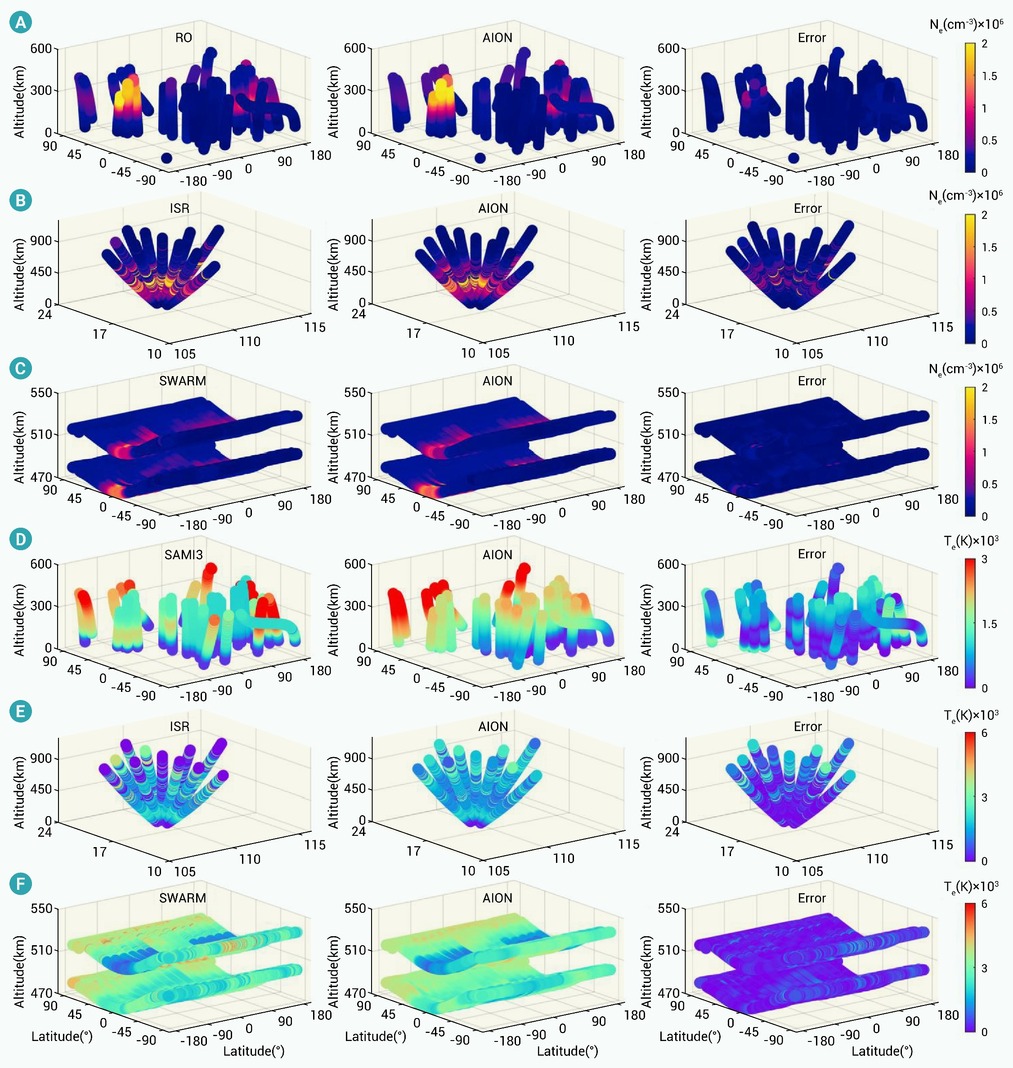
Figure 2.
Validation of 24-hour AION-predicted electron density and temperature on 30 May 2024: multi-source observations (left), AION predictions (middle), and errors (right)
-
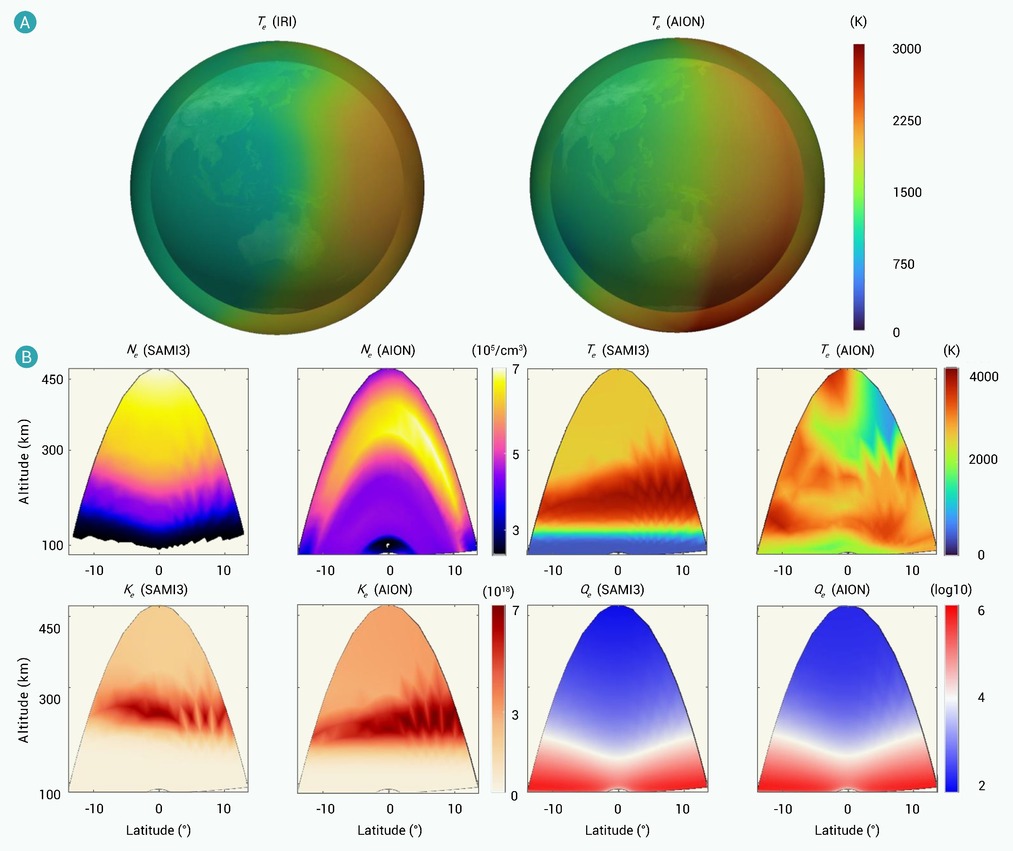
Figure 3.
Ionospheric thermal parameters predicted by AION on May 30, 2024
-
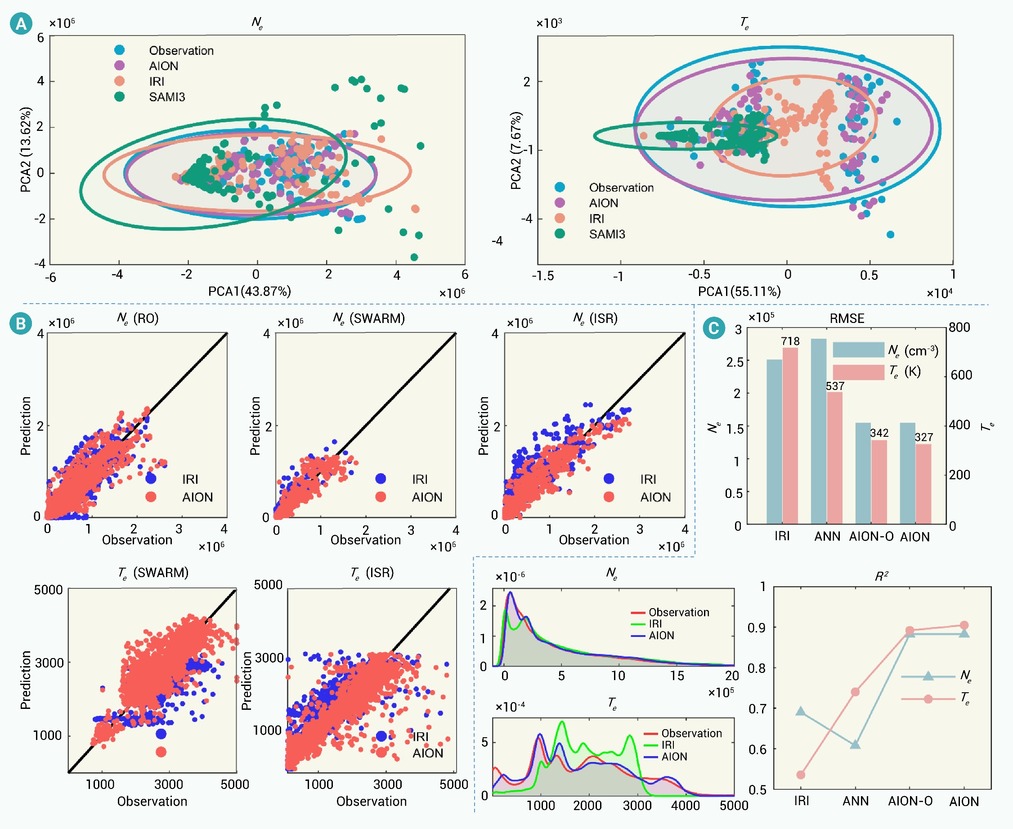
Figure 4.
Performance evaluation of AION 24-h forecasts of electron density and temperature on 30 May 2024
-
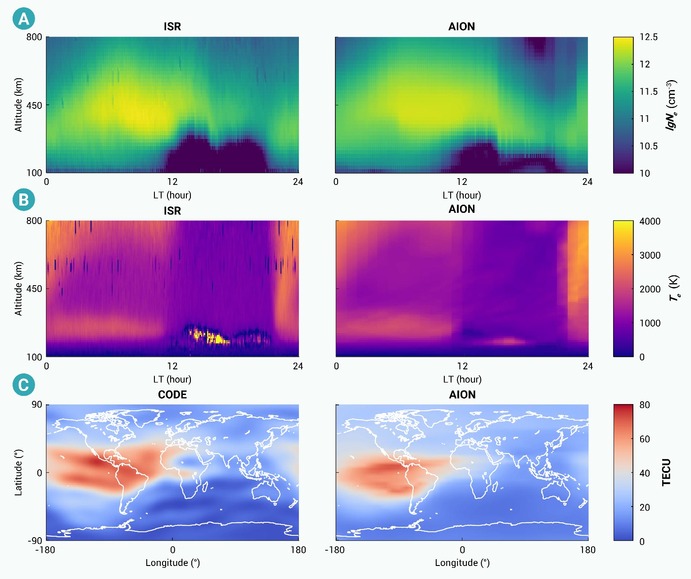
Figure 5.
Validation of AION predictions against ISR and CODE on 30 May 2024
