
Physics-informed neural networks help to strongly reduce uncertainty in ocean state forecasting
-

-
REFERENCES
[1] Zhao T., Wang S., Ouyang C., et al. (2024). Artificial intelligence for geoscience: Progress, challenges, and perspectives. The Innovation 5:100691. DOI:10.1016/j.xinn.2024.100691 [2] Dong S., Li Y., Yin X., et al. (2026). Physics-guided deep learning for global sea surface temperature forecasting: Balancing accuracy and stability across timescales. Geosci. Front. 17:102255. DOI:10.1016/j.gsf.2026.102255 [3] El Aouni A., Gaudel Q., Regnier C., et al. (2025). GLONET: Mercator’s end-to-end neural global ocean forecasting system. J. Geophys. Res. Mach. Learn. Comput. 2:e2025JH000686. DOI:10.1029/2025JH000686 [4] Guo Z., Lyu P., Ling F., et al. (2025). Data-driven global ocean modeling for seasonal to decadal prediction. Sci. Adv. 11:eadu2488. DOI: 10.1126/sciadv. adu2488. DOI:10.1126/sciadv.adu2488 [5] Li X., Liu B., Zheng G., et al. (2020). Deep-learning-based information mining from ocean remote-sensing imagery. Natl. Sci. Rev. 7:1584−1605. DOI:10.1093/nsr/nwaa047 -
ABOUT THIS ARTICLE
Cite this article:
Chen T., Tian Z., Li X., et al. (2026). Physics-informed neural networks help to strongly reduce uncertainty in ocean state forecasting. The Innovation Informatics 2:100051. https://doi.org/10.59717/j.xinn-inform.2026.100051
Welcome!
To request copyright permission to republish or share portions of our works, please visit Copyright Clearance Center's (CCC) Marketplace website at marketplace.copyright.com.
Export File
Citation
Chen T., Tian Z., Li X., et al. (2026). Physics-informed neural networks help to strongly reduce uncertainty in ocean state forecasting. The Innovation Informatics 2:100051. https://doi.org/10.59717/j.xinn-inform.2026.100051

Format
Content
 DownLoad:
-
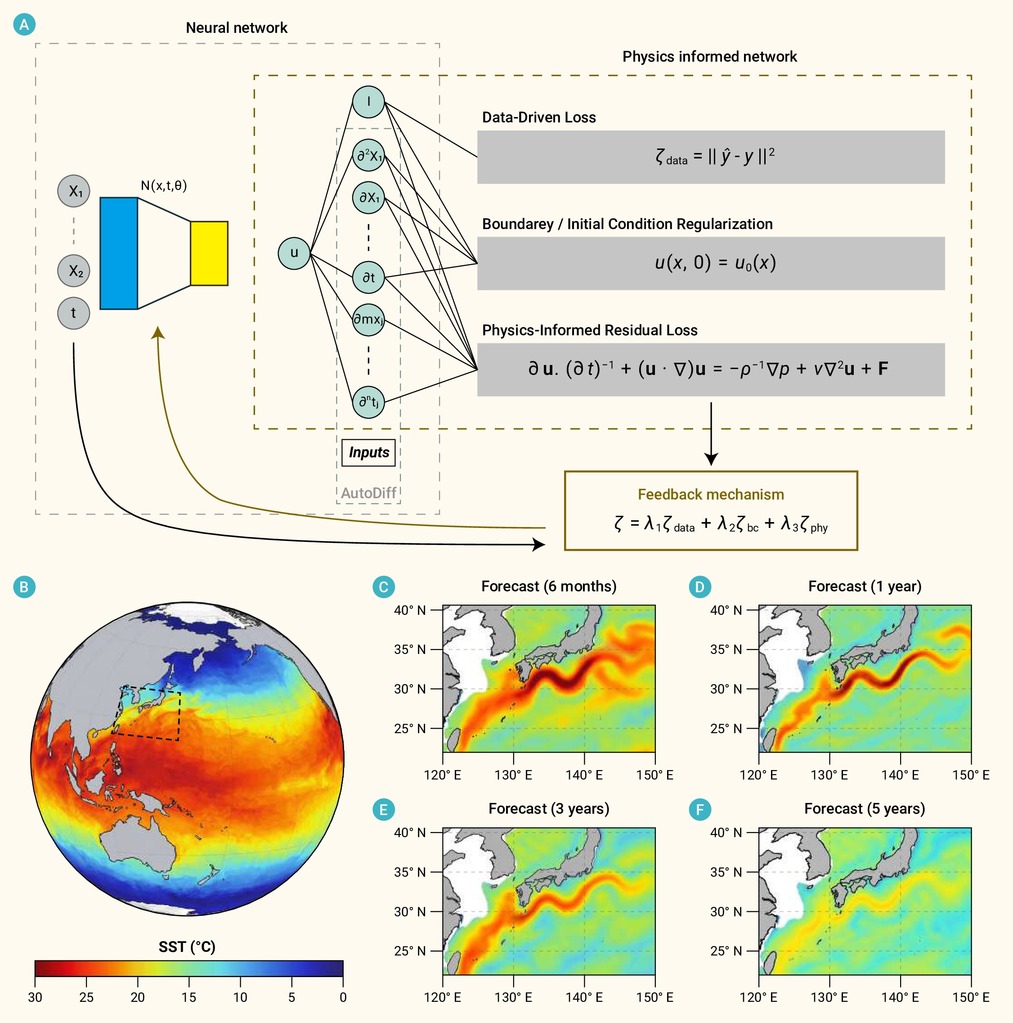
Figure 1.
Schematic of the physics-informed neural network (PINN) framework and ocean-state prediction results at different lead times
