
Bridging physics and intelligence: The evolutionary landscape of PET image reconstruction
-

-
REFERENCES
[1] Bousse A., Kandarpa V.S.S., Shi K., et al. (2024). A review on low-dose emission tomography post-reconstruction denoising with neural network approaches. IEEE Trans. Radiat. Plasma Med. Sci. 8:333−347. DOI:10.1109/TRPMS.2023.3349194 [2] Jiang H., Zhang Q., Hu Y., et al. (2025). Memory-enhanced and multi-domain learning-based deep unrolling network for medical image reconstruction. Phys. Med. Biol. 70: 175008. DOI: 10.1088/1361-6560/adf939 [3] Hein D., Bozorgpour A., Merhof D., et al. (2025). Physics-inspired generative models in medical imaging. Annu. Rev. Biomed. Eng. 27:499−525. DOI:10.1146/annurev-bioeng-102723-013922 [4] Sun M., Yang Z., Huang Y., et al. (2025). Federated learning for large models in medical imaging: A comprehensive review. arXiv preprint. DOI: arXiv:2508.20414 [5] Huang B., Chen K., Li B., et al. (2025). ALL-PET: A low-resource and low-shot PET foundation model in projection domain. arXiv preprint. DOI: arXiv: 2509.09130 -
ABOUT THIS ARTICLE
Cite this article:
Jiang H., Guo W., Zhang Q., et al. (2026). Bridging physics and intelligence: The evolutionary landscape of PET image reconstruction. The Innovation Informatics 2:100052. https://doi.org/10.59717/j.xinn-inform.2026.100052
Welcome!
To request copyright permission to republish or share portions of our works, please visit Copyright Clearance Center's (CCC) Marketplace website at marketplace.copyright.com.
Export File
Citation
Jiang H., Guo W., Zhang Q., et al. (2026). Bridging physics and intelligence: The evolutionary landscape of PET image reconstruction. The Innovation Informatics 2:100052. https://doi.org/10.59717/j.xinn-inform.2026.100052

Format
Content
 DownLoad:
-
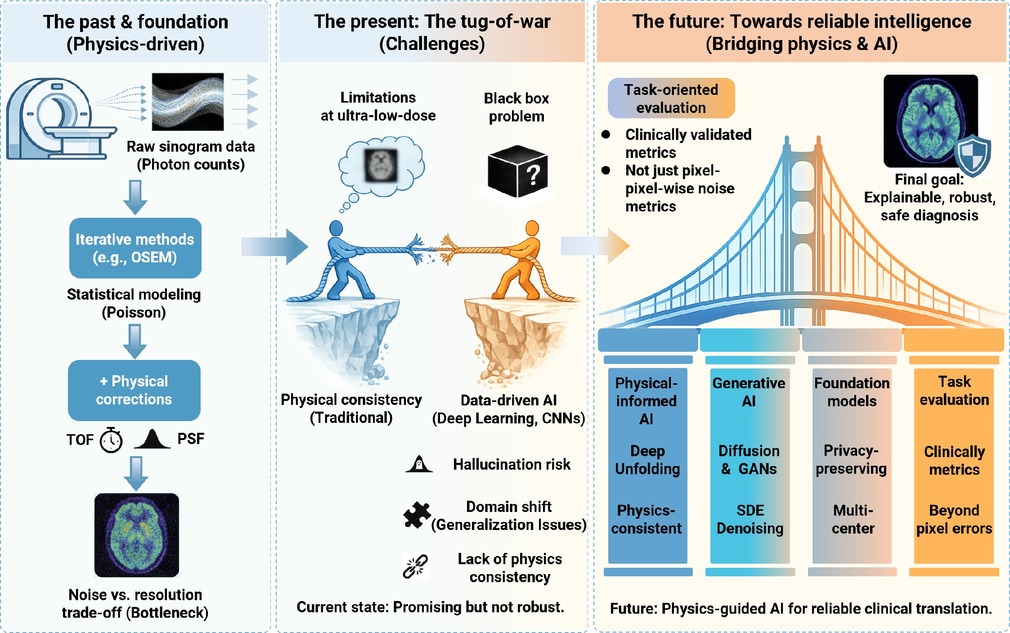
Figure 1.
Bridging physics and intelligence: The trajectory and future blueprint of PET image reconstruction
