
AI predicts grassland SOC, but still falls short of explaining its dynamics
-

-
REFERENCES
[1] Bai Y. and Cotrufo M.F. (2022). Grassland soil carbon sequestration: Current understanding, challenges, and solutions. Science 377:603−608. DOI:10.1126/science.abo2380 [2] Demattê J.A.M., Poppiel R.R., Novais J.J.M., et al. (2025). Frontiers in earth observation for global soil properties assessment linked to environmental and socio-economic factors. The Innovation 6:100985. DOI:10.1016/j.xinn.2025.100985 [3] Zhao T., Wang S., Ouyang C., et al. (2024). Artificial intelligence for geoscience: Progress, challenges, and perspectives. The Innovation 5:100691. DOI:10.1016/j.xinn.2024.100691 [4] Tao F., Huang Y., Hungate B.A., et al. (2023). Microbial carbon use efficiency promotes global soil carbon storage. Nature 618:981−985. DOI:10.1038/s41586-023-06042-3 [5] Miao Y., Tong R., Zhu N., et al. (2025). Effects of stand structural diversity on carbon storage of Masson pine forests in Fengyang Mountain Nature Reserve, China. For. Res. 5:e011. DOI:10.48130/forres-0025-0010 -
ABOUT THIS ARTICLE
Cite this article:
Su J., Yang Y., Yu M., et al. (2026). AI predicts grassland SOC, but still falls short of explaining its dynamics. The Innovation Informatics 2:100058. https://doi.org/10.59717/j.xinn-inform.2026.100058
Welcome!
To request copyright permission to republish or share portions of our works, please visit Copyright Clearance Center's (CCC) Marketplace website at marketplace.copyright.com.
Export File
Citation
Su J., Yang Y., Yu M., et al. (2026). AI predicts grassland SOC, but still falls short of explaining its dynamics. The Innovation Informatics 2:100058. https://doi.org/10.59717/j.xinn-inform.2026.100058

Format
Content
 DownLoad:
-
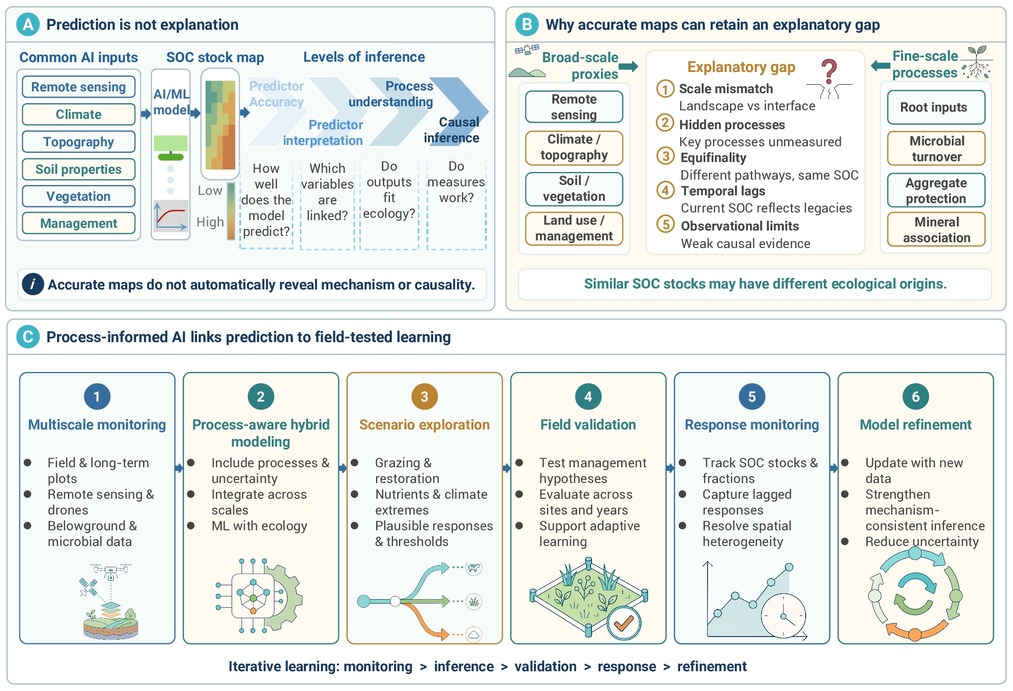
Figure 1.
An inferential framework for AI-based grassland SOC research
